Industrials
Order books, backlogs and factory economics
Capex cycles, freight rates, automation and labour, followed through the machinery, transport and construction names that price them first.
2026-11-09


2026-11-08

Only the First Bag Counts: JetBlue Airways Raised a Price the December FOMC Cannot See
On November 3, JetBlue Airways lifted checked-bag fees for the second time in 2026, taking the first bag to $50 and the second to $75 at peak, to offset a fuel bill that ran $868 million in the third quarter at $3.91 a gallon. US airlines are passing the Iran-driven fuel shock through twice: fares are already 22.4% higher than a year earlier, and the fee layer is now rising on top of them. But the Bureau of Labor Statistics prices only the first checked bag into its airline-fare index, so the second and third bag never enter the CPI the Fed reads at its December 8-9 meeting — an unmeasured price increase landing on shoppers who report being 44% more financially stressed than last year and 72% locked into a strict holiday budget. Meanwhile Phillips 66 and Marathon Petroleum collect the refining spread upstream, and the carriers with the balance sheets to pass the most through are the ones still profitable.

Powell's $2.4 Billion Backlog Is One Contract Deep — and the Stock Has Lost 59% of Its Value
Powell Industries reported record September-quarter orders of $934 million on Aug. 3, 2026 and a backlog of $2.4 billion, up 69%, yet the shares have since fallen 59% in market value. The reason is composition: a single data-center award worth more than $400 million for behind-the-meter, on-site generation accounted for about 43% of that quarter's bookings, roughly half of every data-center dollar Powell has booked, and sits inside a $466 million customer-advance liability. Revenue grew 9% while peers grew 28% to 61%, the twelve-month conversion share of backlog slipped from 59% to 54%, and voters in ten states backed data-center restrictions on Nov. 4. The order book is real; the open question is how much of it one customer can still cancel, and the fiscal 2026 annual report answers that in a single sentence.
2026-11-06
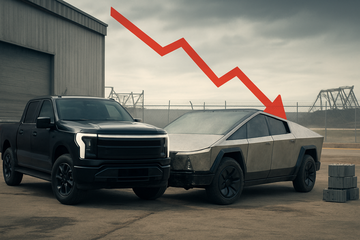
Zero F-150 Lightnings, One Dying Cybertruck: The EV Pickup Collapse Is a Cost Story Before It Is a Demand Story
Ford sold zero F-150 Lightnings in the US in October and Tesla said it will wind down Cybertruck production in Texas around mid-2027 — but the useful read is not that electric pickups failed on appeal. It is that they failed on cost: Model e lost $1.06B on $1.2B of revenue in Q3 2026 while Ford warned of a roughly $2B 2027 headwind from commodities, memory and logistics, with server DRAM contract prices up about 270% cumulatively in 2026. The truck profit pool did not vanish, it migrated to hybrids and combustion — Ram 1500 sales rose 73% in Q3 2026 and Ford's F-Series rose 8.2% in October — which is why the volume damage lands on the lithium and cell supply chain (battery-grade carbonate fell 20.8% in Q3) rather than on the truck franchises. Grid storage is the replacement demand: Tesla started Megafactory Texas, Ford targets 20 GWh of energy capacity, and the truck battery plants now feed the grid. What to watch is Ford's flat 2027 guide, Tesla's Cybercab ramp on freed Texas capacity, and a used-EV correction that has not started yet.

Holiday 2026's Squeeze Is a Diesel Bill, Not a Demand Problem: Valero and UPS Collect the Spread
US on-highway diesel hit $6.292 a gallon in the week of Nov 2, 2026 — nearly 2.5 times the year-ago price — and carriers are passing every cent of it through holiday surcharges ($0.75 a residential package at UPS, $0.80 at FedEx) while demand stays flat, with Visa putting inflation-adjusted holiday spending growth at just 1.1%. That makes this a cost-push season: small merchants absorb the whole bill, while the spread lands on refiners, brokers, LTL carriers and the card network. The pass-through math, not the sales number, decides who earns in 2027.
2026-11-04

Hackers Just Took Europe's Blood Fridges: Cold Chain Is Now Critical Infrastructure and No One Owns the P&L
On the night of Nov. 1-2, 2026, hackers reached France's national blood service through the refrigeration contractor that maintains its cold rooms, and reprogrammed freezers holding blood products and plasma from minus 30 degrees toward 110, while the same technique stripped tens of millions of euros of grocery stock from seven European countries. The blood service lost nothing because its alarms and an on-call technician caught the drift; that near miss exposes the real problem: 12,976 refrigeration supervisory services are reachable from the internet, 54% of them on a single vendor's platform, and the same regulatory and insurance gaps leave the loss with whoever owns the cold inventory. Standard property cover excludes cyber-caused spoilage, standard cyber cover excludes physical damage, and EU reporting duties now force vendors to disclose exploited vulnerabilities without obliging them to fix hardware that is already end-of-life. For investors the read-through is narrow and dated: the beneficiaries sell verification and the new insurance class, while the P&L that absorbs an uninsured cold-chain loss sits with the fractionators carrying 200 to 420 days of refrigerated inventory on four to six times net leverage.
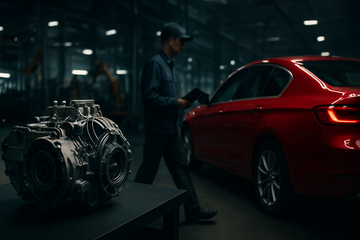
Schaeffler's 3,460 Cuts Price the Auto Downturn One Layer Below the OEM — BMW's Near-Zero Margin Guidance Confirms It
Schaeffler said on Nov 3, 2026 it will cut 3,460 jobs across Europe and close five plants by 2028 to remove about €300M of annual cost, and the next morning BMW guided its 2026 automotive margin to between -0.5% and +0.5%. Read together, the two releases show the downturn has moved out of OEM pricing and into tier-one capacity and labor: a supplier cannot fund overcapacity when its Chinese EV division loses money, and an OEM earning almost nothing cannot fund the discounts that keep its own plants full. For US-listed suppliers the read-through is not a forecast but a report card — Aptiv booked $48M of restructuring charges in nine months, Adient posted a quarterly net loss, and Lear and BorgWarner show what the exit looks like from the other side of the ledger.
2026-11-01
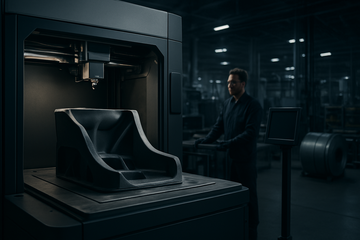
Ford's 200-Plus 3D Printers Buy Lead Time, Not Steel Savings: Why $1,270-a-Ton Coil Is the Wrong Trade
Additive manufacturing has quietly become a Detroit operating variable: Ford runs more than 200 machines with 3D labs headed to more than 23 plants, and Rivian has spent over $5 million on hardware that pays for itself inside a year. The arithmetic underneath is a fixed-cost and lead-time story, not a bill-of-materials one — at Rivian, an implied $5 million-plus annual benefit equals roughly $73 a vehicle against an automotive gross loss of $80 million on 19,248 Q3 deliveries, about $4,157 a car. Steel at $1,270 a short ton, up from $1,255 two weeks earlier, makes stamping economics worse and steel lead times longer, which raises the value of printed jigs and fixtures; it does not make printed vehicle parts cheaper, and it does not repair an OEM's margin. So the exposure worth owning sits one link up the chain — Stratasys at the printer and powder toll booth, Nucor in the material cycle — while per-vehicle cost improvement at the assembly plant stays unproven.

LyondellBasell’s $758M quarter looks like a “war dividend,” not a durable demand rebound — and 2027 capacity risk is the real expiry date
LyondellBasell swung back to $758M of GAAP net income as integrated polyethylene margins ended Q3 2026 about 50% above 2025, but management tied the strength to Middle East supply disruption and acknowledged the return to normal conditions is likely “non-linear” and slower than expected. That combination matters for dividends: the market tends to price “cycle recovery,” yet the underlying driver may be a temporary supply shock that flips again as new capacity timing converges in 2027.

Veralto's Water Quarter Priced AI's Second Constraint — and the Trade Is Permitting, Not Scarcity
Veralto has published the sharpest listed-company evidence yet that the AI buildout's second constraint is being paid for. In the quarter ended Oct. 2, 2026, Water Quality core sales rose 6.4% with double-digit growth in water treatment solutions, North America grew 8.8%, and data center sales doubled off a small base — while China and Latin America contracted. That split is the argument: the company is growing where new permits force operators to monitor, treat and report water, and shrinking where water is scarce but nobody has to prove it. The order book is real — Xylem logged data center orders up more than 200% — yet data centers are on track to be just 2% of Xylem's revenue and an undisclosed sliver at Veralto, so this is an option on permitting rules, best expressed through recurring industrial water revenue rather than municipal metering or data center capex.
2026-10-31

China's Carriers Barely Feel the FCC's Numbering Cut — $16 Billion of US Fraud Losses Sit on the Other Side of It
On November 19 the FCC votes on an order that can deny US telephone numbers to Chinese state carriers without ever naming them: one new certification asks whether an applicant has ever had its Section 214 authority denied or revoked on national-security grounds, and China Mobile, China Telecom and China Unicom have all been through that door. The direct earnings cost is trivial — the three carriers generated RMB 1.97tn of FY2025 revenue and their combined disclosed international revenue is about 2.5% of that — but the line being capped is the fastest-growing one they have: international revenue rose 28.5% at China Mobile and 14.1% at China Telecom in 2025. Meanwhile Americans reported roughly $16bn of fraud losses to the Federal Trade Commission in 2025, and the cheapest input into a US scam campaign is a phone number nobody can trace.

Two-Thirds of Buyers Now Run AI Agents in Production. Almost Half Say Human Oversight Still Eats a Quarter of the Gain
Enterprise agent budgets assume near-zero human touch, and enterprise P&Ls are about to discover otherwise: 45% of B2B software buyers say time spent supervising and correcting agents consumes more than a quarter of the expected productivity gain, while 31% report staff spending six-plus hours a week doing nothing but watching agents work. That oversight layer is already monetised — Accenture booked a record $12.8 billion of Managed Services work in fiscal Q4 2026 and is committing at least $1 billion over five years to embedding human evaluators inside Anthropic — but the price of that work is being marked down at the same time, with clients demanding 25% to 30% less for identical scope. The investable consequence is a two-sided repricing: services firms that convert exception volume into outcome-priced contracts keep the value, while enterprises that booked savings at zero human touch are about to book the correction.
2026-10-30

Dream's $17M Seed Prices a Licence, Not 100M Sq Ft of Data — One Month After AMD Paid $8.2B for World Labs
Two former Palantir executives raised $17M to build world models for construction, and they are selling the idea that the scarce asset is licensed design knowledge rather than model scale. Their training corpus is more than 100 million square feet of US permit archives, which is public record, and NVIDIA already ships an open world-model platform, so neither data nor models are defensible. What is scarce is the right to stamp a drawing that gets built, and one month earlier AMD agreed to pay $8.2B in stock for a horizontal world model sold to every AI developer. For listed investors the read-through is narrow: Autodesk holds the design corpus and the distribution, Procore holds the jobsite record, and Glodon shows what defending a vertical with R&D instead of growth actually earns.
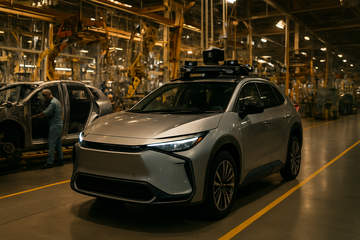
Toyota Just Took the Right-Hand-Drive Robotaxi Supply Chain — and Autonomy Software Is Being Repriced as a Component
On October 30, 2026, Toyota said it will build the 2027 bZ4X at its Takaoka plant and fit Waymo's autonomous-driving hardware to it on the same line, validating a fleet in Japan in 2027 and reaching the United Kingdom in the years after. The move happens because Alphabet's Waymo wants to go from roughly 4,000 vehicles to 20,000 by the end of 2027 on $5 billion of new debt, while the Other Bets segment earned $372 million and lost $2.05 billion in the September quarter alone. Because Japan and the UK require licensed operators and locally homologated cars, the gatekeeper of robotaxi volume is the vehicle supply chain rather than the driving stack, and the profit pool splits three ways: compute and software keep the margin, a roughly $50,000 vehicle sets the cost floor, and everything in between gets squeezed. Read that way, Mobileye and Lucid are on the wrong side of the structure Toyota just signed, Hyundai Motor already holds the scale contract in the United States, and Toyota is buying the right to sell hardware to any operator with a permit.
2026-10-29
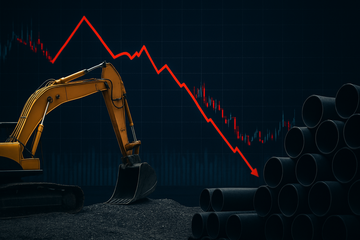
Caterpillar Beat on Earnings, Lost 8%: Why a Record $78 Billion Backlog Stopped Being Enough at a 5.6% Long Bond
Caterpillar's third quarter of 2026 was operationally strong and financially unforgiving: sales and revenues of $20.68 billion rose 17%, adjusted profit per share of $7.20 beat the $7.08 consensus, and the order backlog reached a record $78.1 billion — yet shares fell about 8% because management held full-year sales growth at mid-to-high teens while the market was positioned for roughly 18%. The proximate cause is Caterpillar's own capacity, not demand: one day earlier GE Vernova reported orders up 96% organically and raised guidance, while Caterpillar's turbines and engines cannot be built fast enough to convert its backlog. What changed is the price of long-dated industrial cash flow — with the 30-year Treasury at a 24-year high of 5.61% and the 10-year near 5%, the market now pays for shipped product rather than orders, and Caterpillar's trailing cash yield of about 3% sits below the long bond. The read-through for investors: the earth-capex cycle is not slowing — Deere, Komatsu and United Rentals all raised guidance in the same window — so this is an idiosyncratic, duration-driven unwind rather than the end of the AI build-out.
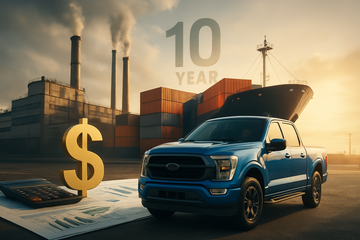
Ford's Flat 2027 Guide Is the Tell: Tariff-Assisted Earnings Just Met a 5% Long-End, and Ford Credit Is Where It Lands
Ford beat on every headline number of the third quarter — $2.66 billion of adjusted EBIT, 49 cents of adjusted EPS, $4.7 billion of adjusted free cash flow — and still guided 2027 to roughly in line with 2026, because commodities, memory and logistics will add about $2 billion of cost next year. The tell is not the plant: Ford Credit supplied 30% of quarterly adjusted EBIT and grew 27% on a favorable derivative mark, even as its US retail loss-to-receivables ratio rose to 0.67% and off-lease auction values fell 3%. With the 10-year Treasury printing 5.13% on October 21 and Ford Credit carrying $139.4 billion of debt at an implied cost of funds of roughly 5%, a flat guide is Ford admitting that tariff-washed pricing power has peaked and the balance sheet is where the shock now lands.
2026-10-28

2026-10-25

2026-10-24

Airlines Are Tearing Down Six-Year-Old Jets: A Parts Supercycle That Fills OEM Backlogs Instead of Emptying Them
Airlines are now dismantling new-generation narrowbodies at an average age of 6.4 years — some fifteen years earlier than the 21.7-year norm for narrowbody retirement — because a 2023 engine recall at RTX's Pratt & Whitney unit and chronic shop-visit backlogs have made a four-year-old A320neo worth more in parts than in service. With engine values near $17 million and engine lease rates of $130,000–$180,000 a month, the scarce asset is certified parts, not airframes, which is why HEICO and TransDigm earn far more than the dismantlers. The same scarcity pulls replacement aircraft into the backlog rather than out of it: Boeing's order book reached 6,371 jets at end-September 2026, and the MAX 10 was certified on October 20, 2026. Own the parts and the repair capacity, not the airframes.

Union Pacific Grew Revenue 15% — and 63% of That Increase Came From a Fuel Surcharge
Union Pacific reported operating revenue of $7.20 billion, up 15%, with adjusted EPS of $3.53 and a 59.1% operating ratio — and $598 million of the $953 million revenue increase came from fuel surcharge programs rather than from freight. Diesel at $6.28 a gallon is the real driver: shippers are moving long-haul freight off trucks and onto trains, which lifted intermodal volume 11% and intermodal pricing 14% while costing the railroad 140 basis points of operating ratio. That tension explains the decision that matters more than the headline — capital spending raised to $3.5 billion to pull 2027 work forward, into a fourth quarter where implied EPS growth decelerates from 16% to roughly 3%-7%, with the Surface Transportation Board's merger decision pushed into the second quarter of 2027.
What to expect
Evidence-first notes with a visible point of view.
This section collects sharp takes on earnings, shareholder meetings, and market structure. Each new piece should make the thesis, the facts, and the implications obvious within the first few screens.
Expect direct analysis, not generic commentary.
Expect the data to be explicit and the argument to be easy to follow.