Materials & Supply Chain
Raw materials and the chokepoints that price them
Lithium, rare earths, copper and shipping — permits, export bans and capacity, followed to the miners and manufacturers on either side.
2026-11-09


2026-11-08
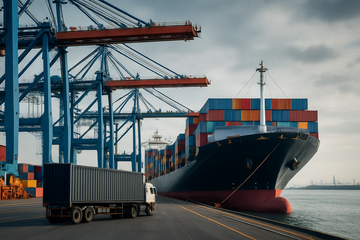
California's Dock Deal Can't Reach December's FOMC — The Goods Inflation Is Already in the Print
The Pacific Maritime Association pushed its talks with ILWU Local 26 to Nov. 20, 2026, the fourth move of a strike clock that had been set to collide with importers rushing cargo ahead of the Nov. 10 expiry of Section 301 exclusions covering roughly 200 Chinese product categories. That deadline now sits after the tariff date and after the October CPI and PCE prints the Dec. 8-9 meeting will read, so no dock dispute can rescue December's rate decision — and none was needed, with CME FedWatch pricing an 81.2% chance of a 25 basis point hike and all 100 economists in a Reuters poll expecting one. What the extension changes is 2027: the front-running that has Union Pacific, ZIM, Matson and C.H. Robinson posting record numbers is already inside the price indexes, and its payback now lands on next year's volume estimates. The winners of the front-run are the ones who sold into it; the losers are import-dependent big-ticket retail such as Home Depot and the households paying 4.6% goods inflation.

Gabon's $2 Billion Rare-Earth Restart: No Offtake, No Financing, No Separation Plant — and No Price Floor
Gabon has told Beijing it wants $2 billion to restart the dormant Mabounié niobium and rare-earth project, presented on Nov 6, 2026 by Emirati-backed New Energy Metals, its Dusk Gabon subsidiary and Chinese engineer ENFI. None of the three ingredients that make a price floor — a signed offtake, a closed financing and separated, magnet-grade output — exists yet, and Gabon's own commitment to the promoter is 35.02 billion CFA francs, roughly 3% of the plan. So a revived Mabounié is more likely to become cheaper feedstock for the Chinese refining chain that already holds 91% of world refined output than to set a price for anyone else. The tradeable consequence is not the mine but the spread: NdPr at roughly $103-106/kg inside China against $125-140/kg outside it makes the scarce assets the contract, the export licence and the toll collectors.

No Buyer for a $40,000 GPU: Microsoft Winds Down Oracle and Puts a Rental Rate on 'Good Enough' AI Compute
Microsoft's walk-away from Oracle's 2023 AI-cloud lease does not put a single accelerator on an auction block, because the chips stay inside Oracle's data centers, depreciated over six years. What it released is contracted demand, and contracted demand is what a market of compute prices against. The consequence is that the marginal price of 'good enough' AI is being set by a rental rate rather than a hardware print, which is why the damage lands on the layer where depreciation is more than half of revenue:69% at IREN and 53% at CoreWeave, against 15% at Oracle, 12% at Microsoft and 1% at Nvidia. Own the facility layer, where occupancy is now the pricing variable and renewal rents are rising, and treat Oracle's $127.8 billion of property and equipment as the balance-sheet expression of a repricing that has barely started to show up in reported numbers.
2026-11-07

600,000 NVIDIA Chips, a $0.4 Billion Charge and a November 10 Deadline: China's Retaliation Menu Is Not Mainly About Rare Earths
On November 7, 2026 China's Commerce Ministry answered reporters' questions on the newest US sanctions against Chinese companies and confirmed a video call between Vice Premier He Lifeng and Treasury Secretary Bessent — one day after Washington demanded Beijing deliver rare earths and farm purchases "fully and immediately." The rare-earth suspension expires on November 10 while the Busan truce runs to January 10, 2027, so Beijing can tighten without breaking the deal. The levers that already cost money are administrative: NVIDIA booked a $0.4 billion H200 charge and says it is "effectively foreclosed" from China's data center market, roughly 600,000 chips sit idle in Hong Kong, and Beijing has named MP Materials and USA Rare Earth on its export-control list. Investors should price the licensing and entity-status dials, not the rare-earth headline.
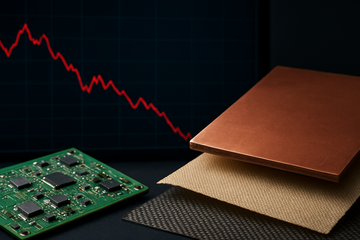
The $8.8 Billion Middleman: Resonac Raised Profit Guidance 40% and Still Fell 49% From Its High
Resonac's roughly US$8.8 billion purchase of Hitachi Chemical placed it in the middle of the AI stack — laminate squeezed between glass cloth and board fab — and in 2026 that position collected a 30% price rise and lifted segment core operating margin from 21.4% to a guided 29.2%. Yet the shares have fallen 48.6% from their ¥20,495 high, and the wider materials chain is down 41% to 72%. The margin is real, but it is rented: priced by a 95%-share film monopoly upstream, competed away by a Chinese laminate maker below, and undercut by substrate capacity that only ships from 2028. Here is where the money actually sits in the AI materials chain, which layers keep it, and what would break the thesis.
2026-11-06

The EU Cleared the $25 Billion Axalta Deal With a European Refinish Carve-Out: PPG and Sherwin-Williams Get a Smaller Rival, Not a Bigger One
The European Commission approved Axalta's all-stock merger with AkzoNobel on November 6, 2026, but only on condition that AkzoNobel sells its European vehicle refinish business to a buyer the Commission first approves. That condition shrinks the combined group in the one segment where coatings margins are highest and puts Europe's body shops in the hands of a new single-purpose owner, so the read-through for PPG and Sherwin-Williams is a capped rival rather than a bigger one. For Axalta shareholders it is 45% of a group guided to roughly 7.6 times adjusted EBITDA, against the 10.6 times their own shares trade at.
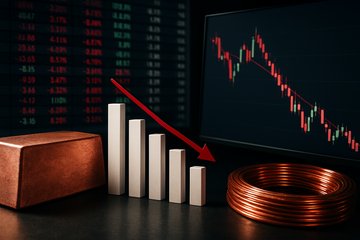
Copper Fell to Its Lowest Since July While Its Physical Market Stayed Tight: The Blue Sweep Broke Both Legs at Once
Copper's record $14,809/t rally rested on two political supports — a US tariff wall that pulled cathode into America and printed a COMEX premium, and an AI buildout both parties wanted. The Nov. 3 midterms took both out in one week: voters approved 40 of 41 data-center restrictions, and copper slid to its lowest since July even as the physical market stayed tight, because the scarcity was itself a tariff artifact. Korea's KOSPI took an 8.6% circuit-breaker halt and China's 10-year bond yield printed a record 1.58% low, so money is leaving a political premium, not a growth cycle. Own the tonnes and the gold hedge, not the copper premium.

Dropbox's $350M Tigris Bid Prices S3 Compatibility at a Commodity Level — While the Drive Makers Keep the Pricing Power
Dropbox agreed on Nov. 3, 2026 to buy S3-compatible object-storage startup Tigris Data for about $350 million in cash — its largest acquisition since 2007 — and wrapped it in DBX Agent Cloud, a storage product sold to developers building AI agents. The read-across is not that storage software is scarce: the S3 API now has at least four credible implementations, and Dropbox paid roughly 11 times everything Tigris has raised and about 61% of the enterprise value of the only listed pure play in the layer, Backblaze. What the price reveals is where the durable margin sits: Seagate and Western Digital grew revenue 61% and 55% year over year at 57%-plus gross margins on AI exabyte demand, while the software toll layers convert that same demand into 53% ARR growth on $6.3 million of trailing capex. For investors the toll is real but the economics accrue upstream to the bytes, while the software layer's pricing power is capped by a $0.015 per gigabyte-month zero-egress card that Cloudflare publishes.

Firefly's $1.3 Billion AST Order Puts an $83 Million Floor Under the Cost of a Launch
AST SpaceMobile is building its own rocket because it cannot get enough rides on other people's rockets, and on Nov. 6, 2026 it bought the engines from Firefly Aerospace instead: 36 engines, a perpetual manufacturing license and three years of engineering support worth more than $1.3 billion. The arithmetic underneath is awkward — $250 million of engine hardware for three vehicles works out to about $83 million per rocket, more than a dedicated Falcon 9 lists for in 2026 — so Blacklift only makes sense at a flight rate that does not exist yet. Only $400 million of the headline is cash at signing, the balance is 10 to 14 million AST Class A shares, and Firefly Aerospace's stock added roughly $947 million of market value in a single session, so the market has already paid for most of this order.
2026-11-05
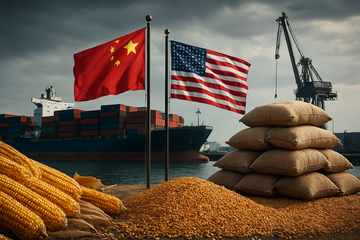
Beijing Made Farm Purchases Conditional — and Corn Basis Cracks First, Not Soybeans
On Nov. 5, 2026 China's commerce ministry said U.S. farm purchases would move only if Washington and Beijing strike a reciprocal tariff-cut deal, turning a $17 billion annual pledge into a condition rather than a contract. The pledge is already running at a seven-year low: $7.2 billion of non-soybean farm goods bought January through September, with soybean buying now steered by state buyers rather than commercial crushers. The first crack is not in soybeans, whose basis sits above its two-year average on a record crush, but in corn, where inland basis hit record lows for the season, and in nitrogen, where China's export quotas took Indian urea tenders from $959 to $352 a ton between April and October. Positioning follows the cash basis and the fertilizer curve, not the bean headline.

DuPont Beat for a Fifth Straight Quarter — and Veralto's Multiple Values DuPont's Water Franchise Above Its Entire Market Cap
DuPont's Nov. 3 print was the first clean look at the company that survived the Qnity separation, and it said three things: adjusted EPS of $2.09 was 62% above the restated prior-year quarter, but roughly a third of that came from interest expense falling from $84 million to $40 million as the balance sheet repaired; Healthcare & Water Technologies earned a 30.4% operating EBITDA margin on strength DuPont attributes to industrial water, semiconductor and specialty markets; and the shares still change hands at 12.2x guided 2026 operating EBITDA. Apply Veralto's 21.6x trailing EV/EBITDA to the $972 million of operating EBITDA DuPont's water and healthcare segment earned in 2025 and you get about $21 billion — more than DuPont's entire $20.4 billion market capitalization — which leaves a $3.6 billion-revenue industrial business valued at close to nothing. What closes that gap is disclosure and portfolio structure, and both are management decisions rather than cycle decisions.

Qnity Electronics Beat, Raised, and Still Got Its Price Target Cut: AI's Interconnect BOM Is Repricing Two Steps Above the Connector
Qnity Electronics reported a 22% organic quarter, beat adjusted EPS by 21%, and raised full-year guidance by $200 million at the sales midpoint — then watched a price target fall from $180 to $165 with consensus slipping to $176.30. The cut blamed semiconductor pressure, but the evidence points elsewhere: AI's interconnect bill of materials is repricing at the conversion layer that owns the scarce inputs, with laminate gross margin up more than 1,200 basis points at Kingboard Laminates and Shengyi Technology against 380 basis points at Qnity's own interconnect business and roughly 120 at Amphenol's connector assembly. The uncomfortable conclusion for the consensus target is that the take is largest where the scarce input is owned, which makes Qnity a second-derivative way to own AI interconnect rather than the first.
2026-11-04

China's $120 Billion Mine-Stake Spree Is the Supply Chain Washington Cannot Screen
Chinese buyers have committed more than $120 billion to overseas mines and upstream processing since 2023, and $8.8 billion to mineral acquisitions in the first nine months of 2026 alone — on pace to be the highest annual total since at least 2018 — while Chinese firms are expected to double outbound mining investment over the next five years. None of that registers as an export control, a tariff line or a screened transaction, because Beijing is buying the right to own the metal rather than the right to ship it. The proof points are a Chinese antitrust condition bolted onto the $54 billion Anglo American–Teck Resources merger, a state-owned group circling the shareholder that holds a stake in MP Materials, and a Congolese government that just showed equity holders cannot outrun the host state. The investable question is no longer who exports the metal; it is who owns the mine, holds the offtake and can pull the licence.

Converted Jet Engines Won a $1.465 Billion Order — and the AI Power Queue Still Runs to 2031
Retired aircraft engines have become sellable power: FTAI Aviation disclosed a $1.465 billion initial purchase order for 25-megawatt gas turbine generator sets built from CFM56 engines, with more than 100 units under contract for delivery in 2027 and 2028. The channel adds almost no megawatts — it adds time, because new-build aeroderivative turbines are sold out through 2029 while a converted engine can deliver in 2027 and bridge a data center for five to seven years. That makes repurposed engines a bridge-power market rather than a power source, with roughly 1,000 retiring engines setting a hard ceiling on supply. The investable result is a new toll layer between aerospace and AI power, captured by whoever already holds the engine cores.
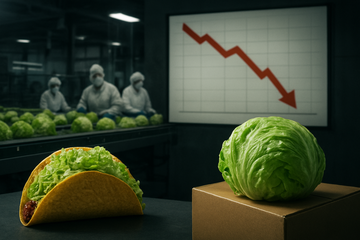
Taco Bell's Parasite Crash Cost $172 Million in Sales and Yum! Brands Only $10 Million — the Franchisee Paid the Rest
The 2026 cyclospora outbreak traced to a single iceberg lettuce processor in central Mexico took Taco Bell's U.S. same-store sales down 4 points in the third quarter of 2026, straight off a 7% gain in the prior quarter. The equity damage was trivial and the franchisee damage was not: Yum! Brands collects roughly 5.7 cents of every dollar of Taco Bell system sales, so an estimated $162 million of lost restaurant revenue — and most of the store-level profit — landed on the operators who actually own the restaurants, who also funded the discounts, the write-offs and the lawsuits. The next cycle is already scheduled: Taylor Farms will pull Mexican iceberg out of the U.S. market during the May-to-August window starting in 2027, while the federal traceability rule that would have forced this chain to document itself is barred from enforcement until July 2028.
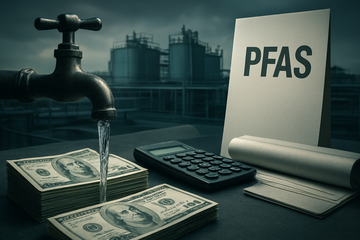
3M’s $7.35B PFAS settlement is creating a new pricing floor—starting with the municipal-water bills utilities can now capitalize on
3M’s $7.35B PFAS personal-injury resolution (timed across 2026–2034) doesn’t just cap chemical-maker liability—it also sets the first nationwide “unit” market reference point for how future PFAS costs get booked and financed by the municipal-water complex. New Jersey’s separately approved $2.5B PFAS settlements show the other half of the pipeline: long-duration, annual payments that translate contamination risk into predictable, credit-relevant cash flows for utilities and their suppliers.
2026-11-03

Coca-Cola Europacific Partners Reaffirmed Guidance on a 1.5% Cost Target That Needs Roughly 2.4% in the Second Half
The third-quarter print looks like a clean growth story — revenue up 5.8% FX-neutral to €5.76bn, unit cases up 3.5%, revenue per unit case up 2.2% — and the full-year outlook was left untouched. The cost target buried in that outlook is the problem: first-half cost of sales per unit case rose 0.6%, so the 1.5% full-year guide implies second-half cost inflation near 2.4%, roughly what third-quarter pricing only just matched. Concentrate is incidence-linked to revenue, but aluminium and PET are not, and can makers are passing metal through in full — $405m of higher material cost at Crown Holdings in a single quarter — while the bottler has hedged more than 95% of FY26 commodities, protecting this year and exposing 2027. The result is a system where Coca-Cola raised 2026 guidance a week earlier at a 33.4% operating margin, and the 13.6%-margin bottler could only reaffirm: the pricing power is real, and it is not evenly distributed.

Only $1.7 Billion of South African Exports Ride on AGOA — Yet Washington Just Turned Eligibility Into a Foreign-Policy Test
Washington has converted trade preference into an alliance instrument. On Nov 1, 2026 President Trump said a US–Canada deal was \"very close,\" with tariff removals and the Keystone XL pipeline inside the concept; a day later the US Trade Representative told Congress that South Africa and Rwanda lose duty-free access to the US from Jan 1, 2027. The economic leverage is thinner than the rhetoric: almost 90% of South Africa's exports to the US already sit outside AGOA, and the metals Washington actually needs — platinum, gold, manganese, chrome — stay outside the tariff wall. What changed is the perimeter, because eligibility is now judged on foreign-policy alignment. For investors the practical consequence is a re-underwriting exercise on both sides of that perimeter, and it matters most for Ford, General Motors, Nucor and TC Energy, whose economics now hinge on political access rather than cost structure.
2026-11-02

What to expect
Evidence-first notes with a visible point of view.
This section collects sharp takes on earnings, shareholder meetings, and market structure. Each new piece should make the thesis, the facts, and the implications obvious within the first few screens.
Expect direct analysis, not generic commentary.
Expect the data to be explicit and the argument to be easy to follow.