Policy & Trade
Tariffs, export controls, and who absorbs them
Rulings, sanctions and trade negotiations traced to the companies that pay for them — margin by margin, route by route.
2026-11-09

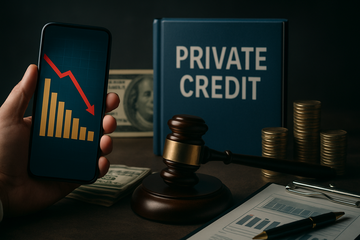
Australia Froze Four Private-Credit Funds in Five Weeks. The US Equivalent Covers $600 Billion — and the SEC Has Proposed It
Between September 22 and October 26, 2026, Australia's ASIC froze new subscriptions, secondary transfers and retail advice in four retail private credit funds holding A$1.66 billion of assets, and revoked every order within eleven days once the disclosure was fixed. The freezes were about the wrapper, not the credit, which is why the US read-through runs through flows rather than defaults: the retail semi-liquid shelf that promises liquidity at net asset value holds roughly $600 billion of the $2.66 trillion private credit universe the Federal Reserve began measuring on October 16, 2026. On September 30, 2026 the SEC proposed letting interval funds defer their first repurchase offer for up to two years, which would convert a promise of cash into an option held by the manager. For equity investors the transmission is fee-earning assets that keep compounding while the exit quietly closes.

China's 24-Point Tariff Suspension Got Two Months, Not a Year: October Imports +8.5%, January 2027 Forecast −1.9%
Beijing's suspension of 24 points of its April 2025 tariff on US goods, and of its rare-earth export controls, now runs to Jan. 10, 2027 — bought at the Sept. 24–26 Washington summit and still, as of Oct. 29, without a published implementing notice. The bridge changes nothing about the US duty stack (22.8% effective on Chinese goods in July 2026 against a 6.7% average) and everything about the two levers that can still break: China's retaliation and its rare-earth licensing. Because importers pulled orders forward — October volumes 8.5% above last year, January 2027 forecast 1.9% below — the decision that matters was made in December, when Chinese factories booked first-quarter books, so Walmart, Target, Hasbro, ZIM, MP Materials and China Northern Rare Earth are all trading on a deadline whose legal paperwork did not exist on Oct. 29.

China's 5.7% Producer Inflation Is an Import Bill, Not a Recovery — the Deflation Trade Is Delayed, Not Dead
China's factory-gate prices rose 5.7% year on year in October, the fastest since June 2022 and above the 5.3% consensus, while headline CPI slipped to 0.7% and core CPI to 0.8%. The surge is an imported energy bill, not a demand cycle: mining prices jumped 27.9%, consumer-goods producer prices still fell 0.1%, and capped retail fuel prices kept the shock out of the checkout basket. That transferred profit upstream — CNOOC and Sinopec earnings jumped while Baoshan Iron & Steel net profit fell 29.7% — and left the demand-driven deflation story intact. With Brent down 7.63% on Iran peace-talk headlines and monthly producer-price momentum already cooling from +1.2% to +0.7%, the actionable move is to fade the energy complex now and re-own Chinese deflation in 2027.
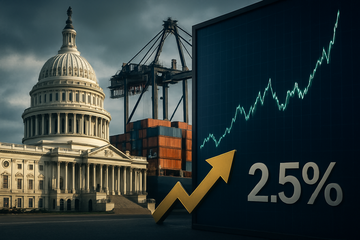
Gridlock, Not Relief: Democrats' January Tariff Bill Can't Undo Section 232 — and the Tape Is Trading a 2.5% Gridlock Rally
House Democrats will put tariff repeal on the floor in the first 100 hours of the 120th Congress, starting with the 50% duty on Canadian goods, but the tariffs that matter now live in statutes rather than proclamations — and with 54 Democratic senators, 60 needed for cloture and 67 to override a veto, real repeal is a 2027 problem, not a January one. The market has already voted on the headline: Costco, Dollar General and P&G rose on the Nov. 4 relief rally, but by no more than the Dow's 2.5% surge, which tells you investors are trading gridlock, not repeal. The tradeable split is between consumer names that rally on the promise of relief and the Section 232-protected steel and chip producers whose pricing power no House vote can touch.

The Blue Sweep Closed Trump's Fed Path for 2027 — and Futures Already Paid for Two Hikes the Committee's Dots Don't Show
Democrats took both chambers on Nov. 3, and the first thing that changes is not fiscal policy but the Federal Reserve: a Senate that starts Jan. 3 can block every replacement Trump wants on the seven-member Board, so the 2027 rate path belongs to the sitting committee. Futures have already paid for that outcome — the two-year closed at 4.51% on Nov. 6, implying roughly two more increases in 2027, while the Fed's September median dot stops at 4.1% and holds there through the year. So the trade is no longer the Dec. 9 decision, which looks close to a formality; it is the projection round attached to it, and the roughly 50 basis points of 2027 tightening the dots must now validate. Bank earnings are already collecting the hiking cycle — JPMorgan Chase's net interest income rose 12.8% to $27.0 billion in Q3 2026 — while housing and long-duration assets are still paying for it at a 7.18% mortgage rate.
Sanders' No-Bailout Line Misreads the Ledger: AI's Real Backstop Is a $108.5 Billion Guarantee Book
On Oct. 30, 2026, Sen. Bernie Sanders told Big Tech it “won't be bailed out, period” — a day after Reps. Greg Casar and Maxine Waters introduced a House resolution opposing any federal rescue of AI firms. The promise costs nothing, because the AI buildout was never financed by taxpayers: the $3 trillion Sanders cites is contractual commitments, mostly undrawn leases, and the credit support that actually matters sits in private hands — Nvidia's guarantee book tops out at $108.5B, Broadcom backs the first lien on a $63B financing vehicle, and roughly $500B of AI debt was issued this year alone. What the no-bailout posture removes is the implicit put private lenders and insurers were pricing at, so losses now arrive as marks on retirement portfolios — private credit is 13% of U.S. insurers' cash and invested assets — while the five largest hyperscalers funded $301.8B of the last twelve months' capex with net new debt and $76.0B with net new equity. The trade is therefore not against AI but against the borrowers whose equity has been stripped out, starting with CoreWeave, where $51.6B of debt sits on $25.6B of market value.

One robots.txt Line, Four AI Giants, Zero Dollars: The AI Training Opt-Out Standardizes Refusal, Not Payment
On October 30, 2026, OpenAI, Google, Microsoft and Anthropic said they would honour a single robots.txt token, so a publisher can refuse AI training once instead of crawler by crawler. The text behind it is an individual IETF draft with no formal standing, Anthropic has already implemented it, and Google and Microsoft only promise 2027 dates, which makes this a deployment schedule rather than a rulebook. The token standardizes the refusal and not the payment: it hands the labs a documented compliance record in the publisher litigation while the real gate stays a CDN default, where mixed-use crawlers are 36.6% of Cloudflare's verified crawler traffic and Cloudflare owns the billing relationship. The gap the token cannot close is the shadow supply chain, including a 30-billion-page index that publishers say resold their journalism to five AI labs.
2026-11-08

The 2.5 Cent AI-Power Premium Is a Policy Choice — and China's $945 Billion Is the Proof
China will spend $945 billion on energy in 2026, 1.5 times the United States, and the marginal dollar is going into grid hardware the West cannot make fast enough. That build-out is why transformers got scarce without becoming unaffordable — until Executive Order 14420 closed the factory door in August 2026. We size the US data-centre capacity premium at roughly 1.5 to 3.7 cents per kWh, about 2.5 cents at the midpoint, and show where the rents land: Western backlogs and US power sellers near term, Chinese exporter volume without profit in the long run.

94% of Bitcoin's $1.28 Billion ETF Exit Came From One Fund — in the Same Week the AI Trade Crashed
US spot bitcoin ETFs shed $1.28 billion in the week to Nov. 6, 2026 — the worst week since late June — pushing 2026 net flows to -$914 million, but the \"crypto complex is exiting at once\" story breaks on the fund-level data: BlackRock's IBIT accounted for $1.21 billion, or 94.4%, of the outflow, while Fidelity's FBTC absorbed $93.1 million. Concentration matters mechanically, because IBIT's bitcoin sits with Coinbase Custody Trust Company and its cash redemptions are executed through Coinbase as prime execution agent, so the selling landed on one venue rather than spreading across crypto. The same five sessions saw the Nasdaq Composite fall 5.52% into correction on AI-capex fears, which makes this balance-sheet de-risking rather than a rotation into AI equity — and it puts bitcoin's $73,188 200-day moving average, not the flow print, at the centre of the decision.
Washington's Nov. 7 Permitting Bill Prices a $615 Billion AI Buildout Before Any of It Is Energized
On Nov. 7 two Republicans and two Democrats released the agreed substitute amendment to the Bipartisan American Affordability and Jobs Act, and the American Council on Renewable Energy and Evergreen Action both endorsed the same text on the same day — proof the bill now trades as a settled framework rather than a partisan wish list. What matters is the machinery: FERC gets project-by-project siting authority, utilities can have their return on equity cut for failing to build grid upgrades, and any data center of 20 MW or more must pay the entire incremental cost of the generation, storage and wires built to serve it. That clause is why the bill is investable and why it is not a demand subsidy — an estimated $6 billion a year of grid cost moves off ratepayers and onto large loads. The buildout it unlocks is already funded: Amazon, Alphabet, Microsoft and Meta spent $615.4 billion on property and equipment in the twelve months to Sept. 30, 2026, and $201.9 billion of that in the September quarter alone, while federal tax support for new wind and solar has been withdrawn. With Democrats controlling both chambers from Jan. 3, 2027, the Nov. 9 cloture vote matters less as a passage event than as a deadline for locking in a framework the next Congress must negotiate against.
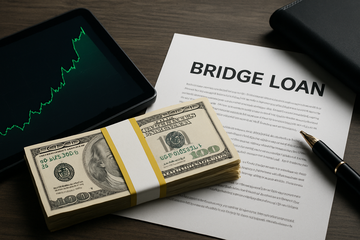
Fox Closed Roku Without a Court Order: The Antitrust Risk Died on Nov. 6, and an $8.4 Billion Bridge Loan Is the Bigger 2027 Risk
Fox closed its roughly $22 billion acquisition of Roku on Nov. 6, 2026, and the Justice Department's Antitrust Division closed its investigation the same day with four behavioral commitments and no court-filed decree. That killed the $1.2 billion regulatory break fee and every scenario in which a federal enforcer unwinds the deal, leaving state attorneys general, an open-ended enforcement posture and commitments that expire in November 2029. What replaced the regulatory risk is measurable: Fox issued 26% of its equity and borrowed $10.4 billion at floating rates for a business with $728 million of trailing EBITDA and $796 million of trailing free cash flow. The close swaps a blocked-deal risk for a refinancing risk.
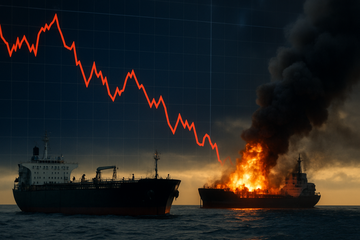
The Democratic Ceiling on Oil Broke on Nov 7 — and Only $3.70 of the $17.65 War Premium Has Come Back
The market sold $17.65 of Brent after the Nov 3 midterms, betting a Democratic House and Senate would force Trump to end the Iran war. On Nov 7 he confirmed fresh US strikes on Qeshm island, Iran reported five tankers and a tugboat ablaze in Hormuz on Nov 5 and two more tankers struck by mines on Nov 6, and an Iranian lawmaker warned that missiles reaching Europe would push oil past $150 — so the premium was always a bet on presidential restraint, not on congressional control. Only $3.70 has been rebuilt, and the money now sits with the hull owners such as Frontline and the crack owners such as Valero Energy, not with crude beta.

5.1 Million Left Medicaid and 4.6 Million Left the Exchanges: The 2026 Coverage Cut Is Federal, and Hospitals Pay for It in Payer Mix
Medicaid's 2026 coverage loss is a federal event, not a state one. The expansion map was unchanged at 41 jurisdictions through Nov. 6, yet Medicaid enrollment fell 5.1 million and the individual market 4.6 million over the past year as enhanced premium tax credits expired. The transmission runs through payer mix and uncompensated care rather than pricing power: HCA Healthcare absorbed roughly $400 million of pre-tax income in Q3 2026 from exchange coverage loss, and guides 2027 Medicaid supplemental payments $550 million to $650 million lower. With Democrats now controlling both chambers, 2027 is locked by statute while 2028 and beyond stay a political option, so Centene has already repriced for a shrinking pool while the operators with the thinnest balance sheets and the heaviest Medicaid mix carry the most risk.

Two Lawsuits Put Medicare's $440 Million Foreign-Price Pilot Before a Court — and the Precedent Is Worth Far More Than the Savings
BIO, Biocom and California Life Sciences sued HHS in the Northern District of California on Nov. 6, joining PhRMA's Oct. 7 challenge in the District of Columbia to the GLOBE model, which ties Medicare Part B rebates to prices paid in 19 foreign countries. The cash is trivial: CMS cut projected seven-year savings from $11.9 billion to $440 million, left roughly four manufacturers in scope, and says 0.3% of Part B beneficiaries would pay less out of pocket. The machinery is not trivial — the benchmark is built from the lowest or volume-weighted foreign net price, so a reimbursement decision in London, Tokyo or Berlin now sets US rebate liability, while the April 2, 2026 tariff-and-MFN arrangement with the UK already trades foreign pricing for tariff relief. For Merck, Bristol-Myers Squibb and Johnson & Johnson, the direct effect is rounding error against revenue bases of $64.9 billion, $48.2 billion and $94.2 billion; for US launch pricing and biosimilar economics, the ruling matters far more than the cash.

Zoetis Bought Genomics at 1.8 Times Sales and Merck Paid $647 Million for Hatchery Vision: The Protein Boom's Trade Is Cost Per Pound
Record protein prices are pulling capital into animal health, but not into medicine. Zoetis is paying $160 million for Neogen's genomics business, Merck is paying $647 million for poultry-technology firm TARGAN while advancing an $895 million biologics expansion in Kansas, and venture capital has put a record $470 million into global livestock management in 2026. The reason is cost per pound: feed is 56% of a cattle producer's cost, so the return on health spending shows up in feed conversion and hatchery precision, not in doses sold. That makes the scarce animal the valuable one, so dollars per head rise while head counts fall, and cattle-linked health revenue grows even with the US herd at its smallest since 1951. The exposure sits in animal health, feed additives and nutrition; processor margins are compressing and grocers are absorbing the price shock.

A Strike on Riyadh's Financial District Moved Aramco 0.31% — Saudi Risk Is Still Priced in Barrels, Not Buildings
On Nov 8, 2026, Houthi missiles hit an Aramco tower in the King Abdullah Financial District: shrapnel damage, no casualties, and a Saudi all-share index down 0.78% in the session that followed. The market read it as another supply event, because the war premium is paid in barrels — Brent at $98.32, marine war risk at 0.75% of hull value — and because Saudi credit has not needed to move, with hard-currency spreads sitting roughly 20bp off their 2025 tights. What is unpriced is the address: KAFD hosts over 140 corporate tenants and 20 regional headquarters, and it is where the Kingdom books its diversification away from oil. The AI buildout now runs through Aramco's balance sheet after the PIF-Aramco Humain deal, which makes physical security, not capital, the binding constraint on Saudi's non-oil future.
2026-11-07

Airbnb Spent $7 Million on Capex and Authorized $12 Billion of Buybacks While the AI Complex Spent $615 Billion
On Nov. 5, 2026, the Nasdaq 100 fell 6.36% — its worst session since March 2020 — and roughly $2.5 trillion of market value evaporated as investors pressed the case that a $900 billion AI capex wave is running ahead of returns. That night, Airbnb reported revenue up 19% to $4.87 billion, a 39% net margin, and a new $12 billion repurchase authorization. The divergence is structural rather than lucky: Airbnb spent $7 million on capital expenditure over the trailing year because the AI it buys is operating expense rented from hyperscalers that spent $615 billion on the same balance sheets. Capital allocation has become the AI factor, and on the test of who turns AI into cash without capitalizing it, Airbnb behaves like an annuity trading at 21 times trailing free cash flow.

600,000 NVIDIA Chips, a $0.4 Billion Charge and a November 10 Deadline: China's Retaliation Menu Is Not Mainly About Rare Earths
On November 7, 2026 China's Commerce Ministry answered reporters' questions on the newest US sanctions against Chinese companies and confirmed a video call between Vice Premier He Lifeng and Treasury Secretary Bessent — one day after Washington demanded Beijing deliver rare earths and farm purchases "fully and immediately." The rare-earth suspension expires on November 10 while the Busan truce runs to January 10, 2027, so Beijing can tighten without breaking the deal. The levers that already cost money are administrative: NVIDIA booked a $0.4 billion H200 charge and says it is "effectively foreclosed" from China's data center market, roughly 600,000 chips sit idle in Hong Kong, and Beijing has named MP Materials and USA Rare Earth on its export-control list. Investors should price the licensing and entity-status dials, not the rare-earth headline.
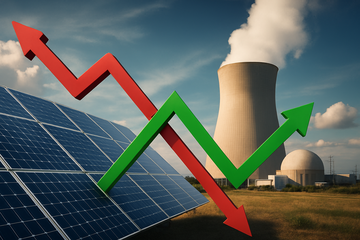
Solar Rallied 8.4% on a Bill Nobody Can Pass; Nuclear Fell 15.4% on a Credit Nobody Needs to Revive
Democrats took both chambers on Nov. 3, 2026, and the first trading day in power stocks bought clean-energy credits that cannot be signed and sold the contracted firm power that actually fills the AI queue. The credit nobody priced is Section 45U, and it is worth less than the rally assumes: it phases out as gross receipts rise from $26.00 to $44.75 per MWh, so Constellation Energy booked $15 million of nuclear credits in the second quarter of 2026 against $45 million a year earlier. The tradeable consequence of a Democratic House is permitting and oversight rather than new subsidies, which points at grid hardware and transmission construction, where backlog is already growing faster than revenue.

Oklo Rose 22.7% on $1.86 Million of Services Revenue: The AI-Power Trade Now Pays for Milestones, Not Meters
Oklo's third quarter produced $1.86 million of revenue and a $41.7 million net loss, and the stock still closed 22.7% higher at $23.55 on Nov. 6, because the print carried a package of dated milestones: the NRC's final rule letting Department of Energy reactor data feed commercial licenses (effective Nov. 25), a domestic forging-capacity reservation with U.S. Forged Rings (first components 2030), and 900 MW under active consideration in PJM's 2026 interconnection cluster study. The revenue itself was the least important number in the release — it came from two engineering-services firms Oklo bought in June, and depending on whose consensus you use the same $1.86 million was either an 80% beat or a 1.2% miss. What the market paid for was a schedule: fuel from Centrus beginning in 2029, a safety analysis management does not expect until roughly 2028, and an interconnection queue that has already cost Oklo one 750 MW project. For investors, that makes the pre-revenue developers a duration instrument on the license-and-fuel calendar rather than a claim on electrons, which is why the leg now trades at roughly 1,400 times trailing sales with a quarter of dilution each year, and why the fuel and component suppliers are the better-structured way to own the same buildout.
What to expect
Evidence-first notes with a visible point of view.
This section collects sharp takes on earnings, shareholder meetings, and market structure. Each new piece should make the thesis, the facts, and the implications obvious within the first few screens.
Expect direct analysis, not generic commentary.
Expect the data to be explicit and the argument to be easy to follow.