Aerospace, Defense & Space
Defense budgets and the contractors behind them
Procurement rounds, backlogs, launch cadence and rearmament programmes, read as multi-year revenue with the primes and suppliers named.
2026-11-08


2026-11-07
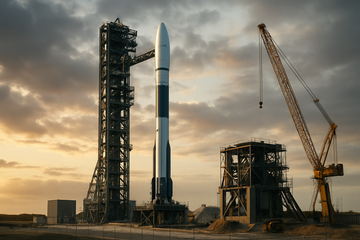
Blue Origin's January 2027 Delay Is a Pad Story, Not a Rocket Story: Zero Flights Since April 19
Blue Origin told staff on Nov. 4 that New Glenn will not return to flight until January 2027, roughly 10 days later than the December target, because reconstruction of Launch Complex 36A after the May 28 static-fire explosion ran long. The failure analysis is finished — the root cause is a faulty liquid-oxygen main valve in a BE-4 engine — while the ground system built to fly dozens of vehicles a year is still being rebuilt, so the binding constraint on cadence has moved from the vehicle to the pad and the federal license that caps New Glenn at 12 flights a year. The cost lands downstream: Amazon's Leo constellation and AST SpaceMobile are waiting on launch slots, Karman Holdings sees launch-hardware demand without near-term revenue, and Rocket Lab has slipped its own flagship into the same 2027 window.

Alphabet’s SpaceX Governance Link Just Broke—Don Harrison’s Exit Forces a Reprice of How Investors Should Think About “AI in Orbit” vs. a $94B Stake
SpaceX disclosed that Google executive Don Harrison resigned from its board effective immediately on Nov. 4, 2026, removing a long-running related-party governance bridge between Alphabet’s SpaceX holding and Google’s competing push to put AI compute into orbit. The next market test is whether shareholders still underwrite Alphabet’s “orbital AI” story on the assumption that board-level alignment reduces execution risk—or whether the loss of that bridge raises the probability-weighted cost of capital.
Scottish Mortgage Took $6.2 Billion Off Tesla and Bought AI's Bottlenecks: The SpaceX Trim Is a Valuation Call, Not a Midterm One
The headline frames this as a Musk discount. The filings say something narrower and more useful: Scottish Mortgage sold its last Tesla shares in April 2026 for roughly $6.2 billion of realised profit on about $470 million invested, and then trimmed SpaceX from 15.0% to 11.1% of assets in the five weeks after its June listing. Neither leg was an election trade — the exit was priced in April and the trim began in October as IPO trading restrictions lifted. Where the money went is the investable part: memory, wafer inspection, dicing, power and gas, plus a 24.9% private-company book that now sits at 53 companies. For investors, the signal is a change in where the AI build-out gets paid, not a change of theme.
Shield AI Paid $5.3 Billion for Echodyne — Exactly What Shield AI Was Worth 20 Months Ago
Shield AI agreed on Nov 5, 2026 to acquire radar maker Echodyne for up to $5.3 billion, funding it with a $2.5 billion raise that marks Shield at $28.8 billion — roughly 53 times the more than $540 million of revenue it projected for 2026. Twenty months earlier the buyer itself was worth $5.3 billion, so the price tag and the acquirer are the same number. Meanwhile the listed primes that build and integrate counter-drone systems have de-rated: AeroVironment's market value fell to $5.7 billion and Kratos's to $6.6 billion, leaving them on two to three times sales. The mechanism is currency, not demand — private capital with a 53x currency bought the merchant sensing layer, while the first program dollars still flow to the listed integrators that cue and defeat drones.
2026-11-06

Firefly's $1.3 Billion AST Order Puts an $83 Million Floor Under the Cost of a Launch
AST SpaceMobile is building its own rocket because it cannot get enough rides on other people's rockets, and on Nov. 6, 2026 it bought the engines from Firefly Aerospace instead: 36 engines, a perpetual manufacturing license and three years of engineering support worth more than $1.3 billion. The arithmetic underneath is awkward — $250 million of engine hardware for three vehicles works out to about $83 million per rocket, more than a dedicated Falcon 9 lists for in 2026 — so Blacklift only makes sense at a flight rate that does not exist yet. Only $400 million of the headline is cash at signing, the balance is 10 to 14 million AST Class A shares, and Firefly Aerospace's stock added roughly $947 million of market value in a single session, so the market has already paid for most of this order.

GE Aerospace's Record $12.9 Billion China Expo Haul Is a Services Lock-In, Not an Airframe Bet — and Boeing's 200 Jets Are Still Unconverted
GE Aerospace's Nov. 6 announcement of more than $12.9 billion of Chinese engine and service agreements — 202 LEAP-1A engines for 101 China Eastern A320neo-family jets, 14 spare engines across three CFM engine types, and repair supply deals with MTU Maintenance Zhuhai — is best read as a long-duration services annuity rather than an airframe bet. The reason is installed base: China Eastern already flies 215 LEAP-1A aircraft and more than 380 CFM56-powered jets, so the spares and repair agreements pull the carrier's entire CFM fleet into GE's parts and service network as deliveries run from 2028 to 2032. That annuity prices against real friction: the Section 232 proclamation of July 9, 2026 set no tariffs on aircraft or engines but started a 180-day negotiation clock closing in early January 2027, while Boeing's May 200-jet China accord remains unconverted with the trade truce expiring Nov. 10, 2026. Treat the order as evidence that GE's aftermarket moat in China is widening, but discount the revenue until the equipment-versus-service split and China Eastern's own confirmation are disclosed.

Korea's Defense Backlog Fell 4.1% in One Quarter — the Market Keeps Paying for a Drone Pivot With One Export Order
Seoul's arms makers have lost roughly two-thirds of their market value from their 2026 peak, and the Nov. 5 selloff after the US midterms was the trigger rather than the cause. The cause sits in the order books: Hanwha Aerospace, Hyundai Rotem and Korea Aerospace Industries together shed ₩3.06 trillion of backlog in Q3 2026, while Hyundai Rotem and Korea Aerospace Industries each won zero new overseas contracts this year. The pivot to drones and counter-drone systems is real in how Seoul buys and empty in what Seoul sells — the country has yet to export a single military drone, and LIG Defense & Aerospace has booked one missile sale to Malaysia. The investable question is not tanks versus drones; it is whether Korean order flow stops shrinking before a won that cut 13.2% against the dollar in ten weeks finishes the damage.

1-for-200, Then 1-for-40: Nasdaq's $1 Bid Rule Is Where the AI Selloff Reaches the Retail Account
Between Oct. 27 and Nov. 5, 2026, six Nasdaq-listed issuers put reverse splits and compliance extensions on the calendar: Solowin Holdings at 1-for-200, Accuray at 1-for-40, Jasper Therapeutics at 1-for-30, Robo.ai at 1-for-25, C3is at 1-for-5 after a 1-for-40 in August, and Intrusion with a second 180-day grace period running to May 3, 2027. None of them sells AI, and that is the point: what they share is a quote that fell below Nasdaq's $1.00 minimum bid and the compliance clock that follows, while the Nov. 5 AI unwind erased roughly $2.5 trillion of index value and repriced AI credit. The splits create no enterprise value, but they are the only mechanism that restores a quotable price without new capital, and they settle in the accounts of retail holders as odd lots and fractional cash, against roughly $315 billion of client margin loans at Robinhood, Charles Schwab and Interactive Brokers.
2026-11-05

Palantir's U.S. Commercial Revenue Just Passed Government. That Changes Its Risk Profile, Not Its 54x Sales Multiple
Palantir's third-quarter print, reported Nov 2, 2026, put U.S. commercial revenue of $984 million above U.S. government revenue of $953 million for the first time, with total commercial revenue of $1.168 billion passing total government revenue of $1.146 billion. The crossover was won rather than forced: U.S. government revenue still grew 96% year over year, so federal exposure held near 41% of sales for a fourth straight quarter instead of shrinking. What the print changes is the shape of the downside — one quarter of U.S. commercial growth added $587 million of revenue, more than a 30% cut to federal revenue would remove. It does nothing for the multiple: at 53.7x trailing sales, roughly 46x the midpoint of its own fiscal 2026 guidance, Palantir already trades above every software comparable, and the stock fell 1.65% on Nov 3 as Democrats took the Senate and were projected to take the House, because investors were trading a bookings deceleration rather than a political overlay.

Qualcomm's Biggest 5G Order Ever Landed in the Same Week Its Margin Guide Fell to 20%
SpaceX picked Qualcomm's Dragonwing radios and baseband to build the first standalone nationwide US 5G network on Nov. 4, 2026 - hours before Qualcomm guided its own segment margin down to 20%-22% from 24% and reported handsets down 26% to $5.14B. Both events are one trade: Qualcomm is swapping a shrinking handset franchise for network and data-center hardware that carries thinner margins, while the customer's cash goes elsewhere - 83% of SpaceX's nine-month capital spending went to AI compute, not cell sites. The suppliers paid in every branch of the story are the tower landlords and the memory makers, not the chip vendor in the middle.

Rheinmetall's Backlog Grew 38% and Its Shares Fell 13% — Europe's Defence Money Is Stuck at the Signature Line
Rheinmetall cut 2026 sales guidance to about €13.2bn from €13.7–14.2bn on Nov 4, 2026 — the second cut in three months — because Germany's Boxer contract is still unsigned and artillery ammunition is stuck in acceptance testing, not because European budgets shrank. The order book grew 38% to €78.0bn while nine-month operating cash flow fell to -€1.70bn, so money is being ordered faster than it is contracted, accepted and paid for, with a Bundestag vote on Arminius set for Dec 9, 2026. The same three gates — authorisation, acceptance, payment — sit inside US primes' books, from Lockheed Martin's self-funded F-35 Lot 20 to Northrop Grumman's SiAW charge and RTX's undefinitised Tomahawk contracts, which is why Europe's contracting friction now reads across the whole group.

No Fed Put: November 5's 5.5% Nasdaq Rout Prices What Warsh's October Hold Does to AI Capex
On October 28 the FOMC held at 3.75%–4.00% on a 10–2 vote, upgraded the economy to 'expanding at a strong pace', left inflation 'elevated', and Chair Warsh told reporters that interest rates 'get in the cracks' and that AI investment is not insulated from monetary policy. Six days later Democrats took both chambers, and on November 5 the AI complex cracked: the Nasdaq Composite closed 5.5% lower, the Philadelphia Semiconductor Index fell 9%, the VIX jumped 71% to 28.3, and the 10-year Treasury rallied to 4.84%. Because roughly a third of hyperscaler capex is now debt-financed and heading to 35% in 2027, the marginal AI dollar must clear a credit market rather than a central bank — which sorts the trade into balance sheets that can fund the boom and balance sheets that need it to continue.
2026-11-04

2026-11-03

2026-11-02
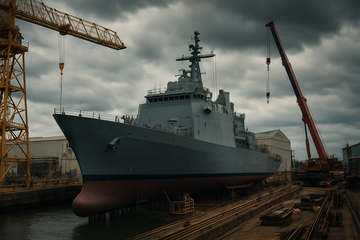
Hanwha Aerospace's First U.S. Navy Hull Prices Below the Navy's Own Budget: the Labor-Cost Wedge Is Philadelphia, Not Korea
Confirmed on Oct. 30, 2026: Hanwha Defense USA will build one Medium Landing Ship for $269 million at Hanwha Philly Shipyard, with options for three more, in the Navy's first shipyard selection under its new vessel construction manager model. The hull is built in Philadelphia, not Korea, at a price below the roughly $315 million per vessel implied by the Navy's own fiscal 2027 request, so the familiar wage-arbitrage reading is wrong. The wedge is a 1,500-person Philadelphia yard that is half non-union, plus a $5 billion capital plan and an ownership reshuffle inside the Hanwha complex — with a public price reference that domestic yards now have to beat.

SpaceX Throttled Grok Bot Because Serving Cost Exceeded Revenue — Twelve Days After Musk Said Its Compute Pays Back in Under a Year
On Nov 1, 2026, Elon Musk said the cost of serving Grok Bot was “unsustainably high relative to revenue” and confirmed tighter weekly limits after subscribers burned through their allowance. Twelve days earlier, on SpaceX's third-quarter earnings call, he told investors something very different about the same hardware: new compute deployments were generating a payback of less than a year at pricing above the top of the $30–50 per watt range. Both statements are true, and the gap between them sets the new floor for consumer AI — enterprise compute sells, flat-priced consumer agents do not. The beneficiaries are the vendors who never sold a flat subscription for agentic work: upstream silicon, ad-monetized apps and metered cloud seats. The labs carrying the biggest capex budgets have to reprice first.
2026-10-31

Third Correction, Third Seller: $2 Trillion Wiped From the Nasdaq-100 as Levered AI Credit, Not the Dip Buyer, Did the Selling
The Nasdaq-100's third correction of 2026 was not a valuation event. It turned a valuation correction into a funding event, because roughly a third of AI capital spending is now debt-financed, credit spreads have doubled, and the equity in levered AI structures has become the margin on the loan. CoreWeave's five-year credit default swaps blew past 1,140 basis points, operating cash flow now covers capex 1.47 times at Microsoft but 0.11 times at CoreWeave, and volatility-target funds sit at the 98th percentile of equity exposure with no dry powder left to catch the knife. The dispersion inside the index is the answer: the market punished the AI exposures that were financed and ignored the ones that were paid for out of cash flow.
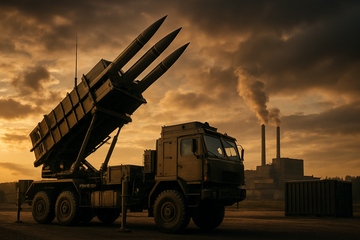
A $2.1 Billion Patriot Sale Buys a Place in Line, Not Missiles — Lockheed Martin Controls the Queue
The State Department approved 500 Patriot PAC-3 MSE interceptors for Ukraine on Oct. 30, 2026 at an estimated $2.1 billion, but published no delivery schedule, and two people briefed on the decision said the rounds are not expected until the early 2030s. Money is not the binding constraint; the sole final-assembly line in Camden, Arkansas is, where Lockheed Martin is scaling output from about 600 to 2,000 interceptors a year by the end of 2030 against a European backlog above 4,300 rounds. Ukraine's order is worth 3.6% of the $58.62 billion multiyear award and buys roughly three months of the target rate, so the real trade is who owns the queue position and who converts it into margin: a flat 14.0% Missiles and Fire Control margin for the prime,190 basis points of expansion at RTX, and volume without a fixed price for upstream suppliers Boeing and L3Harris.

Uber Bought a Tokenized Money Fund on Thursday and Sold It on Sunday: Tokenization's Distribution Channel Is a Treasury Desk, Not a Consumer App
On October 30, 2026, Uber completed a corporate treasury pilot in which it funded a Franklin Templeton tokenized money market fund with HSBC tokenized deposits, executed on Tradeweb and settled delivery-versus-payment on the Canton Network by Fireblocks — buying on a Thursday and redeeming on a Sunday for roughly 1.5 extra days of yield. No consumer product was announced and no rider or driver was involved, so the distribution channel on display is the corporate treasurer, and the economics accrue to the fund manager, the venue and the deposit issuer rather than to any app. The arithmetic says why the pilot matters for reasons other than yield: at full deployment the weekend prize is about $43 million a year, roughly 0.45% of Uber's trailing net income. The investable read-through is that tokenized cash is a wholesale distribution business, and the take-rate risk sits in tokenized equities, where the SEC handed trading platforms a five-year exemption on September 17, 2026.
What to expect
Evidence-first notes with a visible point of view.
This section collects sharp takes on earnings, shareholder meetings, and market structure. Each new piece should make the thesis, the facts, and the implications obvious within the first few screens.
Expect direct analysis, not generic commentary.
Expect the data to be explicit and the argument to be easy to follow.