Aerospace, Defense & Space
Defense budgets and the contractors behind them
Procurement rounds, backlogs, launch cadence and rearmament programmes, read as multi-year revenue with the primes and suppliers named.
2026-09-21


China's 200-Boeing Deal Is Still Unfinalized — The Aftermarket Is Where CFM and GE Aerospace Win or Lose
Four months after Trump's Beijing summit, China's 200-aircraft Boeing purchase has not been signed. The bottleneck is no longer price; it is engine-parts and long-term MRO guarantees. That fight rewires who captures the multi-decade service revenue — and turns GE Aerospace's $170B services backlog and CFM International's freshly-certified China LEAP-1C MRO shop into the single biggest investable lever in the deal. With Xi Jinping landing in Washington on September 24, the next 72 hours set the multi-year aftermarket map.
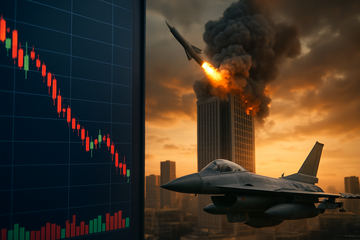
Missiles hit Riyadh and Tadawul fell 0.3% — that gap is where Boeing, Lockheed Martin, and RTX own the re-rate
Houthi ballistic missiles and drones struck the Saudi capital itself on September 19, 2026, hitting fuel storage at King Khalid International Airport — the first direct attack on Riyadh in the renewed Yemen war. Iran's military command responded the next day by warning that any new US attack would trigger 'sustained retaliation' against US bases and interests and that 'Washington's regional allies would be considered parties to the conflict', pulling Saudi Arabia and the wider Gulf into direct retaliation risk. Yet Saudi Tadawul's TASI closed September 20 down only 0.3% at 10,750, with Saudi Aramco reversing an intraday drop to close up 1.3% and Brent crude gaining 0.78% to $104.68 — meaning the political-risk premium is being absorbed by specific names rather than dumped across the index. That re-rates Boeing, Lockheed Martin, RTX, and Northrop Grumman into the cleanest single-name read on whether the standoff escalates, with Chevron and Exxon Mobil collecting the direct Brent beta, while Marriott sits on the wrong side as Gulf travel and conference demand risk a pause.
2026-09-19

An AI hallucination almost triggered a U.S. intercept of a Chinese ship — and the bill is now coming due for Palantir, Alphabet and every GenAI.mil vendor
A chatbot in a U.S. Special Operations Command Pacific intel workflow generated a wholly false cargo manifest on a Chinese vessel this spring, putting armed boarders on the tarmac before the report was caught. The near-miss lands on top of the February Iran school strike and a $1.3 billion Palantir Maven contract ceiling, and it forces a renegotiation of who carries the bill when an LLM hallucinates its way into a targeting chain — the model vendor or the operator. Investors should expect a new wave of \"AI assurance\" procurement to flow through the defense integrators and a fresh discount on frontier-lab multiples tied to sovereign-customer liability.

Palmer Luckey just turned the Taiwan arms freeze into a software‑prime problem
Anduril founder Palmer Luckey publicly tied the company's order book to the Trump administration's stalled $14 billion Taiwan package on Sept. 19, 2026 — the first time the firm has framed its revenue cadence around a single diplomatic hold‑up. With Lockheed Martin, RTX, Northrop Grumman and General Dynamics sitting on record backlogs from $105 billion to $289 billion, the disclosure splits US defense into two trades: software primes whose next dollar depends on new sales velocity, and weapons primes whose next dollar depends on production sequencing.

US network airlines are treating Air China’s extra China flights like a slot/equity threat, not a route add
Major US carriers (via Airlines for America) have publicly opposed Air China’s request to schedule additional Beijing-to–New York and Washington flights, arguing the move would worsen competitive asymmetry created by US limits on Russian overflight. The episode reframes the bilateral fight as an access-and-market-share contest that can pressure pricing power and route economics for Delta, United, and American even if Boeing/Airbus capacity is unchanged.
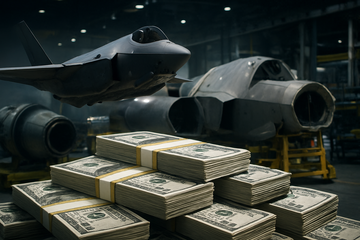
Saudi Arabia's $24.3B F-35 Bid Locks Up a Year's Worth of Lockheed's Jet Line — The Supply Chain Math Sends the Real Money to Four Subcontractors First
The State Department on September 17, 2026 approved the potential sale of 48 F-35A fighters and 49 Pratt & Whitney F135 engines to Saudi Arabia for up to $24.3 billion — a headline figure that mirrors the largest Pentagon production lot in program history. With Lockheed Martin's F-35 backlog already running roughly two years deep and H1 2026 deliveries nearly 50% below last year's pace, the bid forces a production-slot decision that flows directly through Northrop Grumman, RTX, BAE Systems and Honeywell before Lockheed Martin books a cent.
2026-09-18

FAA's $875M AI Win Hands ASI a 12-Year Federal Moat — and Pulls Forward a $50K–$150K Cockpit Retrofit on Every 737 and A320
The FAA awarded Air Space Intelligence a 12-year, $875M contract for the SMART and FMDS systems — the AI brain of the $32B+ BNATCS overhaul — locking in a federal software moat few listed companies can touch. The investable read-through flows through RTX's $438M radar award, L3Harris's aircraft-tracking contract, Boeing's $33B Global Services backlog, and a forced ADS-B In retrofit cycle hitting 737 and A320 operators at $50K–$150K per narrowbody.

FAA's 35-Aircraft 777F Waiver Is Boeing's Only Working Widebody Lever in 2026
The FAA's September 16, 2026 emissions exemption lets Boeing issue airworthiness certificates for 35 more 777F freighters between January 2028 and January 2031 — and that single regulatory action turns a regulatory carve-out into the only widebody delivery story Boeing controls this year, while its delayed 777-8F (now ~2029) sits on the ramp. The waiver protects an estimated $15B in US export value, hands GE Aerospace two extra years of GE90-115B engine flow, and gives FedEx, Atlas Air and other large-cargo operators a confirmed supply line into the next decade. It also sharpens the competitive threat from Airbus: Atlas Air's March 2026 order for 20 A350Fs signals where widebody-freighter buyers go when Boeing's next plane keeps slipping.
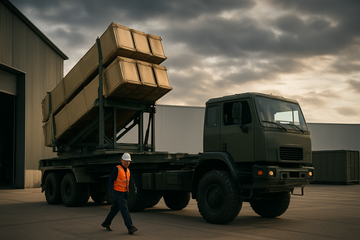
GM Built a Patriot Part in 22 Days — Auto Capacity Just Entered the Munitions Supply Chain for Good
GM Defense delivered its first PAC-3 MSE interceptor housings to Lockheed Martin on August 28 — twenty-two days after the contract was signed, instead of the several months a typical aerospace supplier needs. The shipment is the first concrete evidence that the Pentagon's industrial-base pivot is pulling civilian auto-OEM capacity into the $58.6 billion, seven-year Patriot framework, and it reframes General Motors's 2026 guidance of roughly $700 million in defense revenue and positive EBIT as the floor of a much longer-cycle structural margin story — not an EV-cycle hedge.
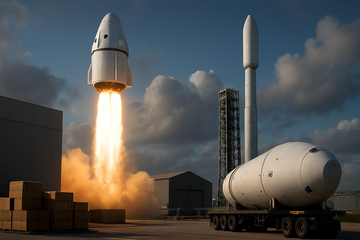
SpaceX locks in $5.92B of NASA crew work as Boeing's Starliner slides a decade late
NASA awarded SpaceX $946M on Sept 18, 2026, for three more ISS crew rotations, lifting its Commercial Crew contract to $5.92B and 17 flights — solidifying SpaceX as the government's de facto astronaut transport through 2030. Boeing loses ~$500M from a six-to-four-mission downgrade on Starliner, faces a potential 2027 certification slip, and now must recertify the spacecraft on a rocket other than the retiring Atlas V, with Lockheed Martin and L3Harris caught in the supply-chain ripple.
2026-09-17
2026-09-16

Korean Air's 103-aircraft Boeing bet is really an aftermarket-services call
The $36.2B list-price order reads like a delivery headline, but the durable investment signal sits inside GE Aerospace's services backlog and Boeing's delivery-conversion risk on the 777X and 737 MAX 10 — two programs that anchor Korean Air's 2026–2039 fleet plan. With Korean Air absorbing Asiana on Dec. 17, 2026 and Boeing's commercial backlog at a record $597B, the trade is whether production throughput can outrun certification delays to monetize the services tail.

Boeing's Turkish Airlines Salvage Is the First Real Commercial-Air Test of 2026 — And It Hinges on a CFM Engine-Servicing Deal, Not the Airframe
Reuters reported on Sept. 15, 2026 that Boeing is close to finalizing a delayed 150-aircraft 737 MAX commitment from Turkish Airlines — part of a 225-jet package announced in September 2025. The bottleneck is not demand: it is a CFM maintenance-economics fight over the LEAP-1B engine that pushed Turkish to threaten switching to Airbus. For Boeing, the deal would slot a $10–14B revenue line into a record $715B backlog just as 737 MAX production ramps from 38 to 47 per month. For GE Aerospace and Safran (50-50 partners in CFM), conceding 'Premier' MRO access to a fast-growing flag carrier sets a precedent every other MAX operator will watch.

Pentagon Confirmed Weapons in Orbit. The Real Trade Is the $185B Contract Pipeline and a Four-Supplier Bottleneck.
Air Force Secretary Troy Meink's Sept. 14 confirmation that the U.S. has deployed 'on-orbit space control weapons' landed five months after the Space Force awarded $3.2B in Golden Dome space-based interceptor contracts to a dozen primes and newcomers, plus roughly $6.45B in Starshield/SB-AMTI work to SpaceX. The investable story isn't the disclosure itself — it's a ~$185B program ramping into a defense industrial base where Lockheed Martin is guiding Space segment sales to $13.85B–$14.05B in 2026 on a 632% planned satellite-delivery increase, and where the entire qualified optical inter-satellite link supply chain runs through four companies.
Ukraine's Chip Disclosure Cuts the Other Way: US Memory Dominates Russian Missiles, but Korea's SMEC Just Got Named
Ukraine's Aug. 26, 2026 disclosure undercut the 'Asian chips in Russian missiles' narrative — US semiconductors outnumber Chinese ones, and Beijing's tech was called 'not relevant.' But a quieter Nov. 17, 2025 HUR release specifically named Samsung Machine Engineering Company, a S. Korean CNC maker feeding Russian missile plants, and the US already fined Applied Materials's Korean unit $252M for re-exporting fab gear to a sanctioned Chinese chipmaker. The real exposure for SK Hynix and Samsung Electronics is not memory chips inside warheads — it's the grey-market conveyor that runs through Hong Kong, Shenzhen, and 13 named Japanese suppliers into Russian weapon lines producing 11,000 strike drones a month.
2026-09-15

EchoStar trades for less than its SpaceX stake. Morgan Stanley says that gap is the trade.
Morgan Stanley initiated coverage of EchoStar on Sept. 14 with an Overweight rating and a $134 price target, framing the satellite carrier as the cleanest public-market vehicle for SpaceX exposure at a discount. With roughly 262 million SpaceX shares flowing to EchoStar from 2025's spectrum transactions — worth more than the company's entire $27.3 billion market cap at recent prices — analyst Sean Diffley argues the market is pricing the proxy at less than the value of the underlying it's meant to track. The thesis rides on a 0.66 daily-return correlation with SPCX since the June IPO, set against two Chapter 11 filings, a 118,000-subscriber wireless loss in Q2, and a $2.4 billion FCC escrow hanging over the balance sheet.

The Pentagon just confirmed weapons in orbit — and the contracts were already larger than the announcement
Air Force Secretary Troy Meink acknowledged on Sept. 14, 2026 that the U.S. Space Force has deployed \"on-orbit space control weapons,\" the first public Pentagon confirmation of operational weapons in space. The doctrinal shift was already priced in: Space Force's FY2027 budget more than doubles to $71B, Golden Dome adds $17.9B, and a wave of space-weapon and Golden Dome prime contracts has flowed to L3Harris, Lockheed Martin, Northrop Grumman, and RTX over the past twelve months. Investors who treat space as a communications market now need to reprice it as a weapons domain — and the procurement pipeline tells them which primes capture the upside.
2026-09-14

The CLARITY Act's 60-Vote Cliff Hits Tuesday. Coinbase and Circle Are Already Past It.
Polymarket prices the Digital Asset Market Clarity Act (H.R. 3633) at 29% to clear the Senate in 2026, and the math — 53 Republicans, two probable GOP defections, and only two Democrats offering conditional support — explains why. The real investment story is structural: Coinbase's $292M Q2 stablecoin revenue and Section 404's preserved activity-based rewards survive either outcome, and Circle's Arc network launches Sept. 16 with BlackRock, Visa, and Mastercard as validators — so the binary vote risk masks a more nuanced trade for COIN and CRCL, with the banks standing as the underappreciated winners either way.
Pentagon Backlogs Are Pricing Defense SPACs Now — Six Mergers, $6.3B of Pipeline, and a Capacity Story That Dwarms Conviction
Six defense and space SPAC mergers announced in 2026 — led by Ursa Major's $2.3B tie-up with Bleichroeder Acquisition Corp III, Quantum Space's $1.2B deal with Inflection Point Acquisition Corp VI, and Space-Eyes's $638M counter-drone play with McKinley Acquisition Corp — are running alongside record Pentagon backlogs at Lockheed Martin ($230B), RTX ($289B), and Northrop Grumman ($105B), plus an FY27 budget request of $1.5T. The capital-markets read is that defense founders are choosing the SPAC lane for capacity certainty — PIPE pre-committed, time-certain close — while the parallel IPO lane is fragmenting: Lyntris priced below range and fell 14% day one, and Starfighters Space trades down 83% year-to-date.

Apple's App-Store Power Survived Unscathed — Musk Dropped the Antitrust Suit on the Same Day iOS 27 Killed the Theory Behind It
X Corp and SpaceXAI quietly filed to dismiss their August 2025 antitrust lawsuit against Apple in a Texas federal court on September 14, 2026 — the very day Apple shipped iOS 27 with a Gemini-powered Siri and a third-party AI Extensions framework that, by design, demotes ChatGPT to one of several options. The dismissal leaves Apple's curation defense and App-Store economics intact, pushes the chatbot-monopoly theory onto OpenAI alone, and gives Alphabet a cleaner runway on both the Gemini integration and the parallel Google-Search antitrust overhang. For investors, the read-through is that platform-gatekeeper risk is now bounded by regulation, not private suits — Apple gained clarity on its most valuable asset while paying nothing in precedent.
What to expect
Evidence-first notes with a visible point of view.
This section collects sharp takes on earnings, shareholder meetings, and market structure. Each new piece should make the thesis, the facts, and the implications obvious within the first few screens.
Expect direct analysis, not generic commentary.
Expect the data to be explicit and the argument to be easy to follow.