Aerospace, Defense & Space
Defense budgets and the contractors behind them
Procurement rounds, backlogs, launch cadence and rearmament programmes, read as multi-year revenue with the primes and suppliers named.
2026-10-30


2026-10-29

2026-10-28

Indian Retail Can Now Buy Nvidia and SpaceX — but a ₹10 Lakh Tax Threshold, Not the $250,000 Cap, Sets the Ticket Size
Groww, Zerodha, Angel One and Upstox have turned US equities into a domestic app feature, and Indian households answered fast: outward remittances for equity and debt investment jumped 111% year over year to more than $321 million in August 2026. Annualised, the whole channel is worth about $3.9 billion — roughly $4 million of brokerage, 1.3% of Nvidia's trailing revenue, and what one percent of India's 46 million active broking clients would produce — so it cannot price a mega-cap, but it changes who holds one. The binding constraint is not the $250,000 remittance ceiling but the 20% tax collected at source above ₹10 lakh and the $60,000 US estate-tax exemption, which together cap the average Indian retail position. The investable consequence is narrow: own the names where that flow meets improving operating leverage, and treat the December 8, 2026 SpaceX lock-up expiry as a dated supply event.

AUKUS Becomes an Order Book: Munitions Lines and Rare-Earth Capacity Are the Real Payload of the 'Swiftly Execute' Pledge
On 27 October 2026, on the margins of the ASEAN Defence Ministers' Meeting in Cebu, Pete Hegseth and Richard Marles agreed to 'swiftly execute' force-posture collaboration: investment at Australian air force bases, combined logistics capacity, and co-production of critical munitions under Australia's Guided Weapons and Explosive Ordnance Enterprise. That is a production decision, not another declaration — it hands Lockheed Martin and RTX a second industrial node outside the United States at the moment the FY2027 request asks for about $70.5 billion of munitions, nearly three times FY2026, into an industry whose binding limits are solid rocket motors and seekers. The submarine leg is already cash: Australia's $3 billion into the US Submarine Industrial Base is funding supplier expansions including a $60 million propulsor line at Pascagoula. The rare-earth leg is the quiet one — no minerals language appears in the readout, yet a separate minerals framework and more than A$5 billion of joint project support are underwriting a non-Chinese processing chain that will not reach earnings before 2028.
2026-10-27

Anthropic Lost on Its Safety Policy. Alibaba Won on Lobbying. The Pentagon's AI Rule Now Sorts Vendors, Not Risks
Two federal rulings a month apart reset how the Pentagon buys software. The D.C. Circuit upheld Anthropic's supply-chain-risk designation on September 25, holding that a model which refuses a lawful military task is itself a national-security hazard; on October 26, Judge Eumi K. Lee in San Francisco blocked the government from denying Pentagon contracts to firms that work with lobbyists for Alibaba, without touching the designation itself. Read together they show that US military AI procurement has split into two tracks testing two unrelated things: whether a model will refuse, and whether a company is Chinese. The investable consequence is a re-routing of government AI demand toward auditable open-weight models — Qwen has passed 3 billion downloads in six months and Chinese models now take 41.4% of Hugging Face generative downloads — while the money keeps leaking out of Alibaba's own accounts as CNY 155.5 billion of annual capital spending drives free cash flow to negative CNY 77.5 billion.

Boeing's Certificate Is Done. Consensus Still Needs $2.8 Billion in One Quarter
Boeing reports third-quarter results before the open on Oct 27, and the certification question that dominated the last two years was already settled on Oct 20, when the FAA issued the 737 MAX-10's amended type certificate. So the print is a cash-conversion test, not a paperwork test: consensus free cash flow of $330.5 million nets a roughly $700 million Justice Department payment, and the $2.3 billion full-year consensus implies about $2.8 billion in the fourth quarter alone. The live questions are whether deliveries convert, whether a rising cost base eats the ramp, and who gets paid when the certified fleet starts flying.

Export Credit Is Just 2% of Aircraft Financing — and Now It Holds the US-EU Trade Truce
USTR Jamieson Greer told the EU on October 26 that Washington's inability to see the terms of the European Investment Bank's €3 billion loan to Airbus threatens the 2021 large civil aircraft truce, moving the aerospace dispute from tariffs to the financing terms of a sovereign loan. The lever came from Boeing, which asked USTR in July for a full accounting of the facility, and the 2021 framework obliges both sides to fund their aircraft champion on market terms through an open and transparent process. Export credit is a tiny share of the money but a concentrated one — 2% of Boeing's first-half 2026 delivery financing, and 23% of the financing behind Boeing's 29 deliveries into Europe and Central Asia — and the 2025 US-EU deal already removed aircraft from the tariff schedule, leaving finance and transparency as Washington's remaining aerospace leverage. The asymmetry is stark: the complainant runs a -5.4% trailing operating margin and $38.7 billion of net debt, while the respondent holds €8.4 billion of net cash and a +8.1% margin, so a broken truce hurts both and hands the next order to whoever finances it best.
2026-10-26

Private Defense Tech Is Marked at 24–32x Sales; Its First Public Print Cleared at 4x
Private defense-tech marks — Helsing at $18 billion, Shield AI at $12.7 billion, Anduril at $61 billion — now price contract revenue at roughly 24 to 32 times sales, a multiple no listed defense company commands. The one clean public test of that model, the Lyntris IPO in August 2026, priced below its marketed range at $17.50 and trades at $10.28, roughly four times trailing sales. The primes are not where the risk sits: Lockheed Martin closed the third quarter with $292.0 billion of backlog, Northrop Grumman with $109.6 billion and RTX with $340 billion, and all three trade between 1.9 and 3.0 times sales. The warning points at the private marks, and it reaches listed investors through the drone and space proxies and the propulsion suppliers that sized capacity to private order books, not through prime backlog.

Intel's $3.5 Billion Pentagon Anchor Became 433 Million Shares — and Still Zero Named Production Orders
The Pentagon's headline chip award for Intel never contained a wafer order. What the Defense Department actually awarded on Sept. 16, 2024 was up to $3.0 billion in CHIPS Act funding for a trusted-manufacturing program, and $3.17 billion of that money was converted into 433.3 million Intel shares at $20.47 when Washington took a 9.9% stake in August 2025. When the RAMP-C prototyping program closed on July 28, 2026, Intel named no customer, product or wafer volume. Federal support for the foundry has arrived as prototypes and equity instead of orders, while Intel Foundry grew revenue 31% to $5.77 billion in Q2 2026 while losing $2.09 billion at the operating line — which makes the Oct. 29, 2026 results the first real test of whether external 18A volume is ever disclosed.
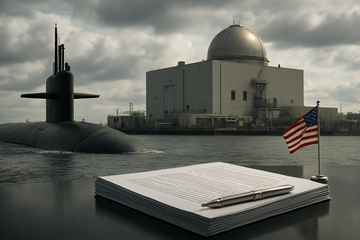
The Navy Just Added $2.41B for Its Reactor “Test-to-Fleet” Pipeline—And AI Cant Buy In
A $2.409B Navy modification sent to Fluor Marine Propulsion expands the Naval Nuclear Laboratory’s naval-reactor work—training and readiness for the submarine and carrier fleet, not data centers. That split matters for investors: the next wave of nuclear demand driven by AI power looks fundamentally non-fungible with the margin structure and contracting leverage of naval propulsion.
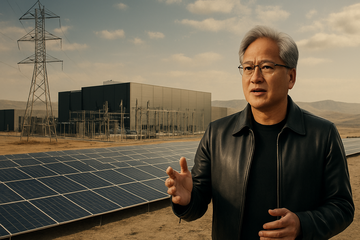
The $450M Pentagon Tungsten Bet Solves the Wrong Problem: China's 85% Refining Grip Still Prices the Metal Inside AI Memory
Washington's $450 million commitment to The Elmet Group buys conversion capacity and a Defense stockpile option — not ore. The United States has not mined tungsten commercially since 2015, China controls roughly 85% of global APT refining capacity, and the first new North American APT plant is dated to restart in the second half of 2028. Meanwhile the metal has already been paid out to the miners: Almonty Industries swung to C$17.6 million of adjusted EBITDA in a quarter while Elmet's margin gain came from holding inventory rather than owning supply. For AI hardware the binding constraint is not price but qualification — standing up an alternative WF6 supplier takes 18 to 24 months — so the chokepoint to watch is a Chinese refinery, not a plant in Maine.
2026-10-25

$31 Million Demanded, $390 Million of Idle Time: Boeing's 777F Standoff Shows Who Really Holds Widebody Leverage
Boeing's 777 freighter line has been dark for nearly two months because a sole-source wing-part supplier stopped shipping trailing-edge rib kits during a price fight. Boeing put the cost of that stoppage at up to $6.5 million a day in its own August court complaint, while a related Delaware filing puts the supplier's demand at roughly $31 million above contract pricing — a gap that says far more about qualification lock-in than about scale. The episode is a cash and timing event, not a demand event: Boeing still books a $715 billion backlog, and GE Aerospace, whose engines cannot be re-sourced, holds more durable leverage in the same chain. Investors should read the episode as a working-capital and execution problem whose only structural fix is bringing the part in-house.

Booz Allen's Civil Revenue Fell 15% While Its Peers Grew: Federal IT Dollars Are Being Re-Scoped, Not 'AI-ified'
Booz Allen's September-quarter revenue fell 3.9% to $2.78 billion, but the headline overstates the damage and the civil line understates it: pass-through billable expenses fell 10.6%, so the fee pool was down only 0.8%, while Civil and Commercial revenue fell 15% as recompetes transitioned to smaller follow-on contracts. Over the same reporting window CACI grew 8.2% and SAIC's civilian revenue grew 9.1%, so a civilian IT budget that fell from $75.1 billion to $67.9 billion is a re-scoping, not a uniform contraction. The AI dollars that are actually growing are buying platforms and defense capacity — 83% of federal AI obligations went to Defense and Palantir grew US government revenue 90% — not civilian advisory hours, which leaves Booz Allen a defense contractor with a shrinking civil option and a second half that must accelerate to stay in guidance.

The AI power trade has its first hard denominator: 412.6 terawatt-hours a month, and 9–17% by 2030 is now an arithmetic test
The EIA's August electricity data, published October 23, 2026, is the first official measurement of a US power market that is no longer flat: retail sales reached 412,568 GWh in August, up 4.6% year on year, with commercial sales — the customer class that holds data centers — up 5.1% while industrial sales fell 1.5%. That turns EPRI's contested 9% to 17% data-center share by 2030 into arithmetic: at the low end it fits inside the EIA's own load forecast, at the high end it needs a 2030 US electricity market roughly 11% larger than any published federal baseline. The supply chain has already booked that demand — GE Vernova took $24.2B of orders in a single quarter and lifted backlog to $176B — yet the complex has de-rated 19% to 49% from its 12-month highs. The investable question is no longer whether AI needs power; it is who is paid when the denominator is re-priced.

The Navy's first full-rate jammer line is $184 million — 0.9% of a single $20.7 billion missile award
The $184 million award for full-rate production of Next Generation Electronics Attack Units, announced Oct 21, 2026, is the Navy funding electronic attack as a production line rather than a development program — but it is a rounding error next to the $20.7 billion AMRAAM increment booked in the same month. Priced against General Dynamics's $54.9 billion of trailing revenue and $136.5 billion backlog, the new line is worth about $31 million a year, so the tradeable read-through sits with the electronic-warfare franchise holders: L3Harris, whose Next Generation Jammer Low Band program has now absorbed roughly $1.46 billion of Navy money, and Northrop Grumman, whose SEWIP Block 3 line is on contract for up to 24 shipborne systems. What changed fastest is not dollars but contract structure, and that moves the binding constraint on jammers from physics to manufacturing throughput and skilled RF labor.
2026-10-24

Dow -652 points, Nasdaq -0.2%: Apollo Global Management's zero-payoff call exposes AI as a funding line, not a productivity story
Apollo Global Management's chief economist says AI has delivered zero financial payoff to corporate America outside technology, and on the same tape the Dow lost 652 points while the Nasdaq lost 0.2% — because oil at $103.27 and a 4.99% 10-year yield squeeze the half of the market with no AI offset. The fault line is no longer AI versus non-AI; it is who can finance a buildout heading past $1 trillion a year against a customer base that shows no measurable return. Credit has already repriced the AI complex — CoreWeave's five-year default swap at 1,145 basis points, Meta Platforms's at a record 114.79 — while equity has not, and mainland China has priced the same dispersion inside its own AI stocks.

Getty Filed Chapter 11 on Wednesday, Nvidia Backed Creative AI on Friday: Higgsfield's $1 Billion Run-Rate Is an Inference Order Book, Not Revenue
NVIDIA did not buy a creative app on Oct. 23, 2026 — it bought the demand side of its own order book. Higgsfield's claimed $1 billion annualized revenue is a four-week exit rate, not twelve months of sales, and the more useful number sits underneath it: 150 million generations and 12 trillion tokens a month, rendered on Nvidia hardware that Higgsfield now plans to extend onto Vera Rubin. That is a standing inference order, and it arrives exactly as memory shortages compress Nvidia's own margin. Two days earlier, Getty Images filed for Chapter 11, wiping out the equity of the company that owned visual content — while the company that generates it was marked at 5.4 times exit run rate by a buyer with a reason to overpay.
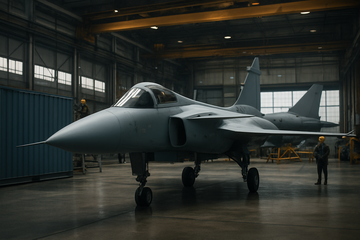
Saab's Gripen-for-Ukraine order triples its quarter’s booking pace—and it re-routes European fighter margin to non‑US primes
Saab reported that third-quarter order bookings reached SEK 65.825B, including a SEK 24.6B contract to supply 16 Gripen E aircraft for Ukraine. The result is not just a bigger order book: it’s a channel-shift signal that European primes can capture fighter demand that otherwise flows through US “prime + FMS” pipelines.

Ukraine's Starlink Speed Cap Produced a Signature, Not a Contract — and the Sovereign Communications Spend Lands on Satellites, Ground Segment and Terminals
Ukraine's Ministry of Defence signed a letter of intent with ICEYE and Nokia on October 22, 2026 to explore a sovereign satellite communications capability, with a first Ukrainian satellite targeted for 2028 — but the document implies no ordering, discloses no price and commits no financing, making it a category-defining signal rather than a revenue event. The trigger was SpaceX's 160 km/h cap on military-grade Starlink in force since October 13 and still binding on October 23, an instruction Reuters traced to inside the White House, while Reuters reported the same day that no viable short-term alternative to Starlink exists for Ukraine. What changes is the addressable order book: governments that cannot tolerate a political kill switch now buy satellites, ground segment and terminals outright, and that money flows to the equipment and platform layer — Nokia's secure networking and terminals, ICEYE's spacecraft, IHI's industrial base — rather than to consumer capacity resellers. The honest conclusion is that this is a 2027–2029 buildout option for platform and ground-system vendors, and a non-event for anyone modelling Ukraine's connectivity bill in 2026.
2026-10-23

What to expect
Evidence-first notes with a visible point of view.
This section collects sharp takes on earnings, shareholder meetings, and market structure. Each new piece should make the thesis, the facts, and the implications obvious within the first few screens.
Expect direct analysis, not generic commentary.
Expect the data to be explicit and the argument to be easy to follow.