Aerospace, Defense & Space
Defense budgets and the contractors behind them
Procurement rounds, backlogs, launch cadence and rearmament programmes, read as multi-year revenue with the primes and suppliers named.
2026-09-13


Anthropic's $2T Nasdaq Pick Was About the 15-Day Index Rule, Not the Exchange
Anthropic filed its S-1 on June 1, 2026 and on September 13 chose Nasdaq over NYSE for an October listing targeting ~$2T, with Morgan Stanley and Goldman Sachs as lead underwriters. The decisive mechanism is Nasdaq's May 1, 2026 rule change that lets a newly public name enter the Nasdaq-100 after 15 trading days — versus the S&P 500's 12-month seasoning — turning a $2T float into immediate passive demand inside the $482B Invesco QQQ Trust and the broader Nasdaq-100 tracking complex. The trade cascades through Nasdaq Inc's listings franchise, the strategic backers — Amazon (~21%) and Alphabet (~15%) — and the AI compute chain led by NVIDIA.

Buffett's $37B 'mistake' is now a $100B castings monopoly — and the supply-chain read explains why
Berkshire Hathaway's Precision Castparts, written down by ~$11B in 2020, is now worth close to $100B per Barron's, rerated not because of cyclical aerospace recovery alone but because competitors are paying 26x EBITDA for the same bottleneck. GE Aerospace's $11.75B bet on Consolidated Precision Products on September 8 — which wiped 10.7% off Howmet Aerospace — put a market price on the castings shortage. The supply-chain read for investors is that Boeing, GE Aerospace and Berkshire now sit on the only physical infrastructure that can clear a 12-year, record 16,683-aircraft backlog, and the next squeeze is titanium, where China controls 75%+ of metal output.

Saudi Shut Its Hormuz Bypass After Iraq-Launched Drones — The $104 Brent Tape Is Missing the Real Risk Channel
Saudi Arabia closed its 5 million-barrel-per-day East-West pipeline on Sept. 11 after drones launched from Iraq struck pumping stations near Medina and Riyadh — the same corridor that has carried 64% of Saudi crude exports since the Strait of Hormuz shut during the Iran war. Brent settled Friday at $104.61, down 2.8%, with traders pointing to 10 million bpd still transiting Hormuz and ship-to-ship transfers off Fujairah. That frame is wrong: Iraq-launched drones penetrating Saudi airspace hit internal infrastructure no Red Sea reroute can replace, and any incremental Hormuz risk now has no domestic fallback. Valero Energy, Marathon Petroleum, Phillips 66 and PBF Energy carry the cleanest heavy-sour margin upside, while Frontline, International Seaways and DHT Holdings ride the war-risk premium.
2026-09-12

2026-09-11

Nasdaq's $100M Bet on Kraken's Parent Just Reshuffled Who Owns the Tokenized-Stock Stack
Nasdaq Ventures invested $100M in Payward at a $21B valuation on Sept 10, 2026 — the first time a US-listed exchange operator has taken an equity stake in a private crypto venue of this size, and a structural endorsement of Coinbase, Robinhood and the wider tokenized-equities race. The deal gives Nasdaq crypto-native distribution for its Q2 2027 Nasdaq Equity Tokens launch while handing Payward a regulator-friendly lane to a 2027 IPO; the competitive question is no longer whether tokenized equities win, but which rails — Nasdaq-Kraken, Coinbase-Base, or Robinhood Chain — capture the volume.

The Pentagon Just Underwrote Fluidstack — And CoreWeave's $35.6B Debt Stack Suddenly Looks Optional
The Pentagon's Office of Strategic Capital is in talks to lend roughly $5 billion to Fluidstack — more than six times the program's largest prior commitment — turning a private UK neocloud into a sovereign-backed competitor and reframing CoreWeave, Nebius and peers as the higher-cost option for the next leg of U.S. AI infrastructure. The mechanism matters: this is not commercial credit. Federal dollars below Treasury rates, paired with Google's existing $1.3B lease backstop, reset the funding curve for the entire neocloud sector — and push TeraWulf, NVIDIA and Texas power plays like Vistra into the most leveraged positions on the supply chain.
2026-09-10

2026-09-09
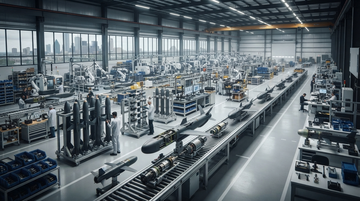
Covenant Just Priced a Cruise Missile at Mid-Six Figures — RTX's $22.9B Tomahawk Deal Is Now the Cushion, Not the Answer
A two-year-old stealth startup backed by Andreessen Horowitz and Peter Thiel's Founders Fund broke cover on Sep 9, 2026 with a 105,000-square-foot Dallas factory — and a target price that puts a 200+ kg cruise missile in the mid-six-figure range, a fraction of the $1.5–3.6M RTX charges for Tomahawk. With12,000 missiles a year of combined capacity planned across Dallas, Saxony and northern Israel, plus two announced DoD contracts, Covenant is less a one-off than the moment the 'American Dynamism' cohort — Anduril, Castelion, Hadrian, Neros, Mach, Quantum — finally has a cruise-missile beachhead. RTX's $289B backlog absorbs the disruption for years; the question is what fills the next $100B and on what economics.

GE Aerospace turns a castings bottleneck into margin: the $11.75B CPP deal targets durable supply, not just faster deliveries
GE Aerospace agreed to buy Consolidated Precision Products (CPP) for $11.75B, explicitly to expand “mission-critical” castings capacity that constrains engine output. The market will focus on whether in-house castings convert temporary shortages into sustained pricing power and higher adjusted cash flow—especially if the $200M expected net synergies translate into steadier throughput through the 2027 closing window.

GE Aerospace’s $11.75B castings move reframes delivery risk as a margin lever—because it attacks the bottleneck, not the symptoms
GE Aerospace agreed to buy Consolidated Precision Products (CPP) for $11.75B to expand mission-critical castings capacity and support a stated >30% airfoil demand outlook. The deal’s $200M net synergies target and “yield/productivity” capacity levers suggest the company is pricing delivery reliability as an income-stream, not a one-off cost. For the broader US aerospace supply chain, the signal is clear: constraint-heavy components are becoming vertical-integration targets, and OEM delivery-risk assumptions are likely to be repriced in contract negotiations.
2026-09-08
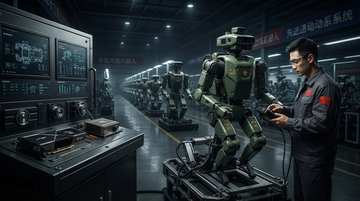
China Owns 95% of Humanoids and the PLA Is Now Buying — The Pentagon's 1260H List Is the Tell
Reuters' September 7 review confirmed the PLA has moved from humanoid research to active procurement — a humanoid tender in May 2025, a National University of Defense Technology \"embodied perception and dexterous operation\" tender four months later, and a roughly $300,000 data-labelling system funded in June 2026. China already builds about 95% of the world's humanoids (BofA Global Research), Norinco's Fuxi teleoperated robot is moving from demo to doctrine, and the Pentagon added Unitree Robotics to its Section 1260H list in June. The read-through runs in two directions: Chinese suppliers (Unitree, Inner Mongolia First Machinery, UBTech, Shenzhen Inovance, Estun Automation) collect a defence-anchored valuation premium, while US-allied component makers (Harmonic Drive Systems, Renesas, NVIDIA) and US peers (Tesla, Hyundai Motor) face a buyer that has already started the procurement clock.
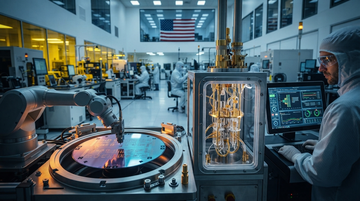
PsiQuantum's $100M CHIPS Award Just Made Photonic Quantum a US Defense Schedule — GlobalFoundries, Lumentum, Coherent Are the Real Trade
Commerce finalized $100M for PsiQuantum on Sept 8 — the same morning it finalized $100M each for Quantinuum, D-Wave and Rigetti, $375M for GlobalFoundries, and $1B for IBM's Anderon foundry. Photonic quantum now has a domestic manufacturing schedule, not a research grant. The listed names that already build its BTO optical switches, 300mm silicon photonic wafers, single-photon detectors, and cryogenic stack — GlobalFoundries, Lumentum, Coherent, Marvell, Applied Materials — become the investable read on a market that didn't exist as a factory line a year ago.
2026-09-07
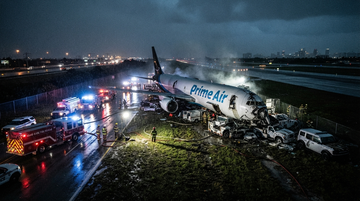
A Miami 767 Crash Just Put the E-Commerce Air Stack in Regulatory Crosshairs — Amazon, FedEx, UPS, and Boeing All Re-Price
Five died when a 32-year-old Amazon-branded 767-300F skidded off Miami's Runway 30 in 26-knot thunderstorm gusts on September 6, 2026. With Amazon Air already operating ~101 aircraft at a 26.5-year average fleet age — equivalent to 14.6% of FedEx capacity and 20% of UPS capacity — and 767 freighter production ending in 2027, the hull loss re-primes aviation insurance, reopens the case for fleet-wide 767 scrutiny ten months after the UPS MD-11 Louisville grounding, and accelerates Amazon's pivot toward drones that already run at one-thirtieth the per-mile cost of ground delivery.

Trump's Bombardier ultimatum is back — and only one US business-jet maker is fully battle-ready
On Sept 7, 2026, President Trump revived his \"build in the US or get out\" demand on Bombardier via Truth Social, but the Section 232 tariff lever was already closed by the White House on July 9, and Canada fires back with up to 50% counter-tariffs on Sept 8. With Bombardier's $21.8B backlog and ~2,700 in-service US jets in play, General Dynamics's Gulfstream is the cleanest winner — and the four-engine-OEM stack around Bombardier (GE Aerospace, Rolls-Royce, RTX and Honeywell) collects the aftermarket either way the ultimatum lands.
2026-09-06
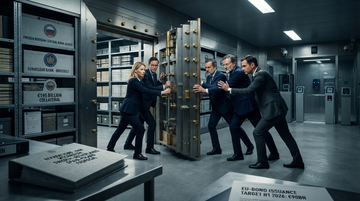
$200bn of Frozen Russian Assets Just Re-Entered the Debate — Belgium Says 'Door Is Closed', Four EU States Just Pushed It Back Open
Sweden, the Netherlands, Spain and Poland are pressing the European Commission to revive a €210bn 'reparations loan' backed by immobilised Russian central bank reserves held at Euroclear in Belgium, after the €90bn Ukraine-support loan was finalized in April without touching those assets. The mechanics turn ~€195bn of sanctioned Russian securities into collateral behind EU-Bond issuance — a 'debt-backed demand floor' that funds Ukraine while repricing credit risk for the European banks and defense primes that sit in the transmission chain. Rheinmetall, Saab and BAE Systems are already converting the demand into backlog; Lockheed Martin, Northrop Grumman and Hensoldt extend the chain into air-defense interceptors and radars; BNP Paribas and ING carry the counterparty and primary-dealer exposure that decides who earns and who absorbs the legal tail.

Seattle Times and Newsday Just Made OpenAI's IPO a Copyright Minefield
A second wave of regional newspaper plaintiffs hit OpenAI and Microsoft in the Southern District of New York on September 4, 2026 — the same week the DOJ sided with OpenAI in the New York Times case and less than three months after OpenAI confidentially filed its S-1. The 38-page complaint from the Seattle Times Co. and Newsday is the third major newspaper suit against the same defendants in 2026, and it is the first to weaponize a 47% YoY collapse in search-referral traffic as a damages anchor. For investors, the filing reframes AI copyright from a binary fair-use question into a publisher-by-publisher licensing arms race — and puts News Corp's $250M OpenAI deal, Lee Enterprises's lack of one, and Cloudflare's paywall enforcement on opposite sides of the trade.
2026-09-05

Howmet survives SpaceX: Bernstein's $328 bet on the 80% blade duopoly Musk is choosing to escape, not break
Bernstein's Douglas Harned called the Howmet Aerospace selloff after SpaceX's Aug29, 2026 turbine-foundry announcement a buying opportunity, kept an Outperform rating and lifted his price target to $328. The thesis: SpaceX is building an internal foundry in Bastrop, Texas to vertical-integrate a bottleneck for its own 20 GW AI-power build, not to compete for third-party IGT blade orders that Howmet Aerospace and Precision Castparts already split roughly 80/20. With Q2 2026 IGT revenue up 38%, customer agreements through 2030, and capacity being added, the dip looked like a mispricing of a duopoly rather than the start of a new competitive era.
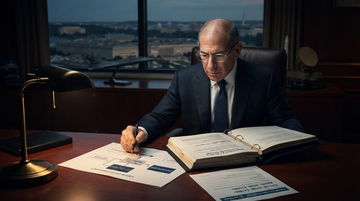
Lutnick Now Approves His Old Bank's Biggest Client's Pentagon Work — A Cantor–Cerberus Audit Trail Opens
Commerce Secretary Howard Lutnick — who disclosed at least $250M of 2025 income from Cantor Fitzgerald on Sep 5 — has been picked by the Department of Defense to vet every Pentagon contract touching Cerberus Capital Management, the firm co-founded by Deputy Defense Secretary Stephen Feinberg. The arrangement forces Lutnick to police roughly $10B of newly awarded pilot-training and hypersonic work and a $185B Golden Dome pipeline where four Cerberus-linked firms already sit on the contractor list, while Cantor continues to prime-broker Cerberus funds under his sons. For listed defense names, the read-through is supply-chain, not contract-by-contract: primes whose subs touch Cerberus entities are the ones whose multiples move first.
2026-09-04

2026-09-03

What to expect
Evidence-first notes with a visible point of view.
This section collects sharp takes on earnings, shareholder meetings, and market structure. Each new piece should make the thesis, the facts, and the implications obvious within the first few screens.
Expect direct analysis, not generic commentary.
Expect the data to be explicit and the argument to be easy to follow.