Aerospace, Defense & Space
Defense budgets and the contractors behind them
Procurement rounds, backlogs, launch cadence and rearmament programmes, read as multi-year revenue with the primes and suppliers named.
2026-08-25

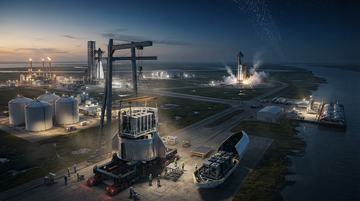
SpaceX’s $100B “Starbase, Louisiana” reframes AI from power-and-chips to launch-and-orbit capacity
SpaceX’s planned $100B Starbase, Louisiana spaceport targets propellant production, vehicle processing, and an expanded launch cadence—then it explicitly pulls forward the timeline for orbital AI data-center deployments to late 2027. The market implication is simple: when orbital compute moves from prototype flights to scaled constellations, launch slots become a gating input that can reprice the space/value chain.

President buys SpaceX shares post‑IPO—why that timing matters more than the stake size
Two weeks after SpaceX’s record IPO, President Donald Trump purchased shares disclosed in his financial filings, turning a liquidity event into an immediate governance optics test. For defense-contract investors, the key issue isn’t whether rules were followed—it’s whether the IPO’s tightly controlled voting structure plus mega-IPO float dynamics will intensify scrutiny over disclosure, Pentagon-facing contracting perceptions, and how markets discount “controlled-company” governance.

Ukraine’s drone campaign targets Ozon’s logistics hubs—turning Russia’s consumer e-commerce into a sanctions-adjacent battlefield
Ukraine broadened its strike campaign to four Ozon logistics hubs, forcing temporary operational halts and hitting the company’s near-term execution risk. For investors with Russian consumer exposure, the signal is bigger than one retailer: disrupting last-mile logistics and fulfillment capacity can turn “consumer resilience” into an economic-pressure channel—especially for e-commerce platforms that concentrate warehousing and inventory flow.
2026-08-24

2026-08-23

2026-08-22

2026-08-21

Citadel’s post-deal unwind challenges the “AI-correction” recovery story for Situational Awareness
After Ken Griffin’s Citadel bought most of [Situational Awareness]’s public equity book in late July 2026, later reporting indicates Citadel has now exited most of the risk it took on—turning the original “buyer of last resort” into a “seller of last resort.” The bigger investor implication: even when the AI drawdown is funding-stable via a rescue buyer, secondary pricing and time-to-liquidate can still reset valuations for the next leg of the AI-correction recovery narrative.
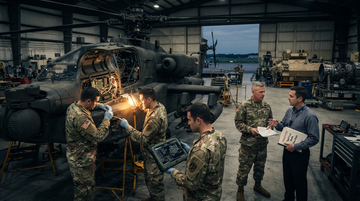
Inside the Pentagon’s “Right to Repair” fight: the policy push targets the defense primes’ sustainment IP profit pool
The Pentagon is pushing contracts to grant the military access to “necessary tools, software, and technical data” so it can repair and sustain weapons without being blocked by intellectual-property limits. Industry pushback is effectively a push to protect the high-margin sustainment economics that come from restricted access to technical data packages—an issue that matters for aftermarket revenue assumptions across RTX, LMT, NOC, GD, and HII.
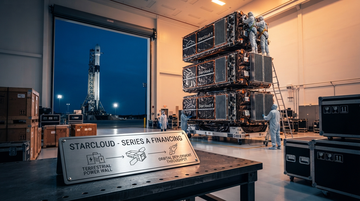
Starcloud’s $170M orbital data-center raise reframes the AI “power wall” as a launch-supply problem
Starcloud’s $170M Series A to build data centers in low Earth orbit leans on a simple thesis: the bottleneck is getting power and heat out—not buying more GPUs. The funding also spotlights a second constraint: as AI shifts to space-based capacity, near-term deployment speed hinges on launch availability and satellite production throughput.
2026-08-19
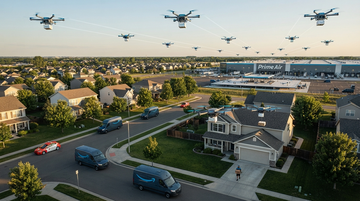
Amazon’s nearly-500-locale drone scale test forces a real question: does air delivery finally beat ground on unit cost—or just on speed?
Amazon Prime Air is expanding drone delivery to nearly 500 U.S. cities and towns by end-2026, using FAA Part 135 regulatory authority and charging $2.99–$4.99 per drone drop. The investment thesis is not “will it fly?” but whether scaled air drops can bend the cost curve enough to undercut ground last-mile and—separately—whether FAA-certified drone operations can compete with DoorDash’s Part 135 advantage in regulated local delivery.

Lyntris’ downsized IPO isn’t a pricing story—it’s a backlog-to-execution test defense investors are failing faster
Lyntris LYNX priced its U.S. IPO at $17.50 and raised about $297.5 million, after targeting a much larger deal at $19–$22. The move spotlights a tightening “proof over narrative” filter in defense capital formation: investors are discounting situations where big backlog and upbeat contracts don’t translate cleanly into realized revenue and margin.
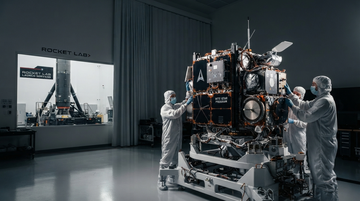
Rocket Lab’s $981M Space Force “vehicle onboarding” is a backlog lever—because its accounting turns eligible bids into contract liabilities, not just headline awards
Rocket Lab RKLB was onboarded to the U.S. Space Force’s $981M NITE-STAR IDIQ contract vehicle on Aug. 18, which makes it eligible for task orders up to the program’s ceiling. Unlike a direct award-to-revenue event, onboarding changes the odds that future work enters backlog/contract liabilities—and Rocket Lab’s current segment economics show why winning more “Space Systems” work matters for margin mix while Launch remains more execution-sensitive.
2026-08-18
2026-08-17

Geospatial Analytics Just Became the New “Recurring Receipts” Layer—Defense-Grade AI-Ready Satellite Feeds Shift the Margin Map
A newly disclosed, eight-figure defense intelligence “AI-ready” subscription underscores a shift: Earth-observation value is moving from raw imagery to analytics-ready data products. The result is a toll-booth dynamic—who owns calibration/consistency and who owns the downstream intelligence workflow determines whether satellite economics get upgraded or commoditized.

L3Harris’ CEO ouster turns governance into a throughput risk test as defense primes hit the ramp’s output ceiling
L3Harris LHX abruptly replaced CEO Christopher Kubasik with insider Sam Mehta after a board investigation found Kubasik engaged in conduct inconsistent with the company’s Code of Conduct. The company said the conduct was unrelated to financial reporting, controls, customer relationships, or operational performance—yet the leadership continuity shakeup lands precisely as defense primes face execution pressure that is harder to absorb than it is to budget.
2026-08-16

2026-08-15

Alphabet’s SpaceX stake turns buybacks into an asset-liquidity story, not just cash-return math
Alphabet’s disclosed SpaceX position is now valued around $94B and dwarfs typical “minority investment” narratives on the balance sheet. The implication for GOOGL investors is that the cash-return story depends not only on free cash flow, but also on when (and how) this post-IPO equity can become sale proceeds or other shareholder value.
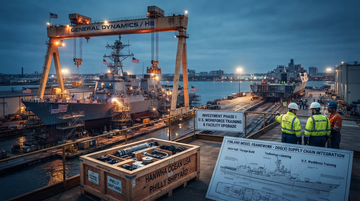
Trump’s “Finland Model” opens a limited route for foreign-built U.S. Navy hulls—Hanwha Ocean and Fincantieri gain optionality while GD/HII lose their “U.S.-only yard” pricing power
A White House memorandum signed Aug. 13, 2026 lets qualifying foreign shipbuilders build initial Navy hulls abroad while requiring major U.S. yard investment, U.S. workforce training, U.S. supply-chain sourcing, and technology licensing. The near-term demand signal is most supportive for Hanwha Ocean and Fincantieri, because they already have large U.S. shipyard footprints, while the traditional U.S. prime shipyard duopoly faces a structurally wider builder base and more competitive capacity.
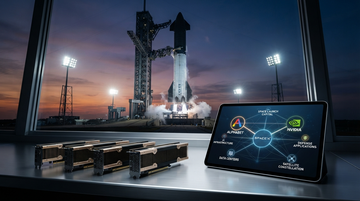
Nvidia’s $21B SpaceX stake turns mega-cap AI cash into launch/defense equity—and concentrates risk where demand can’t be rerouted fast
Nvidia NVDA disclosed a roughly $21B SpaceX position in its latest 13F-HR (as of June 30, 2026), making SpaceX one of its biggest strategic equity exposures. The same ownership map also shows Alphabet’s decade-old bet at about $94B and Tiger Global’s entry, underscoring a new, self-reinforcing loop: AI infrastructure economics can increasingly decide space launch capital, and that concentration can magnify governance and cash-use second-order risks.
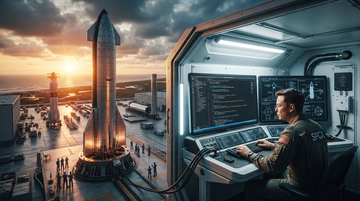
SpaceX’s Closed Cursor Deal Turns an AI Coding “Oligopoly” Into a Distribution Fight
SpaceX SPCX made its $60.0B all-stock Cursor (Anysphere) acquisition effective on Aug. 14, 2026—converting Cursor shareholders into 389,289,254 shares of SpaceX Class A stock. The immediate market impact is less about model quality and more about which developer tools get privileged distribution inside a vertically integrated “Musk stack,” potentially pressuring pricing and partner leverage for GitHub Copilot and other coding-agent workflows.
What to expect
Evidence-first notes with a visible point of view.
This section collects sharp takes on earnings, shareholder meetings, and market structure. Each new piece should make the thesis, the facts, and the implications obvious within the first few screens.
Expect direct analysis, not generic commentary.
Expect the data to be explicit and the argument to be easy to follow.