Data Centers & Cloud
The buildout behind the AI bill
Hyperscaler capex, colocation supply, power, cooling and networking — where the money goes after the GPU order, and which companies book it.
2026-11-09


CoreWeave's Print Is a Coupon Test, Not a Backlog Test: 16% Marginal Debt Meets a $28 Billion Funding Gap
CoreWeave reports Q3 2026 after the close on November 10, and the $104 billion backlog will not decide the stock — the coupon will. Second-quarter interest expense of $640 million already consumed 94% of operating cash flow, management has guided the third quarter to $860–940 million, and the market demanded more than 16% on CoreWeave's 2032 notes even with the 10-year Treasury at 4.86%. Closing the $28–32 billion gap between 2026 capital spending and operating cash flow at that rate would add $4.5–5.1 billion of annual interest, roughly four times guided 2026 adjusted operating income, while funding the same gap with stock at $46.40 would roughly double the share count. Read the print for the interest line, the capex guide and the terms of any new issue — not the backlog.

Two Prices for Powered AI Land: Google's Undisclosed Wyoming Deal and the 45.5% Premium Paid Elsewhere
Alphabet's Google unit acquired Crusoe's stalled southeast Wyoming campus on Nov 6, 2026 and committed $17 billion to build on it, with neither side disclosing a price. The only other observable prints on powered AI land that week were premiums — a 45.5% premium for a non-control 9.9% stake in NEXTDC and talks about a $100 billion Vantage IPO — while the Nasdaq 100 shed $2.5 trillion in one trading day and IREN pushed $4 billion of revenue start to January 2027. The mechanism matters more than the headline: Google bought the entitlements and the schedule risk Crusoe could not carry, while the power itself (a 702 MW fuel-cell plant under a 20-year contract, a 2.7 GW gas hub, nearly 1 GW of contracted carbon capture) never changed hands. Investors should read this as a repricing of developer equity, not of powered capacity, and own the contracted power and the equipment with booked slots.
2026-11-08
$17 Billion and 86% of Alphabet's Free Cash Flow: OpenAI and Google Just Put a Balance-Sheet Test on the AI Buildout
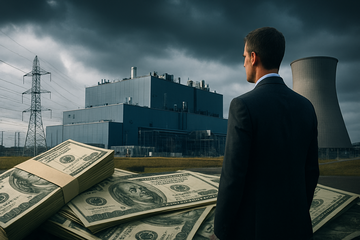
On November 5, 2026 OpenAI published a compact promising to pay the full cost of electricity and grid infrastructure at every compute campus it owns, dropped non-disclosure agreements with public officials and offered financial assurances if a project is cancelled — the same day Google committed $17 billion to its first Wyoming campus and said it would pay for 100% of the power it uses. The political cost of AI power has stopped being a ratepayer problem and become a corporate capital line, and the buildout is consolidating into the few balance sheets that can carry it. That advantage is not free: Alphabet's trailing free cash flow has fallen to $19.7 billion against $159.8 billion of trailing capital expenditure, so one Wyoming campus absorbs 86% of a year of cash generation. Every supplier on the critical path is now pricing a buildout that UBS estimates could lose 30% of its planned 2028 capacity, and the tell for who wins is a credit spread, not a press release.

Powell's $2.4 Billion Backlog Is One Contract Deep — and the Stock Has Lost 59% of Its Value
Powell Industries reported record September-quarter orders of $934 million on Aug. 3, 2026 and a backlog of $2.4 billion, up 69%, yet the shares have since fallen 59% in market value. The reason is composition: a single data-center award worth more than $400 million for behind-the-meter, on-site generation accounted for about 43% of that quarter's bookings, roughly half of every data-center dollar Powell has booked, and sits inside a $466 million customer-advance liability. Revenue grew 9% while peers grew 28% to 61%, the twelve-month conversion share of backlog slipped from 59% to 54%, and voters in ten states backed data-center restrictions on Nov. 4. The order book is real; the open question is how much of it one customer can still cancel, and the fiscal 2026 annual report answers that in a single sentence.
No Buyer for a $40,000 GPU: Microsoft Winds Down Oracle and Puts a Rental Rate on 'Good Enough' AI Compute
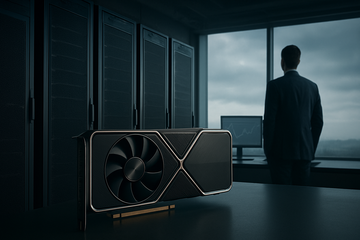
Microsoft's walk-away from Oracle's 2023 AI-cloud lease does not put a single accelerator on an auction block, because the chips stay inside Oracle's data centers, depreciated over six years. What it released is contracted demand, and contracted demand is what a market of compute prices against. The consequence is that the marginal price of 'good enough' AI is being set by a rental rate rather than a hardware print, which is why the damage lands on the layer where depreciation is more than half of revenue:69% at IREN and 53% at CoreWeave, against 15% at Oracle, 12% at Microsoft and 1% at Nvidia. Own the facility layer, where occupancy is now the pricing variable and renewal rents are rising, and treat Oracle's $127.8 billion of property and equipment as the balance-sheet expression of a repricing that has barely started to show up in reported numbers.
2026-11-06

Akamai's AI Upside Is a Warrant, Not Cash Flow: $5.5B of Capex Lands Before the First Anthropic Dollar
On Nov 5, 2026, Akamai Technologies trimmed 2026 revenue guidance to $4.44–4.465B and said roughly $30M of fourth-quarter revenue would slip into 2027 on supply-chain and third-party data-center delays — the same tape on which Cloudflare grew 39% to $782.5M and lifted its own full-year outlook. The gap is capital intensity, not demand: Akamai spent $605M, or 54% of revenue, on capex in the third quarter and burned $172M of free cash flow, pre-funding a $5.5B build to serve a $11.6B, seven-year Anthropic contract that adds nothing to 2026 guidance and only 25–30% of its 2027 ramp. The equity sweetener — a warrant over 7.7M shares, about 5% of the company, struck at $111.33 — is the cheap part of that deal, and the guidance cut is the tell that the bill for edge AI arrives as debt and depreciation long before it arrives as cash.

The Marginal Buyer of Energy Is a Data Center — and Baker Hughes Already Holds $39.4 Billion of Those Orders
At ADIPEC on Nov. 5, 2026, Baker Hughes's Lorenzo Simonelli pitched a \"demand decade\" while bp's Meg O'Neill told CNBC to plan for a lower-price environment. They were describing two different cycles, and only one of them is investable. The volume cycle is real and already contracted: Venture Global has committed up to 11.52 GW of behind-the-meter power with GE Vernova and Baker Hughes, Vistra has contracted 2,609 megawatts of nuclear output to Meta, and Baker Hughes' industrial backlog hit a record $39.4 billion in Q3 2026. That is why the cycle survives the AI capex trims that knocked the power complex 30% to 42% off its 52-week highs — the buyer signs 20-year contracts while the equity market still prices a one-year budget. Trade booked backlog and contracted off-takers, not barrels.

Cloudflare Grew 39% and Fell 280 Basis Points on Gross Margin: the Edge AI Toll Is Real, the Inference Bill Is $461 Million of Commitments
Cloudflare's third quarter was the first print where metered agent traffic showed up as growth while the cost of serving it showed up as margin: revenue rose 39% to $782.5 million and GAAP gross margin fell 280 basis points to 71.2%, with only $4.1 million of the $225.3 million cost of revenue being stock compensation. The $34.1 million GAAP net loss is mostly a stock-compensation and restructuring story — stock compensation rose $64.2 million year over year and restructuring added $11.0 million — so the durable bill is contracted, not incurred: $461.1 million of compute and co-location agreements signed in October 2026 on three-to-ten-year terms, on top of network capital spending at 15% of revenue. The profit split is being settled upstream, where NVIDIA holds a 75.0% gross margin and SK hynix an 80% operating margin, which leaves the edge platform paid in growth and in the right to meter the traffic.

Dropbox's $350M Tigris Bid Prices S3 Compatibility at a Commodity Level — While the Drive Makers Keep the Pricing Power
Dropbox agreed on Nov. 3, 2026 to buy S3-compatible object-storage startup Tigris Data for about $350 million in cash — its largest acquisition since 2007 — and wrapped it in DBX Agent Cloud, a storage product sold to developers building AI agents. The read-across is not that storage software is scarce: the S3 API now has at least four credible implementations, and Dropbox paid roughly 11 times everything Tigris has raised and about 61% of the enterprise value of the only listed pure play in the layer, Backblaze. What the price reveals is where the durable margin sits: Seagate and Western Digital grew revenue 61% and 55% year over year at 57%-plus gross margins on AI exabyte demand, while the software toll layers convert that same demand into 53% ARR growth on $6.3 million of trailing capex. For investors the toll is real but the economics accrue upstream to the bytes, while the software layer's pricing power is capped by a $0.015 per gigabyte-month zero-egress card that Cloudflare publishes.

Google's $17 Billion Wyoming Bet: The First Hyperscaler That Pays for Its Own Grid
Google will build its first $17 billion data center in Wyoming and pay for 100% of the power it uses, locking 2.7 GW of contracted resources with Black Hills and a $4 billion, 702 MW fuel-cell plant from AEP — two days after voters rejected 40 of 41 data-center ballot measures across ten states. The mechanism matters more than the megawatt count: a hyperscaler that signs 22-year, cost-bearing power contracts converts a political objection into a financial cost it can absorb. That splits the AI buildout into two tiers and moves value toward utilities holding credit-backed, self-funded load.

ING Groep's $500 Million Data-Center Loan Auction Shows Who Actually Holds AI Credit Risk
ING Groep put 12 data-center loans worth about $500 million up for bid on Nov. 5, 2026, including the first openly priced slice of Stargate-linked construction debt. The auction is worth less than a tenth of one percent of ING's €903.8 billion loan book, which is exactly why it matters: it puts a market-clearing price on AI construction credit at the moment banks, hedge funds and insurers are all changing hands on the same paper. For Oracle and CoreWeave, which run the same asset class at very different leverage, one winning bid on Nov. 19 sets the cost of capital for both.

IREN Deferred $4 Billion of ARR at Its Customer's Request — and $2.5 Billion of Deferred Revenue Shows the Cash Was Already in the Door
IREN moved its more-than-$4 billion contracted AI cloud ARR target from December 31, 2026 to January 31, 2027 (possibly February 28) after a customer-requested design change and supplier timing, while revenue backlog rose 22% sequentially to $20.3 billion and the program stayed fully contracted and fully funded. Deferred revenue of $2.54 billion and $2.25 billion of net cash show the gap is a commissioning-and-acceptance problem, not a demand or funding problem. The read-through: silicon orders were already placed — Dell Technologies racks and 50,000+ NVIDIA B300s — so NVIDIA and AMD order flow is intact while the neocloud revenue multiple, and the leverage sitting behind CoreWeave and Nebius, is what breaks first.

Microsoft's Oracle Wind-Down Puts $1.09 Trillion of 'Contracted' AI Capacity on Trial
On November 6, 2026, Bloomberg reported that Microsoft has stopped renewing an arrangement to rent AI computing capacity from Oracle and has been switching the rented capacity off - the first publicly reported case of a hyperscaler shrinking a third-party AI capacity lease rather than adding one. The reason it matters is not Microsoft's balance sheet but the financing model underneath the buildout: roughly $1.09 trillion of uncommenced data center lease commitments against about $285 billion of lease liabilities that have actually begun. Oracle alone carries $288 billion of leases that have not yet commenced against $43.8 billion on its books, and it has guaranteed up to $3.3 billion of a lessor's borrowing. Landlords are now funding contracted demand with their own balance sheets, and the option value of a tenant that can walk at renewal has never been priced.
2026-11-05

Goodman and Digital Realty Paid a 45% Premium for NextDC: Data Centers Now Price as Contested Control Assets
A trust vehicle owned 50/50 by Goodman Group and Digital Realty book built up to 9.9% of NextDC at A$9.50 on November 4, 2026 — 45.5% above the previous close and 78% above the price NextDC closed at after its October 21 guidance cut. Roughly US$500 million of buying re-added A$3.15 billion of market value in a single session, because the buyers underwrote 740.1MW of contracted capacity rather than the FY27 guidance that had just been cut by 36%. The investment lesson is narrower than the headlines: listed data center capacity is now a contested control asset, priced by strategic operators with balance sheets, and the binding constraint has moved from capital to grid and council consent.

Bitcoin Bounced 4% and Trump Media Fell 24.5% in One Session: Political Access, Not AI Capex, Is the Factor Being Priced
On Nov. 4, 2026, the day after Democrats took the House and Senate, bitcoin closed 4.6% higher at $80,653 while Trump-linked tokens fell up to 17% and AI data-center equities dropped just as hard — Cipher Mining -21%, CoreWeave -9.5%, Applied Digital -8.8% — even as First Solar gained 8.4% and Samsung SDI jumped 11.6%. The asset that rallied has no political identity; the assets that fell derive cash flow either from access to one administration or from a permitting regime that just changed hands. That makes political access a measurable exposure: the token economy depends on one family's continued access, and the AI buildout depends on governors, permits and tax credits. The names carrying both betas — bitcoin miners rebranded as AI infrastructure — fell hardest, because they surrendered a political hedge just as permitting risk arrived.
2026-11-04

AMD Doubled Data Center Revenue and Guided 2027 to +80%: The Market Paid 6.5% Because HBM4 Now Sets the Margin
AMD's fiscal Q3 2026 data center revenue jumped 97% to $8.55 billion and management guided 2027 revenue growth above 80%, yet the shares rose only about 8% the morning after the release and sit roughly 27% below their 52-week high. The argument is inside the guide: roughly $17 billion of December revenue at about 55% non-GAAP gross margin, down from 56%, because rack-scale Helios revenue carries memory, switches and power that AMD buys rather than makes. That scarcity rent is visible upstream, where SK hynix earned an 80% operating margin and Micron an 86.8% gross margin in the September quarter, while AMD turned only 4% of revenue into free cash flow. The second-source mandate is genuinely won, with five named hyperscalers running production racks, but the margin on it accrues first to the bottlenecks, not to the accelerator vendor.

Big Tech Added $750 Billion After the Blue Sweep — Because Voters Just Made New Data Centers Harder to Build
Democrats took both chambers on Nov. 3, 2026, and the market split the AI complex along one line: platforms that already own compute gained roughly $750 billion in market value, while the companies that must build new data centers were sold hard. Voters in 36 of 36 counted local ballot measures backed restrictions on data center construction, Texas elected a governor promising an immediate moratorium, and the four largest hyperscalers now spend 91 cents of every operating cash dollar on capital expenditure. A permitting brake is therefore a pricing and cash-flow event for Amazon and Microsoft, which can charge more for compute they already own, and a revenue event for everyone downstream of a new site, from CoreWeave to Constellation Energy. This was not a deregulatory trade: Democrats closed off federal preemption of state AI law, so what the market bought was a capex brake, not a regulatory gift.

Converted Jet Engines Won a $1.465 Billion Order — and the AI Power Queue Still Runs to 2031
Retired aircraft engines have become sellable power: FTAI Aviation disclosed a $1.465 billion initial purchase order for 25-megawatt gas turbine generator sets built from CFM56 engines, with more than 100 units under contract for delivery in 2027 and 2028. The channel adds almost no megawatts — it adds time, because new-build aeroderivative turbines are sold out through 2029 while a converted engine can deliver in 2027 and bridge a data center for five to seven years. That makes repurposed engines a bridge-power market rather than a power source, with roughly 1,000 retiring engines setting a hard ceiling on supply. The investable result is a new toll layer between aerospace and AI power, captured by whoever already holds the engine cores.

Texas Flipped, but the AI Buildout's Clock Was Already Set: 474 Gigawatts and a Frozen Permit File
Democrats took both chambers and, in Texas, the governor's office and a US Senate seat, and the AI infrastructure complex sold off overnight: Nasdaq-100 futures fell 0.8%, Oracle lost 4% and CoreWeave 7%, and in Seoul SK hynix closed down 5.03%. The binding constraint on Texas data centers was never Washington's to lift — state permits have been frozen since Sept 21, 2026, and ERCOT's own interconnection calendar (Batch 1 applications in summer 2027, the final batch transmission plan in fall 2027) means no election outcome delivers meaningful Texas data center load before 2028. What the new statehouse changes is price, not volume: the cost of a megawatt is being shifted from Texas ratepayers onto the AI developer in Austin and in Washington at the same time. That is a multiple story for the AI complex and a re-timing story for the utilities holding Texas load.
2026-11-03
What to expect
Evidence-first notes with a visible point of view.
This section collects sharp takes on earnings, shareholder meetings, and market structure. Each new piece should make the thesis, the facts, and the implications obvious within the first few screens.
Expect direct analysis, not generic commentary.
Expect the data to be explicit and the argument to be easy to follow.