Data Centers & Cloud
The buildout behind the AI bill
Hyperscaler capex, colocation supply, power, cooling and networking — where the money goes after the GPU order, and which companies book it.
2026-07-19

2026-07-18

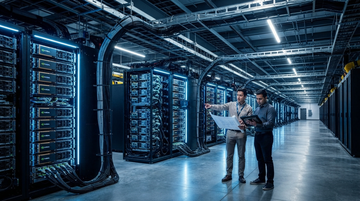
Amazon, Alphabet, Microsoft, and Meta Are Turning AI Capex Into a Return-on-Compute Test
The latest capex debate is not about whether the hyperscalers are spending enough. It is about whether the next dollar of AI infrastructure produces a return that is high enough to justify the power, memory, and financing burden.
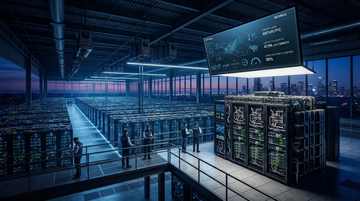
Meta's Anthropic Lease Turns AI Compute Into a Wholesale Market
A potential $10 billion deal to rent compute to Anthropic would move Meta one step closer to treating its AI infrastructure like a saleable utility. That changes the market's question from 'is Meta overinvesting?' to 'can Meta monetize spare capacity better than the cloud incumbents?'

Meta's AWS Poach Turns AI Infrastructure Into a Cloud-Business Trial
Hiring a senior Amazon Web Services executive is a small headline with a large read-through: Meta is no longer just buying compute, it is starting to organize itself like a compute platform. That changes the valuation debate around AI capex, cloud economics, and what counts as a durable moat.
2026-07-16
2026-07-15
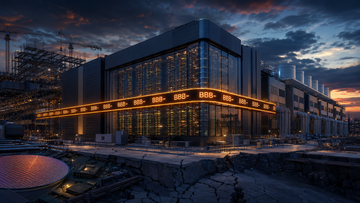
Oracle's 63% Slide From Its 52-Week High Is the First AI-Infrastructure 'Fallen-Angel Watch' the Bond Market Has to Price
Oracle is down roughly 13% over the last 10 sessions and ~63% from its 52-week high of $345.72, with the 52-week low of $127.60 set on July 14, 2026. After the June 11, 2026 8% tumble on a $20 billion capital-raise disclosure and the June 23, 2026 disclosure that Oracle shed ~21,000 roles over the past year, the equity is now pricing the risk that AI-infrastructure capex commitments are pushing the balance sheet toward fallen-angel territory. With debt-to-equity at 322.86%, the question for the bond market is no longer whether Oracle can fund the AI build, but whether the cost of capital will move before the next earnings print on September 7.

Amazon Just Lost a 19-Year AWS S-Team Veteran Right When the AI Capex Cycle Is at Its Peak
Dave Brown, an Amazon Web Services SVP who helped assemble the original EC2 service in South Africa in the 2000s and oversaw AWS's compute and machine learning units including Bedrock and SageMaker, plans to leave the company at the end of July 2026 after nearly 19 years. He will be replaced by Dave Treadwell from the e-commerce division. Brown's exit from Jassy's 28-person S-team comes as AWS recorded 28% revenue growth in Q1 2026 and as Amazon raised at least $25B in a bond sale to fund its AI capex - the worst possible timing for a leadership transition.
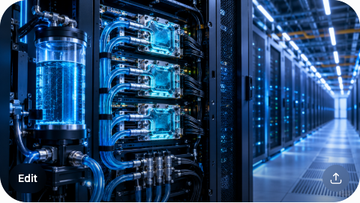
Liquid Cooling Deep Dive: How Vertiv, Boyd, Rittal, CoolIT Systems, and Asetek Built the Most Concentrated AI Data Center Thermal Stack of the Cycle
Liquid cooling is the binding AI data center thermal stack of the cycle - air cooling is no longer sufficient for AI accelerators >700W TDP, and the 2026-2028 liquid cooling demand is the cleanest single read on the AI capex cycle's thermal leg. Vertiv leads with ~30% liquid cooling share, Boyd at ~10%, Rittal at ~10%, CoolIT Systems (the cleanest pure-play, recently acquired by Eaton) at ~8%, and Asetek at ~5%. This is a full-stack deep-dive into liquid cooling: cold plate (DLC) vs immersion (single-phase + two-phase) vs rear-door heat exchanger (RDHx), the coolant chemistry (PG-25, dielectric fluids), the customer base (Microsoft, Alphabet, Amazon, Meta), the top experts, the capex, the 2026-2028 supply-demand, and the read-through for the AI capex stack.
2026-07-14
2026-07-13
2026-07-02

2026-07-01
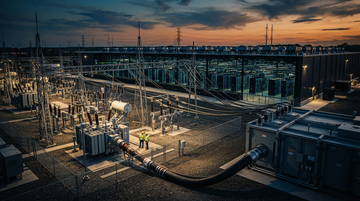
Data Center Power Is Becoming the Real AI Scarcity Asset
The IEA and EIA now describe data centers as one of the biggest drivers of future electricity demand. The scarce input is no longer only GPUs: it is grid capacity, interconnection speed, substation gear, and politically permitted electrons.
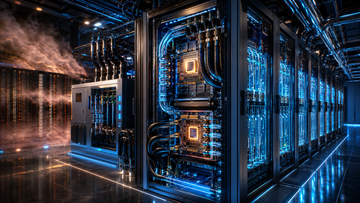
Liquid Cooling Is Becoming the Default Thermal Stack for AI Data Centers
NVIDIA, Supermicro, Vertiv, and Dell are all describing 100kW+ racks, 120-132kW liquid-cooled designs, and large efficiency gains. The read-through is that liquid cooling has moved from an optional upgrade to the default thermal stack for AI factories.
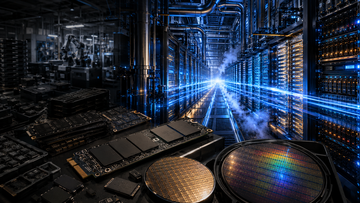
Sandisk's Datacenter Breakout Shows NAND Has Stopped Behaving Like Commodity Flash
Sandisk's Q3 FY2026 results show revenue up 97% sequentially, gross margin at 78.4%, datacenter demand up 233%, and a zero-debt balance sheet. The read-through is that NAND is increasingly being priced like AI infrastructure capacity, not generic storage.
2026-06-30
2026-06-24
What to expect
Evidence-first notes with a visible point of view.
This section collects sharp takes on earnings, shareholder meetings, and market structure. Each new piece should make the thesis, the facts, and the implications obvious within the first few screens.
Expect direct analysis, not generic commentary.
Expect the data to be explicit and the argument to be easy to follow.