Healthcare
Trial data, approvals, and what they are worth
Readouts, FDA decisions, drug pricing and payer behaviour, sized in revenue rather than in press-release adjectives.
2026-11-08

A Pill Matched the Injectables in Psoriatic Arthritis — at $102,000 a Year, Sotyktu Is on the Clock, Not Skyrizi
Johnson & Johnson's Nov. 7 Phase 3 readout for oral icotrokinra put a 58% ACR20 response in biologic-naive psoriatic arthritis on the table — cross-trial, in line with the IL-23 and IL-17 biologics. But ICOTYDE did not beat Skyrizi or Cosentyx; it matched them on placebo-controlled data, and its 41% placebo response leaves the smallest treatment delta in its class. Price is the sharper signal: at about $8,505 per 30-day supply, roughly $102,000 a year, the pill sits at parity with Cosentyx and above Skyrizi — so it does not compress the biologics' price umbrella at all, it compresses the case for the cheaper oral tier and the administration burden that justified paying six figures for an injection. Read it as a threat to Bristol Myers Squibb's young psoriatic arthritis launch and Amgen's fading Otezla, not as an imminent hit to AbbVie's $5.8 billion Skyrizi.

5.1 Million Left Medicaid and 4.6 Million Left the Exchanges: The 2026 Coverage Cut Is Federal, and Hospitals Pay for It in Payer Mix
Medicaid's 2026 coverage loss is a federal event, not a state one. The expansion map was unchanged at 41 jurisdictions through Nov. 6, yet Medicaid enrollment fell 5.1 million and the individual market 4.6 million over the past year as enhanced premium tax credits expired. The transmission runs through payer mix and uncompensated care rather than pricing power: HCA Healthcare absorbed roughly $400 million of pre-tax income in Q3 2026 from exchange coverage loss, and guides 2027 Medicaid supplemental payments $550 million to $650 million lower. With Democrats now controlling both chambers, 2027 is locked by statute while 2028 and beyond stay a political option, so Centene has already repriced for a shrinking pool while the operators with the thinnest balance sheets and the heaviest Medicaid mix carry the most risk.

Two Lawsuits Put Medicare's $440 Million Foreign-Price Pilot Before a Court — and the Precedent Is Worth Far More Than the Savings
BIO, Biocom and California Life Sciences sued HHS in the Northern District of California on Nov. 6, joining PhRMA's Oct. 7 challenge in the District of Columbia to the GLOBE model, which ties Medicare Part B rebates to prices paid in 19 foreign countries. The cash is trivial: CMS cut projected seven-year savings from $11.9 billion to $440 million, left roughly four manufacturers in scope, and says 0.3% of Part B beneficiaries would pay less out of pocket. The machinery is not trivial — the benchmark is built from the lowest or volume-weighted foreign net price, so a reimbursement decision in London, Tokyo or Berlin now sets US rebate liability, while the April 2, 2026 tariff-and-MFN arrangement with the UK already trades foreign pricing for tariff relief. For Merck, Bristol-Myers Squibb and Johnson & Johnson, the direct effect is rounding error against revenue bases of $64.9 billion, $48.2 billion and $94.2 billion; for US launch pricing and biosimilar economics, the ruling matters far more than the cash.

Zoetis Bought Genomics at 1.8 Times Sales and Merck Paid $647 Million for Hatchery Vision: The Protein Boom's Trade Is Cost Per Pound
Record protein prices are pulling capital into animal health, but not into medicine. Zoetis is paying $160 million for Neogen's genomics business, Merck is paying $647 million for poultry-technology firm TARGAN while advancing an $895 million biologics expansion in Kansas, and venture capital has put a record $470 million into global livestock management in 2026. The reason is cost per pound: feed is 56% of a cattle producer's cost, so the return on health spending shows up in feed conversion and hatchery precision, not in doses sold. That makes the scarce animal the valuable one, so dollars per head rise while head counts fall, and cattle-linked health revenue grows even with the US herd at its smallest since 1951. The exposure sits in animal health, feed additives and nutrition; processor margins are compressing and grocers are absorbing the price shock.
Johnson & Johnson's Rybrevant Faspro Just Left the Infusion Chair. Halozyme Fell 15.7%. The Subcutaneous Wave Is Now a Courtroom Story
The FDA's Nov. 5, 2026 accelerated approval of Rybrevant Faspro for pretreated head-and-neck cancer made it the first dual EGFR/MET therapy available as a five-minute subcutaneous injection, replacing a multi-hour infusion. That is a site-of-care event, not a chemistry event, and the royalty structure around it is where the money sits: Halozyme licenses the enzyme inside the formulation and collects a mid-single-digit cut, on a royalty base now guided to $1.235 billion–$1.255 billion for 2026. Yet Halozyme's shares fell 15.7% the next session, because a 1% guidance-midpoint raise, a valuation-driven downgrade and the absence of any Merck settlement talk mattered far more than a partner approval that adds almost nothing to the toll. The investable question is no longer who wins subcutaneous approvals; it is who can enforce the toll when the biggest player builds its own enzyme.
2026-11-06

17% Segment Profit Growth on 5% Revenue Growth: Healthcare Profit Has Moved Downstream, and at 18.3x You Already Pay for It
Cardinal Health reported fiscal 2027 first-quarter results on Nov. 5, 2026 that invert the old drug-distribution story: revenue rose 5% to $67.5 billion while pharmaceutical segment profit jumped 17% to $783 million, lifting segment margin to 1.25% from 1.13% and pushing management to raise full-year non-GAAP EPS guidance to $12.80–$13.00 from $12.40–$12.60. The mechanism matters more than the beat — distributors earn a spread on units shipped and services rendered, so the Medicare price reset that takes effect on Jan. 1, 2027 (a 71% cut to Novo Nordisk's GLP-1 list price in Part D) lands on a manufacturer's price line rather than on the distribution fee pool. Capital is following that logic with cheques, not commentary: roughly $20.4 billion of delivery-layer enterprise value since December 2024, including Option Care Health at a $5.8 billion enterprise value and OneOncology at $7.4 billion. The uncomfortable part is price — Cardinal trades at 18.3x trailing EV/EBITDA against Cencora's 11.6x, and the same quarter contained a 28% profit decline in medical distribution.
Moderna Raised Guidance Into a Fourth Quarter That Implies a 14% to 43% Revenue Drop — and 56% of Its $390M Profit Swing Came From Cutting R&D
Moderna beat and raised on November 6, 2026: third-quarter revenue of $1.31 billion, up 29%, and diluted earnings of $0.38 a share against a consensus loss of $1.25, with full-year revenue growth guidance lifted to 15%–25% from up to 10%. The raise is thinner than the headline suggests, because the $780 million US line was flat against a year earlier, the growth came from overseas COVID-19 volume and shipment timing, and the raised range still implies fourth-quarter revenue of $389–583 million, 14% to 43% below the $678 million booked a year ago. The $390 million swing to operating profit was 56% funded by a 27% cut to research and development, while operating cash flow worsened to negative $1.56 billion, so year-end cash of $8.1–8.3 billion is flat on 2025 only because of a $3.0 billion zero-coupon convertible struck in September. Investors are paying roughly 38 times trailing revenue for a platform whose value rests on the melanoma vaccine Moderna and Merck are taking to regulators, not on this print.

Oscar Health's Record Quarter Was a 36% Price Hike — and Its Own Guidance Books a Fourth-Quarter Loss
Oscar Health's third quarter looked like a boom: $5.14 billion of revenue, up 72%, a third guidance raise, and a swing to a $0.49 diluted profit. But membership rose only 27% while the price per member rose roughly 36%, inside a marketplace whose enrollment fell from 21.8 million to 19.2 million after enhanced subsidies expired — and a single $250 million risk-adjustment true-up was larger than the quarter's entire $178 million operating profit. Oscar's raised guidance actually implies a fourth-quarter operating loss of roughly $315 million to $415 million, because nine-month operating earnings already exceed the full-year range. For investors the question is not whether a managed-care tailwind exists; it is whether a genuinely cheaper cost structure and a redistributed book survive a 2027 market that KFF expects to shrink again.
2026-11-05
2026-11-04
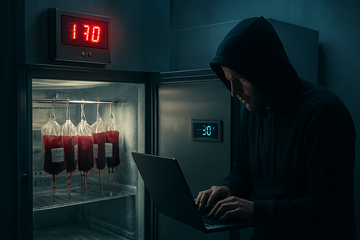
Hackers Just Took Europe's Blood Fridges: Cold Chain Is Now Critical Infrastructure and No One Owns the P&L
On the night of Nov. 1-2, 2026, hackers reached France's national blood service through the refrigeration contractor that maintains its cold rooms, and reprogrammed freezers holding blood products and plasma from minus 30 degrees toward 110, while the same technique stripped tens of millions of euros of grocery stock from seven European countries. The blood service lost nothing because its alarms and an on-call technician caught the drift; that near miss exposes the real problem: 12,976 refrigeration supervisory services are reachable from the internet, 54% of them on a single vendor's platform, and the same regulatory and insurance gaps leave the loss with whoever owns the cold inventory. Standard property cover excludes cyber-caused spoilage, standard cyber cover excludes physical damage, and EU reporting duties now force vendors to disclose exploited vulnerabilities without obliging them to fix hardware that is already end-of-life. For investors the read-through is narrow and dated: the beneficiaries sell verification and the new insurance class, while the P&L that absorbs an uninsured cold-chain loss sits with the fractionators carrying 200 to 420 days of refrigerated inventory on four to six times net leverage.

CVS Health's Drugstore Breakup Doesn't Unlock a Discount: At $180.5 Billion, the Market Already Pays for Both Halves
CVS Health will separate into two public companies, with the roughly 9,000-store pharmacy chain becoming CVS Pharmacy in the first half of 2028 — but the arithmetic does not support the sum-of-the-parts story. Valuing the health half on Cigna-like multiples and the chain on the 0.16x sales private equity paid for Walgreens puts the parts at roughly $125 billion to $194 billion against the $180.5 billion enterprise value the market already pays, so the separation transfers the valuation question to the Form 10 rather than resolving it. What is actually moving the stock is the operating line: adjusted EPS of $2.09 in the third quarter against about $1.63 expected, guidance lifted to at least $8.20, and $11.8 billion of trailing free cash flow against $63.6 billion of net debt at 4.85x trailing EBITDA.

Democrats won both chambers on Nov. 3 — and the managed-care tailwind investors were trading was never there: Molina Healthcare's trailing EPS is minus $0.61
Democrats took the House and Senate on Nov. 3, 2026, putting drug-price controls, a reversal of the nearly $1 trillion Medicaid cut, restored exchange subsidies and a public option on the agenda — but the premise that this reverses a managed-care margin tailwind is wrong. The tailwind was never in the prints: Molina Healthcare lost $0.61 a share on a trailing basis through Sept. 30, 2026 and burned $535 million of operating cash in 2025, while its exchange premium revenue fell 46% year over year. What Democrats now control is a 2028 volume recovery for Medicaid managed care and a 2029 price floor for high-price pharma, with hospital payer mix the channel that has already hit the income statement and Cigna Group's pharmacy benefit economics the one that waits until 2028–29.

Novo Nordisk's tablet won 3.6 million U.S. scripts at about $174 each — and 2026 revenue is still capped at +2%
Novo Nordisk beat on the number that matters: the oral Wegovy did DKK 5,394 million in the third quarter of 2026, 68% above the second quarter and DKK 774 million ahead of the DKK 4.62 billion consensus, and full-year adjusted sales guidance was raised to -2% to +2% at constant exchange rates. The raise is a floor-raise, not a growth signal — nine months are already +2% at constant exchange rates, so the band leaves the fourth quarter somewhere between flat and about 14% below the year-ago quarter. The reason is price: U.S. tablet revenue works out to about $174 per prescription, below the $245 Medicare bridge net price and close to the $149 cash entry tier, so scripts compound into a shrinking revenue-per-patient pie while free cash flow guidance jumps DKK 15 billion at the midpoint to DKK 60-70 billion. The trade has repriced around that split — the market pays about 7 times trailing EBITDA for the manufacturer that has already reset its prices and about 31 times for the one still buying volume with a 15% price cut.
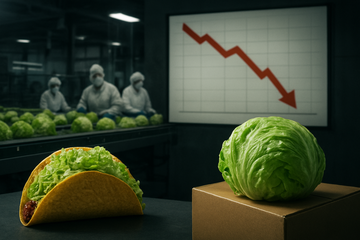
Taco Bell's Parasite Crash Cost $172 Million in Sales and Yum! Brands Only $10 Million — the Franchisee Paid the Rest
The 2026 cyclospora outbreak traced to a single iceberg lettuce processor in central Mexico took Taco Bell's U.S. same-store sales down 4 points in the third quarter of 2026, straight off a 7% gain in the prior quarter. The equity damage was trivial and the franchisee damage was not: Yum! Brands collects roughly 5.7 cents of every dollar of Taco Bell system sales, so an estimated $162 million of lost restaurant revenue — and most of the store-level profit — landed on the operators who actually own the restaurants, who also funded the discounts, the write-offs and the lawsuits. The next cycle is already scheduled: Taylor Farms will pull Mexican iceberg out of the U.S. market during the May-to-August window starting in 2027, while the federal traceability rule that would have forced this chain to document itself is barred from enforcement until July 2028.
2026-11-03

Genmab Doubled on One Hazard Ratio — and 94% of Pharma's $221 Billion Licensing Wave Is Still a Promise
A single interim cut in death risk — an overall-survival hazard ratio of 0.50 in first-line head and neck cancer — took Genmab's market capitalization from $16.8bn at the end of June to $33.8bn, with the shares up 48% in one week after three Phase 3 wins. The re-rating is a financing event rather than a science event: pharma announced $221.1bn of research-and-development licensing value in the first nine months of 2026 across 72 tracked deals, but only 6% of that — roughly $13bn — was payable in cash at signing, so the money that follows a de-risked print arrives mostly as milestones. With 27 US biopharma IPOs priced this year and the restricted shares from the autumn cohort unlocking from late March, heaviest in April 2027, the next two quarters are the cheapest window a de-risked mid-cap will get to convert a re-rating into permanent capital.

Pfizer's Guidance Raise Rests on Eliquis' 25% Surge — a Price-Cut Harvest With a Calendar Attached
Pfizer's third-quarter 2026 beat lifted the 2026 revenue guide $1.5 billion to $62.0–$64.0 billion, and the single biggest reason was Eliquis: up 25% to $2,523 million, with Bristol-Myers Squibb reporting the same product up 39% in the US. That growth came from price mechanics, not demand — Bristol-Myers Squibb discloses that cutting the US list price in 2026 shrank rebates and lifted realized net prices — and it is a harvest inside a franchise whose US clock stops on April 1, 2028, when settled generic apixaban may launch. Meanwhile the engine meant to replace Eliquis reprices itself on January 1, 2027, when Medicare's negotiated prices take effect for Ibrance and Xtandi. The print is real; a 2027 multiple built on it is not.

Tempus AI's First Adjusted Profit Runs on an $88.9 Million Data License — While Quest Diagnostics's Revenue Per Test Fell 4.2%
Tempus AI printed its first positive adjusted earnings per share, $0.07, on Nov. 2, 2026, and the engine is data licensing rather than test volume: data and applications revenue grew 33% to $108.1 million at a 72% gross margin, lifting company gross margin to 64.8% from 62.8% and carrying adjusted EBITDA to $25.6 million from $1.5 million. The licensing line itself, Insights, did $88.9 million of work at 29% growth, and the money behind it comes from multi-year minimum commitments — AstraZeneca alone has a $220 million minimum under a 2021 services agreement running through the end of 2026. That matters because Quest Diagnostics grew 10% on 14.5% more requisitions while revenue per requisition fell 4.2%, and Labcorp's diagnostics laboratories grew just 4.4% organically, immediately ahead of Medicare fee cuts of up to 15% a year that can begin on Jan. 1, 2027. The proof point is real but narrow: $41.5 million of the $65.1 million improvement in GAAP net loss came from non-cash marks on Personalis stock, stock-based compensation of $48.1 million now exceeds adjusted EBITDA, and Tempus must spend roughly $1.5 billion in cash to own the MRD engine behind a quarter of that growth.
2026-11-02

2026-11-01

AbbVie Replaced the Humira Cliff Without Solving It: Two Drugs Now Supply 98% of Growth, and Skyrizi's 2033 Expiry Is the Date Nobody Is Pricing
AbbVie just closed the crisis investors spent three years worrying about. Third-quarter revenue rose 10.3% to $17.404 billion, adjusted EPS more than doubled to $3.82, and full-year guidance moved to roughly $67.8 billion. The same quarter concentrated the company rather than diversifying it: Skyrizi and Rinvoq supplied about $1.59 billion of the $1.63 billion of revenue AbbVie added, lifting their share of sales from 43.7% to 48.7% in twelve months. The mix shift that turned a patent cliff into an earnings inflection also left a $23 billion annualized franchise resting on a single molecule whose US patent expires in 2033, and the shares have already risen about 12% on the guidance raise.
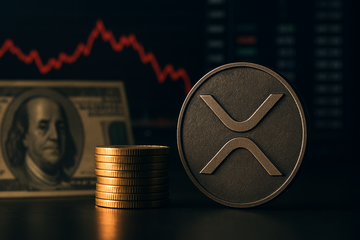
Evernorth Holdings Registered 91.6% of Its Equity for Resale — and Its XRP Treasury Still Trades at 1.9x Its Tokens
On October 30, 2026, Evernorth Holdings filed a preliminary Form S-1 registering up to 73,688,162 Class A shares and 239,653 sponsor warrants for sale by the holders, and the company collects none of the proceeds. This is not Cigna Group's Evernorth: it is a Ripple-backed XRP treasury that closed its merger with a SPAC on October 9, 2026 and began trading on Nasdaq on October 12 as XRPN. Because every share and unit in that deal was priced at a fixed $10.00 while the token fell from $2.36609 at signing to $1.43069 at closing, roughly $363 million of XRP value was absorbed by dilution rather than by the quote. At the October 30 close of $14.20 the stock trades at 1.93 times the market value of the 473 million XRP behind it, while the Bitcoin and Ether treasury peers trade at 0.76 to 1.00 times book.
What to expect
Evidence-first notes with a visible point of view.
This section collects sharp takes on earnings, shareholder meetings, and market structure. Each new piece should make the thesis, the facts, and the implications obvious within the first few screens.
Expect direct analysis, not generic commentary.
Expect the data to be explicit and the argument to be easy to follow.