Healthcare
Trial data, approvals, and what they are worth
Readouts, FDA decisions, drug pricing and payer behaviour, sized in revenue rather than in press-release adjectives.
2026-08-04


Eli Lilly's “Early-Access” Move Is a TAM Pre-Pricing Mechanism
Lilly’s “early access” to its next-gen obesity drug (retatrutide) is not charity—it is a controlled go-to-market rehearsal that can pre-price demand and steer where patients (and cash-pay channels) land once the broader launch hits. In this model, the value comes from learning-and-pricing ahead of approval, while the financials show Lilly can fund growth and scale investment despite periods of low free cash flow.

Merck's “Quarter Beat” Is a Patent-Reset Reality Check
Merck’s latest reported strength shows how much the Keytruda franchise can still carry, but it doesn’t answer the real question: whether Merck has built a durable replacement economics model before biosimilar pressure starts in December 2028. The company also guided FY2026 sales upward into a window that still precedes the hardest 2028–2029 exclusivity step-down.

Pfizer's $2.5B save is the easy part; the question is what it funds after the patent cliff
Pfizer has repeatedly expanded its “cost realignment” targets, with the program originally including at least $2.5B of additional net savings expected to be realized in 2024 and later culminating in ~$5.7B through 2026. The hard investor question is whether these savings are protecting (or crowding out) the cash needed for the post-patent-cliff commercial and pipeline reset.

Procter & Gamble's $3.8B Thorne bet shifts “wellness” from shelf risk to premium supply-chain leverage
Procter & Gamble is reportedly paying $3.8B in cash to acquire Thorne, a science-driven supplements brand, with closing expected later in 2026. The investor question is not “does supplements grow?”—it’s whether P&G can add a higher-growth, higher-trust revenue stream without sacrificing the margin discipline that supports its staple-like cash generation.

Waters’ Forecast Raise Suggests Biopharma Labs Are Moving Past a One-Quarter “Freeze”
Waters’ 2026 guidance raise points to demand that’s not just cyclical—especially because it ties growth to diagnostics and lab equipment rather than a broad market normalization. The investor question is whether this becomes a durable replacement/utilization cycle that pulls through consumables and services, or whether it fades as budgets reset.
2026-08-03

AstraZeneca–Bristol Myers’ alleged $400B oncology tie-up isn’t about synergy—it’s about buying back the “patent-cliff premium” investors demand
If the reported AstraZeneca–Bristol Myers Squibb (BMS) $400B megadeal ever advanced, the first re-pricing would be in oncology patent-cliff expectations: BMS’s revenue concentration in Opdivo and Eliquis LOE risk would effectively get capitalized into the combined group. The deal logic is strongest for BMS because Eliquis exposure is structurally harder to replace than label-expanding immuno-oncology, which forces a buyer-of-last-resort dynamic that would ripple into how investors price other “patent cliff” stories.

Curium’s Lantheus bid is really an isotope-capacity bet—because radiopharma growth is constrained by reactors, not chemistry
Curium’s reported pursuit of Lantheus shows radiopharma is shifting from “drug + distribution” to “drug + isotope throughput.” The investment implication is that bidders can gain durable advantage only by securing upstream nuclear capacity and locking down downstream commercial pull.

Eli Lilly's “cancer win” narrows the addressable audience—and that’s the real 2027 oncology TAM reset
Lilly’s latest oncology positive readout is a genuine efficacy win, but it’s tethered to a biomarker-defined subgroup (RET fusion–positive NSCLC), which shrinks commercial TAM versus “all-comers.” That subgroup math forces a sharper rerate framework for Eli Lilly, changes the opportunity-cost lens on Bristol-Myers Squibb, and matters disproportionately for smaller targeted-oncology platforms like Arvinas and Black Diamond Therapeutics.

Novo Nordisk ‘claws back’ into obesity because the market is shifting from injections-only to pills-and-next-gen demand
Novo Nordisk’s obesity narrative is being re-rated around oral GLP-1 execution (including Wegovy pills) rather than only injection leadership—exactly the demand shift that can loosen Lilly’s pricing power. The setup matters because Eli Lilly still trades like a monopoly ($40.8x trailing P/E), while the Reuters-driven “pipeline reset” forces investors to price a wider share of the obesity wallet into Novo’s future.
2026-08-02

2026-08-01

Replimune Just Doubled After a 10-3 Vote — That's Not the Story. The Story Is That Two FDA Rejections Just Became One Approval
An FDA panel voted 10-3 on July 30, 2026, that Replimune Group's twice-rejected RP1+nivolumab data were 'evaluable and clinically meaningful,' sending shares up ~128% premarket to $12.44 against a ~$5.41 close. The PDUFA date is August 2, 2026, with the panel win coming one day after the same committee voted 9-3 against Capricor's deramiocel — proving that 2026 adcom outcomes now split cleanly on trial design, not on ideological FDA priors. The deeper read: Vinay Prasad is gone, Marty Makary is out, and the agency is being run by an acting commissioner who has not yet telegraphed a stance, which paradoxically raises the floor on biotech downside-skew bets.

The UFLPA’s 43-Company Expansion Turns Supply-Chain Proof Into a Cross-Industry Cost
DHS added 43 China-based companies to the UFLPA Entity List on July 31, bringing the total to 187 and making the restriction materially broader than an apparel-only issue. The immediate risk is not a blanket tariff: it is shipment detention, denied entry, supplier replacement and documentation costs for importers using aluminum, metals, battery materials, food or electronics linked to the listed entities.
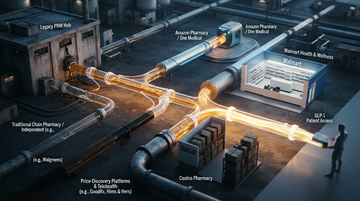
Retail Captures the GLP-1 Script: Walmart, Costco, and Amazon Siphon $14B of High-Margin Cash-Pay From PBMs
Three retailers — Walmart, Costco, and Amazon — now dispense oral GLP-1s from $25 insured and $149 cash-pay, while the July 1 Medicare GLP-1 Bridge sends $50 scripts through their counters just as 10% of large employers drop coverage for 2027. The shift reroutes billions in rebate-eligible prescriptions around CVS Health Caremark and UnitedHealth OptumRx, and forces independent and chain pharmacies like Walgreens to fill GLP-1s at a loss. The structural read-through: branded volumes to Eli Lilly and Novo Nordisk hold up, but PBM rebate economics, telehealth disruptors like Hims & Hers, and price-discovery platforms like GoodRx all lose pricing power and per-script margin simultaneously.
2026-07-31

2026-07-30

Haleon’s H1 “US slip / Oral Health win” reframes the staples trade into a category bet
Haleon reaffirmed full-year guidance, but H1’s internal split matters: Oral Health delivered mid-single-digit growth while North America slowed versus stronger Emerging Markets. For investors running “premium staples” pair trades, the earnings print shifts the question from “staples resilience” to “which category compounds when the US consumer softens.”

Johnson & Johnson's FY2026 EPS guide drops ~5% on deal/integration costs—proof the pharma M&A cycle is now a P&L story
After beating in Q2, Johnson & Johnson still cut FY2026 adjusted EPS guidance to $10.96–$11.11, attributing the reset to integration/transaction costs. The signal is broader than one quarter: the 2026–2027 healthcare earnings template is shifting from “pipeline-shaped upside” to “M&A-shaped near-term earnings pressure,” with investors needing to separate one-time deal costs from underlying franchise health.
2026-07-29

Boston Scientific bets on cost cuts as WATCHMAN mix risk rises—how to separate restructuring alpha from franchise dilution
Boston Scientific’s cost-savings program targets ~$500M annual expense reduction after a $700M–$800M charge window, but it comes while management flagged a 2026 headwind tied to Watchman stand-alone procedure usage. Investors should track whether restructuring-generated operating leverage can offset a shift from “stand-alone” to “bundled” cardiac workflows that can compress product-mix value per procedure at the margin.

FTC’s Hims & Hers Pixel Case Makes Meta and Snap the Real Compliance Bottleneck for Telehealth PHI Advertising
The FTC (with LA County and Utah) alleges Hims & Hers sent sensitive health data to Meta and Snap pixel tracking systems used for ad targeting/measurement. The key shift for investors is that the “HIPAA pixel loophole” becomes a de facto gatekeeping constraint on the entire consumer-telehealth ad-tech stack—raising compliance, remediation, and potential usage-cost risks for Meta META and Snap SNAP alongside the advertiser.
2026-07-28

Boston Scientific’s $700–800M restructuring is a multi-year operating-leverage bet: the $500M annualized savings math has to land by 2029
Boston Scientific BSX approved a 2026–2029 restructuring with ~$700–$800M of pre-tax charges and ~$500M of annualized gross expense reduction, including ~$600–$700M in future cash outlays. The strategic read-through is that this is meant to reconfigure manufacturing and supply-chain footprint for margin expansion—not just cut costs—so 2027 peer comparisons will hinge on how much of the savings the company actually realizes versus the one-time spend.

GSK's $2.5B savings drive is really a pipeline-reliability budget—so the market should price its R&D conversions, not just “patent cliff” cuts
GSK’s announced cost-savings drive is framed as funding its pipeline by improving R&D productivity and execution timing, not merely extending cash via patent protection. That shifts the reinvestment math: investors should watch whether pipeline risk-adjacent value is rising fast enough to justify sustained R&D spend and commercial intensity.
What to expect
Evidence-first notes with a visible point of view.
This section collects sharp takes on earnings, shareholder meetings, and market structure. Each new piece should make the thesis, the facts, and the implications obvious within the first few screens.
Expect direct analysis, not generic commentary.
Expect the data to be explicit and the argument to be easy to follow.