Healthcare
Trial data, approvals, and what they are worth
Readouts, FDA decisions, drug pricing and payer behaviour, sized in revenue rather than in press-release adjectives.
2026-09-30

2026-09-28

2026-09-27

2026-09-24

Anthropic's 'Biology Lab Found Something Big' Turns a Wet-Lab Cost Center Into the Missing $2 Trillion IPO Asset
Anthropic used Claude to scan 200,000 viral enzymes and surface 'ART,' a CRISPR-like system found in 21 hours — the first concrete wet-lab output of a cost center that until Tuesday had only generated hiring posts and biosecurity policy. With the company shifting its IPO to November and analysts modeling ~$67B revenue at 30x to justify the $2T target, an actual scientific discovery reframes the multiple from "frontier model speculation" to "frontier model plus platform plus asset." Pure-computational AI-bio peers Schrödinger, Recursion, Relay Therapeutics, and Absci now have to defend a model that claims to compress discovery cycles by10x against a competitor that does the lab work for free.

Enveda's $311M Round Prices Nature-AI Above Every Pure-Generative Lab — and Forces a CRO Re-Rate
Enveda closed a $311M Series E at a $2B valuation on Sept 23, 2026 — bringing total funding past $845M and doubling its value in twelve months. The round prices empirical, chemistry-first AI higher than every public pure-generative peer on a multiple-of-capital basis, with Recursion at $1.9B market cap on $55M trailing revenue and Schrödinger at $2.2B on $259M. For legacy discovery CROs Charles River and WuXi AppTec, the implication is sharper: capital is migrating from fee-for-service discovery to asset-owning AI labs, even as their top lines keep growing on non-AI backlogs.
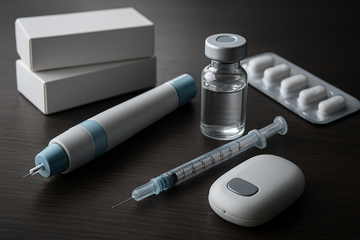
Novo Nordisk's Awiqli Just Won the Once-Weekly Insulin Race — and Insulet, Sanofi, and the Daily Refill Cycle Are Now on the Clock
On March 26, 2026, Novo Nordisk secured the first FDA approval of a once-weekly basal insulin for Type 2 diabetes — Eli Lilly's rival efsitora is still awaiting a Q3 2026 decision. The launch reframes a $7.7B basal insulin market built on daily injections, hands Insulet's Omnipod and Sanofi's Lantus franchise a slow-burn substitution risk, and gives Dexcom and Abbott CGMs a fresh adjacencies tailwind as adherence-flavored prescribing returns to the conversation.
Novo's New Strategy Hinges On Trust It Hasn't Earned — And The GLP-1 Re-Rating Now Hangs On Quarterly Execution, Not Pipeline Promises
Novo Nordisk's September 21, 2026 Capital Markets Day framed its 2030 ambitions around rebuilding credibility, yet the actual targets — sales growth \"in line with peers,\" an adjusted operating margin target near 36% versus 41% today, and >5 multi-blockbusters whose lead asset (CagriSema) just lost a head-to-head trial to Eli Lilly's Zepbound — formalize a credible but unspectacular trajectory. The stock fell 8% on the day and still trades at ~9.9x trailing earnings versus Eli Lilly's ~39x, a valuation gap that is the credibility gap. For investors, the question is no longer whether Novo can outgrow the field; it is whether management can deliver in line with the lower bar it just set, while the orforglipron era and a US$15B-plus generic-compound overhang reshape pricing.
2026-09-23

Anthropic Bought What OpenAI Couldn't Win — Direct Distribution to 757,000 U.S. Doctors
Anthropic's September 22, 2026 partnership with OpenEvidence sidesteps the EHR-gatekeeper problem OpenAI tried to crack with Epic, handing Claude the physician's first-click layer across 757,000 verified U.S. clinicians and ~100 low- and middle-income countries — a quietly pivotal pre-IPO distribution proof point for Anthropic's targeted October 2026 Nasdaq listing at a $965B valuation.

Novo Nordisk's Direct Listing Talk Won't Fix the Pipeline — But It Will Re-Price the Whole GLP-1 Trade
Novo Nordisk (NYSE: NVO) CEO Mike Doustdar told the FT he is open to replacing the company's American Depositary Receipts with a direct NYSE listing — a structural upgrade, not a fresh raise. The angle investors are missing: at 9.9x trailing P/E versus Eli Lilly's (NYSE: LLY) 39.2x, Novo trades at a discount that no longer reflects the operating reality (43.1% operating margin, DKK 78.5B Q2 sales). A direct listing would compress that gap before it would fix the CagriSema pipeline miss. The Danish krone, the obesity-pill race, and Catalent all sit on the same transmission line.
2026-09-22

Europe's Pharma Chiefs Beg Governments for FDA-Speed Trials — Confirming a Permanent Moat for US Drug Stocks
On September 22, 2026, the chairs of nine European drugmakers — AstraZeneca, GSK, Novo Nordisk, Novartis, Roche, Sanofi, plus Boehringer Ingelheim, Chiesi and Ipsen — went public with an open letter demanding faster trials, bigger R&D budgets, and stronger IP protection to keep pace with the US and China. The first-of-its-kind lobby admission puts hard numbers behind the FDA's structural speed advantage: 356 days to approve a new drug versus 430 in the EU, with the EU's share of global clinical-trial starts collapsing from 22% to 12% over a decade. Three European pipeline setbacks this summer — AstraZeneca's Wainua Phase III miss, BioNTech's cancer-vaccine halt and Novartis's del-desiran failure that wiped ~$30B of market cap — turned the abstract competitiveness gap into a balance-sheet event. For US-listed pharma, the message is unambiguous: the FDA's speed edge is now a self-confessed EU policy failure, and investors should price it as a permanent moat.

Iambic's $461.8M Filing Plants Frontier-AI Compute on the Biotech Cap Table — and the S-1 Burn Curve Is the Cleanest 2026 Read Yet
Iambic Therapeutics filed an S-1 on September 21, 2026 with NVIDIA and Qatar Investment Authority already on the cap table, raising $461.8M in private rounds across a multi-trillion-dollar pharma-roster of partners. The thesis the market has been inferring from private markups on Isomorphic Labs and CuspAI is now testable on a public exchange: AI compute dollars are landing inside clinical-stage biotech, and the IAMB, biotech plus BRVE/LTGO read-throughs set the price discovery for the first priced frontier-AI biotech IPO.

Obamacare's 750K Purge Leaves a Sicker, Smaller Pool — Insurers Catch a Margin Tailwind, Hospitals Catch a $1B Payer-Mix Hit
The Vance-led task force cut 760,000 from ACA exchanges at the end of August and flagged 419,000 more for verification, claiming $2.2B in taxpayer savings. The same-day market response was surgical: Oscar Health fell as much as 6.6%, Centene 3.9%, Molina Healthcare 3.5% — but the bigger story is the asymmetric second-order effect. Healthier enrollees disproportionately leave exchange coverage, the sicker pool remains, and Centene just raised its 2026 marketplace pretax-margin guide to 4.5%–5%. Hospitals bear the offsetting cost: HCA Healthcare now sees a $1B–$1.2B full-year payer-mix hit, with Tenet Healthcare exchange revenue down 17% and Community Health Systems self-pay rising above 6% of visits.
2026-09-21

2026-09-19

Anthropic's life-sciences verification program turns frontier biology access into a governance gate — and the bottleneck moves from training compute to who gets certified
Anthropic's Sep 17, 2026 launch of the Life Sciences Verification Program reframes AI biotech as a procurement problem: who gets Mythos-class access for biology work now depends on credentials, ethics oversight, and 30-day monitored retention — not just a credit card. Verified ICON and Novo Nordisk lock in first-mover integration deals; Generate Biomedicines, Recursion, and Charles River Laboratories face a verified-access reckoning; WuXi AppTec gets isolated on the wrong side of a new compliance frontier.

The $949M Omnicare Verdict Just Closed. The $290M Behnke Ruling Is Why Tort Risk Now Outweighs FTC Risk at CVS Health
A federal bankruptcy court approved CVS Health's Omnicare wind-down plan on Sept. 17, 2026 — closing the $948.8M False Claims Act chapter that started with a 2025 jury finding3.3 million fraudulent long-term-care claims. But the more durable story sits beside it: a parallel $289.9M judgment against CVS Caremark for Medicare Part D 'spread pricing,' now on appeal to the Third Circuit, turns PBM economics from a regulatory line item into a per-incident tort variable. With Cigna's Express Scripts and UnitedHealth Group's OptumRx facing the same exposure, the bull case for vertical PBM-plus-payor-plus-retail has to absorb $1.2B of legacy litigation charges and a $5.7B goodwill impairment already in CVS's FY2025 books.
2026-09-18

Anthropic Built a Wet Lab to Run Its Own Drug Programs. The Losers Are Not Charles River or WuXi — They Are the AI Biotechs Without a Pharma Partner.
Anthropic has quietly stood up a physical biology laboratory in the San Francisco Bay Area to run drug science internally, Reuters reported on Sept. 18, 2026, making the Claude maker the first frontier-AI developer to operate simultaneously as a tool vendor and a first-party drug sponsor. The pivot from biosecurity gatekeeper — Anthropic's Responsible Scaling Policy v3.0 still gates CBRN capabilities at ASL-3 — to wet-lab drug developer does not displace the order books of Charles River Laboratories or WuXi AppTec in 2026: CRL just raised full-year guidance on the strongest biotech book-to-bill in nearly four years, and WuXi AppTec grew H1 2026 revenue 38.9% year over year and lifted guidance by 14%. The actual read-through is structural: standalone AI biotechs like Recursion — Q2 2026 revenue down 60% year over year as the Roche collaboration rolls off — face a two-front squeeze as compute-rich AI labs (Anthropic, Alphabet's Isomorphic) run their own pipelines and pharma giants (Eli Lilly, Novo Nordisk) internalize Claude as the new standard tool.

The BIOSECURE Crack: US Quietly Drafting Rules to Keep Pharma Licensing With China Alive
Reuters reported Sep 18, 2026 that US Treasury is drafting investment rules that would let drugmakers keep striking most licensing deals with Chinese biotechs — a quiet reversal from the BIOSECURE-era decoupling that wiped out WuXi AppTec's US customer pipeline and triggered a Charles River Laboratories bidding war. If finalized, the framework rewrites the bear case on the China CRDMO duopoly (WuXi AppTec and WuXi Biologics), unlocks the backlogged pipeline at Innovent Biologics and Jiangsu Hengrui, and removes the geopolitical hair from the US clinical CROs (IQVIA, ICON).
2026-09-14

The $48.7B Kenvue Bid Now Hinges on a Brand-by-Brand EU Carve-Out — Feminine Hygiene Is the Lever
Kimberly-Clark's $48.7 billion acquisition of Kenvue is down to a 15-day clock in Brussels. With the European Commission's preliminary review ending September 29 and Kimberly-Clark already 'readying concessions' (Reuters, Sep 14), the deal's binding constraint is no longer premium or financing — it is which Carefree, Stayfree and o.b. assets Kimberly-Clark must divest to clear the EU's only true horizontal overlap, feminine hygiene, where Kimberly-Clark's U by Kotex already runs against Kenvue. Australia's identical prescription (Carefree/Stayfree forced sale, Sep 2) and Essity's rapid purchases of Edgewell's NA portfolio ($340M, Feb 2026) and Kenvue's Brazilian Carefree/Sempre Livre/o.b. ($284M, Aug 2026) sketch the divestiture template and the buyer universe. For investors, the EU decision sets the precedent for the next US-EU consumer-health merger wave and decides whether Kimberly-Clark keeps the bulk of a category it already controls in roughly half its markets.

Lilly Drops a Bombshell at Morgan Stanley: Zepbound Now Holds 30%+ of New Starts in the Oral GLP-1 Category
Eli Lilly used today's Morgan Stanley healthcare fireside chat to claim Zepbound now controls more than 30% of new starts inside the oral GLP-1 category, framing Foundayo as the funnel and tirzepatide as the destination. The disclosure reframes the Novo Nordisk vs Lilly pill war: Foundayo's $98M Q2 looks small next to oral Wegovy's ~$496M, but Lilly's broader tirzepatide franchise is converting oral starts into injectable revenue at a pace that compresses the strategic value of a stand-alone pill.
2026-09-13

What to expect
Evidence-first notes with a visible point of view.
This section collects sharp takes on earnings, shareholder meetings, and market structure. Each new piece should make the thesis, the facts, and the implications obvious within the first few screens.
Expect direct analysis, not generic commentary.
Expect the data to be explicit and the argument to be easy to follow.