Data Centers & Cloud
The buildout behind the AI bill
Hyperscaler capex, colocation supply, power, cooling and networking — where the money goes after the GPU order, and which companies book it.
2026-11-02

A 1GW Outback Deadline Just Vanished — and $586.6B of Hyperscaler Capex Still Assumes Permitting Is Never the Bottleneck
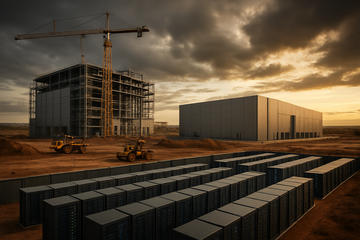
Regulators, not megawatts, now set the pace of AI capacity. After the Northern Territory's environment regulator suspended its own deadline to set environmental parameters for Energy North's 1GW Project Ares, the developer told Reuters it had abandoned the June 28, 2028 first-power date lodged with its referral four months earlier. That is the same fault line Microsoft described three weeks later, when September-quarter capital expenditures of $45.2 billion came in short of plan because third-party capacity deliveries were delayed, cutting its calendar-2026 spending forecast to roughly $170 billion. Amazon, Microsoft, Alphabet and Oracle have put $586.6 billion of property and equipment on the ground in the trailing twelve months, and every dollar assumes permits, connections and equipment land on one calendar. The investable consequence is not to short the equipment chain, which is paid on order, but to underweight capacity operators whose revenue starts at energization and whose balance sheets cannot wait for a regulator.

MaxLinear Beat and Raised, Then Fell 25% in a Month: 92% of Its Growth Comes From One Product Line, and the 1.6T Payoff Lands in 2027
MaxLinear beat on revenue and earnings, guided fourth-quarter sales about 10% above consensus and raised its 2026 optical data-center outlook to $250-270 million on October 22, 2026 — and the stock fell 13.9% that day, then 25% over the following month. The tape is not mispricing the quarter; it is repricing where the AI connectivity profit pool actually sits. Infrastructure supplied $84.6 million of the $91.6 million year-over-year revenue increase, the 2026 optical ramp is 800G silicon with 1.6T revenue only starting in early 2027, and the company booked $28.9 million of GAAP net income while consuming $13.6 million of operating cash. At roughly eight times estimated 2026 sales, MaxLinear is now a bet that 1.6T optics and active-copper silicon convert into cash in 2027 and 2028.
OpenAI's “AI Compute Campus” Push Is a Permit Strategy — and 843 Opposition Groups Say Why
OpenAI will relabel its data centers as “AI compute campuses” and push state legislation that gives residents a say in how projects are built, launching the push right after the Nov. 3 midterms. Read as strategy rather than branding, the campaign times a vocabulary push to the moment state lawmakers write the rules, in a year when 843 local opposition groups and roughly $200 billion of stalled projects have made site selection the binding constraint on AI capacity. For investors, the winners are the balance sheets that already own the permits, the power and the credit: the chip vendor whose balance sheet now backs the landlord's leases, the equipment makers, and the utilities whose rate base grows only if the compact holds. The label matters because the first public prospectus to use it will set the terms for everyone who follows.

SpaceX Throttled Grok Bot Because Serving Cost Exceeded Revenue — Twelve Days After Musk Said Its Compute Pays Back in Under a Year
On Nov 1, 2026, Elon Musk said the cost of serving Grok Bot was “unsustainably high relative to revenue” and confirmed tighter weekly limits after subscribers burned through their allowance. Twelve days earlier, on SpaceX's third-quarter earnings call, he told investors something very different about the same hardware: new compute deployments were generating a payback of less than a year at pricing above the top of the $30–50 per watt range. Both statements are true, and the gap between them sets the new floor for consumer AI — enterprise compute sells, flat-priced consumer agents do not. The beneficiaries are the vendors who never sold a flat subscription for agentic work: upstream silicon, ad-monetized apps and metered cloud seats. The labs carrying the biggest capex budgets have to reprice first.
2026-11-01

Veralto's Water Quarter Priced AI's Second Constraint — and the Trade Is Permitting, Not Scarcity
Veralto has published the sharpest listed-company evidence yet that the AI buildout's second constraint is being paid for. In the quarter ended Oct. 2, 2026, Water Quality core sales rose 6.4% with double-digit growth in water treatment solutions, North America grew 8.8%, and data center sales doubled off a small base — while China and Latin America contracted. That split is the argument: the company is growing where new permits force operators to monitor, treat and report water, and shrinking where water is scarce but nobody has to prove it. The order book is real — Xylem logged data center orders up more than 200% — yet data centers are on track to be just 2% of Xylem's revenue and an undisclosed sliver at Veralto, so this is an option on permitting rules, best expressed through recurring industrial water revenue rather than municipal metering or data center capex.
46 Turbines Without Permits, a Denied Dismissal: The Memphis Ruling Reprices How 130 GW of AI Power Gets Built
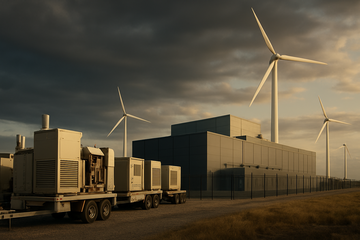
On Oct. 30 a federal judge in Mississippi refused to dismiss the NAACP's Clean Air Act citizen suit against xAI and its affiliate MZX Tech over the gas turbines powering the Colossus 2 data center in Southaven, sending the case into discovery. The claim attacks the trick behind the meter — trailer-mounted units classified as 'mobile' and run without air permits — which is how AI campuses sidestepped interconnection queues now running 36-84 months. Because SpaceX now carries the claim in its own filings alongside $40.0 billion of nine-month AI-segment capital spending, the investable read-through is that time-to-permitted-megawatt matters more than time-to-megawatt: value migrates to fast-to-permit equipment and grid-side suppliers, and away from operators who treat permits as optional.

A Judge Put AI's Power Build-Out on a Court Calendar: xAI's 59 Unpermitted Turbines, $40 Billion of Quarterly AI Capex, and the New Premium on Permitted Power
On October 30, 2026, Judge Debra M. Brown of the U.S. District Court for the Northern District of Mississippi denied xAI's motion to dismiss the NAACP's Clean Air Act suit over the gas turbines at the Colossus 2 site in Southaven, Mississippi, rejecting the arguments that citizen suits are unconstitutional and that temporary mobile turbines escape federal permitting. The shutdown question is still open — a preliminary injunction filed in May remains undecided — so what changed is not the power flow but the price of everything built on top of it. That matters because SpaceX spent $40.0 billion on AI-segment capital expenditure in the first nine months of 2026 while the fleet that feeds those servers has no federal permit to operate. For investors the ruling reprices fast, behind-the-meter gas against permitted, contracted power: GE Vernova is selling into a 122 GW gas backlog, Constellation Energy is signing 20-year nuclear agreements, and CoreWeave is trying to service $51.6 billion of debt against compute that only works if the power is lawful.
2026-10-31
NVIDIA's $108.5 Billion of Guarantees Covered OpenAI. A West Virginia Neocloud May Be Next
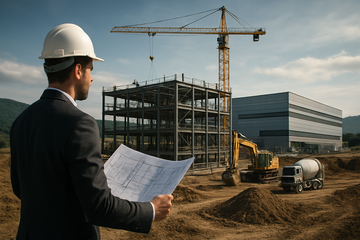
NVIDIA is in talks to guarantee billions of dollars of construction debt for the first 460MW building of Nscale's Monarch campus in Mason County, West Virginia — the site of a six-year, $44.6 billion compute deal with Anthropic — using a residual value guarantee that would let the chip vendor take over the site if the build fails. The instrument is not new: NVIDIA's Q2 fiscal 2027 filing already carries $108.5 billion of off-balance-sheet guarantees, $105 billion of it supporting OpenAI's Ohio lease at SB Energy, alongside $279 billion of supply and capacity commitments. What is new is the counterparty: Nscale's Sept 18, 2026 IPO filing shows $1.48 billion of cash against $27.5 billion of equipment and construction commitments, while Anthropic reported an $80.7 billion first-half net loss of its own. Read the reported guarantee as NVIDIA underwriting a building in a grid-constrained state, not as a sale of more silicon.

Self-Storage Just Beat and Raised — and the AI Buildout Is Starving Its Supply
All three major self-storage landlords raised 2026 guidance inside five days, and CubeSmart's Q3 print on Oct. 29 was the cleanest: $0.66 of FFO per share against a $0.65 consensus, same-store NOI up 2.1% and occupancy up 60 basis points. The engine is supply, not consumers —2026 deliveries are the smallest since 2016 while AI campuses bid up the same land, labor and power. The fashionable \"storage land is an AI-campus option\" story turns out to be real but narrow: two Pennsylvania land deals 60 miles apart price the same asset 23x apart, so the trade is the NOI inflection, and at 16.5 times guided FFO the equity has already paid for it.
2026-10-30
Alliant Energy Wants 1 GW of Data-Center Contracts in Six Months — but the Bottleneck Is a Rate Docket, Not a Turbine
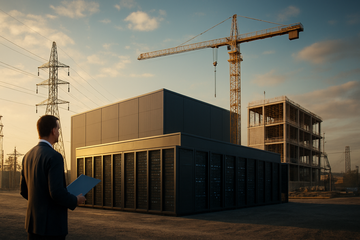
Alliant Energy's chief financial officer said on October 30, 2026 that the company expects to sign roughly one additional gigawatt of contracted data-center load within six months, on top of the 3.4 GW already under contract with Alphabet, Meta and QTS. That headline is a capital decision dressed as a sales win: at the CFO's own $2–3 billion of capital per gigawatt, one more gigawatt is about 13% of a five-year program now worth $18.8 billion and requires roughly $800 million to $1.2 billion of new equity. The revenue clock does not start at the signature — Alliant's own process runs from electric service agreement to individual customer rate approval to construction, and management expects the Wisconsin decisions that unlock the new load in the first half of 2027. The equipment chain is paid at order and delivery in 2028–2029 while the utility waits for rate cases that push earnings into 2030 and beyond, which is why the AI load trade is cleaner expressed through the supply chain than through the utility's balance sheet.

AWS Grew 39% and Amazon Fell 7%: Big Tech's $720 Billion Capex Year Now Trades on Funding, Not Growth
Amazon delivered the cloud acceleration investors asked for — AWS revenue up 39% to $46.0 billion, AWS operating income up 55% to $17.8 billion, a record 13.9% consolidated operating margin — and the stock still fell about 7% after hours on Oct. 29. The reason is arithmetic, not disappointment: Amazon spent $77.3 billion on property and equipment against $42.4 billion of operating cash flow, pushed trailing free cash flow to an outflow of $42.4 billion, and funded the gap with $48.1 billion of new long-term debt in a single quarter while buying back no stock. With the four largest hyperscalers guiding to roughly $720-740 billion of 2026 capital spending against about $677 billion of combined operating cash flow, the market has stopped paying for cloud growth on its own and started paying for how that growth gets financed — a repricing that cuts both ways across memory, power and neocloud credit.
xAI's 418-Home Buyout Slips Through Treasury's Home-Buyer Ban. The Rental REITs Don't
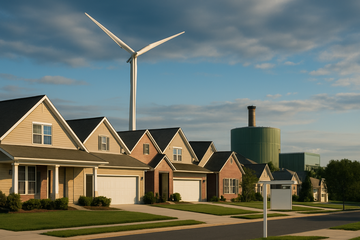
xAI's Southaven subsidiary is offering to buy up to 418 homes for roughly $75.24 million, conditioned on owners releasing a June 2026 noise class action against the 1.2 gigawatt turbine plant behind Colossus 2. Read against Treasury's proposed ROAD to Housing Act rules, the buyout shows the compute buildout can buy its way out of local risk with property while the January 7, 2027 ban lands on housing REITs instead: a temporary-and-incidental carve-out most likely leaves xAI outside the definition of a large institutional investor, while Invitation Homes' 86,192 homes sit 246 times above the 350-home trigger. The tradable split is upstream, where turbine orders keep coming whoever wins the siting fight, and inside the housing names, where acquisition-led growth and development-led growth no longer deserve the same 13.7x multiple.
2026-10-29

Alphabet's 10% Drop Was a Funding Verdict, Not a Demand Verdict: Cloud Doubled, Cash Flow Went Negative, and 2027 Has No Number
Alphabet reported Q3 2026 on Oct. 28, 2026 with revenue of $127.6 billion, up 25% year over year, and Google Cloud revenue of $30.7 billion, up 103% with segment operating income more than tripling to $11.1 billion. Shares still fell more than 10% in after-hours trading and market capitalization slipped below $4 trillion, because the quarter carried $51.4 billion of capital spending, $9.1 billion of negative free cash flow, and a promise that 2027 spending will increase significantly with no number attached. Holding the unchanged $195-205 billion guide now requires $63.0-73.0 billion in Q4, and the suppliers of servers, memory and power are already being paid while the owners of rented compute are being repriced by a credit market in distress.

Ares Just Declined AI Chip Financing. The Money Still Exists — It Now Costs SOFR+550
On October 29, 2026, Ares Management chief executive Michael Arougheti said his firm would not underwrite financing against AI chips, because it cannot model how fast GPU residual values decay; Ares will concentrate on the roughly $2 trillion of data-center shells and power inside a greater-than-$5 trillion AI capital spending need through 2030. That is an underwriting standard, not a funding shortage: roughly $500 billion of AI-related debt was issued in 2026, the marginal compute-backed loan printed at SOFR+550, and 18 data-center financings now yield double digits. The gap is being filled by bank syndicates arranged by JPMorgan Chase and Mitsubishi UFJ Financial Group, by vendor and borrower balance sheets — including residual-value support of up to 25% from Nvidia, $30.2 billion of funded debt at CoreWeave and $5.1 billion of trailing interest expense at Oracle — and by fee-based platforms from Apollo Global Management, Blackstone, BlackRock, Brookfield Asset Management, Goldman Sachs and KKR, whose $500 billion headline is a mobilization target rather than committed capital. For investors, the shift matters less for who is bullish on AI than for where the residual risk now sits: outside the private-credit funds that built the AI lending playbook, and increasingly back on the vendor's own balance sheet.

Microsoft's $45.2 Billion Quarter: Azure's First Dollar Number, a $10 Billion OpenAI Check, and the Capex Guide That Now Funds the AI Trade
Microsoft's September quarter made the AI build auditable for the first time: Azure revenue of $33.165 billion disclosed in dollars, $10.0 billion of revenue from OpenAI (about 11% of sales), and $45.2 billion of capital spending that came in below the $50.7 billion consensus and still rose 30% year over year. CoreWeave, Nebius and IREN fell 3% to 5% anyway, because in this market Microsoft's own capital plan has become the funding variable for everyone who builds compute on Microsoft's behalf — and the quarter's miss was mostly a shift of leases from finance to operating, with cash capital spending up 103% and December-quarter spending guided above $50 billion. The deeper risk is concentration and cash: trailing free cash flow fell 38% to $60.0 billion while revenue rose 18%, receivables grew 85% year over year, and the revenue-sharing component of the OpenAI relationship is capped at $38 billion through 2030.
2026-10-28

Insurers Are Now the Risk-Sink for AI Compute: Barclays Is Buying Credit Protection on More Than $10 Billion of Data-Center Debt
Barclays is buying default protection from insurers on more than $10 billion of AI data-center debt, and has asked them to carry more than 50% of the credit risk on some facilities. The bank keeps the loan, the fee and the client; the loss-given-default moves to insurer balance sheets, where capital is thinner, disclosure is thinner and shareholders are mostly retirement savers. The ask is roughly twice the size of the entire 2025 global synthetic risk-transfer market for bank credit, and it lands while about $37 billion of the $80 billion in data-center bonds issued in 2026 is junk rated and CoreWeave's five-year credit default swaps have topped 1,140 basis points. This is the mechanism investors should track: the AI credit tail is migrating out of bank capital into the least-supervised layer of the financial system.

F5 Grew Revenue 13% and Adjusted EPS 0.7%, Then Fell 20%: The AI Tollbooth's Margin Now Sets Upstream
F5 beat its own guidance on Oct 27, 2026 — revenue of $917 million, up 13%, and adjusted EPS of $4.42 against a $4.26 consensus — and the stock still closed Oct 28 down 20.4% at $365.53, because the fiscal 2027 guide converts 8%–9% revenue growth into just 2.9%–4.6% adjusted EPS growth and cuts gross margin to 80.5%–82.5% from 84.0% on memory and storage costs. The AI demand F5 monetizes is real: direct AI bookings topped $100 million in fiscal 2026, up nearly 300%, and customers deployed 29.2 terabits of F5-powered AI data delivery capacity in the fourth quarter alone. But two-thirds of that fiscal 2026 growth came from systems hardware, the one layer the AI buildout taxes, and the same three months handed Micron an 86.8% gross margin and SK hynix an 80% operating margin while F5 turned $107 million of incremental revenue into $6 million of incremental operating profit. The traffic F5 carries is funded from enterprise and government security budgets, not from hyperscaler capex — so the toll is genuine and early, and it is priced as a volume story that nobody has yet shown converts into earnings.

Vertiv's +16.7% Priced AI's Power Chokepoint: $4.1 Billion Prepaid Before Delivery While NVIDIA's Margin Kept Rising
Vertiv's third quarter is the first reported period in which the binding constraint on AI infrastructure showed up in a price rather than in a shipment delay: net sales of $4,313 million beat the top of its own guidance by 12%, adjusted operating margin expanded290 basis points to 25.2%, and customers had already prepaid $4.12 billion for power and cooling gear they had not taken delivery of. The money did not leave the chip layer, where NVIDIA's gross margin actually rose to 75.0%; it queued up in the power chain, which is why electrical OEMs are expanding margin, installers are not, and hyperscalers are funding the premium with debt and negative free cash flow.
2026-10-27

Amazon's Anti-Tokenmaxxing Memo Puts $220 Billion of AI Capex on Trial, Two Days Before Earnings
On October 27, 2026, Amazon published an updated software-engineer role guideline telling managers that token usage, AI-tool adoption rates and code-change counts are \"deeply flawed\" measures — and that \"tokenmaxxing is at odds with frugality.\" It lands two days before third-quarter results, in a year Amazon raised 2026 capital expenditure to about $220 billion on higher memory prices and saw trailing free cash flow swing to an outflow of $7.6 billion. The signal is not weaker AI demand but a change in the unit of demand, from tokens sold to tasks completed, which protects cloud utilization and upstream memory economics while compressing the metered-token revenue labs are building an IPO on. Third-quarter guidance of 9% to 12% net sales growth, against 20% in the second quarter, is the near-term test of whether discipline arrives before the bill.

Apollo's near-10% stake in Mubadala Capital makes Abu Dhabi the cheapest funder of AI data centers
Apollo's Oct. 26, 2026 agreement to take a minority stake in Mubadala Capital — with Apollo and other strategic investors committing a combined $5 billion to Mubadala's strategies at initial close — is a plumbing deal, not an acquisition: it converts a sovereign balance sheet with $385 billion of assets into permanent, fee-paying capital for the private-credit funds that now finance AI data centers. The timing is the story. Apollo led a $40 billion GPU master lease for SpaceX the same day, hyperscalers have lifted debt-funded capex from 9% of spending in fiscal 2024 to 32% on a trailing basis, and Carlyle estimates private credit alone could finance about $1 trillion of AI compute. Sovereign money lowers the cost of that credit at exactly the moment public markets are repricing it — CoreWeave bonds yielded 15% to 16% in mid-October with credit-default swaps near 1,200 basis points — so the risk does not disappear; it migrates into books that mark far less often than a bond does.
What to expect
Evidence-first notes with a visible point of view.
This section collects sharp takes on earnings, shareholder meetings, and market structure. Each new piece should make the thesis, the facts, and the implications obvious within the first few screens.
Expect direct analysis, not generic commentary.
Expect the data to be explicit and the argument to be easy to follow.