Data Centers & Cloud
The buildout behind the AI bill
Hyperscaler capex, colocation supply, power, cooling and networking — where the money goes after the GPU order, and which companies book it.
2026-09-18

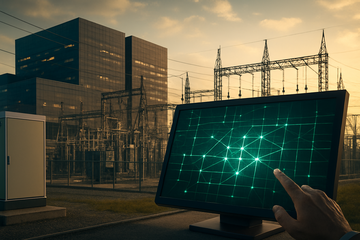
The Grid Becomes a Scheduler: Emerald AI's AEMA Turns 100 GW of Hyperscaler Power Into an Auctionable Resource
Alphabet, NVIDIA, and Anthropic just placed a shared demand-response layer at the center of the AI buildout. By standardizing on Emerald AI's software inside the new AI Energy Management Alliance, hyperscalers convert grid access from a siting moat into a software-mediated commodity, and the marginal dollars flow to the utilities, OEMs, and builders who can credibly deliver flexibility at gigawatt scale.

Salesforce's $63B FY30 Target Hides a 50% ARR Test for Agentforce — and $300M a Year Already Going Out the Door to Anthropic
Salesforce raised its fiscal 2030 revenue target to $63B+ at Dreamforce, four months after lifting it from $60B+ to bake in Informatica. The implied ~11% organic CAGR is mostly arithmetic from the $41.5B FY26 base — the harder question is whether Agentforce can compound at ~50% a year for four more years to carry the back half, while ~$300M of 2026 token spend flows out to Anthropic and competing agent platforms at Microsoft, ServiceNow and Oracle set the pace.
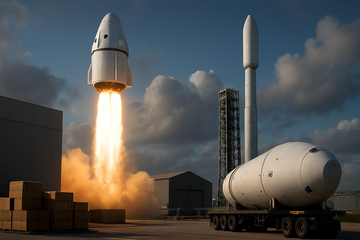
SpaceX locks in $5.92B of NASA crew work as Boeing's Starliner slides a decade late
NASA awarded SpaceX $946M on Sept 18, 2026, for three more ISS crew rotations, lifting its Commercial Crew contract to $5.92B and 17 flights — solidifying SpaceX as the government's de facto astronaut transport through 2030. Boeing loses ~$500M from a six-to-four-mission downgrade on Starliner, faces a potential 2027 certification slip, and now must recertify the spacecraft on a rocket other than the retiring Atlas V, with Lockheed Martin and L3Harris caught in the supply-chain ripple.
2026-09-17
2026-09-16

A $22B bank 'chip loan' to Blackstone's Alphabet JV lands the same day Warsh hikes — turning AI compute into the Fed's newest collateral class
Ten banks are underwriting $22 billion for Crux AI, the Blackstone–Alphabet TPU cloud venture — a bank-led, asset-backed structure with chips, not corporate guarantees, on the hook. Hours later, the Fed under Kevin Warsh raised rates 25 bps to 3.75%–4.00% and penciled in two more hikes, putting a rate-sensitive funding leg at the center of the AI buildout. The combination quietly rewrites who funds hyperscaler capex: a new Broadcom-anchored collateral class that Wall Street banks — led by Morgan Stanley and including JPMorgan, Citi, BofA, Goldman Sachs and Wells Fargo — now bear directly, with the Fed setting the marginal price.
New York's $1M-per-MW Rule Turns AI Capacity Into a Political-Credit Trade
Governor Hochul's new Host Community Investment Framework pairs a 50-MW permitting freeze with a recommended $1 million per megawatt community investment benchmark — turning New York's roughly 10 GW data center pipeline into a bidding contest for local political capital rather than a pure interconnection queue. Vendors whose orders are priced for speed and operators concentrated in New York/New Jersey carry the most direct exposure; alternative markets such as Virginia and Texas absorb the marginal projects.
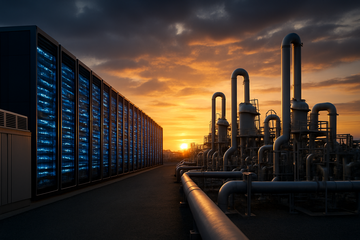
BNEF: US Data Centers Could Burn More Gas Than Germany and Japan Combined by 2035
BloombergNEF's New Energy Outlook 2026 says AI data centers will add ~15 Bcf/d of US natural-gas demand by 2035 — roughly matching Germany and Japan's combined current consumption — making US data centers the world's fifth-largest gas user. The 117% upward revision from BNEF's December forecast destroys the 'clean AI' narrative and re-prices gas-turbine OEMs, midstream pipelines, and behind-the-meter IPPs as structural beneficiaries while pressuring hyperscaler net-zero pledges.

Musk Is Sleeping in a Trailer to Get xAI's Next Gigawatt Online — What That Tells the AI Compute Trade
On September 15, Elon Musk said he is living in an Airstream trailer in Memphis to personally oversee what he called xAI's \"biggest expansion yet\" — a Memphis-to-Southaven buildout that takes the combined Colossus cluster to roughly 2 gigawatts and ~555,000 GPUs. The same playbook Musk ran on the Model 3 line now applies to compute, and it is already reshaping the supply chain: NVIDIA is guiding to $108B of Q3 revenue on Blackwell, Alphabet and Amazon-backed Anthropic are paying SpaceX ~$26B a year for capacity, and Tesla' Megapack division has become the project's battery of choice.
2026-09-15
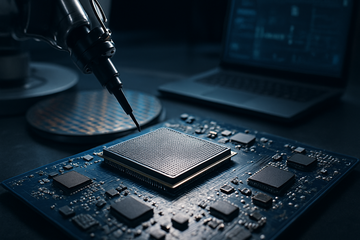
Axelera's Europa Hits EU AI Factories—Not U.S. Hyperscalers. The Foundry and OEM Links Tell the Real Story
Axelera AI shipped its second-generation Europa inference chip and signed 'tens of millions' of dollars in AI-factory contracts on Sept. 15, but the buyers are EU governments, Dell Technologies-led consortia and validated OEMs—not Microsoft, Amazon or Alphabet. The supply chain now has real exposure: TSMC and Samsung Electronics as foundries, Andes Technology for RISC-V control, and Dell and Supermicro as the validated OEM channels. With a $1.5B sales pipeline against 'tens of millions' in signed deals, the question for investors is how much of Europe's €30B AI gigafactory program converts into inference-ASIC orders.
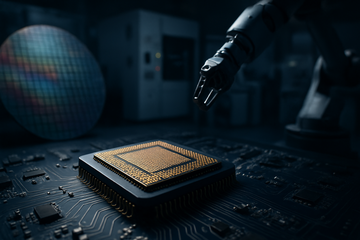
Mobile AI just landed on TSMC's 2nm: MediaTek's Dimensity 9600 Pro makes the advanced-node queue a 2027 on-device bet, not just a hyperscaler story
MediaTek launched the Dimensity 9600 Pro on September 15 — the first Android flagship on TSMC's N2P 2nm node, with Apple's A20 Pro shipping September 9 and Qualcomm's Snapdragon 8 Elite Gen 6 Pro due September 22. The launch locks mobile into the same advanced-node queue as Nvidia-class AI silicon, and the rumored $216/$280/$300+ unit-price gap will decide who funds TSMC's 100K-wafer/month 2nm ramp. Read-throughs: MediaTek's smartphone revenue fell 22% YoY in Q2 even as Smart Edge Platforms rose 26%, TSMC's August monthly revenue hit a record NT$514.8B (+53.3% YoY), and the LPDDR6 cycle at SK Hynix and Micron is now tied to the same 2nm wave.
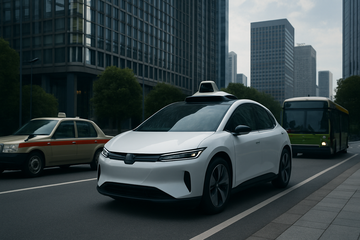
Alphabet's Waymo pins a 2027 Tokyo launch on Nihon Kotsu — putting Tesla's Cybercab export and Mobileye's robotaxi ramp on the clock
On Sep 15, 2026, Waymo, Nihon Kotsu, and GO formally agreed to launch Japan's first commercial driverless taxi service in 2027, starting with a small fleet and scaling toward ~100 vehicles in central Tokyo. The move lands a US-stacked L4 platform on Japanese roads a year ahead of Tesla's Cybercab narrative and runs parallel to Mobileye's own US-city robotaxi launch plan for 2027. Investors should focus on three transmission lines: Hyundai Motor as the IONIQ 5 supplier underpinning every Waymo geography, GO as the distribution rail replacing Alphabet's US ride-hailing app, and the Japanese L4 players — Toyota, Honda, and Tier IV — whose domestic timelines just got crowded.
2026-09-13

Alphabet's $200B AI Bet Just Crossed the Proof Line — But the Stock Market Is Trading the Wrong Alphabet
Alphabet's Q2 2026 results showed Google Cloud revenue up 82% to $24.8B, operating income up 30% to $40.8B, and a $514B backlog — yet GOOGL fell 7.2% on a -$5.9B free-cash-flow print and a $195-205B capex hike, while the bond market awarded the same issuer a $25B offering 4.6x oversubscribed at sub-100bps spreads. Google Cloud CEO Thomas Kurian disclosed a sub-two-year payback on AI servers and a roughly one-year payback on Google's own TPU silicon. The mispricing is the trade: equity still behaves like a credit-risk hyperscaler, while the corporate bond market already treats Alphabet like an AI cashflow compounder.

Xi's BRICS AI Coalition Hands Nvidia, Cisco and the US Hyperscalers a $50B Sovereign-Compute Ceiling—And the China Revenue Is Already Zero
At the 18th BRICS Summit on Sep 12, 2026, Xi Jinping's delegation proposed a BRICS AI open-source community, a digital ecosystem cloud platform, and smart-factory buildouts across 11 member states—a formalization of the parallel AI stack that has already pushed NVIDIA's China Data Center revenue to zero. With Huawei, Cambricon and Alibaba's T-Head now generating roughly $20B of annual AI-chip and AI-cloud revenue and a sovereign-AI market projected to grow from $50B in 2026 to $249.5B by 2035, the binding constraint on NVIDIA, Cisco, Microsoft, Amazon and Alphabet is no longer whether they keep China, but whether the rest of the bloc buys from anyone but them.

Nscale's Simo Board Seat Isn't a Hire — It's a $30B IPO Distribution Play
Nscale added former OpenAI applications chief Fidji Simo to its board on September 11, 2026, hours after disclosing a $103B contracted-revenue backlog and a $3.5B pre-IPO convertible round at a $30B valuation cap. The board stack — Sandberg (Meta network), Clegg (EU policy), Decker (Yahoo financial discipline), now Simo (OpenAI/consumer distribution) — reads less like governance and more like a roadshow war room. With the Anthropic $45B compute deal and a CoreWeave-comparable backlog, Nscale is pricing into the public market at roughly 60–75x EV/sales, nearly 5x CoreWeave's multiple.
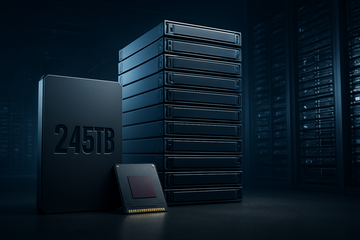
OpenAI's 1B-User Habitat Reveal Confirms a Second AI Capex Wave—And the Better Storage Trade Isn't Seagate
OpenAI's Sep 11 engineering post on its Habitat online store—70M requests/sec, 500+ petabytes, ~40 regions—turns the storage tier into a measurable AI capex line, and OpenAI is separately shopping ~5 exabytes. Seagate is sold out through 2027 on HAMR and the HDD trade still works, but Micron's shipping 245TB SSDs cut AI data-lake energy use 84× and rack count 82%, making the SSD+NAND complex—Micron, SK Hynix, Samsung—the higher-margin leg. The cleanest single-name way to play the storage-tier frontier is NVIDIA's growing equity grip on OpenAI's power stack.
2026-09-12

Data Centers Are Too Big for Today's $66B Cat Bond Market — So Reinsurers Are Building the Bridge
Munich Re, Swiss Re, Aon, Arthur J. Gallagher and Marsh McLennan are quietly positioning to become the first risk-transfer channel for hyperscale AI data centers, with the inaugural cat bond or sidecar expected inside 12–18 months. The catalyst is structural: a single hyperscale campus now carries $20–30B of insurable value — beyond any one carrier's appetite — and data-center insurance premiums need to roughly double to $24B by 2030 per Swiss Re. The first buyers of that risk are reinsurers and ILS managers, not capital-market lenders, because fire, water, power-outage and business-interruption losses still cannot be modeled at bond-grade resolution; the inaugural structures will be parametric sidecars and inland- nat-cat portfolios, not indemnity covers on a single GPU hall.

$7.5B Ellison Exit Plus a $2.8B Restructuring Tab — Oracle's AI Cloud Beat Can't Outrun Its Capex
Oracle cofounder Larry Ellison filed a 10b5-1 plan in June to sell up to 50 million shares (~$7.5B) through October 24, 2026 — and the company has now disclosed another $700M in restructuring costs, lifting its 2026 plan to $2.8B. Cloud infrastructure revenue jumped 121% in Q1 FY2027, but FY2026 free cash flow came in at negative $23.7B against $55.7B of capex, and Oracle is funding the buildout with $45–$50B of new debt and equity. The AI revenue story is intact; the AI FCF story isn't — and the founder's trading plan says he knows it.

UAE's €40B German AI Bet Steals Sovereign Capital From the U.S. Power Wall
On September 10, 2026, the UAE pledged €40 billion ($46.4B) to Germany — anchored by ~1 gigawatt of new data-center capacity and 29 corporate MoUs worth €9.4B — the first sovereign capital deployment large enough to re-price the transatlantic AI compute map. With nearly half of 2026 U.S. data-center projects already delayed or cancelled by grid bottlenecks, the package quietly opens a European fast lane for NVIDIA-powered capacity, the Equinix/Digital Realty colocation duopoly, and Vertiv-grade power infrastructure, while pressuring U.S. hyperscalers to reprice their own European expansion roadmaps.
2026-09-11
Microsoft's 38 GW by 2032 Plan Hard-Codes Power, Not GPUs, as the Binding AI Capex Constraint
Microsoft's plan to lift data-center capacity from ~12 GW today to 38 GW by 2032 — roughly tripling its footprint — reframes the AI buildout around electricity, transmission, and grid interconnect rather than accelerator supply. Constellation Energy, Vistra, NextEra, Vertiv, Eaton, Monolithic Power Systems, Wolfspeed, Quanta Services, Hanwha Solutions and Doosan Enerbility sit directly in the path of that constraint, with transformer lead times already past 160 weeks and 6.4 GW of 2026 capacity delayed in Q1 alone. Investors should underweight GPU-pure-plays as the binding bottleneck and overweight the picks-and-shovels of the new electric grid.

Oracle's Cloud-Infra Revenue Just Doubled to $7.4B. The Stock's 4% After-Hours Pop Says Nobody Believes It Yet.
Oracle printed 121% OCI growth, $664B backlog, and raised FY27 revenue to at least $90B — yet shares moved just 4% after-hours against a ±12% options-implied move. The disconnect is the trade: capex is climbing to $70B, leverage is one notch from junk, and the stock is already off 53% from peak, so even a clean beat on every line barely registers. The megacampus thesis isn't retired — Oracle deployed 850MW in one quarter, GPU utilization sits at 97.9%, and the $300B OpenAI contract doesn't even start recognizing until 2027.
What to expect
Evidence-first notes with a visible point of view.
This section collects sharp takes on earnings, shareholder meetings, and market structure. Each new piece should make the thesis, the facts, and the implications obvious within the first few screens.
Expect direct analysis, not generic commentary.
Expect the data to be explicit and the argument to be easy to follow.