Data Centers & Cloud
The buildout behind the AI bill
Hyperscaler capex, colocation supply, power, cooling and networking — where the money goes after the GPU order, and which companies book it.
2026-09-28


2026-09-27
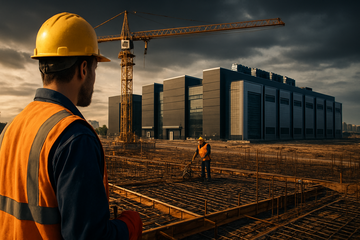
Blue-Collar AI Jobs Are Booming — Local Permit Backlash Is the Wave That Breaks the Pipeline
Quanta Services, EMCOR Group and Eaton just printed record backlogs on the back of a ~$730 billion 2026 hyperscaler capex wave — but the same week New York signed the first statewide data center moratorium and Michigan crossed 45 enacted local pauses. The labor pipeline was already short roughly 499,000 construction workers and 72,700 electrician openings per year; a permit slowdown would close the only escape valve. The trade is to own the contractors while watching permit velocity as the leading indicator.
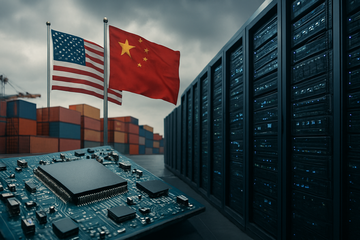
The $30B US–China Deal Doesn't Cover the Parts AI Buildout Needs — But Chinese Capital Is Coming Anyway
Sep 26's $30B reciprocal tariff cut and a new US-China AI dialogue opened a bilateral track between Washington and Beijing, but the goods covered are agricultural and energy, not the optical transceivers, transformers and batteries that the ~$700B hyperscaler buildout still runs on. Chinese cloud providers, prefab builders and component makers are positioning anyway, leaving US semis, REITs, and power-gear stocks as the structural winners and Chinese names carrying option value tied to a supply chain neither side can easily unwind.

Five Data-Center IPOs Now Sit in One Scrutiny Bucket — and the Class, Not the Names, Is the Trade
DayOne, Switch, Vantage, CyrusOne, Accelevation and Nscale are being priced off a single set of filters: contracted power, customer concentration, and post-rate-hike hurdle rates. That filters out the marginal developers but leaves Vertiv, GE Vernova and Eaton insulated by their order books, CoreWeave and Nebius re-rated by the same lens, and Microsoft, Amazon and Alphabet decoupled because their data-center capex is already committed.

Goldman's $300 Billion Reality Check: Hyperscalers Are Spending AI Money They Haven't Earned Yet
Goldman Sachs strategist Ryan Hammond says the five largest U.S. hyperscalers need roughly $300 billion in annual AI revenue to break even on their AI capex — yet Q2 2026 cloud revenue is running only ~$70 billion above the pre-AI trend, leaving a ~$230 billion gap. With the group's free cash flow projected to turn negative through 2026-2027 and more than a third of next year's AI investment funded by debt, the AI trade splits: upstream beneficiaries like [NVIDIA], [TSMC], [SK Hynix] and [ASML] keep winning on volume, while Microsoft, Amazon, Alphabet, Meta and Oracle face a cash-conversion test that earnings season — not capex announcements — now decides.
2026-09-26

Crusoe's $1.25B Boom Turbine Pullback Hands GE Vernova and Siemens Energy the Hyperscaler Power Keys
Crusoe abandoned its $1.25 billion order for 29 Boom Supersonic turbines on Sep 25, 2026 — nine months before the first unit was due to ship — because the modified jet-engine platform no longer fits its near-term power mix. With heavy-duty gas turbine lead times at the established OEMs already booked out to 2031, the freed-up 1.21 GW of demand — and likely every Crusoe campus that follows — flows back to GE Vernova and Siemens Energy. Baker Hughes takes the collateral hit on 1.3 GW of generator orders that were sized for a customer that may not exist.
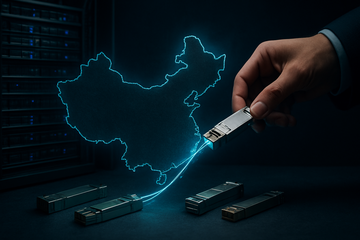
Lawmakers Just Drawn a Procurement Border Around Chinese Datacenter Optics — Innolight, Eoptolink Get a 5-Year Countdown
A bipartisan Senate bill introduced September 25, 2026 would bar Zhongji Innolight and Eoptolink optical transceivers from federal national-security systems, with Commerce and Defense free to widen the list. The named vendors control roughly a third of global data-center optical module revenue, while US peers Lumentum and Coherent are already absorbing the share-shift signal — the procurement law layers a federal-exclusion overlay on top of the FCC's separate August draft import ban.
Nscale's $3.36B Pre-IPO Convertible Stops Working Above a $30B IPO — What Existing Holders Give Up If Pricing Opens Lower
Nscale priced $3.36 billion of pre-IPO convertible notes with a $30 billion valuation cap, converting automatically at the IPO at a double-digit discount. Above $30 billion the conversion price stops adjusting — noteholders surrender any extra upside. The cap is set roughly double the $14.6 billion March Series C mark, anchored to a S-1 that shows $140.6 million of H1 2026 revenue against a $1.02 billion H1 net loss and $103.4 billion of contracted total contract value of which only $2.6 billion (2.5%) is active. The question for the listing is not whether the converts convert — they auto-convert — but whether existing equity keeps or loses the cap subsidy depending on where bankers set the IPO range.

Oracle's $988M CEO Pay Went Underwater in Eight Months — Now the Board Is Trapped Inside Its Own Strike Prices
Oracle's compensation committee granted nearly $1 billion in stock options to Larry Ellison and co-CEOs Clay Magouyrk and Mike Sicilia in September–October 2025 — at the AI-cloud peak. With Oracle Corp shares down 53% to $137 by fiscal year-end (May 31, 2026), every option was underwater, per the Sept. 25, 2026 proxy. The same filing that exposes the compensation mismatch also reveals the deeper trap: $55.7B in capex ate $23.7B of free cash flow, and management is committing to another $90B–$95B in fiscal 2027. The November 18 proxy vote is now a referendum on whether the board priced the AI buildout into governance at all.
2026-09-25

2026-09-24

2026-09-23
2026-09-22
Accelevation's $5.4B IPO Tests the One AI Trade Wall Street Hasn't Priced: the Rack-Builder
Accelevation filed to price 30 million shares at $20–$24 on Sept. 22, 2026, targeting a $5.37 billion market cap — the first standalone US listing of a vertically integrated power-distribution and white-space manufacturer built specifically for AI data centers. Its $1.1 billion backlog and 32% gross margin sit between Crusoe's $30.9 billion private mark and Vertiv's $96 billion public valuation, putting the multiple for the rack layer of the AI build on the tape for the first time.
Microsoft opens a DARPA-doored quantum lab in Maryland — the hyperscaler-defense stack just got a tier-1 anchor
Microsoft will give DARPA on-site, hands-on access to its Majorana 2 topological quantum chip at a new research center in the University of Maryland's Discovery District, Reuters reported Sept. 22, 2026 — a shift from the remote evaluations DARPA had run out of Redmond and Europe. The move puts Microsoft and PsiQuantum as the only two performers in DARPA's QBI Stage C, hardens Maryland as the U.S. defense-quantum hub, and re-prices the listed trapped-ion, photonic, and foundry names that orbit the same corridor: IonQ, Quantinuum, IBM, GlobalFoundries, Lumentum, and Coherent.
2026-09-21
2026-09-20
Cornelis's $205M Round Tests Whether AI-Fabric Stocks Rerate Like Hyperscaler Optics
A private interconnect player just raised a Series C at an implied valuation that, against disclosed revenue, puts it well above public-comps multiples — the same setup that rerated Zhongji Innolight and Credo Technology two years ago. Cornelis Networks' pitch: programmable compute inside the fabric can claw back roughly half the hours GPUs spend idle on data, a $1.68B/year problem per 100,000-GPU cluster by its own model. The thesis matters because the public AI-network layer — NVIDIA networking at ~$70B annualized, Broadcom Tomahawk 6 silicon, Arista Networks just hitting a $3B quarter — is already priced like a winner. Whether Cornelis's fabric-compute angle validates or commoditizes that layer is the read-through.

Vals at $400M is AI's Moody's moment — hyperscalers' own gating made a third-party yardstick inevitable
a16z just priced CoreWeave partner Vals at $400M on $40M raised and roughly8x year-on-year revenue growth, betting that enterprises can no longer independently evaluate frontier models now that OpenAI gates GPT-6 Astra behind Daybreak Access and Anthropic restricts Mythos 5.1 to vetted cybersecurity and life-sciences buyers. All five frontier labs already cite Vals in their model cards, federal agencies have begun using its benchmarks for AI procurement, and the only public-market conduits to the thesis are the listed hyperscalers plus CoreWeave itself.
2026-09-19
Data centers just became the 2026 ballot question — and the AI capex trade is now a permitting trade
With 18 Ohio communities voting Nov. 3 on data-center bans and Sherrod Brown leading Jon Husted by 8 points on the issue, the ~$725B 2026 hyperscaler capex stack now faces a political risk it cannot engineer around. President Trump's December executive order carved state permitting out of federal preemption, leaving New York's first-in-the-nation hyperscale moratorium and Ohio's township-level bans free to bind — and the utilities, power producers, and electrical-equipment suppliers that rode the AI buildout face a new vote-driven ceiling on their rate-base growth.

Oracle's $18B Project Jupiter Loans Hit 89–91 Cents — The First Hard Print on the AI Buildout
About $18B in syndicated project-finance loans tied to Oracle's $165B Project Jupiter campus in New Mexico are being quoted at 89–91 cents on the dollar, per the FT — the first time the secondary market has priced a discrete AI-buildout tranche, and well below the near-par levels at which comparable Oracle paper cleared last year. With Oracle now at $125B of total debt, S&P at BBB− one notch above junk, and S&P's FY27 capex estimate lifted to $90–95B, lenders — not the rating agencies — are drawing the line on how much AI infrastructure debt the market will still clear at investment-grade spreads.
2026-09-18
What to expect
Evidence-first notes with a visible point of view.
This section collects sharp takes on earnings, shareholder meetings, and market structure. Each new piece should make the thesis, the facts, and the implications obvious within the first few screens.
Expect direct analysis, not generic commentary.
Expect the data to be explicit and the argument to be easy to follow.