Data Centers & Cloud
The buildout behind the AI bill
Hyperscaler capex, colocation supply, power, cooling and networking — where the money goes after the GPU order, and which companies book it.
2026-10-07


Lambda's $14.5B Pre-Money Hands Public Markets a Live Neocloud IPO Price — and Asks Whether Two Customers Are Actually the Asset
Lambda is raising up to $4B at a $14.5B pre-money valuation from Coatue and Blackstone ahead of a planned 2027 IPO, after its contracted backlog tripled to $50B in three months. At roughly 12x forward revenue, the round prices Lambda inside CoreWeave's public multiple band — but with Microsoft and Anthropic already accounting for roughly $95B of disclosed Lambda-side commitments, the real question for public investors is whether they are buying GPU rack rental or a single-tenant compute offtake. The actionable trades live in the listed proxies: CoreWeave, Nebius, NVIDIA, Oracle, Applied Digital, Hut 8, Blackstone and Microsoft.
OpenAI Plants Its Flag Inside Jira — and Resets the Enterprise Workflow Race
Atlassian and OpenAI expanded their partnership on Oct 6, 2026, pulling GPT-6 family models into Rovo, Jira, and Confluence through a spend commitment and the Atlassian MCP server — which already clears 15 million calls a day and 1 million monthly active users. The deal converts the engineering and IT workflow seat into a three-front fight: Microsoft Foundry wins a tailwind on Azure inference but loses ground on the agent-of-record layer; Salesforce Agentforce sees its engineering-desk ambitions narrowed; ServiceNow sits in the same crossfire with its own OpenAI deal. The central call: this is a Rovo-monetization inflection, not a defensive scramble — December's Rovo credit metering is the first concrete proof point.

Apollo is underwriting SpaceX's $40B Nvidia-chip order — and the chip-financing frontier just expanded past the hyperscalers
Apollo is leading a roughly $40 billion debt raise for SpaceX — about $10 billion in bank loans plus $30 billion of investment-grade paper — to fund a single chip order from Nvidia, with closing targeted for 2027. The unusual part isn't the size; it's the borrower: a non-AI-lab, ex-IPO private-equity story whose Starlink-backed cash flow is now backing compute, not connectivity. Apollo's August framework with Nvidia and peers — designed to mobilize $500 billion of third-party capital for AI infrastructure — has moved from theory to its first mega-ticket, and the chip-financing frontier has officially moved past the hyperscalers to any operator with hard assets and an Nvidia purchase order.
2026-10-06

Constellation Just Sold Google a 20-Year Power Floor — and CEG's Stock Already Front-Ran the Trade
Constellation Energy locked a 20-year, 890 MW nuclear PPA with Alphabet — plus a separate 15-year agreement covering 2,700 MW more — committing $4.3B across 11 reactors in Illinois, Pennsylvania, and New Jersey. Shares, down 24% year-to-date entering the day, jumped roughly 12% on the announcement, and the read-through dragged the entire AI-power complex higher: Vistra +9%, Talen Energy +11%. The deal makes Constellation the only operator with four hyperscaler nuclear anchors and reframes CEG as long-duration AI infrastructure, not a rate-cycle utility.

Singapore's DayOne asks public investors for ~54x EBITDA — twice Digital Realty — on 69% revenue from one hyperscaler
DayOne Data Centers filed an F-1 with the SEC on October 5, 2026, targeting up to ~$5B at a ~$20B Nasdaq valuation under ticker DODC. H1 2026 revenue nearly tripled to $512M with a 40.2% adjusted EBITDA margin, but 69.2% of that revenue came from a single customer and the balance sheet carries $4.35B of long-term debt against negative book equity. At an implied ~54x annualized H1 2026 EBITDA, the deal prices roughly double Digital Realty and Equinix, making it the first Asian test of whether a colocation operator can clear AI-infrastructure pricing despite concentration risk, Singapore tariff exposure, and a queue of rival filings led by Switch and CyrusOne.

Foxconn's $95.4B quarter moves AI capex to the rack — and the 18x margin gap shows who really owns the trade
Foxconn's NT$3.03 trillion Q3 2026 print (+47% YoY) confirms that rack-scale assembly — not NVIDIA silicon — is where hyperscaler dollars are landing. Foxconn's quarterly revenue now sits within a hair of NVIDIA's most recent reported quarter ($96.2B), and its stated ~40% global AI server share keeps the order book locked in. But Foxconn's 1H26 operating margin of 3.7% versus NVIDIA's 66.2% explains why the GPU and HBM layer — SK Hynix especially — is still where the value sits. The rack-scale read-through runs through Supermicro, Vertiv, and Arista Networks.
2026-10-05
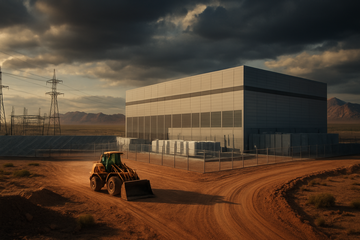
Federal Lands Just Halted the First AI Data Center on Public Estate — 17,600 More Acres Are in the Permit Queue
On Sept. 1, 2026 the Interior Board of Land Appeals stayed construction of the 167-MW Townsite Data Center near Boulder City, NV — the first AI build ever authorized on U.S. public land — after finding the Bureau of Land Management likely violated NEPA by reusing a 2023 solar review. With at least 12 more data-center or related-infrastructure proposals pending on 17,600 acres across six Western states, the Center for Biological Diversity and Sierra Club have turned the AI capex trade from a state-zoning story into a federal-NEPA fight. Read-through names Oracle, NVIDIA, AMD, Vistra, Constellation Energy, Vertiv and Equinix.
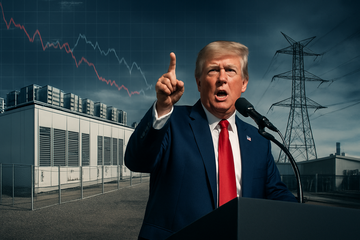
Trump's 'Lower-Taxes-for-Yes-Towns' Data Center Threat Has No New Statute — But EO 14318 and the OBBBA Already Gave Him the Real Levers
President Trump's weekend push to brand data-center-friendly towns as winners and holdouts as 'backwards and poor' is a continuation of an eight-month messaging campaign, not new federal policy — but two statutes already on the books (EO 14318's permitting fast-track and the One Big Beautiful Bill Act's rural opportunity zone expansion) make the threat operationally real. With $725B in hyperscaler 2026 capex now colliding with 399 local moratoriums and $130B of projects already halted in Q1 2026, federal pressure on reluctant municipalities shifts the bottleneck from local politics to federal coordination, with direct read-throughs to colocation REITs Equinix and Digital Realty, hyperscalers like Microsoft, power generators Constellation Energy and Vistra, and infrastructure supplier Vertiv.
2026-10-04
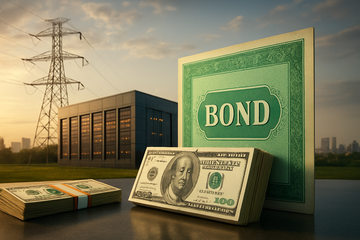
Amazon Just Issued the Industry's First $1B, 5-Year Permit Bond — Hyperscalers Are Now Pricing Community Opposition Like Capital
Amazon paired a $1B+, five-year \"Built Together\" community fund with the end of data-center NDAs on Oct 2, 2026 — fixing $200M a year of community goodwill into the cost of every permit, exactly eight weeks after Meta priced the same instrument. The math behind the structure: AWS carries a $496B backlog against $220B of 2026 capex, so a $1B community line is rounding error. CoreWeave and Nebius cannot write that check, so they will either pay the implied premium on their own build pipeline or be shut out of the next 100+ moratorium fights. Vistra, Constellation Energy, Vertiv, Equinix, Digital Realty and Quanta Services read straight through the deal.
Amazon Drops Data-Center NDAs — Every Permit Just Became a Repricing Event
On October 2, 2026, Amazon ended its use of nondisclosure agreements with local governments on data-center projects — the first hyperscaler to publicly concede that concealment is no longer a viable siting strategy. The concession arrives as community opposition has stalled an estimated $170 billion of US data-center projects across 44 states, and the House Judiciary Committee has opened an investigation into the practice. For the data-center supply chain — utilities, REITs, power-equipment makers, and builders — every project now has to be priced with transparency as the baseline, tilting the siting map away from moratorium-heavy states and toward community-engaged ones. Microsoft, Alphabet, and Meta face the same repricing math; the question is whether they follow Amazon or fight the Raskin probe.
2026-10-02

2026-10-01

Accelevation's $18 IPO Was Priced 10% Below the Mark, and the Multiple Stack Says Is Worse for the Neoclouds Behind It
Accelevation priced at $18 against a $20–$24 range, opened down 2.5%, and closed essentially flat on day one — a tepid verdict on the rack-builder model that puts the spotlight on listed neocloud peers trading at 12–43x EV/Sales. With ~$176B of GPU-collateralized debt on the books and a Lambda/Nscale/Groq IPO queue still to clear, the read-through forces a discount on every chip-collateralized name priced like hyperscaler-equivalent capacity.

HPE Pops 5% on $1.2B Vultr Helios Deal While Dell and SMCI Sit Still — The Rack-Scale Tell for 2027 AI Capex
Hewlett Packard Enterprise shares surged about 5% to $64.55 on Sept. 30, 2026, after landing its first commercial order for the AMD Helios rack-scale AI platform — a $1.2 billion commitment from private cloud operator Vultr — while Dell (+1%) and Super Micro (–0.4%) barely budged. The price action is the real signal: Helios is consolidating the AI server procurement dollar toward integrators that own the full stack (networking, services, rack design), not commodity box-builders, and Advanced Micro Devices is the substrate underneath them all. Investors watching the 2027 buildout should weigh the integrators' networking content and services attach rate, not raw GPU counts.
2026-09-30

Delta's Amazon Leo Bet Locks In a Two-Year Wi-Fi Gap as United's Starlink Fleet Pushes Past 600 Jets
Elon Musk's Sept. 29, 2026 warning that Delta Air Lines 'will lose a lot of customers' for choosing Amazon's Leo over Starlink turns a March partnership into a competitive flashpoint. United Airlines now flies ~600 jets with Starlink on board — roughly 36% of its fleet, on track to 100% by end of 2027 — while Delta's Leo Ultra hardware won't enter revenue service until 2028, leaving it stuck with Viasat Ka-band against a faster rival just as premium-cabin Wi-Fi becomes a tiebreaker. For Amazon, the deal validates its enterprise-LEO distribution playbook alongside JetBlue, L3Harris, and DirecTV Latin America; for Viasat, the deal preserves a contract but cedes the high-ground narrative.

Reco's $55M round crystallizes AI-agent security as its own venture category — and the PANW/ZS/CRWD bundle math gets harder
Agent-runtime security — a layer Palo Alto Networks, Zscaler, and CrowdStrike all claim to cover — now has a standalone funding market of $435M deployed in five months. Reco's $55M Series B extension, anchored by AT&T Inc. as both investor and customer, validates a SaaS-resident thesis that complicates the platform bundle: agents live inside Salesforce and ServiceNow, not on endpoints, so an endpoint-bundled AI feature alone won't win. The platforms are responding with acquisitions — Palo Alto's $500M Console deal, Zscaler's Symmetry Systems, Okta's $200M Permiso, and SentinelOne's Prompt Security — but until they replicate Reco's 280-app discovery footprint, incumbents face a widening gap in agent governance.

Restate's $20M Raise Lands Next to a $12.55B Peer — The Picks-and-Shovels Layer That Decides Which Agent Stack Survives Production
A Berlin startup with $27M in cumulative funding is going head-to-head with Temporal, the $12.55B-valued heavyweight of durable execution, for the infrastructure layer that every production AI agent stack now requires. Restate's Sep 30 Series A — led by Singular with Redpoint Ventures and Capital One Ventures — closes 16 days after Temporal's $550M Series E and lands in the same week MongoDB shipped Atlas Agent Engine and Cloudflare deepened its Durable Objects stack. The durable-execution layer is consolidating fast, and the read-through for investors runs straight through Microsoft, Salesforce, ServiceNow, and the observability attach at Datadog.
2026-09-29
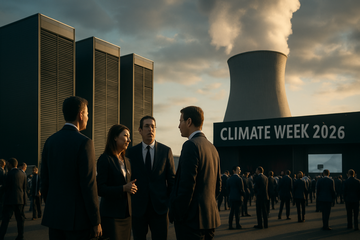
Hyperscalers Walked Into Climate Week 2026 With $700B of AI Capex, a 16% Emissions Spike, and a 22-Year Nuclear Deal — All at Once
Climate Week NYC 2026 became an AI forum by accident, and the four hyperscalers arrived arguing both sides: Amazon disclosed a 16% jump in emissions driven by data centers, while announcing1,920 MW of new nuclear PPAs from Talen Energy; Microsoft brought its $41 billion Q4 buildout into a week where the UNECE warned that AI capacity is growing faster than the grids that must power it; Alphabet inked a $15 billion Finland nuclear deal two weeks earlier; and Meta quietly sits on three plant extensions. The policy fork no one priced is whether regulators treat AI as a clean-energy buyer or as the next industrial polluter — and that framing will decide who pays for the grid, who sells the power, and how much margin the AI capex actually clears.
Modal's $15.75B Marks the Third Tier of a Layered Inference Market — And the Cheapest Stack Now Costs the Most
Modal Labs is closing a $750M Accel-led round at a $15.75B valuation — a 3.4x step-up in four months and roughly 52x its disclosed $300M ARR, per a TechCrunch report on Sept. 28, 2026. The round lands alongside Baseten's $13B and Nscale's $14.6B, three inference specialists clearing double-digit billions in six months. The listed read-through — CoreWeave, IREN, Nebius — shows what the public market is willing to pay for raw GPU rental versus what private capital is paying for serverless inference on top of it.
2026-09-28
Meta poached MongoDB's CEO, killed 23% of its market cap, and turned enterprise AI into a land grab
On September 28, 2026, Meta hired MongoDB chief Chirantan "CJ" Desai to run a newly created "Meta Enterprise Platform" unit and went directly head-to-head with Salesforce, ServiceNow, and the OpenAI/Anthropic class. MongoDB cratered ~23% even though it reaffirmed guidance and even though Desai had been CEO for less than a year — the read is that the tape believes the next leg of the AI race is enterprise distribution, not data layers, and that a $33B database franchise is exposed if the people who know how to sell to the enterprise walk out the door.

Nvidia's $99B Buyback Wedge Forces the AI Trade to Reframe: From Hyperscaler Duration to Nvidia's Own Free Cash Flow
Nvidia returned $26B to shareholders in Q2 FY27 and still has roughly $99B left under its buyback authorization — about four years of firepower at the current pace and more than its annual operating-cash capex. That arithmetic reframes Michael Burry's duration-bomb thesis on Oracle: even if hyperscaler capex rolls over, Nvidia's own free-cash machine now retires shares faster than it reinvests, shrinking the float regardless of what Oracle's $664B RPO can underwrite. The trade is no longer 'will the hyperscalers keep spending' — it is how much Nvidia returns while they still do.
What to expect
Evidence-first notes with a visible point of view.
This section collects sharp takes on earnings, shareholder meetings, and market structure. Each new piece should make the thesis, the facts, and the implications obvious within the first few screens.
Expect direct analysis, not generic commentary.
Expect the data to be explicit and the argument to be easy to follow.