Materials & Supply Chain
Raw materials and the chokepoints that price them
Lithium, rare earths, copper and shipping — permits, export bans and capacity, followed to the miners and manufacturers on either side.
2026-11-02


BWXT Owns the U.S. Naval Fuel Gate — Tonight's Print Is About Commercial Growth, Not the $189 Million Headline
BWX Technologies is the sole supplier of nuclear fuel to the U.S. Navy, has just booked a $189 million naval contract, and has won a $1.5 billion federal contract to enrich the very fuel it currently only downblends — yet the stock closed Oct. 30 at $130.48, 46% below its 52-week high, because the market sold the AI-power trade rather than the fuel business. The two loudest announcements of the quarter sit in the slow-moving 81% of backlog that is government work, where second-quarter adjusted EBITDA fell 4.9% year over year, while the growth engine, Commercial Operations, rose 71.8% to $302.5 million and is about to shrink again as medical is sold for up to $800 million. Consensus of $1.18 of adjusted EPS on $970.5 million of revenue will look light by construction, since management expects roughly 55% of second-half earnings in the fourth quarter. The investable question is whether commercial nuclear equipment and TRISO fuel justify27 times 2026 guidance — and whether the upstream gate, held by Centrus Energy and demanded by Meta Platforms's reactor buildout, is the better place to sit.

Hanwha Aerospace's First U.S. Navy Hull Prices Below the Navy's Own Budget: the Labor-Cost Wedge Is Philadelphia, Not Korea
Confirmed on Oct. 30, 2026: Hanwha Defense USA will build one Medium Landing Ship for $269 million at Hanwha Philly Shipyard, with options for three more, in the Navy's first shipyard selection under its new vessel construction manager model. The hull is built in Philadelphia, not Korea, at a price below the roughly $315 million per vessel implied by the Navy's own fiscal 2027 request, so the familiar wage-arbitrage reading is wrong. The wedge is a 1,500-person Philadelphia yard that is half non-union, plus a $5 billion capital plan and an ownership reshuffle inside the Hanwha complex — with a public price reference that domestic yards now have to beat.

Crude Slid 6% as the Gulf Came Back — Vitol's 3 Million Barrel-a-Day Demand Call Is the Number That Actually Breaks the Bull Case
Brent's January contract fell $7.13, or 6.3%, to $106.30 on Nov. 2 after US-Iran talks in Doha unwound a war premium — and the barrels behind that premium had already come back, with Middle East shipments averaging 24.6 million barrels a day against 23.3 million before the war. The bull case does not break on supply; it breaks on demand. Vitol's Russell Hardy told ADIPEC that global demand could sit roughly 3 million barrels a day below 2025 levels by year-end, close to the IEA's 2.6 million barrel average decline, and that changes who captures the cheap barrel: refiners running negative Saudi selling prices with utilization still below pre-war win, US shale plateaus rather than breaks, and the AI power buildout gets a cheaper fuel floor.
2026-11-01
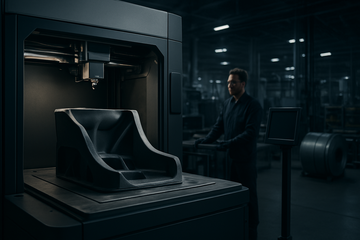
Ford's 200-Plus 3D Printers Buy Lead Time, Not Steel Savings: Why $1,270-a-Ton Coil Is the Wrong Trade
Additive manufacturing has quietly become a Detroit operating variable: Ford runs more than 200 machines with 3D labs headed to more than 23 plants, and Rivian has spent over $5 million on hardware that pays for itself inside a year. The arithmetic underneath is a fixed-cost and lead-time story, not a bill-of-materials one — at Rivian, an implied $5 million-plus annual benefit equals roughly $73 a vehicle against an automotive gross loss of $80 million on 19,248 Q3 deliveries, about $4,157 a car. Steel at $1,270 a short ton, up from $1,255 two weeks earlier, makes stamping economics worse and steel lead times longer, which raises the value of printed jigs and fixtures; it does not make printed vehicle parts cheaper, and it does not repair an OEM's margin. So the exposure worth owning sits one link up the chain — Stratasys at the printer and powder toll booth, Nucor in the material cycle — while per-vehicle cost improvement at the assembly plant stays unproven.

LyondellBasell’s $758M quarter looks like a “war dividend,” not a durable demand rebound — and 2027 capacity risk is the real expiry date
LyondellBasell swung back to $758M of GAAP net income as integrated polyethylene margins ended Q3 2026 about 50% above 2025, but management tied the strength to Middle East supply disruption and acknowledged the return to normal conditions is likely “non-linear” and slower than expected. That combination matters for dividends: the market tends to price “cycle recovery,” yet the underlying driver may be a temporary supply shock that flips again as new capacity timing converges in 2027.

Meta's Humanoid Runs on a Chinese Bill of Materials — and the US Robot Firewall Only Reaches the Robot
Meta built a working humanoid with Shanghai-based Fourier Intelligence in roughly three months, Reuters reported on Oct 31, 2026, three months after Washington barred foreign-produced humanoids from new US market access — but the FCC's rule is written on place of production, so it covers the finished robot and leaves the Chinese joints inside it untouched. The practical result is a demand shift, not a decoupling: Chinese reducer and actuator makers keep shipping into US assembly lines, Chinese finished-robot brands lose the US channel, and the margin gap shows up in the numbers, from Leaderdrive's roughly 22% net margin to Harmonic Drive Systems' 4.3% operating margin. The investable conclusion is upstream: own the joints and the compute, not the robot.

The SNB's CHF 19.1 Billion Quarter Was Mostly a Weak Franc — and October Reversed CHF 10 Billion of Its Gold Gain
The Swiss National Bank's 30 October print of CHF 19.07 billion was 61% currency translation and 39% gold revaluation, and the gold leg has already given back about CHF 10 billion as spot gold fell to $3,880.97 and USD/CHF reached 0.8212 — leaving the nine-month gold contribution near CHF 1.2 billion, not CHF 19 billion. The binding constraint on monetising official gold is the size of the tap, not the size of the gain: distributions to the Confederation and cantons are capped at CHF 6 billion a year, the federal budget assumes CHF 4 billion in 2026, and the rest sits in a CHF 12.9 billion reserve. That makes repatriation the wrong frame, because the marginal buyer of gold in 2026 is now the ETF complex, which took $11.7 billion of Q3 inflows while central banks bought just 170 tonnes through August. The tradeable consequences sit one layer down the chain: Newmont's realised-price reset, CME Group's volatility toll, and Chow Tai Fook Jewellery Group's ticket-price relief.
2026-10-31

2026-10-30

The Rare-Earth Truce Bought Two Months on Paper and 11 Days in Law — and Only Nov. 10 Is Tradable
Washington and Beijing extended the trade truce to Jan. 10, 2027 on Sept. 23, yet as of Oct. 29 neither government had published the notices that would carry China's export-control suspension past Nov. 10 or the U.S. Affiliates Rule suspension past Nov. 9. What is actually being priced is the ex-China heavy-rare-earth premium: dysprosium oxide trades at $2,500–3,500/kg outside China against a $179.48/kg APAC benchmark, a 14–19x spread that exists because April 2025 licensing on seven medium and heavy rare earths was never suspended. MP Materials owns a $110/kg Defense Department floor through 2035 and must hand 30% of its upside back once its 10X plant ramps, while the binding constraint on the whole Western magnet buildout is not Beijing but utilization — General Motors walked away from a magnet contract on July 1, 2026 and U.S. EV sales are down 30.7%.
DTEC's $600M Malaysian Refinery Puts the First Price on 'Process It Abroad' — and the Scarce Asset Is Now the Contract, Not the Plant
A US-majority-owned startup has committed $600M to a Malaysian rare-earth refinery — 5,000 tonnes a year first, 10,000 across two plants within three years — and told Washington it is eligible for Export-Import Bank, Development Finance Corporation and Defense Department money. Because ex-China NdPr oxide has slipped to about $95/kg, below the $110/kg floor Washington pays, the scarce asset in this chain is no longer separating capacity but a floored government contract, and every new refinery competes for the same defense-side demand pool. That directly challenges MP Materials, whose $17.6M of price-protection income in Q2 2026 — 16% of revenue — is the government contract doing the work. The market has already repriced the sector down 26% to 67% from June 30, 2026, paying only for delivered, floored volume.

Toyota Just Took the Right-Hand-Drive Robotaxi Supply Chain — and Autonomy Software Is Being Repriced as a Component
On October 30, 2026, Toyota said it will build the 2027 bZ4X at its Takaoka plant and fit Waymo's autonomous-driving hardware to it on the same line, validating a fleet in Japan in 2027 and reaching the United Kingdom in the years after. The move happens because Alphabet's Waymo wants to go from roughly 4,000 vehicles to 20,000 by the end of 2027 on $5 billion of new debt, while the Other Bets segment earned $372 million and lost $2.05 billion in the September quarter alone. Because Japan and the UK require licensed operators and locally homologated cars, the gatekeeper of robotaxi volume is the vehicle supply chain rather than the driving stack, and the profit pool splits three ways: compute and software keep the margin, a roughly $50,000 vehicle sets the cost floor, and everything in between gets squeezed. Read that way, Mobileye and Lucid are on the wrong side of the structure Toyota just signed, Hyundai Motor already holds the scale contract in the United States, and Toyota is buying the right to sell hardware to any operator with a permit.
2026-10-29

Apple ushers in the “touch Mac” era with a new PROLED XDR BOM: OEMs face a panel+hinge cost step-up Apple is willing to pay
Apple confirmed on Oct. 28, 2026 that its new MacBook Pro with PROLED XDR gets integrated touchscreen capability—ending the company’s long-standing “no-touch” stance. The move rebuilds the MacBook Pro bill of materials around a touch-enabled display stack and a redesigned hinge, creating a direct pricing and manufacturing-yield stress test for competing PC OEMs already under pressure from memory storage cost inflation.

Memory Split in Two: SK hynix's 80% Margin Is an HBM Mix Story, Samsung's Record Profit Is a Volume Story
SK hynix beat the sell-side on Q3 2026 operating profit and rallied 11%, while Samsung printed a larger record profit, missed the higher consensus bar and slid — same shortage, same AI budget, different mix. SK hynix converts a quarter of the DRAM market into half of all HBM, has already locked more than half of 2027-28 capacity under long-term agreements with 14 customers, and is entering2027 with HBM4 pricing fixed; Samsung sells more bits at commodity DRAM prices that are decelerating (contract prices up 10-15% quarter on quarter in 4Q26 against roughly 60% in 2Q26) and is still negotiating its 2027 HBM4 book. The consequence for investors is that memory is no longer one trade: with memory rising from 47% to 68% of cloud capex in 2027, the premium is collected by HBM-weighted suppliers and the HBM4 equipment chain, while server and PC buyers absorb the bill.

Qatar Just Became a Buyer of American Gas: 4 Million Tonnes Contracted Through 2054, and a $25/MMBtu Spread the Oil Trade Never Saw
QatarEnergy, the world's largest LNG producer, is now buying the molecules it used to sell: 33 US spot cargoes worth about $1 billion so far, a 4 mtpa free-on-board contract with Cheniere Energy running through 2054, and at least 3 mtpa in advanced talks with Venture Global. The hedge works because American molecules never transit the Strait of Hormuz, and it costs more than $20 a MMBtu because the same gas sells into Asia at $32.36 while Cheniere realized $7.07 on its legacy long-term volumes in 2025. Brent at $113.88 captures the oil side of the chokepoint; the equity consequences sit in US liquefaction fees, contracted 2030s volumes and freight tonne-miles, which is where the premium actually changes hands.
2026-10-28

2026-10-27

Apple's Foldable Cracked in Its First Weekend: The $14B December Ramp Depends on One Panel and One Hinge
Apple admitted on Oct 26, 2026 that a small number of iPhone Duo units have an inner-display defect, and will replace them under AppleCare. The failures cluster along the crease, which points at hinge tolerance and a reported final-assembly yield of only about 60% — the same constraint behind the missing volume, not the screen itself. With the foldable panel locked to Samsung Display at roughly $250 a panel and contract memory prices set to rise 10–15% into the fourth quarter, the December-quarter ramp Morgan Stanley modeled at $14B is a supply forecast, and the money accrues to the panel and memory suppliers rather than the assembler.

Honda's 'Catastrophic' Warning Is a Content Warning — U.S. Content in Canada-Built Cars Has Fallen to 50%
Honda called a doubling of U.S. auto tariffs on Canadian-built vehicles to 50% \"catastrophic for the entire industry\" on October 27. The arithmetic behind the word is a content problem Washington's own trade report already documents: U.S.-origin content in Canada-built vehicles fell from 85% in 2017 to 50% in 2024, so the dutiable base has tripled before the rate doubles. Toyota and Honda build 76% of Canada's 1.2 million vehicles while the Detroit Three have cut their share to 24%, which puts the exposure squarely on the transplant OEMs — and on Honda in particular, which just posted its first full-year net loss since 1957 and has already frozen its Canadian growth capital.
2026-10-26

Record Diesel Is Now a Delivery Fee: The Crack Spread Reaches the Front Door Before the Fed's December Hike
Diesel at $6.276 a gallon in the week ending Oct. 19, 2026 — a quarter of a dollar below the record set the week ending Sept. 21 — is being priced into holiday delivery fees, not just into pump prices: FedEx, UPS and Amazon Shipping all switched on holiday surcharges between Oct. 25 and Oct. 26, on top of fuel charges that reset weekly against the national diesel average. The engine is a refining constraint, not an oil price. The diesel crack spread has held above $100 a barrel since Sept. 1 for the first time in 2026 and stood at $113.24 on Oct. 20, while September producer prices showed gasoline up 20.3% in a month and final demand up 6.3% from a year earlier. That print is why the Fed raised rates on Sept. 16 to 3.75%-4.00% and why every economist polled expects another quarter-point on Dec. 9. The money has one destination: refiners booked $8.8 billion of refining operating income in a single quarter at a $39.24-a-barrel margin, while carriers, truckers and retailers carry the rest of the crack on their price tags.

Grok Shipped Seven Minutes of AI Video. A Finished Minute Now Costs More Than 175x What It Sells For
xAI's Grok Imagine published Episode 1 of an AI-generated Odyssey series on Oct 23, 2026 — 7 minutes 12 seconds, made with a partner studio and a director, three months after promising a full-length feature. The runtime is the headline; the unit economics are the story. Generating a finished minute costs $13 to $220 at the model layer, while the only AI-native feature sold to consumers prices at $9.99 for 135 minutes, or seven cents a minute, so a finished minute costs at least 175x what it fetches. The margin in this chain is accruing upstream and to rights holders — NVIDIA's data-center revenue reached $89.0 billion last quarter and Micron earned an 86.8% gross margin — while the studio layer is still waiting for a buyer. For investors, generative video is a compute-and-rights trade today, not an entertainment trade.

NVIDIA's $1.1 Billion Test Prepayment Puts the AI Buildout on Its Suppliers' Balance Sheets
NVIDIA has stopped letting its back-end vendors finance the AI buildout themselves. On October 21, 2026 it prepaid $1.1 billion to King Yuan Electronics to reserve U.S. chip-test capacity, alongside a multibillion-dollar advance to IBIDEN, a $1.3 billion agreement with Amkor Technology and co-investment with Samsung Electro-Mechanics — all six of its capacity partners are now building with customer money. The structure matters more than the size: NVIDIA's supply and capacity commitments jumped from $119 billion to $279 billion in a single quarter while its own capital spending stayed at 2.4% of revenue, so the fixed assets — and the free cash flow — have migrated onto vendor balance sheets that now spend 25% to 74% of sales on capacity. The durable profit is moving with the owners of scarce capacity: Amkor Technology with $3 billion of NVIDIA agreements, ASE Technology Holding whose packaging unit is scaling optical engines 15x, and upstream at Advantest and Teradyne, whose tool revenue is growing faster than the chips they test.
What to expect
Evidence-first notes with a visible point of view.
This section collects sharp takes on earnings, shareholder meetings, and market structure. Each new piece should make the thesis, the facts, and the implications obvious within the first few screens.
Expect direct analysis, not generic commentary.
Expect the data to be explicit and the argument to be easy to follow.