Materials & Supply Chain
Raw materials and the chokepoints that price them
Lithium, rare earths, copper and shipping — permits, export bans and capacity, followed to the miners and manufacturers on either side.
2026-10-26

The $450M Pentagon Tungsten Bet Solves the Wrong Problem: China's 85% Refining Grip Still Prices the Metal Inside AI Memory
Washington's $450 million commitment to The Elmet Group buys conversion capacity and a Defense stockpile option — not ore. The United States has not mined tungsten commercially since 2015, China controls roughly 85% of global APT refining capacity, and the first new North American APT plant is dated to restart in the second half of 2028. Meanwhile the metal has already been paid out to the miners: Almonty Industries swung to C$17.6 million of adjusted EBITDA in a quarter while Elmet's margin gain came from holding inventory rather than owning supply. For AI hardware the binding constraint is not price but qualification — standing up an alternative WF6 supplier takes 18 to 24 months — so the chokepoint to watch is a Chinese refinery, not a plant in Maine.

Verizon raised guidance a third straight quarter without raising capital spending — the AI backhaul bill is being paid by copper retirement
Verizon reported third-quarter 2026 net income of $5.3 billion, adjusted earnings of $1.31 a share and free cash flow of $7.8 billion, then lifted full-year guidance for a third consecutive quarter while holding 2026 capital spending at $16.0 billion to $16.5 billion — a range below every year since 2023. The funding comes out of the legacy network: AT&T is running copper service down to 1% of eligible customers, counting on $4 billion of annual savings by the end of 2028, and moving half of a new wholesale fiber platform to GIP and CPP Investments in a joint venture that closes in the first half of 2027. Meanwhile Verizon has ordered more than 80 million miles of fiber from Corning for 2027 through 2032 and sold Google more than $1 billion of dark fiber. The capital is rotating out of the carriers' build programs and into the fiber supply chain and contracted hyperscaler demand.
2026-10-25
Audi's $4 Billion Georgia Plant Prices a Tariff, Not a Car — While Georgia's Grid Already Carries 17 Gigawatts of Data Centers
Volkswagen's Audi will build 200,000 premium SUVs a year at the Middle Georgia Megasite for about $4 billion, with full production in 2031, after 25% Section 232 duties cost the brand roughly €1.2 billion in 2025. The plant is a hedge priced against a policy variable, not a growth bet: VW Group's2025 operating profit roughly halved to €8.9 billion and first-half 2026 operating profit fell 12% on a 3.8% margin. The grid framing is the wrong worry — Southern Company already carries 17 GW of contracted large load and an $81 billion 2026-30 capital plan, while Georgia's dedicated large-load tariff means an industrial customer pays for its own grid build. The tradeable consequences sit in the tariff schedule, the rate base and the rail, not in the plant itself.

$31 Million Demanded, $390 Million of Idle Time: Boeing's 777F Standoff Shows Who Really Holds Widebody Leverage
Boeing's 777 freighter line has been dark for nearly two months because a sole-source wing-part supplier stopped shipping trailing-edge rib kits during a price fight. Boeing put the cost of that stoppage at up to $6.5 million a day in its own August court complaint, while a related Delaware filing puts the supplier's demand at roughly $31 million above contract pricing — a gap that says far more about qualification lock-in than about scale. The episode is a cash and timing event, not a demand event: Boeing still books a $715 billion backlog, and GE Aerospace, whose engines cannot be re-sourced, holds more durable leverage in the same chain. Investors should read the episode as a working-capital and execution problem whose only structural fix is bringing the part in-house.
Bloom Energy grew revenue 138% and its stock fell 11%. The fuel cell bottleneck is cash, not orders
Rystad Energy, reported Oct 23, 2026, expects data-center fuel cell spending to reach about $30 billion by 2030 from roughly $2.8 billion in 2025, with a visible order book near 9 GW. Bloom Energy is the one vendor turning that demand into hardware — third-quarter 2026 revenue of $1,235.8 million, up 138.1%, at a 33.8% gross margin — but its own Form 10-Q shows why the stock dropped 11.24% the next day: operating cash flow of negative $27.1 million, contract assets up $617.5 million, and roughly69% of revenue in two customers. Speed-to-power is a real moat, but the fuel cell build is a working-capital machine, and margin only appears for the vendor that can manufacture at scale.
Malta's $21 Billion: Japan Buys the Wafers, the Tool Chain Gets Paid First, and GlobalFoundries Gets 4% Diluted
Japan's up-to-$21 billion commitment to two new 300mm fabs at GlobalFoundries's Malta, New York site, announced Oct. 14, 2026, is not an equity investment: the fabs will be jointly owned by the Japanese and US governments while GlobalFoundries operates them, and the first wafer arrives in 2029. The money lands first with the semiconductor equipment vendors — Americas 300mm equipment spending is forecast to more than double from $18.1 billion in 2026 to $40.6 billion by 2029 — while Washington takes roughly 4% of GlobalFoundries' equity and redirects $955 million of CHIPS money into silicon photonics, silicon-germanium and advanced packaging at the same site. Investors are being asked to pay 34.7x trailing earnings for a sovereign-backed foundry option that carries no disclosed volumes, no firm power for the new fabs and no revenue before 2029.
Venture Global's $17.2 Billion Bet Is a Slot Option: Only 8 of 15 Turbines Are Reserved
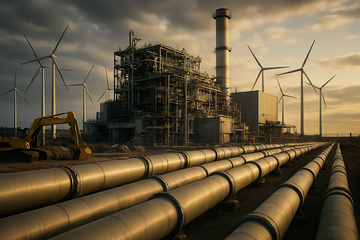
Venture Global's October 9 power and grid frame agreements with GE Vernova and Baker Hughes cover up to 16 gas-fired power islands and an aggregate ~$17.2 billion of equipment, but only eight of the fifteen remaining islands sit under a definitive manufacturing reservation. The economics are not a gas story: at 720 MW a block, the islands could burn up to 1.9 Bcf/d, which turns a fee-based, gas-price-neutral LNG exporter into the operator of a gas-cost-exposed merchant power book where one dollar per MMBtu of Henry Hub moves roughly $424 million of annual EBITDA. For investors this is a slot option — cheap to hold, expensive to exercise — and the test is whether data center customers sign power contracts before the mid-December 2026 grid reservation deadline.
2026-10-24

Airlines Are Tearing Down Six-Year-Old Jets: A Parts Supercycle That Fills OEM Backlogs Instead of Emptying Them
Airlines are now dismantling new-generation narrowbodies at an average age of 6.4 years — some fifteen years earlier than the 21.7-year norm for narrowbody retirement — because a 2023 engine recall at RTX's Pratt & Whitney unit and chronic shop-visit backlogs have made a four-year-old A320neo worth more in parts than in service. With engine values near $17 million and engine lease rates of $130,000–$180,000 a month, the scarce asset is certified parts, not airframes, which is why HEICO and TransDigm earn far more than the dismantlers. The same scarcity pulls replacement aircraft into the backlog rather than out of it: Boeing's order book reached 6,371 jets at end-September 2026, and the MAX 10 was certified on October 20, 2026. Own the parts and the repair capacity, not the airframes.
Two-Thirds of a $389M Federal Chip Award Went to Fusion: Commonwealth Fusion's $85M Buys Electronics, Not Equity
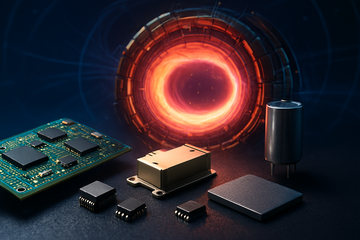
On October 22, 2026 the Commerce Department signed letters of intent worth up to $389 million with four companies, and $260 million of it — two-thirds — went to the two private fusion developers. Commonwealth Fusion Systems's $85 million is not a venture round: it funds radio-frequency heating semiconductors, high-voltage power electronics, advanced packaging and radiation-hardened controllers, because power systems and power components are now the most-cited bottleneck in fusion at 48% of fusion companies, ahead of heat management at 44% and vacuum hardware at 32%. The listed exposure is the supplier of record, not the fusion story: Fujikura has booked the largest superconducting-tape order in history, GlobalFoundries hosts Helion's semiconductor program at its Burlington fab, and the same high-voltage device class is being funded on both sides of the fusion and AI-power markets. At $260 million against $681 million of projected 2026 fusion supply-chain spending, fusion remains a small buyer of chips: this is a qualification and design-in story, not a revenue story.

Helium Is Now a Critical Material — and the Shortage Is in Refineries, Not Reservoirs
Washington's Oct. 23 designation of helium as the 20th critical material is a throughput verdict, not a scarcity verdict: the United States sold or used roughly 43% of the world's helium in 2025 and remains a net exporter, yet the Energy Department names limited refining capacity and slow permitting as the binding constraint. The money therefore accrues to owners of purification, liquefaction and bulk-container logistics — Linde and Air Products are already repricing Asian contracts and drawing down US storage caverns — while the cost lands on buyers who cannot substitute, including leading-edge fabs that signed long-term US helium supply deals and MRI operators running conventional magnets. The second-order effect matters most: sealed-magnet MRI caps imaging helium demand just as semiconductor demand grows.
2026-10-23
GM Did Not Cancel a Magnet Plant. It Canceled the Contract That Made 90% of It Sellable
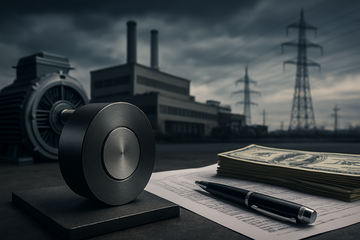
General Motors terminated its magnet supply agreement with Vacuumschmelze's South Carolina subsidiary on July 1, 2026, and the magnet maker is now arbitrating for damages over a contract that covered roughly 900,000 EV motors a year — about nine times GM's current run-rate US electric vehicle sales. The policy stack around this chain finances capacity, not customers: a $110/kg NdPr price floor, a $140 million annual EBITDA guarantee at MP Materials's 10X campus, and federal loan support for mines upstream. Energy Fuels paid the price for the missing customer, with a $1.9 billion acquisition whose purchase price now moves with the arbitration outcome.

The Dirty Secret of Vietnam's Coal Boom: 25-Year Fuel Contracts Written Against a Narrowing Tariff Moat
Vietnam is importing 17-19 million tonnes of coal in 2026 and has begun locking fuel supply to state-owned plants through 2047, because coal now supplies 54.5% of its electricity and gas, hydro and the grid cannot close the gap on the same timetable. The hidden fault line is price elasticity: the same Iran-driven spike that made coal strategically necessary pushed Newcastle to $150 a tonne, and Vietnam's seaborne buying shrinks as prices rise. The listed consequences are narrow — Mitsubishi Corp and Doosan Enerbility bank contracted fuel and EPC revenue, Core Natural Resources is converting the demand into profit while Peabody Energy ships its first cargo from a cost curve it cannot yet cover, and the relocation premium behind the load is deflating, which is the bullish case for Jasan Holding.
TTM Technologies Just Printed the Largest Quarter in Its History — and the Market Sold the Stock 28%
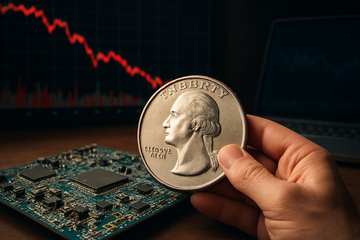
TTM's third quarter of 2026 was a genuine inflection: net sales of $1.20 billion (+60% year over year), data center and networking revenue of $493.6 million (+115%, 41% of sales), record adjusted EBITDA margin of 20.1%, and initial 2027 guidance of $6.5–6.75 billion of revenue and $8.10–8.90 of non-GAAP EPS. The stock still fell 27.7% to $73.89 on October 22, because a $1.43 billion Q4 revenue midpoint sat below the $1.44 billion consensus while material lead times stretched toward 24 weeks and $650 million of cash went out for Ophir Optics. The deeper read is where the profit is being printed: Kingboard Laminates grew first-half revenue 55% on just 14% more shipment volume, and Ajinomoto raised ABF build-up film prices about 30% into a market that may be 40% short by 2028. The AI server content cycle is real, but its economics accrue one tier above the board — and every layer of the chain adds capacity in 2028, the same year TTM's own new lines start shipping.
2026-10-22

One Stolen OAuth Secret Put 1 Million SMBs in Scope: The Chokepoint Moved to the IT-Services Channel
Attackers turned one compromised application credential at ConnectWise's Cloud Backup service into a cross-tenant key for Microsoft 365: Huntress confirmed 173 unauthorized sign-ins, Microsoft counted more than 2,250 tenants attempted, and one ConnectWise app self-granted Global Administrator inside a partner tenant. Because that credential sat behind ConnectWise's 44,000 partners serving more than 1 million SMBs, the blast radius was set by vendor reach rather than by a software bug, and Microsoft's own threat intelligence attributes the operation to a China-aligned group running an agentic AI framework against hundreds of organizations. The remediation budget now runs through three lines: identity governance at Microsoft, backup and recovery at Commvault and Rubrik, and channel-delivered detection at SentinelOne and CrowdStrike. The closest listed peer to the breached vendor, N-able, is de-rating instead — the chokepoint itself is privately held, so investors own the fixes, not the victim.
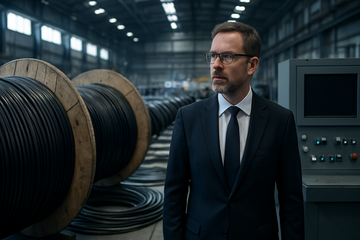
Nexans calls cable capacity the AI data-centre bottleneck—meaning the copper price trade is now an electrical-equipment order-book story
Nexans’ CFO says AI data-centre builds are increasingly gated by cable manufacturing capacity, not by upstream demand or even grid constraints. The key timing detail is long-lead XLPE (“CV”) production—about three years—which shifts investor attention toward how electrical-equipment and grid operators place and sequence orders, and how copper-linked material costs flow into those commitments.
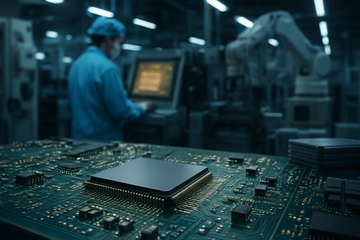
Nvidia and Tesla Now Fund the Substrate Lines They Depend On: $2.8B Moves AI Capex Inside a Korean Fab
The order of events in AI hardware has inverted: the buyer now pays for the supplier's factory. Korean reporting puts Nvidia's and Tesla's combined commitment to dedicated FC-BGA lines at Samsung Electro-Mechanics's Sejong plant at KRW3.7 trillion (about $2.8 billion) — roughly 87% of the KRW4.27 trillion the company itself approved for Sejong — and Nvidia confirmed the instrument in Berlin on October 21, 2026: a multibillion-dollar capacity reservation advance to Ibiden plus dedicated Sejong and Busan lines built for its own accelerators. This is capacity with money attached to volume, and it only makes sense because AI package area per accelerator has risen about twelvefold, pushing the real bottleneck out of substrate lines and into Ajinomoto's ABF film, where a third plant does not open until 2032. The investable consequence is a reordering of risk: Samsung Electro-Mechanics swaps capex risk for volume risk, the material layer above it earns scarcity rents, and unbacked substrate makers — including China's — get squeezed.

Santos just turned LNG into a timing advantage—and oil into a risk: record output in Q3 changes where the margin sits across the LNG value chain
Santos reported record quarterly production of 26.3mmboe in the September quarter (Q3 2026), alongside high LNG run-rate and cargo liftings. The signal investors should care about is not just higher volumes: when gas prices are soft while oil is buoyed by geopolitics, the “in-the-middle” players that earn on logistics, tolling, shipping and regas can capture more value than upstream producers.
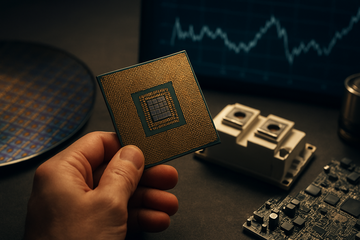
The $389 Million Power-Chip Award Is 77% of Everything Washington Has Actually Spent on Chip R&D
On October 22, 2026, the Commerce Department's CHIPS R&D Office signed four letters of intent worth up to $389 million for power semiconductors and critical materials — the first federal R&D money pointed at the grid-facing end of the AI buildout instead of at accelerators. Against the $506.8 million Commerce had actually spent on the whole advanced-microelectronics R&D program, this single round equals about 77% of delivery to date. Two-thirds of it ($260 million) goes to fusion companies that have nothing to do with data centers, only $73 million targets vertical gallium nitride for a 2.5-megawatt AI rack, and the metal behind that transistor — gallium — is still roughly 99% Chinese. The investable read-through sits with the vendors already selling power into AI racks (onsemi, Vertiv, Eaton), the specialty foundry being paid to build the tooling (GlobalFoundries), and the substrate and materials layer with real pricing power (Coherent, Shin-Etsu Chemical, Sumitomo Metal Mining).
2026-10-21
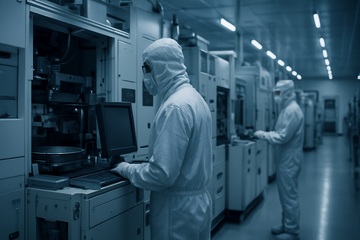
One Generation Behind, on Purpose: Samsung and SK Hynix Upgrade Their China Fabs as the Licenses Expire Every December
Reuters reported on Oct 21, 2026 that Samsung Electronics is moving its Xi'an fab to 286-layer V9 NAND and that SK Hynix is targeting at least 240 layers at Dalian — which reads as defiance until you notice that both China lines now sit one node generation behind Korea. After Washington struck Samsung China's, SK hynix's and Intel's Dalian entities off the validated end-user list in September 2025, the two groups run their China fabs on annual, case-by-case export licences, so the binding constraint is a renewal calendar rather than a node specification. That has three consequences: the tool vendors have not lost China — Applied Materials, Lam Research, KLA and Tokyo Electron still ship roughly 30–34% of revenue there — Chinese tools are substituting only below the advanced nodes, and the live binary is SK hynix's Dalian authorisation, which expires Dec 31, 2026 with no 2027 approval issued. The market's mistake is to read China's buildout as pricing power: Chinese accelerator makers are repricing upward because HBM is scarce, so CXMT's 9.5% share of global DRAM revenue is a commodity share gain, not an HBM threat, until its reported HBM3E output scales.
Super Micro's $4 Billion Quarter Was Already Funded — Nov. 3 Audits the Cash, Not the Revenue
On Oct. 20, 2026, Super Micro Computer pre-announced fiscal first-quarter revenue of $18.5–19.5 billion, $4.0 billion above the $14.5–15.5 billion it had guided on Aug. 11, roughly 25% above the $15.23 billion consensus, and disclosed 14 days before the Nov. 3 print — with gross margin guided to 12.0–12.5% against the 17.5% posted in the June quarter. The money behind that revenue was committed months earlier: a June financing raised $4.90 billion of net equity proceeds earmarked for components against roughly $39 billion of orders, inventory reached $12.90 billion at June 30, and fiscal 2026 operating cash flow was minus $6.81 billion. The revision converts a publicly disclosed order book faster than the plan implied; it does not create demand, and at roughly 4.9% sequential incremental gross margin the dollars accrue to memory, GPU and power suppliers rather than to the integrator. Nov. 3 decides who finances the ramp, and it does so against one customer that bought 28.1% of last year's revenue, unremediated material weaknesses, and a live export-control investigation.
What to expect
Evidence-first notes with a visible point of view.
This section collects sharp takes on earnings, shareholder meetings, and market structure. Each new piece should make the thesis, the facts, and the implications obvious within the first few screens.
Expect direct analysis, not generic commentary.
Expect the data to be explicit and the argument to be easy to follow.