Financials
Banks, credit, and where the risk is sitting
Net interest margins, credit quality, capital rules and deal flow — what the numbers say about the banks, insurers and asset managers reporting them.
2026-10-18

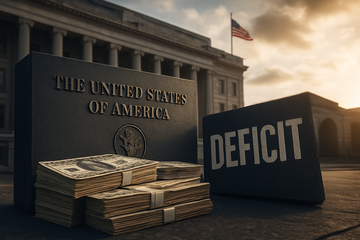
US Closes FY2026 at a $1.99T Deficit and a $1.36T Interest Bill — The $3B/Day Fixed Cost the AI Capex Cycle Now Sits On
Treasury's Oct 17, 2026 print closed fiscal 2026 at a $1.992 trillion deficit — up 12% year-over-year — with a record $1.36 trillion in gross interest ($2.9 billion net per day), as the average cost of federal debt sits at 3.53% even while new issuance clears 5.10% on the 10-year. Hyperscalers funding a projected ~$1.2 trillion of 2027 AI capex through investment-grade debt now compete with the Treasury for the same marginal buyer at the same yields, turning record federal interest into the floor of the AI cost of capital rather than a tail risk. The Goldman and JPMorgan dealer franchises sit on the issuance flood; the hyperscalers with the thinnest free-cash-flow coverage sit on the cost.

Salesforce and Walmart Are the AI Trade's First Two Substitutes — Barclays Just Cut Five Names to Make Room
The same week Wall Street logged its worst stretch since June, two upgrades and five downgrades drew the first concrete map of where capital rotates when the AI trade stops working. BofA double-upgraded Salesforce on rare evidence that AI entrenches enterprise platforms rather than disintermediating them, while Deutsche Bank turned bullish on Walmart as sticky inflation redrew consumer demand. Barclays countered with equal-weight cuts on Dell, HPE, NetApp, HubSpot and monday.com — five names whose AI theses had stalled under the weight of CoreWeave's $50B debt and a hot CPI print.
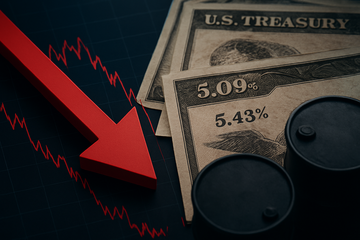
5.10% Yields Plus Brent at $110 Just Named the Bond Market's Sector Pain List — AI Infra, Small-Caps, and Long-Duration Tech Take the First Hit
Friday Oct 16, 2026 delivered a single-session cascade: S&P 500 -1.09%, Nasdaq -2.14%, VIX +21% to 19.99, 10Y at 5.09%, 30Y at 5.43%, and Brent +3.7% to $109.86 on renewed Iran–Hormuz attacks. The bond market's verdict was already visible in the AI-debt complex — CoreWeave -12% in a day and 25% in five, Broadcom -3.6%, Oracle -4.7% — even as the AI enablers like Nvidia held up. Investors positioning into the Nov 10 CPI and Dec 9 FOMC now face a defined pain list: AI infrastructure debt, small-caps, and long-duration growth first; REITs, regional banks, and energy derivatives downstream.
2026-10-17

BNY's $92M of Securities-Lending Fees Just Named the 'AI Cash Drag's Real Address
Bank of New York Mellon's Q3 2026 print — $5.68B revenue, $2.37 adjusted EPS, both ahead — wasn't built on AI hype; it was built on the cash that hyperscalers can't yet spend. Securities-lending revenue jumped ~48% YoY on $630B of client securities on loan, and the Securities Services segment booked $1B of pretax income at a 36% margin. With hyperscaler capex on pace for $610B–$760B in 2026 and free cash flow turning negative, BNY's custody books are the cleanest gauge of where the AI capex pile is actually parked and earning — putting the lie to the idle-cash narrative and giving read-throughs to State Street, Northern Trust, and BlackRock's cash-management complex.
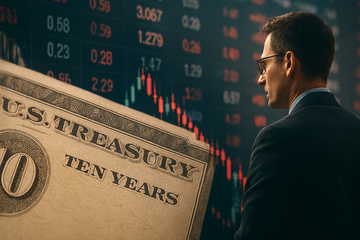
Treasuries Just Did Their Oldest Job for the First Time in Months — Skiba Names the Bond-Equity Divorce the Tape Has Been Hiding
On October 16, RBC Global Asset Management's Andrzej Skiba told CNBC that bonds had finally performed their safe-haven function — rallying into a weaker tape for the first time in months. The move came only after a $2 trillion chip rout finally did what BlackRock CEO Scott Bessent's $4 billion Treasury buyback couldn't: pull 10-year yields back from 5.36% to 5.08%. With the SPDR S&P 500 ETF Trust +14% YTD but four in ten names in the red, the equity risk premium below zero, and the bond-equity correlation plumbing a 15-year trough, the long-promised rotation from passive equity into Treasuries just got its first real print — and the listed names most exposed to it sit on both sides of the trade.

IBKR's Q3: Customer Margin Loans Surged 36% Right Before the AI Rout Tested Them
Interactive Brokers reported Oct. 15 with customer margin loans up 36% year-over-year to $105.2 billion and management calling the posture \"risk-on\" — then the next session's Nasdaq 2.14% slide, with CoreWeave down 12%, became the first live test of that leverage book. Net interest income climbed 19% to $1.15 billion on a still-widening balance sheet, but stock volume fell 24% and annualized DARTs per account slid 14% — so the gains came from heavier bets on fewer trading days, not more activity. The Oct. 27 Robinhood print is the next retail-only window; until then, IBKR's Q3 is the only broker-released snapshot of what retail was holding when the AI trade broke.

$325 Is the Line: Why JPMorgan Just Became the Cleanest Non-AI Breakout in the Market
CNBC's Jay Woods pinned JPMorgan Chase as the breakout candidate for the week ahead — and the call has nothing to do with Mag-7 derating. The chart is coiled above the 2026 AVWAP with a bullish MACD crossover and RSI divergence, while a Q3 print that missed headline EPS still grew managed revenue 8% and prompted management to raise full-year net interest income guidance to roughly $106 billion. In a market where energy is up 51% YTD and financials are the cheapest they have been in years, the cleanest expression of the rotation is the largest U.S. bank.

Trump's Loan Cap Pushed Grad Students Into 16% Private Debt — Sallie Mae and Capital One Are on Opposite Sides
The One Big Beautiful Bill Act capped federal graduate and professional borrowing on July 1, 2026, pushing a generation of med-school, law-school, and doctoral students into private credit at double-digit rates — and former U.S. Bankruptcy Judge Sarah Sharer Curley is warning that personal filings will rise as a result. The trade splits cleanly across sectors: Sallie Mae and SoFi collect the displaced demand at high yields, while Capital One and Synchrony Financial carry the most direct exposure if those borrowers convert to credit-card stress. Bankruptcy filings are already up 12.2% over the trailing year on Administrative Office of the U.S. Courts data — the OBBBA cohort has not yet started defaulting.

Mastercard and Citigroup went from 'ask' to 'demand' in Bangkok — the $290B cross-border fight is now a Trump–Xi deliverable
On Oct 16, 2026, U.S. Treasury Deputy Secretary Francis Brooke pressed the PBOC and China's finance ministry in Bangkok for Mastercard independent domestic clearing status and Citigroup approval for a wholly-owned China securities license — both framed as deliverables from Xi Jinping's late-September Washington visit, not favors. The push follows the Oct 13 PBOC 'Application to Prepare' for Visa and converts a long-running market-access complaint into a line-item in the bilateral trade ledger. Investors should treat Mastercard and Citigroup as the two cleanest beneficiaries — Visa is now the template — while American Express loses first-mover insulation and Chinese incumbents like CITIC Securities absorb the first wave of new foreign competition in onshore underwriting and principal trading.
2026-10-15

AI Stock-Pickers Just Crossed the Live-Capital Threshold — the Real Test Starts at the Fee Stack
Israel's FINQ put AI on the buy/sell button for two SEC-registered U.S. ETFs in February 2026, and AIUP/AINT have since trounced the S&P 500 by 22+ percentage points. But with AIUP sitting at $5.5M in assets, winning on returns is not the same as winning the fee war. As Pictet's 22-bp AI-enhanced ETF clears $90M in three months and BlackRock targets $4.2T in active ETFs by 2030, the contest is now over who can price human judgment out of a stack that already runs on22 basis points.
Bank of America's $1.21B AML Fine Ended a Six-Quarter Beat Streak — Strip It Out and Q3 Tells a Different Story
A $1.21 billion penalty — the third-largest in Treasury Department history and the largest OCC fine on record — turned Bank of America's Q3 2026 into a print it had six prior quarters of beating. Adjusted EPS landed at $1.08 versus a $1.10–$1.11 consensus; revenue of $29.96B missed by roughly $0.6B. Underneath the charge, net interest income still rose 8%, average loans grew 6% for a tenth straight quarter, and CET1 held at 10.9%. JPMorgan also missed on trading weakness, while Citigroup, Wells Fargo, and Goldman Sachs all cleared the bar. The structural read isn't the Q3 line — it's the consent-order remediation bill to come and the precedent this fine sets for peer-bank AML scrutiny.

Goldman's 72% Equities Surge Masks a 2% NII Decline — The Bond Rout Gave the Trading Desk a Windfall While Quietly Pushing Funding Costs the Other Way
Goldman Sachs reported Q3 2026 EPS of $17.01 on net revenues of $18.68 billion — a 32% consensus beat — but the headline conceals a sharp divergence that explains the whole quarter. Equities net revenues jumped 72% YoY on volatility while FICC intermediation fell 7%, and net interest income actually declined 2% YoY to $3.77 billion despite a 10-year yield sitting at 5.21% on Oct 13, confirming the funding-cost drag side of the bond-rout trade. Investment banking fees rose 21% to $3.22 billion with a record $1.65 billion in advisory, anchored by AI capex financings like Intel's $23 billion equity offering and Applied Digital's $3.5 billion high-yield data-center bond. The print cements Goldman's position as the AI-infrastructure syndicate of choice — but the larger fee wave from financing a $10+ trillion data-center buildout is still in front of investors, not behind them.

Morgan Stanley's $232B Wealth Quarter Outearns What JPMorgan Chase and Citigroup Just Printed — And the Mix Is What Matters
Morgan Stanley posted Q3 2026 net revenues of $20.34B (+12% YoY) and EPS of $3.03, with wealth management adding a record $232.4B in net new assets and $80.5B in fee-based flows — making wealth, not markets, the engine of the beat. The same week, JPMorgan Chase missed both top and bottom lines despite a 49% surge in equity trading, while Citigroup used a 40% net-income jump and 15% wealth growth to clear estimates on a much smaller base. The cleanest read for investors: the Morgan Stanley print is structurally more durable because fee-based AUM, not deal flow, drove the upside.

UBS's $16 billion Swiss capital bill just turned Basel endgame into a relocation auction — and eight foreign banks are already in the room
Switzerland's upper house voted 29–16 on Sept 23 to make UBS back 90% of its foreign units with common equity, adding $16B of CET1 at the parent and $33B in total since the Credit Suisse deal. UBS has replied with the loudest lever a global systemically important bank can pull: an open threat to redomicile via US acquisition, European merger, or holding-company move. With at least eight foreign banks — Morgan Stanley, Deutsche Bank and JPMorgan Chase among the named suitors — already in the room and US Basel III requirements heading the opposite direction, the question for investors is no longer how much capital a G-SIB has to hold, but where the world's largest wealth manager will park its $1.7 trillion balance sheet.
2026-10-14

BlackRock's $15.5T Q3 Just Made It a Private-Markets Story — Not a Passive-Flow Story
BlackRock reported $10.57 GAAP EPS / $15.93 adjusted and a record $15.488T in AUM on Oct 14, 2026, but the print hid the real inflection: $15.311B of private-markets net inflows beat the Street by ~25% and the AI Infrastructure Partnership closed its first deployment in the same quarter. With GIP, HPS and Preqin now all contributing, the firm has crossed from passive-flow proxy to private-markets hybrid, and the comparison set has shifted from STT and Vanguard to BX, APO and KKR — a re-rating the multiple has not yet absorbed.

Same Week, Opposite Trajectories: Citi's 40% Q3 Beat Punctures JPMorgan Chase's Miss
On October 13, 2026, Citigroup posted a 40% jump in net income to $5.2 billion on Services, Wealth and ECM-led Investment Banking, while JPMorgan Chase booked a rare top- and bottom-line miss driven by a $550 million FICC shortfall. The split isn't about execution — it's about mix. Banks levered to fee-based, lower-jurisdiction revenue (Citi, Goldman) out-ran banks levered to fixed-income flow (JPM, Wells Fargo), turning Q3 into a tradeable rotation signal rather than a single quarter's noise.

LSEG Just Paid 24x EBITDA for a $145M Credit-Data Asset — and SPGI and Moody's Now Have to Match It
LSEG's £3.5B offer for Permira-owned Octus at roughly 17x forward EBITDA hands it the proprietary sub-investment-grade and private-credit dataset the ratings duopoly could not replicate — at the moment SPGI's stock trades22% below its 2025 high on AI-pricing fears and private-credit AUM has crossed $2T. The deal compresses the credit-data funnel to four toll-takers and forces SPGI and Moody's into a consolidation race at exactly the wrong time for their multiples.

Visa just broke into China's $144T card market — here's what the Oct 13 approval rewrites for [V], [MA], [AXP], [PYPL] and [DAL]
The People's Bank of China on Oct 13, 2026 cleared Visa to begin preparations for a domestic bank-card clearing institution — its first real path into a market that processed 963.6 trillion yuan on bank cards in 2025 and is ~90% controlled by UnionPay. With Mastercard already operating in China via its NetsUnion JV since May 2024 and PayPal lighting up Weixin Pay merchants in August, the next 12 months re-rate the entire US card-network complex — but the bigger spillover lands on transpacific airlines ([DAL] +13% YoY already) and the inbound-travel payment volume none of these multiples yet price in.
2026-10-13

AmEx Just Made the Card Network the Gatekeeper for AI-Agent Commerce — And Its Closed-Loop Stack Is Why Visa and Mastercard Can't Match It Yet
American Express on Oct. 13, 2026 published the Intent Intelligence Framework, the first card-network-level authorization standard that captures a cardholder's purchase intent before an AI agent is allowed to transact. The move reframes the agent-commerce fight from card-vs-card to network-vs-network: because American Express runs a closed loop — issuing the card and often acquiring the merchant — it can credibly guarantee end-to-end that an agent's purchase matches the human's intent, something Visa and Mastercard can only approximate. The framework lands with EMVCo backing and sits inside American Express's Premier membership in the x402 Foundation, the open HTTP-402 standard backed by Cloudflare and Coinbase — institutional credibility that turns an internal product spec into industry plumbing. The investable read: incremental transaction volumes for the early winners (Fiserv, American Express and its ACE pilot merchants Delta and Expedia), a competitive squeeze on standalone wallets (PayPal, Block) that lack end-to-end network control, and a price/value question for Visa and Mastercard at ~24x forward earnings.

BoA's $1.21B Treasury AML Fine Lands a Day Before Its Q3 Print — And the Q4 Charge Is Now the Sector's Compliance-Opex Benchmark
Treasury, the OCC, and OFAC imposed a combined $1.21 billion in penalties on Bank of America on October 13, 2026 — the largest OCC civil penalty ever and the third-largest FinCEN action against a U.S. depository, anchored on $5B+ in late suspicious-activity reports and 475 OFAC violations spanning Iran, Russia, Belarus, Burma, and Somalia. Announced a day before BoA's Q3 print and after the quarter-end, the fine slips into Q4 and turns BoA's provision line into the cleanest public read on what systemic AML failures now cost a top-three U.S. bank. With JPMorgan, Wells Fargo, Citigroup, and Goldman Sachs all reporting Q3 the same morning with no comparable exposure disclosed, the read-through is peer multiples, not peer P&Ls.
What to expect
Evidence-first notes with a visible point of view.
This section collects sharp takes on earnings, shareholder meetings, and market structure. Each new piece should make the thesis, the facts, and the implications obvious within the first few screens.
Expect direct analysis, not generic commentary.
Expect the data to be explicit and the argument to be easy to follow.