Financials
Banks, credit, and where the risk is sitting
Net interest margins, credit quality, capital rules and deal flow — what the numbers say about the banks, insurers and asset managers reporting them.
2026-10-09


Rapid Yield Moves Have Preceded Every Major Blowup Since 1970 — and Q3 Just Delivered 87 Basis Points in 90 Days
Treasury yields are rising at the fastest pace since 1994, the 10-year touched a 24-year high above 5.35% this week, and the MOVE index has pushed through 100 — the threshold that historically marks the moment something breaks. Stocks are refusing to fall, which is itself the danger signal: every prior blowup since 1970 was preceded by rapid yields plus an eventual equity re-pricing. Bessent's \"I am the house\" trade has already been called. The question now is which asset class absorbs the next leg.

USDA Says US Farm Debt Hit a Record $605 Billion. Research Suggests That's Roughly Half the Story.
USDA's September 2026 forecast pegs US farm-sector debt at a record $605.1B, but a 2024 peer-reviewed study of 4.4M equipment liens found non-traditional equipment debt ran up to four times what USDA captures — and the survey USDA relies on for that bucket now responds at a 33% rate, down from 68% in 2009. With ad hoc subsidies at a record $47.4B masking cash-flow stress, farmland values still up 5%, and 312 Chapter 12 farm bankruptcies filed in the 12 months through March 2026 (+20% YoY), the real risk is the borrowing the official tally cannot see.
2026-10-08

ConnectOne's Q3 Setup Puts a $14B NJ/NY Bank in the Middle of the 2026 Consolidation Tape
ConnectOne Bancorp's Oct. 8 8-K is not a strategic action — it schedules the Q3 earnings release for Oct. 22 — but the disclosure lands a post-FLIC, $14.4 billion-asset commercial bank with a 1.0x price-to-book, 41% CRE concentration and NJ's #5 deposit share directly in front of the year's hottest community-bank M&A tape. With Columbia Financial/Northfield setting a $597M, $18B-asset New Jersey template and the industry's 2026 consolidation rate on pace for a seven-year high, the Oct. 22 print becomes the de-facto catalyst for the next move.

Dimon Put Numbers on the AI Labor Trade: $150K Truckers to $25K, and a 'Civil Unrest' Warning
On October 7, 2026, JPMorgan Chase CEO Jamie Dimon turned a Davos hypothetical into a market event: 2 million truckers making $150,000 falling to a $25,000 replacement job would, in his words, 'bring civil unrest.' That sentence lands in the same week the McKinsey Global Institute named transportation and logistics as one of three sectors absorbing three-quarters of all AI-driven occupational churn, the same month Aurora Innovation said it will exit 2026 with 200 fully driverless trucks, and against a backdrop of record diesel prices and a trucker base that just spent September flirting with an October 1 strike. For bond markets and the Fed, this is the moment a CEO-level 'phase it in' ask becomes a sectoral macro argument the labor-side inflation story can't ignore.

Webull just crossed the “China-link” line regulators can’t ignore—because the risk now sits in customer-cash handling
A House Select Committee report says Webull is “tied in structural ways” to the PRC through ownership, technology and financing, and that the concern escalated after Webull began carrying customer cash directly in October 2025. For investors, the key takeaway is not politics—it’s how the compliance burden shifts when a brokerage’s customer-cash model turns a front-end data risk into a balance-sheet risk.
2026-10-07
Bonds Now Out-Yield Half the Dividend Aristocrats — And the Income Trade Is Re-Rating
The 10-year U.S. Treasury hit 5.31% on October 7, 2026 — its highest level since the spring of 2002 — while the 30-year crossed 5.69%. With a risk-free yield that high, the math on every dividend-paying stock has inverted: Coca-Cola and Procter & Gamble now yield LESS than Treasuries, NextEra Energy and AT&T are roughly at parity, and the once-fat premium on Realty Income, VICI Properties and Enterprise Products Partners has been cut in half. The result is a sector-level rotation that is punishing the entire yield-oriented cohort as income allocators mechanically re-underwrite dividend stocks against a 5%+ benchmark they cannot beat on a risk-adjusted basis.

Dimon's 'The Market Will Ask for More' Just Made the Corporate Credit Squeeze a CEO-Level Trade
JPMorgan Chase CEO Jamie Dimon's Oct 6, 2026 Bloomberg interview turned a borrower-side warning into a Wall Street catalyst: with the 10-year Treasury already at 5.31%, investment-grade BBB spreads at 106 bps, and $489B of AI-related debt already issued in 2026, the IG and BBB refi wall from 2027 is being repriced in real time. Banks with trading books and underwriting pipelines — including JPMorgan, Bank of America, Goldman Sachs and Morgan Stanley — capture the spread-widening volatility, while BlackRock's IG ETFs and the Apollo/KKR private-credit books absorb the long-duration pressure on the other side.
2026-10-06
Texas Now Leads the Nation in Repossessions — and the Buffett 'Housing Bottom' Bet Just Cracked
Completed foreclosures (REOs) jumped 42% year-over-year nationally in August 2026, with Texas posting 1,835 REOs and the nation's second-highest foreclosure start count, per ATTOM. The print lands directly inside Berkshire Hathaway's ~11% stake in Lennar — built around a 'bottom is behind us' thesis — and forces a re-pricing of Texas-heavy banks (Cullen/Frost Bankers, Texas Capital), homebuilders (D.R. Horton, PulteGroup), title insurer First American Financial, and the largest upstream supplier Builders FirstSource, whose shares are already down more than 50% from their 52-week high.

Upstart's Stress Gauge Just Glimpsed Normal — Yet Synchrony and OneMain Haven't Priced It
Upstart Holdings' Macro Index fell to 1.49 on Oct. 5, the first decline after a months-long climb — yet the reading remains ~49% above a normal economy baseline, where UMI has stayed since early 2022. Synchrony Financial, which carries ~26% non-prime credit exposure, held steady and OneMain Holdings rose0.3%, while Upstart itself rallied 6%. The lagging balance-sheet lenders have not repriced for the elevated stress regime that a leading AI-driven lender's data is still broadcasting.

Wall Street Just Booked $45.9B in Half a Year. Now Dealmakers Are Tracking 30% Bonus Pops — and the $90B Path Has a Catch
U.S. securities industry profits reached $45.9B in H1 2026, up 51% YoY, putting the year on track for a record above $90B per NY Comptroller DiNapoli's Oct. 6 report. The boom is concentrated in equities trading (Goldman up 72%), investment banking fees (Goldman +55%), and AI-fueled IPOs (underwriting revenue +68%) — but a 5.35% 10-year Treasury yield is the structural risk. Johnson Associates forecasts stock traders and IPO bankers collecting up to 30% bigger bonuses while private credit, real estate and venture-capital professionals get cut or stay flat. The spillover lifts independent M&A advisors like Evercore and Lazard, alternative managers like KKR, and New York City's tax base, while rate-sensitive balance sheets remain exposed.
2026-10-05

Barclays Just Handed Anthropic Its First Universal-Bank Reference — And the $2T IPO Math Just Shifted
On October 1, Barclays widened its Anthropic partnership to run Claude across software engineering, Global Markets email triage, and a colleague knowledge assistant already used by 16,000 staff — the first time a tier-one universal bank has formally anchored Anthropic for core workloads. The deal re-prices Anthropic's pre-IPO channel mix: after Charles Schwab for wealth custody and OpenAI for investment banking with Morgan Stanley, Claude now owns the wholesale bank. For Amazon, Alphabet, Nvidia and Broadcom, every Barclays query is another credit of training-grade and inference-grade compute flowing back to their multi-billion-dollar Anthropic infrastructure bets.
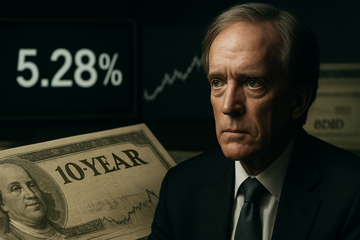
Bill Gross Says Don't Own Them. The 10-Year Is Already at 5.28%, TLT Is Down 7.8%, and the Bond King Has Been Vindicated.
On September 30, 2026, Bill Gross — the co-founder of PIMCO and the figure who turned the bond fund into a $100-trillion asset class — used a Financial Times op-ed to tell investors to avoid bonds outside one-year Treasury bills, which he pegged at 4.55%. The10-year Treasury is already at 5.28%, a 24-year high; the 30-year at 5.61%, the highest since 2007; the iShares 20+ Year Treasury Bond ETF (TLT) is down 7.81% year-to-date despite a 5.54% yield. The structural drivers Gross is calling — a record $40.17T federal debt load, term-premium repricing, and a hedge-fund basis trade unwinding that has drained leveraged duration demand — make this warning stick harder than his earlier calls. The trade Gross is calling wrong is duration: 73 basis points of extra yield for ten extra years of risk, in a $84T credit system where the marginal buyer is leaving, not arriving.

Buffett's 11.2% Lennar Bet Says the Housing Bottom Is Already Behind Us
Berkshire Hathaway has quietly accumulated an ~11.2% stake in Lennar — roughly 26.6 million shares worth about $2.16B at an average near $81 — by buying aggressively through the Sept. 16 delivery-guidance cut and the 30-year mortgage's breakout past 7%. The position sits next to the $8.5B Taylor Morrison acquisition Greg Abel closed in July, turning Berkshire into a top-five U.S. homebuilder at the precise moment peers are pulling guidance. The message: the worst of the rate damage is in the rearview mirror, not the next two quarters.

EliseAI's $4B Round Puts a 20× ARR Multiple on the Line — and Vivmark Residential's 184,000 Units Are Why It Might Hold
EliseAI closed a $350M Series F at $4B on Sept. 29, 2026 — a roughly 1.8× step-up from its $2.2B Series E thirteen months earlier, but a clean ~4× step from its $1B Series D in Aug. 2024. At $200M ARR, the round prices a 20× multiple on a vertical-AI vendor whose single largest demand engine just became the Vivmark Residential merger of AvalonBay Communities and Equity Residential. The investable question is whether the data flywheel compounds in EliseAI's favor — or whether RealPage and the cap-rate math on Zillow's rentals segment leave the multiple stranded.
2026-10-03

Goldman's Retirement Survey Shows the Consumer Slowdown Just Became Structural
Goldman Sachs Asset Management's 2026 Retirement Survey finds the share of Americans increasing retirement contributions collapsed from 55% to 39% in one year, with 14% now cutting contributions. Combined with Vanguard's record 6% hardship-withdrawal rate and a personal savings rate under siege, the data reframes the consumer slowdown as structural: today's bills are being funded by tomorrow's accounts, shrinking the long-duration capital pool and pushing demand toward guaranteed-income annuities.

September Broke the Long-Short Math: Quant Funds Banked 3.5%, Discretionary Lost 0.5%
September 2026 punished the trade hedge funds were most crowded into. A Federal Reserve rate hike on Sept 16 — the first since July 2023 — combined with a Sept 14 letter from leading AI CEOs calling for a development slowdown hit both legs of the AI-long, duration-short book simultaneously. Fundamental equity long-short funds fell 0.55% on average while systematic quant funds made 3.46% — the strategy's best month of 2026 — and trend-following CTAs gained more than 4%. The dispersion between discretionary and quant was the widest in years, and the most investable signal is structural: prime brokers, trend-following platforms, and alternative asset managers captured the flow, while concentrated AI positioning bore the brunt.

Ellison Is Now Leveraged Into Both AI-Era Debt Binges at Once — and One of Them Is Already Slipping
Larry Ellison personally guaranteed $40.4 billion of [Paramount Skydance's WBD financing](psky), then watched Oracle take on $156B of total debt while pledging 413 million of his own Oracle shares as collateral. With Paramount Skydance's $52B financing package now priced — and its $44.4B bond already trading underwater — and Oracle's $18B Project Jupiter loans quoted at 89–91 cents on the dollar, the two trades now share one human balance sheet. Investors who read the Oracle and Paramount Skydance stories in isolation are missing the cross-collateralization that turns a 10% Oracle drop into a forced-sale risk on both empires.

LBMA’s gold benchmark faces a “duty of care” suit—if courts treat accreditation as liability, miners and royalties will price in a new spread
A London High Court case argues the London Bullion Market Association (LBMA) owed a legal duty of care tied to gold refining accreditation under the LBMA Good Delivery framework. The claim centers on whether LBMA’s standards and enforcement duties should have been escalated—potentially including threatening/suspending an accredited refiner—after allegations tied to Tanzania’s North Mara mine. For listed gold exposure, the risk isn’t the gold price itself; it’s how much of the physical-vs-paper “quality premium” and counterparties’ compliance costs get repriced if benchmark governance becomes litigation-sensitive.

Up to 25M Trump Accounts Could Be Funded by Mid-October — That Locks $25B+ Into U.S. Equities for 17 Years
IRS CEO Frank Bisignano confirmed up to 25 million Trump Accounts could be funded within weeks, on top of Treasury's automatic enrollment of 60 million-plus children on Oct. 1. Every dollar flows into one of five ETFs — SPDR Portfolio S&P 500 ETF by default — and none of it can touch bonds, foreign, sector, or small-cap-only funds until the child turns 18. State Street and BlackRock are the two listed asset managers sitting at the choke point of a guaranteed, locked-in equity demand stream the bond-and-treasury headlines miss.
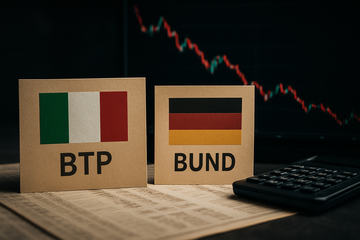
UBS just turned bearish on Italian BTPs vs Bunds — and the trade sits next to its 8,100 S&P call without contradicting it
On Oct 2, 2026, UBS's head of European rates strategy opened a fresh short in 10-year Italian government bonds against 10-year German Bunds, betting the BTP-Bund spread — already at ~127 bps — keeps widening as the global bond rout migrates from France to Italy. The same house still carries an 8,100 year-end target on the S&P 500 and a $3 billion buyback of its own stock. The two views are consistent: UBS expects long yields to stay higher, equity earnings to absorb the rate drag, and European sovereign dispersion to do the painful work instead.
What to expect
Evidence-first notes with a visible point of view.
This section collects sharp takes on earnings, shareholder meetings, and market structure. Each new piece should make the thesis, the facts, and the implications obvious within the first few screens.
Expect direct analysis, not generic commentary.
Expect the data to be explicit and the argument to be easy to follow.