Financials
Banks, credit, and where the risk is sitting
Net interest margins, credit quality, capital rules and deal flow — what the numbers say about the banks, insurers and asset managers reporting them.
2026-10-13

Hammack Just Tipped the Fed Toward a December Hike — The 5.36% 10-Year Is Already Pricing Both the Bank NII Trade and the AI Capex Funding Test
Cleveland Fed President Beth Hammack told the Inflation Conference on Oct. 12 that 'a restrictive monetary policy stance is appropriate' and that even higher rates could come if inflation stays sticky. With the September SEP dot already implying one more 25 bp hike in 2026, Hammack's freshly on-the-record hawkishness makes December the base case. The 5.36% 10-Year Treasury — a 24-year high touched Oct. 7 — is now pricing both sides of that decision: banks harvest the steepest deposit-repricing benefit in three years while the $725 billion hyperscaler capex machine faces the most expensive AI funding window of the cycle.

JPMorgan's Trading Boom Is the Only Floor Under the Banks This Print — Provisions Just Confirmed the Trade
With JPMorgan Chase, Goldman Sachs, Wells Fargo and Citigroup all reporting before the bell on Oct. 13, the print-day setup looks like a record $47B Q2 trading haul fading into a ~19% sequential drop — but still up ~13% YoY — while Wells Fargo's consumer charge-off rate keeps drifting lower. The real signal is whether the 'trading saves the day, provisions stay benign' trade keeps working as the 10-year sits at its highest yield since 2002 and the KBW Bank Index enters prints down 9.7%.
2026-10-12

Aon Just Told Wall Street Its M&A Business Flipped. The Quiet Map for the AI Deal Spree Is Willis Towers Watson, Aon plc, and Marsh & McLennan.
Aon plc told investors on its Q2 2026 call that M&A services had shifted from a Q2 headwind to a H2 tailwind, with announced transactions up more than 60% year over year. The same deal wave is feeding Willis Towers Watson's franchise growth and underwriting fresh off Marsh & McLennan's record $91.6 billion in 2025 transactional risk limits placed — meaning the AI deal economy is quietly lifting three old-line insurance brokers whose Wall Street narrative still runs on rate cycles and Insurify disruption.

This Week's Bank Earnings Tell the Consumer Story Through Provisions, Not IB Fees
JPMorgan kicks off big-bank reporting Tuesday with Bank of America's 10% Q3 IB-fee warning already in the price; the asymmetric tell on whether the consumer is bending will sit in loan-loss provisions across the four largest reports, against a Fitch subprime auto ABS index still near 6.1% and a 10-year Treasury back above 5.2%. Jamie Dimon's just-sharpened corporate-credit warning makes reserve builds the new line of consequence — for the bank print itself and for Capital One and Synchrony on the consumer-finance side.
2026-10-11
Bessent's Oct 10 reply to Warren turned the 10-year into a midterm referendum — and the bond market has already voted against him
Treasury Secretary Bessent's public reply on October 10 mocking Senator Warren's October 7 letter over the 10-year Treasury yield marks the moment Treasury long-end suppression stopped being a technocratic exercise and became a political contract. The market has already cast its verdict: the 10-year sat at 5.22% on October 8 and the 30-year at 5.60%, with the 30-year mortgage above 7.57%, despite the 'Bessent Twist' buyback expansion, a looming November 4 refunding auction cut, and a quarter-point Fed hike in September. If Bessent wins the public narrative, the term premium can stay compressed and AI capex duration holds; if Warren converts the rise into a midterm story, term premium re-widens and every long-dated AI and infrastructure multiple re-rates lower.

Goldman Just Put Italy on the Contagion Map — Why the Rome Call Reprices US Bank Capital, Not Just European Sovereigns
Goldman Sachs projects Italy's debt-to-GDP will hit 137% by 2028 — the highest in Europe — after Rome raised deficit targets to 3.4%/3.2% in 2027/2028 and approved €28B in defense and energy borrowing. Italy is now firmly the next sovereign risk after France, with the 10-year BTP-Bund spread at ~108bps on Oct. 11. The US equity read-through runs through Italian banks' ~€350B domestic sovereign holdings, the European IG credit channel — Euro IG widened 16bps to 100bps last week — and US money-center banks with European operations.
The $5,000 Dividend Is Now a Campaign Promise — That's Why the 30-Year Yield Just Hit 5.66%
At a Clarksville rally on Oct. 10, 2026, President Trump re-promised a $5,000 annual payment to every U.S. adult if Republicans keep Congress, framing it as a tariff-funded dividend. Three independent scorekeepers now put the cost at $1.2–$1.25 trillion against net tariff revenue of roughly $125 billion in 2027 — a 10:1 shortfall that is large enough to force either new borrowing or a new tax. Long-end Treasury yields have already absorbed that signal: the 30-year cleared a 24-year high of 5.66% and the 10-year touched 5.35% within days. For investors, the Tennessee relaunch reframes a dismissed campaign line as a Treasury-durability event — repricing long-duration debt, lifting the equity-over-bond case, and reframing dividend-payer exposure as a yield-substitute trade.

Eight tech firms just lost the green-card lane — and a separate, older hammer is still flattening refugee resettlement
The Oct 8 PERM suspension of Microsoft, Adobe and six Indian/French IT firms is the proximate shock — indefinite, not 120-day — layered onto a twice-blocked $100K H-1B fee, an indefinite refugee admissions ban since Jan 2025, and a Sept 2026 $1B funding rescission. Indian IT labor arbitrage is the policy target, not collateral damage.
2026-10-10
Banks Are Down 13% Into JPMorgan's Print — and Wall Street Says Buy. Who's Right?
The KBW Bank Index has fallen 13% from its August high while the S&P 500 is up 4%, and a Morgan Stanley upgrade of Wells Fargo to a top pick with a $102 target is the boldest version of the dip-buying thesis. But with the 10-year Treasury at5.24%, credit-card charge-offs running ~3.2%, and Q3 estimates already baking in up to 20% earnings growth, the tape is telegraphing that JPMorgan's Tuesday print has to clear a high bar — and dispersion across the group, from trading-heavy Goldman Sachs to ROTCE-rebuilding Citigroup, is the only honest way to play it.

U.S. Household Debt Stress Just Hit a 2010 High — And the Fed Hiked Rates Into It
Friday's Federal Reserve Survey of Consumer Finances showed nearly one in five American families behind on loan payments — the worst reading since the post-crisis 2010 survey — and 8.6% now devote more than 40% of income to debt service. The New York Fed's Q2 data had already pushed credit-card 90+ delinquencies to 12.8%, just 94 basis points below the 13.74% Great Recession peak, while auto-loan 90+ delinquencies now exceed the 2010 high. With the FOMC having just raised rates 25 bps in September and minutes showing officials still see \"more work to do,\" Q3 bank earnings starting October 13 will tell investors whether charge-offs finally crack or whether — as Capital One and JPMorgan data already suggest — the cycle is more bifurcated than the household survey makes it look.

RBI rewrites the rupee rule book: dollar window for state oil firms, derivatives clampdown as $51B defense meets a record-low currency
On October 10, 2026, the Reserve Bank of India opened a direct dollar window for IOC, HPCL and BPCL, banned the rebooking of cancelled rupee derivatives, and cut the exposure cap on uncovered FX bets from ₹100M to ₹5M — the most aggressive rule change since 2013. The trigger is a perfect storm: the rupee at 96.73/USD against its all-time low of 96.96, $51B of forex reserves burnt in four weeks, a $200B net forward short, Brent at $102, India's 10Y at 7.21%, and the first $26.3B monthly EM outflow since June. For HDFC Bank and ICICI Bank, the read-through cuts through net interest margins and the value of the FCNR-B swaps that artificially inflated Q2 loan growth — making the rupee defense the dominant fundamental story of the October2026 earnings cycle.

The Radiant World Freeze: How Jefferies' $500M Receivables Hit Tests Private Credit's Fraud Defenses
A Jefferies-managed trade-finance fund just secured a worldwide freezing order for up to $499M against Singapore iron-ore trader Radiant World, exposing a ~$870M receivables fraud that stretches across six banks and a major commodity trader. Because Jefferies Financial Group owns only 5.9% of the fund, the direct hit to the parent is small — but the case shows how trade-finance warehouses, private-credit funds, and bank syndicates are silently absorbing the same falsified-invoice template that hit Hin Leong, Tricolor, and First Brands.

JPMorgan's Buy-Side Calls 6.5% IG 'Once-in-a-Generation' While Dimon Still Won't Touch the Long End
Inside JPMorgan Chase & Co., portfolio manager Priya Misra frames 6.5% investment-grade corporate yields — lockable inside a BBB+ portfolio — as the best risk-adjusted entry in decades. CEO Jamie Dimon, speaking in July 2026, still won't buy long-dated Treasuries. The trade between those two views is being intermediated by every major U.S. fixed-income desk, where Q2 2026 revenue ran 6% to 32% higher year over year.
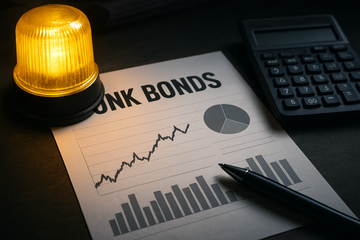
Junk Bonds Are Flashing Yellow — Why the Index Looks Calm but New AI Paper Is Pricing at 9.75%
The US high-yield index spread has widened only 15 basis points on its BB cohort over the past year, and 33 bps on the overall index — yet the 10-year Treasury sits at 5.28%, pushing absolute HY yields to 8.1% and forcing new BB issuers like SoftBank ($11.1B at 9.75%) and CoreWeave ($1.75B at 9.75%) to pay double-digit coupons. With BB bonds now 60% of the index (vs. 38% pre-GFC), AI-related issuance at 24% of new supply (vs. 6% a year ago), and 372 large US bankruptcies in H1 2026 (a 16-year high), the tape is pricing a slow-burn default cycle. Moody's forecasts HY spreads widening to 470 bps over the next year; investors should watch BB composition, hyperscaler CDS, and the 5.3% Treasury level as the triggers that turn yellow to red.
Miebach Picks the War: Mastercard's CEO Just Put $290B of Cross-Border Revenue in Play Against the Banks
From a Bloomberg TV appearance on Oct. 9, 2026, Mastercard CEO Michael Miebach named cross-border payments the clearest stablecoin use case. With the $1.8B BVNK acquisition now closed, SoFiUSD live on its rails, and an 8-point gap already between Mastercard's cross-border volume growth and assessment growth, the card networks have the means to capture most of the $290B revenue pool that McKinsey sizes as cross-border payments — leaving correspondent banks defending a market their own rails are about to eat.

SCOTUS Signals the 401(k) Pleading Bar Will Hold — and the $51T Retirement Pool Just Got a New Map
The Supreme Court heard Anderson v. Intel on October 6 with both Democratic and Republican-appointed justices leaning toward keeping the Ninth Circuit's \"meaningful benchmark\" requirement for ERISA underperformance claims. A pro-Intel ruling stacks on top of Executive Order 14330 and the DOL's pending alternatives safe harbor to clear the path for private equity and private credit into target-date funds run by BlackRock, State Street, T. Rowe Price, and the $1.8 trillion Vanguard franchise. The next decision is the single biggest asset-allocation signal for $51.2 trillion of US retirement savings in years.
Trump's Cook Mortgage-Fraud Committee Sets a Nov. 5 Removal Showdown — And the 7.4% Mortgage Market Has to Price It
President Trump convened a three-person inquiry committee to examine Federal Reserve Governor Lisa Cook's 2021 mortgage statements, with a closed-door White House hearing set for Nov. 5, 2026 — converting a yearlong legal fight over Fed independence into a procedural countdown that the Freddie Mac PMMS 7.40% mortgage market, large-cap bank stocks, and the 5.24% 10-year Treasury have to price. The mechanism runs through two channels: a higher term premium on Fed-removal risk, and the prospect of a Trump-aligned Federal Reserve majority voting for cuts the Federal Reserve Open Market Committee just rejected 12–0.
2026-10-09

AmEx's $350M AML Fine Is Small. The Read-Through to Compliance Opex Isn't.
American Express will pay a $350 million civil penalty — the first large BSA/AML enforcement action against a US card network this cycle — for missing roughly $13 billion in suspicious activity from 2014 to 2025. The fine is just over 3% of its $11.45 billion trailing-twelve-month net income, but the parallel Federal Reserve order against the parent and a mandatory 90-day remediation plan reset compliance spend as a real P&L line item — a frame investors will now apply to every hybrid network-bank, from AmEx to its closest chartered competitors.

$8 Trillion in Money Funds Won't Move Until the Fed Cuts. That's the AI-Capex Funding Test.
Bank of America's Michael Hartnett wrote on Oct. 9, 2026 that the cash parked in money-market funds has stopped being a tactical waiting room and become a structural position — one that exits only when the Federal Reserve delivers sustained easing. The bond market has priced the opposite: the 10-year yield sits near a 24-year high of 5.36% and 'short Treasuries' is back as a top crowded trade, with fund managers citing a disorderly rise in yields as their biggest tail risk. That gap is the AI-capex funding test, because hyperscalers have already issued nearly $500 billion of AI-related debt in 2026 while competing with a Treasury that crossed $40 trillion in August.

Eight Down, One Standing: Bittar Quashing Caps a Five-Year Rout for Rate-Rigging Prosecutions
London's Court of Appeal on October 9, 2026 overturned the conviction of Christian Bittar, a former Deutsche Bank star trader who pleaded guilty to rigging Euribor in 2018. With that ruling, eight of nine Serious Fraud Office rate-rigging convictions are gone — and the DOJ's parallel fights in LIBOR and FX have lost at the Second Circuit too. For trading desks, the rout rewrites the cost-of-compliance math: trading surveillance budgets built up to defend against benchmark and front-running cases now face a credibility question.
What to expect
Evidence-first notes with a visible point of view.
This section collects sharp takes on earnings, shareholder meetings, and market structure. Each new piece should make the thesis, the facts, and the implications obvious within the first few screens.
Expect direct analysis, not generic commentary.
Expect the data to be explicit and the argument to be easy to follow.