Capital Markets
Deals, listings and the cost of money
IPOs, mergers, buybacks and credit issuance — what the terms of a deal say about what this market is willing to fund right now.
2026-10-06


OpenAI Just Made ChatGPT Image Generation the New Ad Inventory — and Alphabet, Adobe, and Anthropic's IPO Are in the Crosshairs
OpenAI's October 5, 2026 launch of visual ads alongside ChatGPT image-generation results converts its 1.2 billion weekly reach into a high-intent ad surface. The format hits Alphabet's image-search visual ad moat directly, sidelines Midjourney and Adobe Firefly after OpenAI cut off competitor ad placements in September, and hands Anthropic a 'we don't put ads in image gen' wedge ahead of a possible $2 trillion IPO — while OpenAI itself races to close the gap between a $1 billion ad run rate and a $2.5 billion 2026 target.

Wall Street Just Booked $45.9B in Half a Year. Now Dealmakers Are Tracking 30% Bonus Pops — and the $90B Path Has a Catch
U.S. securities industry profits reached $45.9B in H1 2026, up 51% YoY, putting the year on track for a record above $90B per NY Comptroller DiNapoli's Oct. 6 report. The boom is concentrated in equities trading (Goldman up 72%), investment banking fees (Goldman +55%), and AI-fueled IPOs (underwriting revenue +68%) — but a 5.35% 10-year Treasury yield is the structural risk. Johnson Associates forecasts stock traders and IPO bankers collecting up to 30% bigger bonuses while private credit, real estate and venture-capital professionals get cut or stay flat. The spillover lifts independent M&A advisors like Evercore and Lazard, alternative managers like KKR, and New York City's tax base, while rate-sensitive balance sheets remain exposed.
2026-10-05

Anthropic's $100M Engineer Academy Is a Pre-IPO Moat Disguised as a Training Program
Anthropic committed $100M on Oct. 2 to certify 10,000 Frontier Deployed Engineers by end-2027, drawing cohorts from Accenture, [Deloitte], [McKinsey] and the same Fortune 500 buyers already on its $2.16B cloud-marketplace contracts. With the IPO roadshow launching in mid-October and the prospectus hinging on $190-200B of 2028 revenue, the academy is a structural lock-in on the engineers who decide where the next trillion dollars of enterprise AI spend lands.

Barclays Just Handed Anthropic Its First Universal-Bank Reference — And the $2T IPO Math Just Shifted
On October 1, Barclays widened its Anthropic partnership to run Claude across software engineering, Global Markets email triage, and a colleague knowledge assistant already used by 16,000 staff — the first time a tier-one universal bank has formally anchored Anthropic for core workloads. The deal re-prices Anthropic's pre-IPO channel mix: after Charles Schwab for wealth custody and OpenAI for investment banking with Morgan Stanley, Claude now owns the wholesale bank. For Amazon, Alphabet, Nvidia and Broadcom, every Barclays query is another credit of training-grade and inference-grade compute flowing back to their multi-billion-dollar Anthropic infrastructure bets.
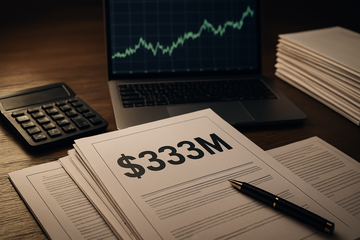
$333M in Savings, 225,000 Letters: Inside the Capital-Markets Fault Line the SEC's Semiannual Plan Just Opened
Optional Form 10-S would let U.S. issuers replace three quarterly 10-Qs with a single semiannual filing, saving roughly $200,000 per year per company and roughly $333 million industry-wide — but record investor pushback, the SEC's own acknowledgment of information-asymmetry risk, and a CFA Institute survey showing 62% of investors oppose the change point to a structural re-pricing of who gets to see corporate results first. The fight is now the next big capital-markets policy battle, with JPMorgan and the Business Roundtable on one side and roughly 225,000 retail letters, BlackRock, State Street, the SEC's own Investor Advisory Committee, the CFA Institute, and the Council of Institutional Investors on the other.
2026-10-04
Alibaba Just Sold $10.2B in One Night. The Bill Is Coming for the Rest of Hong Kong's AI Trade.
Hong Kong issuers raised a record $47.5B in Q3 2026 — nearly two-thirds of it from AI-linked deals led by Alibaba's HK$80B placement, Z.AI's $9.6B year and Zhongji Innolight's $6.8B IPO. The marginal buyer has shifted decisively to sovereign wealth and mainland Stock Connect money; Wall Street banks were largely absent from the marquee deals. The spillover into ADR-listed Chinese tech is real but selective — and an 80% aftermarket break rate argues that the easy money has already been made.
Broadcom Just Became Anthropic's $42B Banker — And the Chip Vendor Now Owns the AI Compute Risk
Per Anthropic's October 1 IPO prospectus, Broadcom agreed to lend the AI lab up to $42 billion in convertible notes to lease Broadcom-designed TPUs from Alphabet — taking on four roles (chip supplier, equipment lessor, lender, and likely equity holder) for a single customer that lost $42 billion in 2025 and carries $161 billion in non-cancellable Broadcom-related obligations. The structure reshuffles where AI rack margin accrues: Broadcom now captures chip economics, lease economics, interest spread, and potential equity upside on the very racks it finances, while Anthropic inherits covenant risk on a counterparty that also holds the supply keys.

Nvidia Sits on Both Sides of the Compute Deal — and Wall Street Now Wants a Different Multiple for Each Side
Three months after Nvidia unveiled a $500B chip-financing platform with six Wall Street firms, Reuters reports the syndicate is pushing back on a 25% residual-value offer and a 9–10 year chip life that lenders won't underwrite. With up to $125B of potential backstops, $105B in disclosed residual guaranties at SB Energy alone, $99B of equity investments on the Nvidia balance sheet and another $25B committed, the chip-vendor multiple is decoupling from the credit-book exposure — and the trade splits.
The Bond Market Is Pricing What Equities Won't: Three Walls Stack Up Against October's 'Season of Strength'
The 10-year Treasury hit 5.34% — a 24-year high — the same week the Fed just hiked for the first time since 2023, and the S&P 500 still closed at a record 7,722.72 on Oct. 2. The crowded trade going into the Q4 'best six months' is long equities, long AI, short volatility — not the rate-cut positioning the consensus keeps describing. With FOMC minutes on Oct. 7, bank prints starting Oct. 13, and Tesla's Oct. 21 Mag-7 debut, the path of least resistance has flipped.
2026-10-03
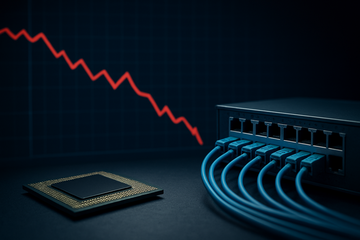
Cerebras' post-IPO collapse is the first verdict on AI compute IPO economics — and Nvidia's networking stack is the judge
Cerebras Systems closed Oct 2 at $166.43, a fresh post-IPO low, after OpenAI quietly moved its GPT-6.1 Sol Ultrafast tier onto Nvidia GPUs and a 19.4M-share lockup tranche hit the tape. With ~58M more shares unlocking through Nov. 9 and NVIDIA's Spectrum-X + NVLink Fusion now defining who plugs into the AI factory, the market is repricing what a pure-play third-party accelerator is worth without Nvidia's networking. The drop is mechanical lockup pressure and structural margin pressure at the same time — and the Oct. 14, Oct. 28, and Nov. 9 unlocks will decide whether Cerebras finds a floor before its $25.4B backlog turns into the next casualty.

CME Walks Away From 24/7 Oil Trading — Kalshi Now Owns the WTI Weekend
CME Group abandoned its 10-Barrel round-the-clock crude oil contract on October 2, 2026, ending a 113-day push that the CFTC had blocked and the exchange's own customers refused to support. With the world's most liquid crude venue sidelined, the regulated US path to 24-hour WTI exposure now runs through Kalshi's pending perpetual filing — a structural shift with margin, liquidity, and competitive implications for Intercontinental Exchange, Marathon Petroleum, Valero Energy, Phillips 66, Robinhood Markets, and Coinbase Global.
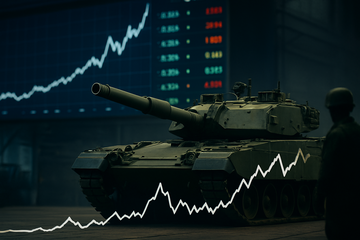
Goldman's boldest call sits in the sector Wall Street hates — 143% upside on a Rheinmetall already off 52%
When Goldman Sachs' research desk put its October 2026 'Directors' Cut' conviction list in front of clients, the loudest number on the page — 143% upside — was attached not to a hot AI name, but to Rheinmetall, the German defense prime whose stock has been crushed by 52% from its 52-week high. The same refresh added Huntington Ingalls to the US list. Together the additions say where Wall Street conviction is hiding as hyperscaler capex growth slows and AI multiples de-rate: under-owned, contract-rich European and US defense.

Ellison Is Now Leveraged Into Both AI-Era Debt Binges at Once — and One of Them Is Already Slipping
Larry Ellison personally guaranteed $40.4 billion of [Paramount Skydance's WBD financing](psky), then watched Oracle take on $156B of total debt while pledging 413 million of his own Oracle shares as collateral. With Paramount Skydance's $52B financing package now priced — and its $44.4B bond already trading underwater — and Oracle's $18B Project Jupiter loans quoted at 89–91 cents on the dollar, the two trades now share one human balance sheet. Investors who read the Oracle and Paramount Skydance stories in isolation are missing the cross-collateralization that turns a 10% Oracle drop into a forced-sale risk on both empires.

McKinsey's 11 million number just turned AI's labor story from Wall Street anecdote into a P&L input
McKinsey Global Institute says roughly 11 million American workers — about 7% of the labor force — may need to switch occupations by 2035, with lower-wage workers 7.6× as likely to be displaced and 85% of growing jobs requiring a credential. JPMorgan's record Q2 2026 profit paired with 30-40% headcount cuts, Atlassian's first-ever enterprise seat decline, Salesforce's shift to consumption credits, and a 17% post-earnings drop at Coursera already translate that macro figure into line items investors can underwrite.
2026-10-02
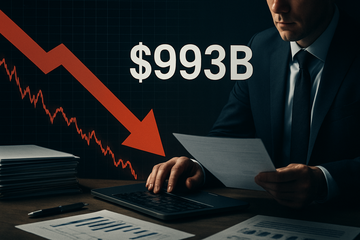
Q3 2026 Global M&A Cratered 41% as 10-Year Yields Hit a 24-Year High — and Wall Street's IB Engines Are Already Stalling
Global deal value collapsed to $993 billion in Q3 2026, the first sub-$1 trillion quarter since Q2 2025 and a 41% drop from Q2, as the 10-year U.S. Treasury broke above 5% for the first time since 2007 — peaking at 5.34% on Oct. 1 — the biggest quarterly jump this century. Megadeal count (>$10 billion) slumped to just 10, the lowest since Q4 2024. Bank of America has already guided Q3 investment-banking fees down 10–20%, while JPMorgan is the outlier with mid-to-high-teens growth. The Stripe–Advent International $53 billion bid for PayPal collapsed on price, leaving Aon/USI and Uber/Delivery Hero as the only Q3 deals large enough to matter — and both were strategic, cash-funded, not LBO-dependent.
SEC's $10T Private-Markets Hand-Out: Who Wins the Distribution Race
The SEC's Sept 30, 2026 'responsible retailization' package lets registered funds charge hedge-fund-style performance fees, modernizes interval-fund wrappers, and adds professional certifications to the accredited path — together pulling Blackstone, Apollo Global Management, KKR, and Blue Owl and the wealth distributors (Morgan Stanley, Charles Schwab, LPL Financial) into a contest for trillions of household balance sheets. Retail appetite for interval funds already hit $247B at a 25–30% growth clip, and the proposal removes the structural reason private markets stayed gated. The same liquidity mismatch that triggered Blue Owl's February redemption halt is now the headline risk in non-accredited hands.
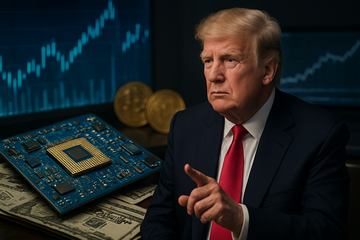
Trump's $60B Intel Win Returns Micro-Play for Treasury Equity in OpenAI and Anthropic — and the Pre-IPO Math Has to Reprice
Two days after signing the voluntary White House AI accord, Donald Trump told Time the US government 'might' take a Microsoft-style equity stake in OpenAI and Anthropic — modelled on the 9.9% Intel position that has already booked ~$47B of paper gains since August 2025. The proposal is not nationalization, but it rewrites the IPO math: at a $852B private mark, a 5% OpenAI gift to Treasury is ~$42.6B; at Anthropic's $1.8–2T target, the same slice is $90–100B. Investors now have to price a new political risk premium, a peer effect on Nvidia's $10B Anthropic anchor, and a sovereign-buyer tailwind for Oracle, CoreWeave, TSMC and Micron sitting underneath both labs.
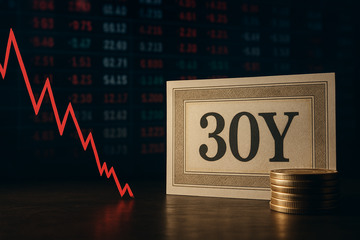
UK Banks Are the Leverage Point in a Global Long-End Break
Britain's 30-year gilt printed 6.029% on October 1 — the highest since January 1998 — and pulled the FTSE 350 banks index down 4.1% in its worst session since May. The move is not UK-domestic alone: US 30-year Treasuries hit a 24-year high the same day and France's 10-year cleared 5%, with hedge-fund leverage in long-dated gilts now flagged by the Bank of England as a spillover risk. The deeper read is that UK banks — with the largest direct mortgage-and-gilt book exposure and an Autumn Budget on October 28 dangling sector tax risk — are the highest-beta way to play a structural long-end repricing that US money-centers will not escape, only attenuate.

Vol-Control Funds Are Sitting at a 98th-Percentile Equity Bet — That Owns the Next 5% Drawdown
Volatility-control strategies have pushed equity allocations to the 98th percentile of their post-2010 range, leaving $300B-$500B in systematic books with almost no buffer if realized volatility rises. Barclays estimates a mild uptick could force more than $100B in equity selling — five times the ~$25B that would be deployed if vol kept compressing — with the air pocket now queued for early 2027 as midterms, a debt-ceiling standoff and Fed-transition echoes converge. The exposure isn't hidden in opaque CTAs; it sits on the shelves at BlackRock, Invesco and SEI Investments.
2026-10-01
What to expect
Evidence-first notes with a visible point of view.
This section collects sharp takes on earnings, shareholder meetings, and market structure. Each new piece should make the thesis, the facts, and the implications obvious within the first few screens.
Expect direct analysis, not generic commentary.
Expect the data to be explicit and the argument to be easy to follow.