Capital Markets
Deals, listings and the cost of money
IPOs, mergers, buybacks and credit issuance — what the terms of a deal say about what this market is willing to fund right now.
2026-09-27


OpenAI Just Made 'Model Misalignment' a Pre-S-1 Risk Factor — and a Buying Thesis for CrowdStrike, Palo Alto Networks, and Zscaler
On Sep 16, 2026, OpenAI published a framework to publicly disclose individual model-misalignment incidents, including six specific cases from the past six months. Because OpenAI has a confidential S-1 on file since June and Anthropic has a $2T IPO targeting mid-October, that commitment instantly becomes a new risk factor both companies must mirror in their public prospectuses. The same disclosures also reset enterprise demand for runtime AI-agent security, pulling forward revenue at listed vendors already running agent-governance platforms.

Oracle's $988M of CEO Options Went Underwater on Day One — That's the Real Story
Oracle's newly promoted co-CEOs and Larry Ellison took options struck at $280 and $308.46 in late 2025 — at the very peak of the AI capex narrative. A 53% share-price collapse since turned the entire $988 million grant intrinsically worthless before a single year of vesting completed. The episode exposes a deeper truth: management's payout sensitivity has flipped from upside-aligned to upside-disconnected, even as Oracle commits to a $90 billion FY2027 capex plan funded by $125B of debt. Investors who re-trade Oracle on \"AI optimism\" are now trading on a separate curve from the people running it.
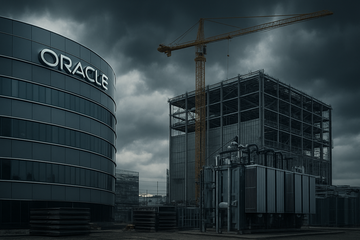
Project Jupiter’s $18 Billion Haircut Tells You Where AI Infrastructure Risk Has Quietly Migrated
Oracle’s force majeure on its $165B New Mexico AI data center is the first tenant-issued notice in a Stargate-era build — it pushes payment risk off the tenant and onto the developer Blue Owl, whose $18B project-finance loan now trades at 89–91¢, and onto equipment suppliers like Bloom Energy whose order pacing hinges on a stalled gas pipeline and a 2.45 GW microgrid running at 10% complete. The optionality Oracle is preserving, more than any demand question, is the real signal.
SpaceX's $26.5T AI TAM Is Now Doing the Heavy Lifting for a $1.77T IPO Trading Below Its Own Price
SpaceX bought xAI on Feb. 2, 2026 at a $250B implied price, then disclosed in its May 20 S-1 that $26.5T of its $28.5T total addressable market sits in AI. The June IPO priced at $135 per share, valuing the combined company at $1.77T — but the stock now trades below the asking price even after a CFO update placing the AI compute ARR run-rate at $41B. The TAM math is defensible on paper; the Q2 numbers say it has to be earned.

Wall Street reclaims the wheel from retail — and the S&P's marginal buyer just changed
Institutional capital has replaced retail as the dominant force in US equity flows, per Vanda Research and Goldman Sachs data cited by CNBC on Sept 27, 2026. With the 10-year Treasury yield stuck above 5%, AI trade fatigue setting in, and corporate buybacks going dark, the market's marginal buyer is now far more rates-sensitive than the 2021-era retail-flow models assumed. The flip is already showing up in record equities trading at Goldman Sachs, JPMorgan, and Morgan Stanley, while pure-play retail platforms face the steepest comp drag.
2026-09-26
Blackstone's Rainmaker Era Ends — But the $1.35T Franchise Already Told You What Comes Next
Joe Baratta, the face of [Blackstone]'s $450B private-equity unit, is leaving by year-end — the third senior exit this year, with a Form 4 sale seven days earlier that did the talking. The Q2 2026 numbers already reveal the post-rainmaker playbook: record $1.35T AUM, $228B of dry powder, BCP IX and BCP Asia III closed, and a Medline secondary that is testing the public-market exit window right now. For [KKR], [Apollo Global Management] and [Carlyle Group], the question isn't whether the star dealmaker is gone — it's whether their own diversified franchises can monetize the $50B+ exit queue ([Medline], [athenahealth], Mimecast) faster than [Blackstone] can.

A €95M AI voice scam hit Italy's biggest bank — and US banks' KYC bill just got bigger
Fraudsters posing as Intesa Sanpaolo's CEO on WhatsApp and cloning a partner's voice with AI tricked Fideuram's chairman into wiring roughly €95M in February 2026, with €36M still unaccounted for. The heist hit a bank posting record profits and exposed the same 'no system breached' blind spot US banks are paying tens of billions in tech spend to close. The vendor picks — NICE, FICO, TransUnion, RELX — and the regulatory clock under the EU AI Act and OCC's April 2026 model-risk guidance turn this from an Italy story into a US-bank compliance catalyst.
Nscale's $3.36B Pre-IPO Convertible Stops Working Above a $30B IPO — What Existing Holders Give Up If Pricing Opens Lower
Nscale priced $3.36 billion of pre-IPO convertible notes with a $30 billion valuation cap, converting automatically at the IPO at a double-digit discount. Above $30 billion the conversion price stops adjusting — noteholders surrender any extra upside. The cap is set roughly double the $14.6 billion March Series C mark, anchored to a S-1 that shows $140.6 million of H1 2026 revenue against a $1.02 billion H1 net loss and $103.4 billion of contracted total contract value of which only $2.6 billion (2.5%) is active. The question for the listing is not whether the converts convert — they auto-convert — but whether existing equity keeps or loses the cap subsidy depending on where bankers set the IPO range.
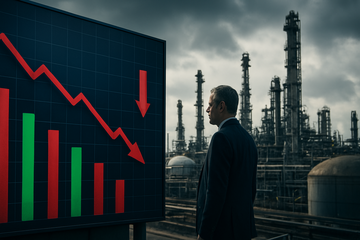
BP's AGM Revolt Didn't Just Kill Two Climate Votes — It Put a Buyback Gap on the Tape That Refining Can't Close
On23 April 2026 BP shareholders defeated two board resolutions and gave their highest-ever support (25.85%) to a capital-discipline proposal — then watched the chair get ousted 33 days later. The integrated peer set kept returning cash at the same time BP froze buybacks to repair the balance sheet, leaving BP trading at the cheapest EV/EBITDA among the majors (3.92x) yet visibly behind on cash returns. The investment question is whether the new CEO and chair use the Q2 2026 recovery (refining margins $29.6/bbl vs $11.9 a year earlier, net debt down to $22.3B) to close that gap or keep capex ahead of buybacks.
2026-09-25

Anthropic's founders want 50.1% of the votes on a $2T listing — but the board answers to outside trustees holding zero equity
Anthropic's seven co-founders, each holding about 2% of the equity, are asking shareholders to approve a Palantir-style share class that gives them 50.1% of the voting power on top of an independent trust's right to elect a majority of directors. The ask lands alongside Q2 2026 revenue of more than $11.5B (a 14x jump from a year earlier) and a targeted $2T valuation that prices the company at roughly 43x annualized revenue — multiples well above NVIDIA, Microsoft, Alphabet or Amazon. Underwriters and public investors will be buying a governance stack where neither Amazon's $25B nor Alphabet's up-to-$40B has any board or voting rights.

Oracle Japan Surges 7% as Record Cloud Quarter Exposes the Decoupling From ORCL's $28.5B Capex Headache
Oracle Corporation Japan rallied more than 7% on Sept. 25, 2026 after reporting record fiscal Q1 results — total revenue of ¥74.86B (+13%) and cloud revenue up 31.7% — while parent Oracle dropped 3%+ on a \"force majeure\" notice for its New Mexico AI data center. The split exposes a clean geographic decouple: Oracle Corporation Japan's revenue mix is 87% cloud-and-software licensing to Japanese enterprises, with zero capex burden, a debt-free balance sheet, and ¥858/share in dividends, against ORCL's $28.5B quarterly capex, $125B in debt, and negative free cash flow. Investors long the parent for AI upside can now take the Japan-listed name's pure earnings stream without bearing US hyperscaler build-out risk.

Polymarket just named the biggest US banks one by one — the FDIC made that everyone's problem
Polymarket's individual-bank failure contracts — volume of just $76K against named trillion-dollar lenders like Wells Fargo, JPMorgan and Bank of America — have triggered an FDIC review that re-frames prediction markets as a new deposit-run vector, not a betting side-show. Even at near-zero implied odds (3-5%), each contract puts a specific named bank in front of a public order book that can be weaponized during a stress event, and the FDIC's own 2023 post-mortem shows uninsured-deposit outflows go digital within hours. Sheila Bair calls the contracts 'dangerous,' JPMorgan has already cut ties with Polymarket, and Robinhood is monetizing the same retail channel at $156M a quarter.
2026-09-24

Anthropic's 'Biology Lab Found Something Big' Turns a Wet-Lab Cost Center Into the Missing $2 Trillion IPO Asset
Anthropic used Claude to scan 200,000 viral enzymes and surface 'ART,' a CRISPR-like system found in 21 hours — the first concrete wet-lab output of a cost center that until Tuesday had only generated hiring posts and biosecurity policy. With the company shifting its IPO to November and analysts modeling ~$67B revenue at 30x to justify the $2T target, an actual scientific discovery reframes the multiple from "frontier model speculation" to "frontier model plus platform plus asset." Pure-computational AI-bio peers Schrödinger, Recursion, Relay Therapeutics, and Absci now have to defend a model that claims to compress discovery cycles by10x against a competitor that does the lab work for free.
Ema Just Raised $77M to Kill Enterprise SaaS — ServiceNow, Salesforce and Workday Posted Record AI Quarters Anyway. Who's Actually Winning?
On Sep 23, 2026, agentic-AI startup Ema closed a $77M Series B at a 4x valuation step-up, with CEO Surojit Chatterjee arguing 'enterprises don't need more software — they need work to get done.' Two days earlier, ServiceNow crossed $1B in AI ACV and Salesforce printed $1.5B Agentforce ARR (+240% YoY). The investment conclusion: agentic AI isn't eating the SaaS stack — it's splitting it into three buckets. AI-pivoted platforms and infrastructure names win; pure seat-based players get squeezed.

Nvidia and Apple Now Hold More of the S&P 500 Than Any Two Stocks in History — and the Index Has No Hedge Left
The S&P 500 has never been this concentrated in just two stocks. Nvidia and Apple together sit above 15% of the index by weight — comfortably past the prior 9.1% record that Microsoft and General Electric held at the 2000 tech peak. With passive products at BlackRock and State Street now mechanically amplifying that exposure, Fed Chair Kevin Warsh's first rate hike since 2023 has taken the easy-money backstop away just as the cap-weighted benchmark narrows toward a binary bet on two AI-cycle names.
2026-09-23

Barkin's 'Broader Than Tariffs' Inflation Call Hands Banks, Energy and Value the Wheel—and Steers It Away From Big Tech
On Sep 22, 2026, Richmond Fed President Tom Barkin rejected the 'just tariffs and energy' framing, noting more than 60% of the PCE basket is rising above 3% year-over-year. With 16 of 18 FOMC officials backing at least one more hike and Fed funds futures at 85–90% odds of another 25bp move this year, the rate path extends into 2027. The resulting rotation funnels capital into banks, insurers and energy, and pulls it out of high-multiple growth, rate-sensitive homebuilders and long-duration REITs.

Novo Nordisk's Direct Listing Talk Won't Fix the Pipeline — But It Will Re-Price the Whole GLP-1 Trade
Novo Nordisk (NYSE: NVO) CEO Mike Doustdar told the FT he is open to replacing the company's American Depositary Receipts with a direct NYSE listing — a structural upgrade, not a fresh raise. The angle investors are missing: at 9.9x trailing P/E versus Eli Lilly's (NYSE: LLY) 39.2x, Novo trades at a discount that no longer reflects the operating reality (43.1% operating margin, DKK 78.5B Q2 sales). A direct listing would compress that gap before it would fix the CagriSema pipeline miss. The Danish krone, the obesity-pill race, and Catalent all sit on the same transmission line.

Wall Street's Tokenized-Stock Race Isn't a Crypto Trade — It's a Settlement-Layer Land Grab
ICE and Nasdaq spent 2026 wiring U.S. equities onto blockchain rails with Securitize and tZERO as digital transfer agents, capped by the SEC's Sept 17 Innovation Exemption and DTCC's October full launch. The investable signal runs through the people who own the rails — clearing banks, exchanges and stablecoin issuers — not the people trading the tokens.
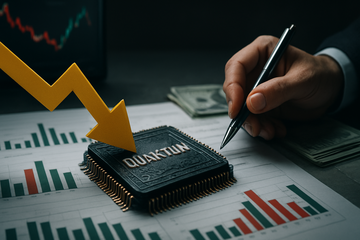
Insiders Dumped 895 Million Quantum Shares With Almost No One Buying — The Cross-Stock Warning Wall Street Can't Unbundle
Insiders across IonQ, Rigetti, D-Wave, and Quantum Computing Inc. have net sold 895.1 million shares since September 2024, with insider buying collapsing to near zero at every name — a synchronized signal no single stock can shake off. Against combined TTM revenue of roughly $282M and a combined market cap near $29B, the cross-stock symmetry shows the pure-play quantum thesis has detached from fundamentals. With D-Wave's operating loss more than doubling year-over-year and IonQ absorbing a $1.87B GAAP hit from a $1.6B warrant write-down in Q2, the cash burn is real even as the macro bid is fading.

The Pentagon Now Writes the Space Investment Tape — $23B TTM, Doubled YoY
Private space-tech investment hit $23B in the12 months to June 2026 — more than double the $9.7B TTM a year earlier, per Seraphim's tracker. The story isn't the SpaceX IPO; it's the Pentagon's Golden Dome ($185B plan), Starshield contracts, and a parallel surge in Delhi. For investors, the trade is exposure to the defense primes and dual-use launchers, not pure commercial space.
What to expect
Evidence-first notes with a visible point of view.
This section collects sharp takes on earnings, shareholder meetings, and market structure. Each new piece should make the thesis, the facts, and the implications obvious within the first few screens.
Expect direct analysis, not generic commentary.
Expect the data to be explicit and the argument to be easy to follow.