Capital Markets
Deals, listings and the cost of money
IPOs, mergers, buybacks and credit issuance — what the terms of a deal say about what this market is willing to fund right now.
2026-11-03


2026-11-02

Oracle's $20 Billion Raise and Anthropic's $895.4 Billion Book Are the Same Warning: The AI Buildout Now Runs on Other Companies' Balance Sheets
Oracle filed on Nov 2, 2026 to sell $10 billion of common stock alongside $10 billion of senior notes, and Anthropic's amended Form S-1 the same morning lifted its contracted compute obligations to $895.4 billion against $131.8 billion of cash. Neither buildout is financed by the customer paying cash on time: Oracle's new paper covers roughly three months of its own trailing capital spending, and Anthropic's $69.8 billion twelve-month bill is bridged by up to $42.0 billion of convertible notes from Broadcom, $6.2 billion of notes from Amazon and a warrant handed to Akamai. The picks and shovels are now being paid in equity and credit claims on their own customers, and that is where the margin is migrating.

Apollo's $11.2 Billion European Credit Launch Backs the Only Part of Private Credit That Isn't Being Marked Down
On November 2, 2026, Apollo launched European Credit Company, a €10 billion ($11.2 billion) pan-European platform for performing corporate and asset-backed credit, backed by the Abu Dhabi Investment Council, Athora, Norinchukin, Standard Chartered and Aranda Principal Strategies. It is not a fix for the market's live problem: Apollo's own credit outlook puts more than $100 billion of US software and services loans maturing between 2027 and 2029, more than half of them already trading below 90 cents, while business development companies wrote down 81% of software loans in 2026 against 40% of loans elsewhere. The signal is the shareholder register rather than the size — €10 billion is roughly 1% of Apollo's $1.047 trillion of assets, but Apollo separately committed $5 billion to take a minority stake in Mubadala Capital, giving it two Abu Dhabi channels in eight days. For investors the read-through is that sovereign and Japanese bank money is being routed to the cleanest collateral in private credit, squeezing European fee growth at Ares, Blue Owl and Blackstone while the retail vehicles funding the marked US books keep redemptions gated.

Who's Funding Anthropic's $2 Trillion IPO? Asia's AI Winners Are Being Sold to Pay
Anthropic filed its S-1 on Oct. 26 for a Nasdaq listing marketed at up to $2 trillion, and Korean brokers now name the deal as one reason foreigners are liquidating Korean semiconductor shares to raise cash. Taiwan printed a record NT$302.56 billion foreign-selling session on Oct. 15, while the central bank put 2026 fund outflows at US$77.6 billion through Oct. 28. The money funding the largest AI listing in history is coming out of the AI complex itself, which makes Anthropic's clearing price an immediate input into TSMC, the memory complex and AI credit. The loop has a stress point: CoreWeave carries US$51.6 billion of debt against US$5.0 billion of equity.

Shell's $10–15 Billion LNG Canada Stake Is Unsold, and $111 Oil Is the Wrong Reason to Buy It
Shell has been trying to sell its 40% operating stake in LNG Canada to a single buyer; Apollo, Blackstone and KKR reached the final round on a price reported at well north of $10 billion and possibly $15 billion, and as of Nov 2, 2026 nothing has been signed. The tempting explanation, a Brent print of $111 after crude crossed $100 on Sept 9, is the wrong one, because LNG Canada's volumes sit under long-term Asian supply agreements and the toll does not float with crude. What actually made the asset scarce is Hormuz: JKM printed $32.84/MMBtu on Oct 30, chokepoint-free Atlantic supply now carries a strategic premium, and that is what pulled a sovereign investment arm into a process that began as a financial one. The investable consequence is that owners of contracted LNG cash flow reprice first, with Cheniere raising 2026 adjusted EBITDA guidance to $8.75–9.25 billion and trading at 11.0x trailing EV/EBITDA against Shell's 4.5x, while whoever wins the auction inherits roughly C$13 billion of Phase 2 equity for revenue that starts in the early 2030s.
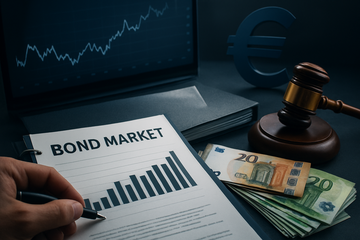
Hedge Funds Now Drive More Than Half of Europe's Bond Market — and the SEC's Nov. 2 Deadline Decides How They Hedge It
The SEC's proposal to add European Union debt obligations to Exchange Act Rule 3a12-8 closes for comment on Nov. 2, 2026, and Bloomberg reports hedge funds are backing it, with the Managed Funds Association endorsing the same day. The list governs which sovereign debt can be hedged on-exchange without US securities-law ambiguity, and the EU's own bonds — now roughly €738 billion and growing — are the one major euro issuer missing from it. With hedge funds behind more than half of the roughly €13 trillion euro government bond market and Europe's rate plumbing showing its worst liquidity since 2008, the practical consequence is that a Washington rule decides who can trade euro duration directly and who must still go through a dealer's balance sheet.
Fractile's Mark Rose 6.5x on a $250M Order for Silicon That Doesn't Ship Until 2027 — In the Same Week OpenAI Cut $150 Billion Off Its Own
In the eight days between Anthropic opening its IPO book and OpenAI trimming its round, private AI marks moved in opposite directions: Fractile re-rated about 6.5x to $6.5 billion on a $250 million pre-shipment order from Anthropic, with the UK's Sovereign AI Fund taking a slice, while OpenAI cut its target valuation by $150 billion and Anthropic's expected valuation fell from roughly $2 trillion to about $1.5 trillion. The cause is not demand. Anthropic's filing shows at least $518 billion of mostly non-cancellable compute obligations and NVIDIA's 10-Q shows $108.5 billion of guarantees backing an OpenAI affiliate's leases, so the risk has migrated out of model-lab equity and into supplier credit and sovereign balance sheets where no quarterly mark exists. For listed investors, the compute layer's cash flows remain intact while its equity is repriced on funding quality, and Anthropic's IPO is the settlement event that decides which side is right.
2026-11-01
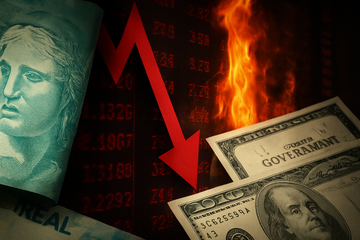
Brazil's One-Day Rout Wiped Out 73% of a Year's EM Carry — and the 4.93% Funding Leg Has Nowhere to Fall
Lula's re-election on Oct 25, 2026 took the Brazilian real down 8.36% in a single session and pushed the 10-year local government bond up 246 basis points to 15.45%, erasing 73% of the 11.45-point spread that dollar-funded investors were paid to hold. The shock was a positioning event, not a solvency event: hard-currency credit barely moved while the currency and local rates absorbed the damage. With the Fed on hold at 3.75–4.00% and the 10-year Treasury at 4.93%, the funding leg of every carry trade is fixed while the currency leg can gap — which is why the most crowded EM carry market is where the unwind shows up first.

Crocs' 25% Earnings Jump Was Mostly a Court Refund and a Buyback: Only the Brand's Own DTC Channel Still Keeps the Full-Price Consumer
Crocs' shares closed at $150.26 on Oct 29, 2026, up 25.5% after a quarter in which revenue rose 4.6% and adjusted EPS of $3.69 beat a $3.30 consensus. But $64.07 million of non-recurring IEEPA tariff refunds accounted for 614 of the 770 basis points of GAAP gross-margin expansion, and roughly 53% of the adjusted EPS increase came from an 11.2% smaller share count. The durable signal is where the profit landed: enterprise direct-to-consumer revenue grew 6.9% while Crocs Brand wholesale slipped 0.5%, and management is now deliberately moving North American volume out of its own channel and into wholesale. In the same window, DICK'S Sporting Goods cut FY2026 EPS guidance to $11.00-$12.00 and its shares fell about 31%, while off-price TJX raised margin guidance on 4% comparable sales and banked a $219 million net refund benefit. With DRAM and NAND prices rising double digits every quarter and device units set to fall, the household budget funding branded footwear is the contested resource — and this quarter the branded-direct model kept it.

Washington Deregulated Crypto by Fiat — and the Fee Pool Moved to Banks: Coinbase Transaction Revenue Fell 43% in Q3 2026 While Bank Net Interest Income Grew 13-15%
After the CLARITY Act died on a 49-50 cloture vote on September 15, 2026, the rulebook moved to the agencies: the SEC and CFTC reclassified most crypto assets, the OCC finalized its stablecoin rule, and Treasury Secretary Scott Bessent promised on October 27 to convene the SEC and CFTC to write more. The gap that matters is not what those rules say but what they cannot reach — the CFTC admits it cannot force crypto assets onto registered platforms — and the price of that gap showed up on October 29, when $6.36 billion moved out of Binance wallets, the largest theft on record. The market's response has been to shrink the crypto-native float ($298.5 billion of stablecoins, lowest since August) while bank balance sheets grew net interest income 13-15%, so the investable read is that value migrates from trading venues to regulated balance sheets. Own the intermediaries, not the order flow.
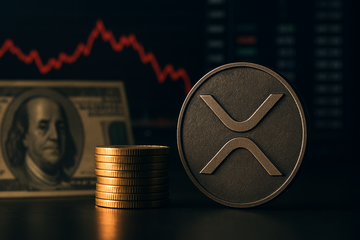
Evernorth Holdings Registered 91.6% of Its Equity for Resale — and Its XRP Treasury Still Trades at 1.9x Its Tokens
On October 30, 2026, Evernorth Holdings filed a preliminary Form S-1 registering up to 73,688,162 Class A shares and 239,653 sponsor warrants for sale by the holders, and the company collects none of the proceeds. This is not Cigna Group's Evernorth: it is a Ripple-backed XRP treasury that closed its merger with a SPAC on October 9, 2026 and began trading on Nasdaq on October 12 as XRPN. Because every share and unit in that deal was priced at a fixed $10.00 while the token fell from $2.36609 at signing to $1.43069 at closing, roughly $363 million of XRP value was absorbed by dilution rather than by the quote. At the October 30 close of $14.20 the stock trades at 1.93 times the market value of the 473 million XRP behind it, while the Bitcoin and Ether treasury peers trade at 0.76 to 1.00 times book.

JPMorgan Priced Bitcoin at 10% and Left It Out of Every Portfolio — In a Book Built on $900 Billion of AI Capex
J.P. Morgan Asset Management's 2027 Long-Term Capital Market Assumptions, published October 19, put a 10% compound annual return on bitcoin — above the 7.5% it assumes for US large-cap equities — while keeping bitcoin out of every strategic allocation and out of the covariance matrices its own optimizers run on. The same book assumes $900 billion of AI capex this year and $5.5 trillion by 2030, and the bank publishing the hurdle is the one arranging the build: $3.0 billion of investment banking fees in the September quarter and $9.6 billion of Stargate construction loans. The result is a 10% hurdle rate that private AI marks — OpenAI's $1.25 trillion and Anthropic's reported ~$1.5 trillion — must clear, and a bitcoin forecast that functions as a warning rather than a recommendation.

S&P Put Meta on Negative Outlook: a 1.0x Leverage Trigger Now Governs the $225 Billion AI Capex Plan
S&P Global Ratings moved Meta to a negative outlook on Oct. 30 while affirming its AA- rating, forecasting free operating cash flow deficits of $22 billion in 2026 and $71 billion in 2027, and warning that adjusted leverage could cross the 1.0x downgrade threshold as early as 2027. The $95 billion equity plan priced three days earlier is a liquidity bridge, not a credit fix: most of that money converts into leases and purchase commitments — $825 billion of them — which is precisely how the agency's own leverage math deteriorates. The investable consequence is a split between owners of contracted AI inputs and arrangers of AI capital, who collect cash whether Meta spends $145 billion or $225 billion, and the companies levered to Meta's credit, which do not.
2026-10-31

Anthropic's Lenders Raised the Coupon From 8.5% to 10%. The Equity Market Still Wants $1.5 Trillion
Anthropic filed its S-1 on Oct. 26, 2026 to list on Nasdaq under ANT, and investors were discussing about $1.5 trillion on Oct. 15 — down from roughly $2 trillion a week earlier — while the only public credit mark on the lab, Kroll's BB+, sits one notch below investment grade. The $18 billion junior tranche of its $63 billion Broadcom chip financing now prices above 10%, against 8.5% on comparable paper four months earlier and 6.84% for the BB high-yield index on Oct. 15. The contradiction is not an error: equity owns the residual claim on $518 billion of compute commitments that are about 80% non-cancellable, while credit owns the floor of a payment schedule running to 2045. What has not been priced is who absorbs that schedule if revenue lands short of the $190-200 billion of 2028 revenue the market is underwriting — and November's listing forces the agencies that have withheld their ratings to rule.

Arini's $800 Million Fire Sale Is the First Real Clearing Price for AI-Disruption Credit Risk
Arini Capital Management's flagship hedge fund is down roughly 26% this year and has sold about $800 million of debt in recent weeks, partly to meet bank margin calls, and on Oct. 30, 2026, Pimco and Oaktree bid for the high-yield paper it wants to unload. The paper on offer is the liquid, performing kind: the distressed positions driving the losses have no bid, so the only exit for a margin call is the bonds that actually trade, which makes this the first observable clearing price for credit priced on AI-disruption fear. That price matters more than the headline loss, because it resets what every other holder of stressed paper must accept. Arini's own answer to the squeeze — $1.5 billion of new credit commitments and a direct lending fund closed above $4 billion — moves the same risk into private credit, where marks are set by appraisal instead of trade.

Big Tech's Buyback Floor Vanished — and the AI Trade Became a Funding Trade
The five largest U.S. AI spenders returned 9.3% of operating cash flow to shareholders in the first nine months of 2026 — the smallest share in at least 15 years, against 27.4% a year earlier — and the group is now a net seller of its own stock. Buybacks collapsed 83% to $13.6 billion while capital spending roughly doubled to $556.9 billion, flipping combined free cash flow to a $14 billion deficit. The money did not disappear; it moved into data centers and onto the bond ledger, where Microsoft priced its first U.S. investment-grade issue since 2017 on October 29 with share repurchases listed among the intended uses. The consequence for investors is that AI exposure now prices off funding cost rather than end demand, which is why October's drawdowns arrived without a broad guidance cut.
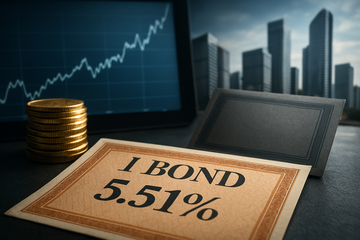
I-Bonds at 5.51% Just Raised the Household's Risk-Free Bar — and the AI Buildout Answered With $228 Billion of Bonds
Treasury's Oct. 30, 2026 announcement set the Series I composite rate at 5.51% for purchases from Nov. 1, 2026 through Apr. 30, 2027 — a 1.40% rate locked in real terms for two decades plus a CPI adjustment, with no mark-to-market and no state or local tax on the interest. That guarantee now sits above the trailing cash yield of most of the AI capital-spending chain: Microsoft, Alphabet, Amazon and Meta Platforms turned $615 billion of trailing capex into $61 billion of trailing free cash flow. The buildout did not slow; it changed sponsors, with Alphabet, Amazon, Meta Platforms and Oracle issuing more than $228 billion of bonds through Oct. 13 — so the marginal risk in the AI trade now sits in credit priced off a 4.98% risk-free rate, not in household equity demand.
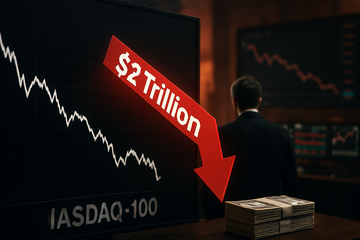
Third Correction, Third Seller: $2 Trillion Wiped From the Nasdaq-100 as Levered AI Credit, Not the Dip Buyer, Did the Selling
The Nasdaq-100's third correction of 2026 was not a valuation event. It turned a valuation correction into a funding event, because roughly a third of AI capital spending is now debt-financed, credit spreads have doubled, and the equity in levered AI structures has become the margin on the loan. CoreWeave's five-year credit default swaps blew past 1,140 basis points, operating cash flow now covers capex 1.47 times at Microsoft but 0.11 times at CoreWeave, and volatility-target funds sit at the 98th percentile of equity exposure with no dry powder left to catch the knife. The dispersion inside the index is the answer: the market punished the AI exposures that were financed and ignored the ones that were paid for out of cash flow.

New York Halved Its Budget Gap on Wall Street Money — and Its Tax Base Is Now Levered to the AI Trade
New York's Division of the Budget used a record Wall Street year to project roughly $9 billion of surplus for the fiscal year ending March 2027 and cut the state's three-year General Fund gap from $31.7 billion to $17.6 billion. The receipts behind that swing are concentrated: the securities industry generated an estimated $26.3 billion of New York State tax in State Fiscal Year 2025-26, 20.8% of all state tax collections and 88.3% of it personal income tax funded by bonuses and realized gains. That makes the state's balance sheet a derivative of the same equity cycle that pays Wall Street, and the New York City Comptroller's own scenarios show the downside arriving as a $3.4 billion city revenue hit in a single year. Read the update as a cyclical windfall being banked, not a structural fix: the gap re-widens to $8.9 billion by fiscal 2030, and the listed exposure runs from Goldman Sachs and Morgan Stanley through the volume tolls at Intercontinental Exchange and Nasdaq to M&T Bank and SL Green Realty.

OpenAI Cut Its Round to $20 Billion and Its Valuation by $150 Billion — Its Compute Plan Went the Other Way, to $856 Billion
The Oct. 30 report that OpenAI trimmed its funding target from $30 billion to $20 billion has been read as the first downgrade of AI infrastructure demand. It is the opposite: OpenAI's compute budget has been revised upward three times in 2026, to about $856 billion through 2030. What was cut was the revenue investors were told — an annualized run rate of roughly $68 billion became roughly $50 billion — and the equity meant to fund the build. Because the revenue base shrank faster than the price, the implied multiple on run-rate revenue rose from about 20.6 times to 25 times. That migration of risk, from silicon orders onto the balance sheets of Oracle, CoreWeave and Microsoft, is the investable consequence.
What to expect
Evidence-first notes with a visible point of view.
This section collects sharp takes on earnings, shareholder meetings, and market structure. Each new piece should make the thesis, the facts, and the implications obvious within the first few screens.
Expect direct analysis, not generic commentary.
Expect the data to be explicit and the argument to be easy to follow.