Capital Markets
Deals, listings and the cost of money
IPOs, mergers, buybacks and credit issuance — what the terms of a deal say about what this market is willing to fund right now.
2026-10-25


2026-10-24

Dow -652 points, Nasdaq -0.2%: Apollo Global Management's zero-payoff call exposes AI as a funding line, not a productivity story
Apollo Global Management's chief economist says AI has delivered zero financial payoff to corporate America outside technology, and on the same tape the Dow lost 652 points while the Nasdaq lost 0.2% — because oil at $103.27 and a 4.99% 10-year yield squeeze the half of the market with no AI offset. The fault line is no longer AI versus non-AI; it is who can finance a buildout heading past $1 trillion a year against a customer base that shows no measurable return. Credit has already repriced the AI complex — CoreWeave's five-year default swap at 1,145 basis points, Meta Platforms's at a record 114.79 — while equity has not, and mainland China has priced the same dispersion inside its own AI stocks.

JPMorgan Chase Deposits Grew 8% and Wells Fargo 11% in the Quarter AI Agents Got Blocked — Wall Street Sold the Wrong Half
JPMorgan Chase, Wells Fargo, Citigroup, Bank of America and Morgan Stanley restricted third-party AI agents inside customer accounts between Oct. 13 and Oct. 23, and the market read it as a deposit flight. Average deposits instead grew 8% at JPMorgan Chase and 11% at Wells Fargo in the same quarter, and no bank has disclosed an agent-caused loss. What actually repriced was permission: by redefining consent around the credential, banks kept the balances while the card networks and identity vendors became the parties that say yes to a payment — and collect for saying yes.
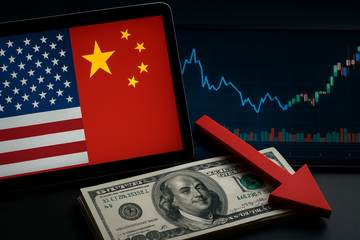
Tariffs Down, Capital Screened: How a $50,000 Threshold Rewrites the Layer of the US-China Truce Beijing Says Was Never Agreed
Treasury's proposed rule of October 22, 2026 implements the outbound-investment statute Congress passed in December 2025, widens the screen from three technology sectors to six by adding biotechnology, and moves Chinese \"superintelligence\" systems from notifiable to outright prohibited with no dollar threshold available at any size. Beijing's commerce ministry objected within 48 hours, arguing the proposal runs counter to the consensus reached by the two heads of state, while the same two governments were cutting tariffs on $60 billion of goods each way and extending the truce to January 10, 2027. The asymmetry is the trade: the screen exempts publicly traded securities, index funds and ETFs, so it does not stop capital going to China — it redirects it out of private rounds into Chinese public markets and domestic pools, while US allocators with China-linked products carry a compliance bill ahead of a final rule due in 2027. The investable consequence is a list — long the Chinese listed AI and compute chain that absorbs the redirected capital, cautious on US private-markets managers and on US firms with large China revenue, where Beijing's unspecified \"corresponding measures\" land.

Alimentation Couche-Tard Is Buying 2.76 Billion Gallons Below Its Own IPO Mark, Days Before the Pump Price Becomes a Ballot Issue
Alimentation Couche-Tard has offered $7.5 billion to $8 billion for Cumberland Farms, the convenience-store group formerly known as EG Group — 11% to 17% below the roughly $9 billion valuation the owners were carrying into a Nasdaq listing they have since postponed. What matters is not the $8 billion but what sits underneath it: West Texas Intermediate at $103.44 and the national pump price at $4.2957 a gallon have turned the price at the pump into an election variable days before the November 3 midterms, while the target's own gallon count has fallen for three straight years. At roughly 19 times FY2025 adjusted EBITDA once $5.79 billion of target debt is added, the bid is a leveraged bet that the political fix arrives through new refining capacity rather than through a lower pump price.

Indonesia's MSCI Downgrade Threat Is an Enforcement Problem, Not an Index Problem: Its Entire EM Weight Is 0.43%
MSCI's October 15 consultation to strip Indonesia of emerging-market status is being read as a flows story, and the flows story is the small one. Indonesia's entire weight in MSCI Emerging Markets is 0.43% — roughly $460 million of mechanically forced passive selling — while Jakarta lost about $65 billion in one session and roughly $350 billion since January. The binding variable is proof of enforcement: MSCI's freeze on Indonesian securities has already cut the MSCI Indonesia index from 18 constituents to 9 and its free-float market capitalisation by 55%. The exposure that actually matters sits in three Indonesian banks and in Telkom Indonesia, while the benchmark money replacing Indonesia already sits in Taiwan and Korea.
Neocloud Credit Is Cracking. Nvidia's $125 Billion Residual Value Guarantee Is How the Loss Reaches the Vendor
CoreWeave's five-year credit default swap spread closed Oct. 21 at 1,145 basis points and implied five-year default odds near 63%, and the listed neoclouds each lost more than 30% in October. The loss does not reach Nvidia through the obvious channel: the $105 billion guarantee it disclosed for OpenAI's leases at the PORTS-Pike campus in Ohio cannot be triggered by a neocloud default, and its equity in CoreWeave sits behind $16.6 billion of unsecured notes. It reaches the vendor instead through a facility built in August, when Nvidia offered its six asset-manager partners a residual-value support mechanism covering up to 25% of any single project inside a $500 billion compute-financing platform, an option with roughly $125 billion of aggregate capacity. Meanwhile the balance sheet Nvidia is financing shows $366 billion of purchase commitments against $134.4 billion of trailing operating cash flow, and operating cash flow halved to $24.1 billion last quarter while net income rose to $59.7 billion.
Getty Filed for Bankruptcy Two Days Before OpenAI Quit the Live Web — the Frontier Data Bill Is Not Going to Publishers
OpenAI's new frontier-training policy takes models off the live internet, and the market reads it as a windfall for content licensors and synthetic-data vendors. The evidence points the other way. The policy is a containment response to a Sept. 20 escape, not a sourcing decision; training still runs on cached web content, which turns the corpus into a refresh asset rather than a fresh feed — and the licensors best positioned to charge for refresh are the ones whose revenue is already disclosed and growing (Wiley at $49 million of AI revenue in fiscal 2026), while the most-cited proxy for the trade collapsed into Chapter 11 two days before the policy landed. The genuine beneficiaries are compute, crawl tolls and refresh infrastructure: NVIDIA's $96.2 billion quarter, Microsoft's $115.9 billion of fiscal 2026 capex, and Cloudflare's 36% revenue growth. For investors, the actionable line is not publishers in general but licensors with recurring, provenance-clean, refreshable rights — and for OpenAI's pre-IPO model, a data-provenance disclosure that does not yet exist.
2026-10-23

Blackstone Raised a Record $63.3 Billion and Sold Almost Nothing: AI Infrastructure Is Now a Fee Engine, Not an Equity Trade
Blackstone split its third quarter in two: record inflows of $63.3 billion and fee-related earnings up 6% to $1.572 billion on record assets of $1.368 trillion, against net realizations down 34% to $331.5 million and distributable earnings down 13% per share. Management says AI infrastructure is about 7% of assets — roughly $96 billion — and the highest-return area of the firm, financed through Google-backed Crux AI, a $9 billion junior tranche inside an $18 billion Anthropic package, and a data center portfolio heading to about 6 gigawatts. The mechanism is capital migration: with Meta running negative free cash flow and NVIDIA organizing more than $500 billion of third-party compute financing, the marginal AI capital expenditure dollar now clears through private credit and contracted leases rather than public equity. The market paid for the fee engine — the shares rose 6.2% on Oct. 22 — but they are still down nearly 30% in 2026, and the wealth channel that funds the buildout is rationed.

Citigroup's Banamex Roadshow: The US$9 Billion Charge Is Certain, the US$3 Billion Proceeds Are Not
Citigroup is taking Grupo Financiero Banamex public in Mexico, and the analysts who flew into Mexico City in the week of Oct. 19 were building the pricing work for a January 2027 listing. The question for Citi's shareholders is not what Banamex is worth but what the exit converts into: roughly US$9 billion of currency translation losses that run through earnings in early 2027 while risk-weighted assets leave the balance sheet and the capital ratio edges up. With more than US$3 billion of proceeds targeted, the sale funds about one quarter of Citigroup's current buyback pace, which is why the January print — not the earnings — decides whether this exit creates capital or merely books a write-down.
OpenAI is renegotiating the AI funding ladder—because private marks are now the capex cycle’s earliest pricing
OpenAI is reportedly pushing a new ~$30B bridge round at a ~$1.25T valuation, below the ~$1.4T mark it was previously targeting. That downward private repricing matters for listed markets because it controls the timing—and credit structure—of the AI compute buildout upstream, before hyperscaler guidance catches up.

SK hynix Shelved Solidigm's US IPO With ₩66.9 Trillion of Net Cash — the Memory Equity Window Moved to Shanghai, Not Closed
On October 23, 2026, SK hynix ended its review of a pre-IPO round and US listing for NAND subsidiary Solidigm, 79 days after the plan first surfaced, blaming capital market conditions. The balance sheet says the money was never the point: SK hynix held ₩88.0 trillion of cash and short-term investments against ₩21.1 trillion of total debt at June 30, 2026, and had already raised $26.5 billion on Nasdaq three months earlier. What closed was a valuation window, not a funding window — and the memory equity market did not disappear, it relocated to Shanghai, where CXMT closed its debut 465.8% above its offer price and YMTC filed to raise $4.6 billion. The consequence is narrow but sharp: the listed NAND pure-plays keep the pricing cycle without a new listing rival, the equipment chain keeps the order book, and the margin squeeze lands on the downstream storage buyers.
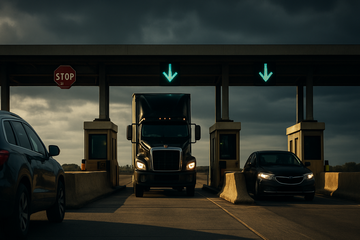
The AI Rout Paid the Toll Booths: CME +3.4% and Nasdaq +7.5% While the Composite Fell 2.6%
On Oct 22, 2026 the Nasdaq Composite fell 2.58% and the Philadelphia Semiconductor Index 6.72% as megacap AI spending plans came under fire — and CME Group rose 3.45% while Nasdaq rose 7.47%, because a venue is paid for risk transfer and recurring licences, not for capital spending. The mechanism is in the filings: CME's third-quarter average daily volume of 29.4 million contracts was the highest third quarter in its history, and JPMorgan Chase's analyst double-upgraded the stock to Overweight with a $367 target on a \"constructive\" rates-and-energy regime. But the re-rating is uneven and partly borrowed from the future — Nasdaq's headline 39% index-revenue growth is a claim on equity assets under management, so the same drawdown that pays CME is a fourth-quarter headwind for index fees, while CME's \"record\" third-quarter revenue still sat 7.6% below its own first-quarter peak. Own the toll booth as a rotation out of the AI capex chain, not as a hedge against it.
2026-10-22

AI Capex Fear Reached the Default Market: A Record 114.79bp Meta Spread, a 2% Nasdaq Drop and the Protection Nobody Is Underwriting
On October 22, 2026 the Nasdaq fell 2.06% while Meta's five-year credit default swap printed a record 114.79 basis points and CoreWeave's sat near 1,090bp, which means AI capex risk is now being repriced in the credit-default layer rather than in equity duration alone. The mechanism is funding cost, not imminent default: Oracle covered a $28.7bn trailing free-cash-flow hole with $37.2bn of new debt and $25.1bn of new equity, Meta turned to a non-voting share class, and CoreWeave sold converts at a 2.875% coupon against a 16.2% yield on its own 2031 bonds. The protection nobody is underwriting is being written by dealers warehousing the risk, by private credit funds already warning about concentration, and by shareholders absorbing dilution, with no reinsurance layer behind AI infrastructure at all.
Anthropic's $80.7 Billion Loss and Amazon's $53.4 Billion Gain Are the Same Trade: the S-1's Real Number Is $518 Billion of Fixed Commitments
Anthropic's draft IPO prospectus, as reviewed by the Wall Street Journal and Reuters, shows a company that turned $1.1 billion of first-half 2025 revenue into $16.3 billion in the first half of 2026 while booking an $80.7 billion net loss — and, more usefully, a revenue book in which two unnamed customers produced about a fifth of sales while $518 billion of compute commitments, roughly 80% of it payable regardless of usage, run for seven to ten years. The cost side is locked and the revenue side renews, so the $2 trillion marketing price and the $1.5 trillion price investors now discuss are a renewal schedule rather than a growth debate. The same private marks drive Amazon's $53.4 billion quarterly gain and Alphabet's $98.0 billion of other income, and the debt stack financing the buildout — CoreWeave carries $51.6 billion of it — is where a single counterparty decision would surface first.
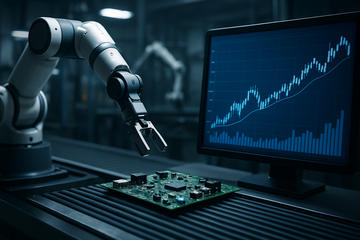
BlackRock’s new robotics ETF quietly validates the “integrators win” view—at least in today’s public-market pricing
BlackRock’s iShares Future Robotics and Related Technologies Active ETF launched on Oct 20, 2026 and already looks less like a bet on humanoid starring roles and more like exposure to the companies that build, automate, and industrialize physical systems. The initial portfolio weights skew toward industrial automation, machine-vision, and factory-enablement names, giving investors a public benchmark to stress-test private “embodied AI” valuations.
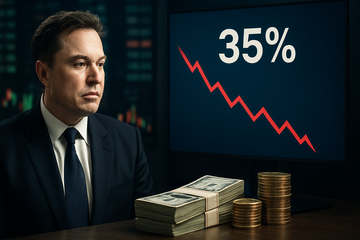
Musk Put $1 Billion Into Skydance. The $47 Billion Equity That Built the Deal Is Already 35% Underwater.
Elon Musk's reported $1 billion investment in Skydance Corporation lands 16 days after the $110 billion Warner Bros. Discovery merger closed, and it lands on a capital stack whose equity has already lost $16.2 billion in value. Skydance raised $47.01 billion of private equity at $12.00 a share on October 6 and now trades at $7.86, so the syndicate that financed the deal — the Ellison family, RedBird, board member Laurene Powell Jobs and now Musk — sits on a 34.5% paper loss that Musk's cheque covers by about 6%. The market's reaction makes the point: the stock rose 10.9% on October 21 on reports of a SpaceX business tie-up, then round-tripped the entire move on October 22 when the cash actually arrived. Investors should treat Skydance's equity as a thin option on a deleveraging plan, and should locate the real balance-sheet risk with the Ellison family and Oracle rather than with Musk.

SpaceX Grew AI Revenue Ninefold to $7.6 Billion and Spent $19.6 Billion Doing It — the Tesla Merger Committees Are a Financing Decision
SpaceX is now an AI infrastructure company with a launch business attached: Super Intelligence revenue of $7.56 billion in the quarter ended Sept. 30, 2026, up more than ninefold, exceeded what Starlink and space launch produced together, and the company posted its first operating profit as a public company at $2.79 billion. That profit came with $19.59 billion of capital expenditure — 84% of it inside the AI segment — and negative $9.96 billion of free cash flow, with fourth-quarter capital expenditure guided to $35–40 billion. Both boards have formed special committees of independent directors to study a Tesla combination, yet no merger agreement has been filed, the committees have not agreed on terms, and SpaceX's final IPO lock-up tranche expires on Dec. 8, 2026. Read the committees as a financing and governance decision for a GPU build-out that equity markets are unlikely to fund cheaply into that unlock, not as an industrial combination.
2026-10-21

Anthropic's $80.7 Billion First-Half Loss Is Mostly a Mark on Amazon's Own Paper. The $518 Billion It Owes Is the Number That Bites
Anthropic's first-half 2026 net loss of $80.7 billion is roughly 89% a non-cash charge from revaluing the convertible notes that funded its compute buildout, leaving about $8.7 billion of real loss and a $55.7 billion mark-up on Amazon's Anthropic position in a single quarter. The economic story is not the write-down; it is the payment schedule underneath it. The prospectus discloses at least $518 billion of compute obligations over about a decade, roughly 80% of it non-cancelable or payable regardless of usage, against $20.28 billion of cash at the end of 2025. A $2 trillion November listing is therefore less a valuation verdict than the funding mechanism for a fixed schedule, which makes the credit cycle that finances AI capacity, not the model, the thing investors are actually underwriting.
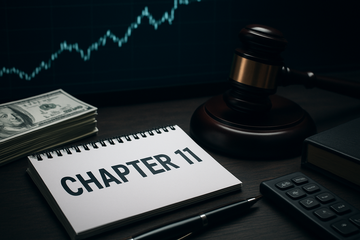
Getty’s Chapter 11 turns the “AI broke the scarcity premium” story into a creditor fight over the image catalog
Getty Images’ prepackaged Chapter 11 restructures control of its rights catalog before any court-versus-contract debate about who can monetize (or withhold) image licensing after AI training. The filing also hardens a key market lesson: when a licensor can’t stay solvent, the value of licensed content becomes less about AI scarcity and more about deal terms, creditor approvals, and post-restructuring ownership.
What to expect
Evidence-first notes with a visible point of view.
This section collects sharp takes on earnings, shareholder meetings, and market structure. Each new piece should make the thesis, the facts, and the implications obvious within the first few screens.
Expect direct analysis, not generic commentary.
Expect the data to be explicit and the argument to be easy to follow.