Consumer
What households are actually spending on
Traffic, pricing power, trade-down and inventory across retailers, restaurants and brands — who is holding margin, and who is buying volume.
2026-11-05


The 47-Point Gap: e.l.f. Beauty's 51% Quarter Leaves L'Oréal's Mass Unit and Coty's Color Brands Behind
e.l.f. Beauty grew net sales 51% to $520.8 million in the September 2026 quarter and lifted fiscal 2027 guidance to $2.00–2.03 billion, but the headline stacks three separate levers: rhode consolidation, roughly $55 million of tariff refunds recycled into $1 price cuts on about 10% of units, and price-and-mix dollars in a US core where unit volume actually fell. The investable signal sits on the other side of the shelf — in the same three months L'Oréal's Consumer Products division grew 4.3% like-for-like while Coty's Consumer Beauty fell 3%, so roughly 47 points of category growth are transferring from incumbent mass portfolios rather than riding a recovering market. And the margin that funded the fight was a June-quarter windfall: the company's own disclosure implies about $50 million of refunds landed in the June quarter, leaving underlying gross margin roughly 200 basis points lower in September. The losers have no comparable answer — Coty carries $3.25 billion of net debt against a shrinking color business, while L'Oréal can only fight with margin it does not have in its slowest-growing division.

Flutter Entertainment bought 13% more handle and earned $3 million. Kalshi raised $1 billion at $40 billion
Flutter Entertainment's first quarter under new chief executive Dan Taylor shows what defending the US sportsbook market now costs: handle up 13% and average monthly players up 12%, but US segment adjusted EBITDA down 94% to $3 million, because promotional spend rose 60 basis points to 6.0% of handle while category-wide media spending rose more than 60% year-on-year on prediction market entrants. The volume itself went to Kalshi, which raised $1 billion at a $40 billion valuation on October 29 — nearly three times Flutter's market capitalisation and roughly three and a half times DraftKings's. The answer to who pays is that the listed operators funding customer acquisition with promotions carry the cost, while the exchanges and the data vendors serving them collect it.
Arabica at $2.79 and Kraft Heinz Is Selling Coffee: The Glut Is a Pricing Problem, Not a Margin Gift
Kraft Heinz agreed on Nov. 4, 2026 to sell its North America coffee business — Maxwell House, Gevalia, Sanka, Yuban, Tassimo, Nabob and Ethical Bean, plus roasting plants in Jacksonville, Florida and Vancouver, British Columbia — to One Rock Capital Partners at a $650 million enterprise value. It keeps a 30% stake, banks about $500 million of net proceeds for debt paydown, and closes in mid-2027, on the same day arabica settled at $2.79 a pound, 32.4% below a year earlier, on a record Brazil crop forecast. The $650 million is not the tell: the buyer is a levered financial sponsor rather than a strategic roaster, and the multiple BNP Paribas called unattractive for the seller prices a category whose problem is shelf pricing, not green beans. Keurig Dr Pepper shows how the deflation actually lands — moderating green coffee costs were reinvested in trade spending instead of margin, net price realization fell 4.2% in U.S. Coffee, private-label share rose, and legacy EPS guidance was cut to 3%-5% from 4%-6%.
Nintendo's 41% Unit Drop Is a Memory-Cost Event — and the Unchanged 16.5M Forecast Is the Real Risk
Nintendo sold 2.67 million Switch 2 units in the September quarter, down 41%, after lifting prices by $50 in the US and ¥10,000 in Japan to cover a memory and tariff bill the company now sizes at about ¥100 billion. Units broke; profit did not — first-half operating profit rose 49.1% to ¥216.5 billion while software shipments climbed 18.8%. The real problem is the guidance Nintendo refused to touch: 16.50 million units for the year now requires a 5.5% second-half rebound in the most price-elastic purchase in consumer hardware.

Snap Fell Over 10% on a Half-Percent Revenue Miss — the Answer-Engine Print Was Reddit's, Six Days Earlier
The market punished Snap for four million missing daily users, not for a broken ad business: Q3 revenue of $1,722 million missed the $1.73 billion consensus by roughly 0.5%, while ARPU of $3.48 actually beat the level implied by consensus, adjusted EBITDA of $383 million beat by 13.5%, and fourth-quarter guidance landed above the street. The genuine answer-engine evidence came six days earlier at Reddit, which disclosed Google search referrals falling by more than a million a week and guided daily uniques to a low-double-digit decline, and at Alphabet, which said AI Mode monetizes less per search than classical search. So the discovery budget was not taken; it was repriced, and Snap now sells the most repriced inventory on the board — upper-funnel brand ads, whose decline management attributed to weak consumer-goods spending. The deeper issue is that Snap is quietly changing the scoreboard, retiring daily users as its headline metric from Q1 2027 at the exact moment user growth halved, while trailing stock compensation of roughly $1.03 billion exceeds trailing free cash flow of $777 million.

Uber's 20% Bookings Beat Came With a 510-Bp Mobility Take-Rate Bill: Buying Drivers Now, Automating in 2028
Third-quarter results at Uber Technologies split cleanly: gross bookings of $59.82B, up 20%, and adjusted EBITDA up 31%, but Mobility gross bookings rose 18% to $29.51B while Mobility revenue fell 2% to $7.52B, taking the segment's revenue margin from 30.6% to 25.5%. Management blamed elevated fuel prices and thin driver availability in international markets, then shifted incentive dollars from riders to drivers to rebuild marketplace balance. The automation investors are underwriting is arriving on the supply side, not the demand side: third-party AI agents filled four rides in the quarter, while roughly 700 driverless vehicles by year-end and a 35,000-vehicle Lucid commitment carry the marketplace into 2028 — the year Waymo ends Uber exclusivity in Austin and Atlanta.
2026-11-04

Apple's 18+ Gate on AI Companions Is the AI Safety Rule Congress Still Can't Pass
Apple has done what Washington has not: from November 16, 2026, any App Store app whose virtual companion engages users in sexual or romantic content must carry an 18+ rating, with declarations due January 12, 2027, while the federal GUARD Act that would bar minors from AI companions still has no floor vote. Enforcement happens where installs happen — Apple's own adult-confirmation pipeline blocks 18+ downloads in Australia, Brazil and Singapore, and the Declared Age Range API hands apps an age signal — so the compliance bill lands on companion apps while Apple's first-party assistant, sold outside the App Store, carries no descriptor at all. Roblox has already run the same experiment, cutting daily users 9% and bookings 12% in a single quarter, which is the best available price tag on a permanent age gate. For investors, the binding constraint on AI consumer apps has moved from model capability to distribution eligibility, and whoever writes the eligibility rule captures the category.

CVS Health's Drugstore Breakup Doesn't Unlock a Discount: At $180.5 Billion, the Market Already Pays for Both Halves
CVS Health will separate into two public companies, with the roughly 9,000-store pharmacy chain becoming CVS Pharmacy in the first half of 2028 — but the arithmetic does not support the sum-of-the-parts story. Valuing the health half on Cigna-like multiples and the chain on the 0.16x sales private equity paid for Walgreens puts the parts at roughly $125 billion to $194 billion against the $180.5 billion enterprise value the market already pays, so the separation transfers the valuation question to the Form 10 rather than resolving it. What is actually moving the stock is the operating line: adjusted EPS of $2.09 in the third quarter against about $1.63 expected, guidance lifted to at least $8.20, and $11.8 billion of trailing free cash flow against $63.6 billion of net debt at 4.85x trailing EBITDA.

Disney's 20% Cost Target Is a Pricing Signal, Not a Demand Signal — and It Cuts Less Than Netflix's 6%
Disney is asking some managers for 20% cuts in annual costs across the TV networks and the motion picture studio, a move Bloomberg reported on Nov 2, 2026, with savings redirected into programming, technology and the parks. Treat it as a price, not a volume call: in the June quarter Disney grew Entertainment revenue 6% while holding segment costs flat at $9,757M, turning that into 64% segment operating income growth to $1,680M, so the cost base — not the audience — is the variable being reset. The headlines overstate how much Disney is cutting and understate what the number means: Netflix cut 6% of its workforce on Oct 14, Comcast booked a $1B-plus charge on Oct 22, and the merged Paramount Skydance group is chasing $6B-plus of savings, so 20% is becoming the sector's cost benchmark. The milestones are dated: fiscal 2026 results and the first post-cut headcount on Nov 17, 2026.

Alphabet's K-12 AI Ultimatum Adds No Revenue — It Defends a $63.4B Search Line
On November 3, Alphabet said K-12 student accounts would lose Gemini, Gemini Notebook, Gemini in Classroom and Google Search until district administrators turned them on, then softened the policy after Senator Bernie Sanders and New York Mayor Zohran Mamdani objected — but only in a way that keeps AI-generated summaries inside search. The classroom is the one distribution channel where the default costs Alphabet nothing, so the policy trades free default behavior for consent to AI rather than for revenue. With rivals giving classroom AI away through 2027 and 2028 while Alphabet buys the compute with $51.36 billion of quarterly capex, the payoff is cohort behavior carried into consumer search; the risk is a remedy or procurement rule that reaches education distribution.

HP Inc Hired a GSK Cost-Cutter Into a Memory Cost Crisis: $1.8 Billion of New PC Revenue, Zero New Profit
HP Inc named Emma Walmsley chief executive on Nov 4, 2026, effective Jan 4, 2027, handing a restructuring veteran a problem she cannot restructure away: DRAM and NAND inflation has migrated the industry's margin upstream. In the September quarter, Personal Systems revenue rose about $1.8 billion year over year to $11.77 billion while segment operating profit was flat at $537 million, because unit shipments fell 16% and every dollar of growth was price and mix. Printing, a quarter of revenue at an 18.1% margin, now produces 57% of HP's segment operating profit, so the company the market buys as an AI-PC story is really a printing business with a shrinking PC attached. The shares rose 8.0% to $30.53 on the hire, 11% above the $27.52 consensus target, before the incoming chief executive has said a word about fiscal 2027.
Schaeffler's 3,460 Cuts Price the Auto Downturn One Layer Below the OEM — BMW's Near-Zero Margin Guidance Confirms It
Schaeffler said on Nov 3, 2026 it will cut 3,460 jobs across Europe and close five plants by 2028 to remove about €300M of annual cost, and the next morning BMW guided its 2026 automotive margin to between -0.5% and +0.5%. Read together, the two releases show the downturn has moved out of OEM pricing and into tier-one capacity and labor: a supplier cannot fund overcapacity when its Chinese EV division loses money, and an OEM earning almost nothing cannot fund the discounts that keep its own plants full. For US-listed suppliers the read-through is not a forecast but a report card — Aptiv booked $48M of restructuring charges in nine months, Adient posted a quarterly net loss, and Lear and BorgWarner show what the exit looks like from the other side of the ledger.
Shopify's 8.7% Drop Was About Mix, Not Agents: Blended Take Rate Rose While Gross Margin Fell 130 Basis Points
Shopify's Q3 2026 print missed on GMV and on the subscription line investors watch most closely, and the shares fell 8.7% on Nov 4 — yet the arithmetic does not support the theory that AI agents and payment networks are already siphoning Shopify's take rate. Blended revenue-to-GMV rose to 3.14% from 3.09%, and the only agent that ever tried to price the checkout, OpenAI's 4% ChatGPT fee, was withdrawn in March 2026. What actually broke was mix: subscription gross profit grew 17% while merchant solutions gross profit grew 35%, cutting gross margin 130 basis points to 47.6% and pointing to a Q4 gross margin of roughly 44% to 46%. At about 65 times forward earnings, the question is no longer whether agents steal the toll but who holds the wallet when checkout moves into AI surfaces — and Shopify is betting the company on Shop Pay.
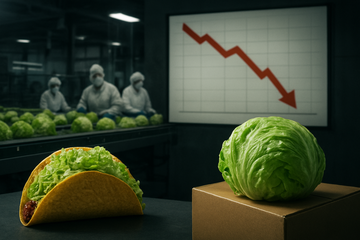
Taco Bell's Parasite Crash Cost $172 Million in Sales and Yum! Brands Only $10 Million — the Franchisee Paid the Rest
The 2026 cyclospora outbreak traced to a single iceberg lettuce processor in central Mexico took Taco Bell's U.S. same-store sales down 4 points in the third quarter of 2026, straight off a 7% gain in the prior quarter. The equity damage was trivial and the franchisee damage was not: Yum! Brands collects roughly 5.7 cents of every dollar of Taco Bell system sales, so an estimated $162 million of lost restaurant revenue — and most of the store-level profit — landed on the operators who actually own the restaurants, who also funded the discounts, the write-offs and the lawsuits. The next cycle is already scheduled: Taylor Farms will pull Mexican iceberg out of the U.S. market during the May-to-August window starting in 2027, while the federal traceability rule that would have forced this chain to document itself is barred from enforcement until July 2028.

Wayfair grew orders 12% with baskets 2% smaller: the big-ticket consumer is splitting, not deferring
Wayfair's September quarter, reported Nov 4, 2026, is the cleanest proof yet that the furniture slowdown is a share problem rather than a demand problem: U.S. revenue rose 11.4%, orders delivered jumped 12.2% to 11.0 million, and the company swung to $62 million of GAAP net income from a $99 million loss a year earlier. The catch is that average order value fell about 2% and gross margin slipped to 29.6% from 30.0%, so the buyer is transacting more often and spending less per trip while the store channel stays pinned near $10.6 billion a month and home resales run at their slowest pace of 2026. With retail diesel at $6.29 a gallon and the EIA forecasting Brent at $105 a barrel in the fourth quarter, the delivery costs that diluted margin should ease in 2027, which makes the gross margin line, not the revenue line, the thing to watch through the holidays.
2026-11-03
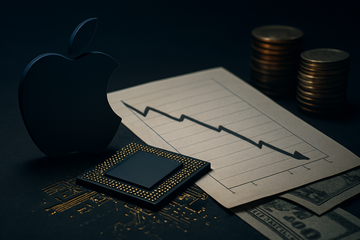
Apple's Memory Squeeze Just Cut Its Margin Guide to 45-46%. The Fix Points at a Toll on Every AI Lab
On his first earnings call as chief executive, John Ternus guided Apple's December-quarter gross margin down to 45-46% from 47.9% and blamed memory costs plus Siri AI ramp expense, while CFO Kevan Parekh said AI opens \"opportunities across third-party apps and partnerships.\" Read together, the two remarks say the memory squeeze, not Siri, is the real story, and that Apple intends to refill a roughly $1.6 billion-a-quarter gross profit hole with services revenue collected from the labs whose apps sit on its own store. The catch: a 30%-era toll is the one instrument Apple's pending Supreme Court case and the EU's new 5% out-of-store commission make hardest to use, while ChatGPT and Meta's Muse are building storefronts designed to route around any such fee. Memory makers have already been paid; the toll remains an option Apple has not priced.

Coca-Cola Europacific Partners Reaffirmed Guidance on a 1.5% Cost Target That Needs Roughly 2.4% in the Second Half
The third-quarter print looks like a clean growth story — revenue up 5.8% FX-neutral to €5.76bn, unit cases up 3.5%, revenue per unit case up 2.2% — and the full-year outlook was left untouched. The cost target buried in that outlook is the problem: first-half cost of sales per unit case rose 0.6%, so the 1.5% full-year guide implies second-half cost inflation near 2.4%, roughly what third-quarter pricing only just matched. Concentrate is incidence-linked to revenue, but aluminium and PET are not, and can makers are passing metal through in full — $405m of higher material cost at Crown Holdings in a single quarter — while the bottler has hedged more than 95% of FY26 commodities, protecting this year and exposing 2027. The result is a system where Coca-Cola raised 2026 guidance a week earlier at a 33.4% operating margin, and the 13.6%-margin bottler could only reaffirm: the pricing power is real, and it is not evenly distributed.

The Office Is Full and the Collaboration Is Gone: The New York Fed Survey That Undercuts the Office Recovery
A New York Fed survey of 1,835 college-educated workers, fielded in September 2026, found that 48.8% had no in-person meetings on their most recent day in the office and 70.6% had at least one teammate absent, which means attendance has been restored but the collaboration that offices are priced for has not. Because organizational sprawl, not absenteeism, explains about 48% of the lost face time, employers cannot repair it with mandates, and the landlord data already shows the strain: Hudson Pacific Properties lifted same-store leased occupancy 8.1 points year over year while average rent per square fell to $56.78 from $57.57, while SL Green Realty still shows a $128.3M trailing net loss against roughly 14x net debt to EBITDA. The pain sits upstream in real estate and office services, while commuting-linked demand holds up: Starbucks grew comparable coffeehouse sales 6.2% in Q4 FY2026 and Uber grew revenue 12.2% year over year in Q2 2026. For the December policy debate, the same bank's research argues that soft payrolls are compositional, so the committee should be reading inflation, not headcount.
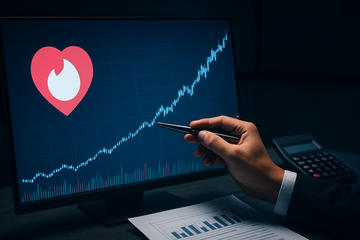
Tinder DAUs Grew for the First Time in 3½ Years on $10 Million of AI Spend — Match Group's 14% EBITDA Jump Is Mostly a Base Effect
Match Group's third quarter looked like a margin story and was really an engagement story, and only one of the two is new. Revenue fell 2.5% to $891.2 million while adjusted EBITDA rose 14% to $344 million — but the GAAP line items show the profit came from a $55.8 million drop in general and administrative expense while research and development rose $14.8 million, the line where the roughly $10 million AI budget lands. The genuinely new information is engagement: Tinder's daily active users returned to year-over-year growth in September for the first time in three and a half years, and U.S. daily users grew in October. The unresolved information is monetization: 13.8 million payers, down 5%, at a company whose fourth-quarter guidance implies adjusted EBITDA falls 11%. Investors are being asked to pay a cash-flow multiple today for a user story management says converts in 2027.

Ryanair's €2bn Fuel Bill Works Out to €9.35 a Passenger — So the 20% Fare Hike Is a Floor, Not a Ceiling
Ryanair guided on Nov 2 to a roughly €2bn increase in its fuel bill for the year beginning April 2027, and chief executive Michael O'Leary has said European fares may need to rise as much as 20% to absorb it. Spread across the 214m passengers the airline plans to fly, €2bn is €9.35 each — 16.8% of the €55.70 average fare — so the 20% is the fuel-only breakeven, and because fuel is a per-passenger cost it inflates the cheapest seat fastest. The United States has already run the demand test Europe has not: Frontier Group raised base fares 71% to $67.82 and flew 18% more passengers, though fuel still outran fares and the airline lost $104m. Meanwhile the profit pool moved upstream to the refinery, where Valero Energy nearly tripled its refining margin per barrel to $39.24 — and every part of the thesis is conditional on a war that moved Brent 7.63% in a single session.
What to expect
Evidence-first notes with a visible point of view.
This section collects sharp takes on earnings, shareholder meetings, and market structure. Each new piece should make the thesis, the facts, and the implications obvious within the first few screens.
Expect direct analysis, not generic commentary.
Expect the data to be explicit and the argument to be easy to follow.