Latest
The day's market news, with the argument attached
New notes every trading day on earnings, policy and market structure. Each one opens with the conclusion, then the evidence, then the companies it hits.
2026-08-20


Moderna's 160% surge on intismeran has priced in a near-miss level of oncology upside—while the cash-burn and mFLUSIVA reality can still decide whether this rerating sticks
After Moderna moved sharply higher on Aug. 19–20 following positive late-stage melanoma vaccine data for intismeran, investors repriced the company as an oncology platform in hours. But the equity math implied by a “double” rerating conflicts with the cash-burn profile shown in recent financials—and it may be underweighting the more immediate, commercial (flu) ramp from mFLUSIVA and the continuing operating cash needs.

OpenAI’s “zero data retention” is less about compliance—and more about owning the enterprise trust choke-point
OpenAI’s Aug 19 pledge goes beyond “we don’t train on your data” by targeting the other enterprise objection: storage of prompts and outputs for abuse monitoring and human review. But the offer also comes with practical constraints—ZDR applies to eligible API endpoints and changes endpoint behavior—meaning the business win depends on how reliably customers can route real workloads into the ZDR-compatible surface.

SK Hynix's $29B buyback is a cycle bet: management is paying in the stock selloff to pull the bottom forward
SK Hynix approved a KRW 40 trillion (about $28.6B) share repurchase and cancellation on Aug. 19, with buying starting Aug. 20 and running about three months. In a memory market still trading through a selloff, that timing uses buybacks as a “bottom-signal,” while the parallel strength of its U.S. ADR creates an unusual capital-structure setup for investors and forces peers to answer the same payout question.

TerraPower’s Natrium turns nuclear into a data-center “load-following battery,” not just baseload
Natrium pairs a 345 MWe sodium fast reactor with a molten-salt energy storage system that can boost output to 500 MWe, giving nuclear dispatchability that hyperscalers need for AI-driven peak demand. TerraPower is already moving Kemmerer Unit 1 through the 10 CFR Part 50 construction-permit milestone and building a HALEU fuel path—suggesting the next bottleneck is less “baseload availability” and more flexible, contractable output.

After the “slip-to-2027” scare, the White House just put 2026 Clarity back on the table—so what changes for Coinbase?
The Aug. 19 White House crypto summit revived the legislative push behind the CLARITY Act, targeting clearer market-structure rules for crypto brokers and exchanges. At the same time, the SEC’s “Regulation Crypto Assets” proposal leans into a structured exemption + conditional safe-harbor approach—meaning the market’s repricing can transmit quickly into fee-and-rail economics (platform trading, custody/stablecoin monetization, and institutional access) rather than waiting for a full “doomsday-to-clear” cycle.

Utility-scale power transformers are the AI grid’s multi‑year choke point—and today’s ~5.2% long-rate turns every delay into a financing problem
High-capacity transformer lead times have stretched to years, shifting “grid connection readiness” from a construction issue to a procurement-and-capital-access issue. With 30-year Treasuries recently around ~5.2%, the present value of AI-driven grid buildouts falls just as transformer delivery schedules slip—rewarding vendors and projects that can win connection queues first.
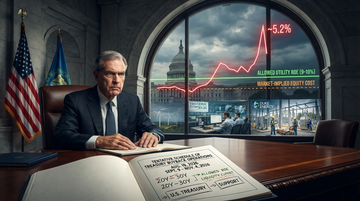
Regulated utilities at ~5.2% 30-year: why “allowed ROEs” don’t protect equity investors when the cost of capital moves faster
On Aug. 19, 2026, the U.S. Treasury increased the size of long-end liquidity-support buybacks to rein in the 20–30 year funding window, after the 30-year yield pushed higher. Even with that intervention, a ~5.2% 30-year reference rate implies a duration-sensitive equity math problem for regulated utilities: allowed returns (often ~9–10%) sit well below market-implied equity costs that rise when long yields stay elevated, forcing rate-case timing, issuance, or dividend trade-offs.

Walmart’s Q2 FY2027 print: the consumer is slowing, but margin “quality” may be wearing a costume
Walmart’s Q2 FY2027 results show steady demand rather than a break, but reported profitability vs. underlying cash generation can be distorted by program timing and discrete items. The key investor question is whether today’s margin variance is primarily mix/cost driven (investable) or lumpy/refund-linked (potentially reversible).

Wolfspeed’s outlook break shows the SiC trade is splitting: AI power could stay tight, but EV/industrial SiC demand is no longer a one-way bet
Wolfspeed’s Aug. 19 guidance reset (and the stock’s -7.5% pre-market move into Aug. 20) is the first “hard” datapoint that AI datacenter power silicon and EV/industrial SiC are moving out of lockstep. The message for investors: the market may reward the SiC supply chain differently by end-market—tight 48V-to-rack power needs versus a cooling EV/industrial ramp—creating winners in adjacent power silicon and control platforms while pressuring wafer/device oversupply.
2026-08-19

Analog Devices ADI calls out AI-linked signal-chain strength—showing analog demand is no longer the “late” trade, it’s the supply bottleneck
Analog Devices’ latest guidance commentary reinforces that AI capex is spilling into mature-node analog/mixed-signal—power management, data converters, and upstream signal conditioning—rather than staying confined to GPUs. The investor takeaway: the next constraint may be not compute, but the analog “plumbing” that turns electricity into usable, low-noise data in data-center racks.

Amazon’s nearly-500-locale drone scale test forces a real question: does air delivery finally beat ground on unit cost—or just on speed?
Amazon Prime Air is expanding drone delivery to nearly 500 U.S. cities and towns by end-2026, using FAA Part 135 regulatory authority and charging $2.99–$4.99 per drone drop. The investment thesis is not “will it fly?” but whether scaled air drops can bend the cost curve enough to undercut ground last-mile and—separately—whether FAA-certified drone operations can compete with DoorDash’s Part 135 advantage in regulated local delivery.

Berkshire Hathaway is selling Nucor even as tariffs should be “most” protective — which points to a demand problem the market isn’t pricing
Berkshire Hathaway’s successor, Greg Abel, has trimmed Nucor by more than half in the latest disclosed portfolio changes, turning a steel trade that looked tariff-protected into something Abel no longer wants as a bet. The deeper read isn’t “tariffs stop working”; it’s that steel upside is being driven by order and end-demand durability, and when demand weakens, even a tariff bloc can fail to prevent earnings compression. For investors, the move shifts focus from the tariff math to the domestic steel order book, working-capital intensity, and how fast producers can re-price supply.

Bitcoin’s “whale flip” vs. ETF outflows: price usually follows exchange liquidity, not who’s net-buying on-chain
Reports that large Bitcoin holders added roughly $2.9B in 60 days while spot Bitcoin ETFs turned negative set up a clean tug-of-war between on-chain supply absorption and traditional fund-flow demand. The reconciliation is that ETF outflows matter immediately through exchange/liquidity channels, while whale accumulation tends to show up as a slower, supply-constrained stabilizer. For investors, the actionable test is whether exchange reserves keep falling after ETF redemptions—not whether whale balances rise in isolation.

Tariff Whiplash Gets a 3-Day Refund: What Gets repriced first in autos, dairy, alcohol, and construction materials
The 50% Section 338 tariffs on select Canadian goods were paused for three days right before the midnight start, followed by a “deal” framework. For markets, the investment question shifts from “damage” to “unwind”: which sector discounts were priced for immediate tariff flow disruption—and how fast they can reverse when the policy shock is temporarily removed.

CHF Funding Quietly Replaces JPY in Carry—And That’s a Direct EUR/CHF + EM Credit Shock Channel
After yen volatility spiked, investors have been rotating carry funding away from the yen and toward the Swiss franc, citing the euro and CHF as alternative “funders of choice.” That shift matters because a CHF rally can force leveraged EUR/CHF and CHF-funded emerging-market carry positions to de-risk at the same time, turning FX funding stress into immediate risk-asset drawdowns and margin pressure for Swiss exporters.

Lagarde’s “order” warning reframes EURUSD: the risk isn’t just currency—it’s Europe’s supply-chain competitiveness lagging the US
ECB President Christine Lagarde says the weakening of a rules-based global order—specifically tied to America’s pullback from Western security leadership—is eroding the conditions behind Europe’s post-war growth model. The bigger market risk may be the second-order transmission: slower European investment and scaling under geoeconomic fragmentation, which can pressure both competitiveness and the euro’s role in trade, not merely EURUSD spot levels.

Estée Lauder's fragrance forecast vs. Lowe's and Target: premium beauty is showing up as the cleanest “American consumer split” signal
On the same earnings day that Lowe's guided conservatively, Estée Lauder framed fiscal 2027 as a resilience test where fragrance is still delivering and adjusted operating margin can approach 13%. The result is an unusually sharp divergence: premium self-care is buying time with pricing power while mass retail is leaning on policy tailwinds and project pullbacks—exactly the bifurcation investors keep seeing in US spend data.

Etched’s $21B jump signals that inference silicon is moving from “experiment” to “economics”—and it pressures Nvidia’s GPU advantage on both cost and capacity
Etched’s Aug. 18 financing valued the company at $21B after a prior $10.3B valuation just weeks earlier—an investor re-rate that coincides with first customer delivery to Jane Street and more than $1B in customer contracts. The market takeaway is not “another chip startup,” but a shift toward dedicated inference hardware that competes with GPUs on two fronts: utilization/cost per token and rack-level capacity to meet urgent decoding demand.

Fed minutes lean hawkish while the Treasury scales buybacks—September becomes a tug-of-war between inflation control and fiscal support
The latest FOMC minutes underscore a conditional path to rate firming if inflation stays elevated, with policymakers explicitly linking “some policy firming” to inflation scenarios. At the same time, the Treasury announced a doubled scale for certain debt buyback operations, supporting market liquidity and pushing yields lower—so September is set to be decided by which transmission mechanism dominates first.
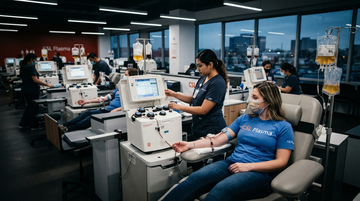
Haemonetics HAE just locked CSL CSLLY into a plasma-collection device flow—without exclusivity. The stock jump is the market betting the “bottleneck” is CSL’s capacity, not Haemonetics’ supply.
Haemonetics HAE formalized an expanded, non-exclusive plasma-collection supply agreement with CSL CSLLY that lets CSL use Haemonetics’ NexSys PCS devices with Persona PLUS technology and buy related disposables in the U.S., with no minimum purchase commitments. The deal shifts the adoption test to CSL’s collection-center transition plan—exactly where plasma liquidity is structurally constrained—explaining why investors treated the announcement as a high-signal catalyst.
What to expect
Evidence-first notes with a visible point of view.
This section collects sharp takes on earnings, shareholder meetings, and market structure. Each new piece should make the thesis, the facts, and the implications obvious within the first few screens.
Expect direct analysis, not generic commentary.
Expect the data to be explicit and the argument to be easy to follow.