Latest
The day's market news, with the argument attached
New notes every trading day on earnings, policy and market structure. Each one opens with the conclusion, then the evidence, then the companies it hits.
2026-08-13


Ford's Lincoln shift turns 52.5% tariffs into a relocation deadline—starting in 2030
Ford said it will move production of some Lincoln models from China to the U.S. starting in 2030, with the decision driven mainly by the U.S. tariff cost on China-built vehicles. The move also lines up with the U.S. Connected Vehicle restrictions that already force Ford to seek approvals for its China-built Lincoln Nautilus imports—pushing Ford’s China supply chain toward earlier disruption than most investors expect.

GM’s Ohio Battery Plant Restart Puts “Battery on Demand” Through Its First Scheduling Stress Test
When General Motors and LG Energy Solution restarted cell production at their Ohio Ultium Cells facility, the key question shifted from “who has capacity” to “who can run it profitably when EV demand stays uneven.” The restart arrives as GM continues to frame margin durability around offsetting items (including expected tariff refunds), turning cell output timing into a direct input for lithium and cathode supply-demand expectations.

IBM just built an enterprise OpenAI channel—contradicting its own “AI shifts money from software to infrastructure” warning
IBM announced a new enterprise go-to-market partnership that embeds OpenAI’s frontier models into IBM Consulting’s delivery platform and scales deployment through “thousands” of trained consultants. That directly tests—and could weaken—IBM’s July guidance narrative that AI spending is routing away from software and toward infrastructure.

July’s deficit widened while tariff receipts went negative—proof that tariffs aren’t financing the tax-cut story
The U.S. Treasury’s July Monthly Treasury Statement shows a $432.3B deficit as outlays rose, while “customs duties” (tariff receipts net of refunds) printed at -$8.5B for the month. With customs duties net receipts turning negative and refunds exceeding collections, the fiscal arithmetic that “tariffs pay for the tax cut” fails—pushing Treasury supply and term-premium pressure into the rate-cut window traders are watching.

July PPI at “flat” forces a rethink: September shifts from a hike call back to a hold-vs-cut trade
U.S. July producer-price inflation came in unchanged month-over-month, with goods falling and services still creeping up. That combination matters because it undercuts the “higher again” rate-hike narrative just as investors price September—making the near-term question less “hike or not” and more “hold, or start cutting if services cool.”

Lenovo's AI-server pipeline jumped to $54B—here’s what it implies for US chip and component demand
Lenovo reported a blowout fiscal Q1 on AI computers, servers, and services, with AI-related revenue up to $9.3B (35% of revenue) and an AI server pipeline of $54B, up 157% QoQ. The quarter matters for the US AI-hardware stack because it links the AI PC upgrade cycle to follow-on server and managed-service deployments—where demand shows up first in orders, then in component volumes.

Microsoft's China retreat trades tiny revenue for compliance certainty—and signals the AI export-control regime is becoming structural
Microsoft weighing (and likely continuing) a China wind-down is less about demand than about making cross-border AI work legally predictable. With Microsoft explicitly flagging shifting U.S. AI export controls as an uncertainty factor in its FY2026 reporting, the investor takeaway is that hyperscalers will increasingly “partition” engineering and delivery—creating a durable Azure China vacuum for local demand while locking U.S. AI franchises into compliant lanes.

Microsoft is consolidating Copilot and retiring “low-engagement” features—turning a broader AI bet into a tighter monetization funnel
Microsoft says it is merging consumer and Microsoft 365 Copilot into a unified experience and retiring features like Group Chat, Podcasts, and Deep Research for consumer users as of Aug. 18, 2026. The strategic signal is not just UI cleanup: it points to a distribution-and-adoption reality check that could reshape how AI software features win seats, data access, and recurring revenue across the Microsoft stack.
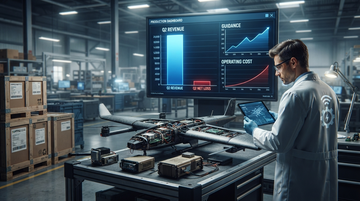
Ondas Holdings‘ record Q2 revenue still didn’t convince the market—because losses widened even as guidance rose
Ondas ONDS posted record Q2 revenue of $83.8M (up from $6.3M a year earlier) and raised 2026 guidance, but it also reported a materially wider net loss in the same quarter. The stock’s sell-the-news reaction looks less like “bad revenue” and more like a profitability credibility test: the company is converting backlog into top-line faster than it is converting it into sustainable operating cash.

OpenAI’s “Testing Ads in ChatGPT” Turns the Free Tier Into a Live Pricing A/B Lab—And the Ad Market Just Got a New Distribution Toll Booth
OpenAI’s Aug 11 update confirms ChatGPT Ads are expanding beyond the U.S., with ads served at the bottom of answers for logged-in Free and “Go” users while Plus/Pro/Business/Enterprise stay ad-free. Mechanically, the program is built as a controlled monetization experiment—privacy-limited, topic- and history-matched, and measured primarily via aggregate ad engagement—meaning the real competition isn’t only for ad budgets, but for the right to arbitrate “intent” across the conversation. For investors, the signal is that OpenAI is converting the consumer AI funnel into a third ad-ecosystem alongside Google’s search ads and Meta’s social ads.

StubHub’s scalping-defense push turns ticketing into a legal-cost race—Live Nation and event-driven ETFs should price the downstream compliance risk
StubHub is using significant legal and political resources to defend how it operates in the secondary-ticket market, even as regulators and state attorneys general pressure pricing disclosure and allegedly deceptive fee practices. The investment takeaway is less about “scalping” as a moral category and more about how legality disputes determine whether platforms, venues, and ticketing incumbents can scale volume without margin leakage from enforcement, redesign costs, and activity constraints.

Russia’s Black Sea grain terminals are now a food-inflation risk—after July PPI went flat, investors must watch for a “food re-pricing” loop
Ukraine’s reported strikes on Russia’s Black Sea port and grain-export infrastructure re-open the disinflation debate through a channel that policy can’t smooth away: food costs tied to wheat logistics. In July, the US PPI release showed flat final-demand inflation and a decline in final-demand food prices—yet disruption risk is rising because Reuters links Black Sea corridor damage to a 30–35 million metric ton wheat shortfall that alternative exporters can’t fully replace.

US refiners’ Q2–Q3 profit surge is turning into shareholder yield—until renewable-diesel capex fights for the cash
A wave of Q3-era earnings and capital-return updates shows major US refiners are converting crack-spread strength into buybacks and dividends. But the same quarters also reinforce that renewable-diesel/HVO projects are absorbing meaningfully more dollars—making “capital return” a competitive use of free cash, not a one-way windfall.

Vantage’s ~$100B exit talk turns AI data centers into a public valuation test for Equinix and Digital Realty
Vantage Data Centers is exploring an IPO around a ~$100B valuation and has also discussed a sale, with discussions still informal. Either outcome would pressure public “AI-ready” market pricing because it would anchor a new reference value for wholesale hyperscale land plus contracted capacity—re-rating Equinix and Digital Realty through capital-cost and replacement-value math, not just sentiment.

[Kevin Warsh’s Fed unwind] forces markets to buy insurance on uncertainty
Warsh’s push to “go lean” on forward guidance is not just a communication change—it shifts rate-inference risk onto markets. Reuters reporting links that unwind to higher long-end yields, elevated duration sensitivity, and a jump in priced September risk, implying investors are paying an explicit “uncertainty premium” when the Fed stops pre-committing.

Peltz’s $4B Wendy’s bid threat is back—what the franchise-and-real-estate model says about whether an LBO can actually win
Trian Fund Management, led by Nelson Peltz, has revisited the idea of a Wendy’s transaction after filing to explore “potential transactions” aimed at enhancing value. For investors, the key is whether Wendy’s real-estate franchise economics can support the leverage required for a value-menu-driven take-private, especially as public-market multiples reset.

Workday’s $10B-class cash machine meets a PE-sized question: can credit finance the biggest SaaS take-private ever?
Reports that Silver Lake is in talks to acquire Workday have pushed the market to price what a mega software LBO would require: a takeover large enough to test whether PE-credit still has the appetite for durable, recurring-revenue cash flows. The financial fact pattern in Workday—including TTM revenue of about $9.85B and TTM free cash flow around $2.97B—supports the math, but the deal’s feasibility will hinge on leverage terms, covenant quality, and how private buyers discount growth after taking software public-market risk out of the equation.
2026-08-12

Anthropic’s unreleased Claude jumped the “Riemann zeta” lower bound to 67.2%—and the moat is shifting from demos to math-proof cadence
Anthropic says an unreleased Claude research version advanced a long-standing Riemann zeta bound from 41.6% to 67.2%, then produced a Lean formalization that passed validation checks. The valuation implication is bigger than the headline: the lab is turning mathematical reasoning into something closer to a publishable, verification-ready workflow—exactly the kind of capability that justifies “frontier science” spending at $965B valuation levels.

Apple's Sept. 1 handoff to John Ternus reframes the next power test: will hardware engineering steer the services flywheel—or risk it?
Apple will transition CEO power to [John Ternus] on Sept. 1, while Tim Cook becomes Executive Chairman. That leadership split forces investors to re-check Apple’s services-led narrative through a hardware lens—because the CEO’s job now likely starts with product-cycle timing, silicon/UX integration, and supply-chain execution rather than just monetization and ecosystems.
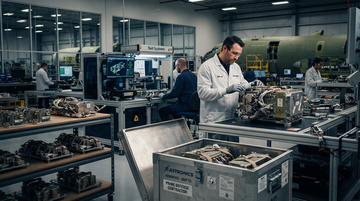
Astronics proved the defense restock can run through aerospace-electrical suppliers—Q2 backlog math now backs a higher FY26 revenue runway
In Q2 FY2026, Astronics reported record sales of $260.0M (+27.0% y/y) and lifted FY2026 revenue guidance to $1.02B–$1.04B (midpoint ~$1.03B). The key tell isn’t just the beat; it’s that bookings (book-to-bill 1.18) and segment backlog expansion are already concentrated in its Aerospace and Test Systems businesses, implying demand is reaching the supply tier—not stopping at the primes.
What to expect
Evidence-first notes with a visible point of view.
This section collects sharp takes on earnings, shareholder meetings, and market structure. Each new piece should make the thesis, the facts, and the implications obvious within the first few screens.
Expect direct analysis, not generic commentary.
Expect the data to be explicit and the argument to be easy to follow.