AI & Software
Where AI spending is actually landing
Model releases, enterprise adoption and software margins, read for what they do to revenue — across the labs, the platforms and the software they run on.
2026-10-30


AWS Grew 39% and Amazon Fell 7%: Big Tech's $720 Billion Capex Year Now Trades on Funding, Not Growth
Amazon delivered the cloud acceleration investors asked for — AWS revenue up 39% to $46.0 billion, AWS operating income up 55% to $17.8 billion, a record 13.9% consolidated operating margin — and the stock still fell about 7% after hours on Oct. 29. The reason is arithmetic, not disappointment: Amazon spent $77.3 billion on property and equipment against $42.4 billion of operating cash flow, pushed trailing free cash flow to an outflow of $42.4 billion, and funded the gap with $48.1 billion of new long-term debt in a single quarter while buying back no stock. With the four largest hyperscalers guiding to roughly $720-740 billion of 2026 capital spending against about $677 billion of combined operating cash flow, the market has stopped paying for cloud growth on its own and started paying for how that growth gets financed — a repricing that cuts both ways across memory, power and neocloud credit.

Anthropic's $9.7 Billion Research Bill Is Why the Shorts Are Lined Up for the $2 Trillion Print
Anthropic's first-half research spend of $9.7 billion — up 427% year over year — turns its planned Nov. 16 Nasdaq debut into a collateral event for the whole AI-credit chain rather than a fund-raising event for the model business. With $131.7 billion of cash against $265.6 billion of non-cancelable purchase commitments and $417 billion of future minimum payment obligations, the equity becomes the funding plan that lenders, neoclouds and short sellers have been positioning against. A strong print de-risks that chain and forces the crowded short base in the most-shorted AI names to cover; a soft one re-prices $63 billion of loan collateral built on the assumption that GPU residual values hold. Allocation, not valuation, is where the risk sits over the next three weeks.

Canada's C$1.6 Billion Bet on Cohere Now Hangs on a Washington Export-Control Decision Nobody Has Made
Ottawa's C$1.6 billion equity purchase in Cohere — announced Oct. 29 alongside a C$7 billion Series E at a C$35.7 billion valuation — buys an implied 4.5% option on Canada's seat at the frontier layer, with the money directed at compute: at least C$1.7 billion of Canadian infrastructure and 1,000 technical jobs by 2030. Four weeks earlier, on Oct. 2, Prime Minister Carney stood up a 13-member National Council on Artificial Intelligence, giving the state an advisory seat next to its equity one. The binding constraint sits in Washington: on June 12, 2026 the Commerce Department required licences before any foreign person could reach Anthropic's Fable 5 and Mythos 5 models, and on June 26 it carved out only 'certain trusted partners' — for one of the two models. Cohere says it will begin frontier-scale training with allied partners, so the investable question is not whether Canada's money moves but whether Washington's list includes a Canadian state-backed lab. For NVIDIA, CoreWeave and BCE the answer sets the price of sovereign demand; for the incumbent model vendors it sets the price of the premium they can charge in regulated industries.

Deepgram Bought Pipecat's Maker and Left the Code Free — Voice-Agent Margin Is Moving Down the Stack
Deepgram agreed on Oct. 29, 2026 to acquire Daily, the company behind the Pipecat framework, without disclosing a price and while promising Pipecat stays free, BSD-licensed and vendor-neutral under an independent foundation. The framework was never the profit pool: Pipecat already carried more than 200 provider integrations with almost 400 contributors, and Deepgram already shipped as the recommended speech layer inside it. The acquisition buys the default production path — models, a 75-point media network and the new Real-Time Context Standard — and the margin data points the same way, with gross margin compressing at NICE and Five9 as agentic mix grows, holding flat at Twilio, and riding a 117% data-center ramp at NVIDIA.

Dream's $17M Seed Prices a Licence, Not 100M Sq Ft of Data — One Month After AMD Paid $8.2B for World Labs
Two former Palantir executives raised $17M to build world models for construction, and they are selling the idea that the scarce asset is licensed design knowledge rather than model scale. Their training corpus is more than 100 million square feet of US permit archives, which is public record, and NVIDIA already ships an open world-model platform, so neither data nor models are defensible. What is scarce is the right to stamp a drawing that gets built, and one month earlier AMD agreed to pay $8.2B in stock for a horizontal world model sold to every AI developer. For listed investors the read-through is narrow: Autodesk holds the design corpus and the distribution, Procore holds the jobsite record, and Glodon shows what defending a vertical with R&D instead of growth actually earns.

Microsoft's $25 Billion Bond Ends the Net-Cash Myth: At 65 Basis Points, Its Spread Now Governs AI Capex
On October 29, 2026, Microsoft priced $25 billion of senior notes — its first US investment-grade bond sale since 2017 — with the 10-year at 65 basis points over Treasuries and a $115 billion order book. The bond does not add leverage so much as replace it: cash and short-term investments have already fallen $37.5 billion in twelve months while property and equipment rose $121.4 billion, so the $29.0 billion of net cash that headlines the balance sheet becomes $69.4 billion of net debt once $98.5 billion of lease obligations are counted. What changes is the price of money: with Microsoft's AAA rating setting the cheapest long-dated funds in the AI buildout, every marginal data center now clears a published 5.55% hurdle, and the spread — not the annual budget — decides how much capacity gets built. Investors should watch new-issue coupons on AI paper, because credit has not yet been asked the question equity asked on October 29.

OpenAI's Governance Stack Is Now the Product: A $70 Billion Run-Rate Just Got an Auditable Paper Trail
On Oct. 29, 2026 OpenAI rewrote its Model Spec around five values, retired most of the style guidance, and published the four-layer monitoring system that catches a model misbehaving in production. The commercial read is not \"safety\" but \"contract\": a written behavioural specification plus monitoring with a 30-minute review cadence and customer-facing webhooks gives a regulated buyer something it can actually diligence. The timing is the tell — Microsoft\u2019s OpenAI licence went non-exclusive in April, OpenAI\u2019s models reached all three hyperscalers by October, and Anthropic filed publicly on Oct. 26. Investors should watch whether the spec is cited by name in enterprise contracts, and whether the monitoring layer ever gets priced as a cost of goods sold rather than buried in inference.
OpenAI Doubled ChatGPT's Usage Limits After a Revolt — and Its $500 Tier Now Gives Back $500 in Free API Credits
OpenAI cancelled the 50% usage cut it had announced for ChatGPT Pro 200 on Sept. 29, 2026, then doubled Work and Codex allowances on every paid Pro tier and on Business Premium effective Oct. 29 — a month-long retreat from a price-discrimination move it never had to test, because it cut quantity rather than price. A day before the reversal it began handing Pro and Business subscribers API credits worth exactly their subscription price ($100, $200 or $500 a month), so the top rung of the ladder now works as a pre-sold block of inference capacity. The money follows the compute: Microsoft booked $10 billion from OpenAI arrangements in a single quarter against a $38 billion cap, Anthropic's Oct. 26 S-1 prices frontier AI on consumption rather than subscriptions, and the compute chain — NVIDIA, SK hynix, Oracle, CoreWeave — is where the margin sits.
Reddit's Login Gate Is the First Real Price on Human Data — and the Market Just Marked It Down 28%
Reddit will test a logged-in-only experience in select markets outside the US from Q4 2026, and the equity is being repriced for what that costs: shares traded at $93.60 at 11:24 a.m. ET on October 30, a new 52-week low, after an 18% after-hours drop on the company's warning that daily uniques could fall by a double-digit percentage in Q4. The gate itself is cheap for the advertising business — logged-out visitors are 59% of the 130.3 million daily audience but the app and logged-in cohort produce more than 80% of revenue — so the real question is what Reddit can charge for the human data behind the wall. Data licensing grew 35% to $48 million in Q3 2026 on two counterparties, while Getty Images' Chapter 11 filing and Shutterstock's collapsing data business show that only live, attributable conversation earns a premium. At roughly 12.5 times trailing free cash flow with $3.03 billion of cash and marketable securities, the tollbooth option is close to free — if the audience does not melt down first.

No God Required: Two Workers Won Religious Exemptions From Workplace AI in 2026 — and Every Enterprise Rollout Now Needs a Documented Opt-Out
Two US workers have won religious exemptions from mandatory workplace AI, and the second one involves no religious affiliation at all: David Durman, a research administrator at the University of Kentucky, was granted a Title VII accommodation on Sept. 25, 2026 excusing him from personally using ChatGPT and Microsoft Copilot. Because the Supreme Court's Groff standard makes refusal hard to defend and the EEOC elevated religious liberty to a chair-level priority on June 4, 2026, enterprises that mandate AI tools now need a per-user opt-out, a documented business rationale for the mandate, and an audit trail of who was excluded. That requirement is sold by the same vendors selling the tools — ServiceNow, Workday, Microsoft, ADP — and the interesting part is that none of them has built or priced it yet, while the market punished ServiceNow for anything but hard AI monetization.

ServiceNow's Record 27% Drop Priced the App-Software Discount: Its Premium to Salesforce Fell From 2.1x to 1.5x
ServiceNow closed at $109.67 on October 29, down 26.95% and its worst session as a public company, after a Q3 2026 print that beat on revenue, raised full-year guidance and missed only on adjusted EPS. The damage landed on the forward book rather than on the quarter: Q4 current remaining performance obligations were guided to 18.5% constant-currency growth, 250 basis points below the 21% just posted, while GAAP diluted EPS fell 44% year over year once $198 million of Armis purchase amortization and $630 million of stock compensation landed on a company that had paid $7.6 billion in cash for cyber-security assets five months earlier. That is the app-software discount with a number on it — enterprise value to sales fell from 10.4x to 7.7x in a single session, the premium over Salesforce was cut from 2.1x to 1.5x, and the read-through hit every seat-priced application while the layers that capture agent spending, NVIDIA silicon and Accenture implementation, barely moved. The live question for investors is whether 7.7 times sales still pays for a 20% grower whose booked business is decelerating from 21% toward 18.5%.

OpenAI's roll-up bought ADT for $10 a share — the house just became an AI agent's execution layer
Thrive Holdings, the OpenAI-backed holding company Joshua Kushner spun out of Thrive Capital, agreed on Oct. 29, 2026 to take ADT private for $10.00 a share in cash — roughly $7.6 billion of equity and $15.3 billion of enterprise value, financed by Apollo-managed funds with no financing condition and expected to close in the first quarter of 2027. The strategic prize is physical: 6.1 million monitored homes, UL-listed monitoring centers, a dealer installation network and a human dispatch chain that an AI agent can act through. But the price tells you what the market thinks of the software story: 5.7x trailing EBITDA against roughly 4.8x before the bid, so about $2.4 billion of enterprise value sits above the pre-deal multiple — the AI option was bought nearly free. That leaves the hard part: recurring monthly revenue of $360 million is shrinking, gross customer revenue attrition has risen to 13.1%, and the announcement promises unchanged data policies and no new data sharing — so the payoff has to come from cheaper monitoring and better retention, not from selling household data.

Wabi's 2.5x re-rating prices a surface, not a business — and Wabi's own privacy notice shows the rent still goes to Meta, Google and Apple
Wabi repriced to $1.25 billion on Oct. 29, 31 days after abandoning its app-builder story for a shared 'personal agent' messenger — with no revenue, no business model and no disclosed user count. The round is not paying for consumer agent economics; it is paying for the right to own the last surface a user opens. But Wabi's own privacy notice shows that layer is rented at both ends: Google, Anthropic and OpenAI supply the intelligence, Meta and TikTok supply the users, and Apple collects the subscription. The investable read-through is the surface owners and the silicon underneath them, not the standalone agents.
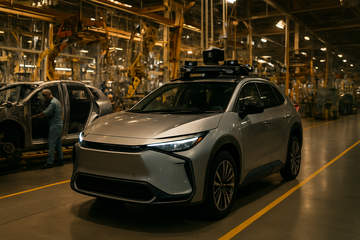
Toyota Just Took the Right-Hand-Drive Robotaxi Supply Chain — and Autonomy Software Is Being Repriced as a Component
On October 30, 2026, Toyota said it will build the 2027 bZ4X at its Takaoka plant and fit Waymo's autonomous-driving hardware to it on the same line, validating a fleet in Japan in 2027 and reaching the United Kingdom in the years after. The move happens because Alphabet's Waymo wants to go from roughly 4,000 vehicles to 20,000 by the end of 2027 on $5 billion of new debt, while the Other Bets segment earned $372 million and lost $2.05 billion in the September quarter alone. Because Japan and the UK require licensed operators and locally homologated cars, the gatekeeper of robotaxi volume is the vehicle supply chain rather than the driving stack, and the profit pool splits three ways: compute and software keep the margin, a roughly $50,000 vehicle sets the cost floor, and everything in between gets squeezed. Read that way, Mobileye and Lucid are on the wrong side of the structure Toyota just signed, Hyundai Motor already holds the scale contract in the United States, and Toyota is buying the right to sell hardware to any operator with a permit.
2026-10-29

Alphabet's 10% Drop Was a Funding Verdict, Not a Demand Verdict: Cloud Doubled, Cash Flow Went Negative, and 2027 Has No Number
Alphabet reported Q3 2026 on Oct. 28, 2026 with revenue of $127.6 billion, up 25% year over year, and Google Cloud revenue of $30.7 billion, up 103% with segment operating income more than tripling to $11.1 billion. Shares still fell more than 10% in after-hours trading and market capitalization slipped below $4 trillion, because the quarter carried $51.4 billion of capital spending, $9.1 billion of negative free cash flow, and a promise that 2027 spending will increase significantly with no number attached. Holding the unchanged $195-205 billion guide now requires $63.0-73.0 billion in Q4, and the suppliers of servers, memory and power are already being paid while the owners of rented compute are being repriced by a credit market in distress.

Anthropic’s new “smart reports” turn enterprise AI spend into a receipt—and force the vendor to defend the ROI it’s selling
On Oct 28, 2026 Anthropic rolled out Claude Enterprise tools that show admins what teams used Claude for, what it cost at list price, where sessions hit friction, and how much shared budgets ran out. By embedding cost/quality attribution and spending controls inside the model product, Anthropic shifts renewals from “usage volume” to a tighter, vendor-mediated proof of cost-per-outcome—right when enterprises are trying to stop AI budgets from drifting.

Cohere's CAD $35.7 Billion Is the Richest Revenue Multiple in AI: 106x Its Own Disclosed Sales, Funded by Governments
Cohere's Oct. 29 initial Series E close values the enterprise-AI lab at CAD $35.7 billion — about US$25.5 billion — which is roughly 60 to 95 times the recurring revenue implied by its own 165% growth rate, and two to four times what Mistral costs per dollar of sales on its own year-end target. The price was not set by model quality but by sovereign capital: Canada's government (up to C$1.6 billion of equity) and Schwarz Group (EUR 500 million) are underwriting a lab that has already contracted US$745.6 million of GPU capacity from listed landlords HIVE Digital and Boost Run. That chain turns a private mark into debt-financed data centers, which is where the credit risk now sits — and it leaves public AI software priced from 11.6x sales at Microsoft to 73.3x at Palantir, with no floor beneath it.
Fortinet's AI-Security Billings Grew 15% — Half Its Own Rate — and the Stock Fell 26%. Palo Alto Networks and CrowdStrike Carry More Risk
Fortinet beat on revenue, raised full-year guidance for the third time in 2026, and still lost about 26% after hours on Oct. 28, closing Oct. 29 down 22.6% at $134.71. The market did not punish AI-security demand: billings rose 29% and AI-infrastructure demand was the strongest driver management could point to. It punished the recurring base — 2026 service revenue guidance was cut while product guidance was raised — and it noticed that Fortinet's own AI-driven security operations billings grew just 15%, less than half the pace of the company. That is the exposure still sitting inside Palo Alto Networks at 28 times trailing sales and CrowdStrike at 49 times, neither of which has been marked down.

Microsoft's $45.2 Billion Quarter: Azure's First Dollar Number, a $10 Billion OpenAI Check, and the Capex Guide That Now Funds the AI Trade
Microsoft's September quarter made the AI build auditable for the first time: Azure revenue of $33.165 billion disclosed in dollars, $10.0 billion of revenue from OpenAI (about 11% of sales), and $45.2 billion of capital spending that came in below the $50.7 billion consensus and still rose 30% year over year. CoreWeave, Nebius and IREN fell 3% to 5% anyway, because in this market Microsoft's own capital plan has become the funding variable for everyone who builds compute on Microsoft's behalf — and the quarter's miss was mostly a shift of leases from finance to operating, with cash capital spending up 103% and December-quarter spending guided above $50 billion. The deeper risk is concentration and cash: trailing free cash flow fell 38% to $60.0 billion while revenue rose 18%, receivables grew 85% year over year, and the revenue-sharing component of the OpenAI relationship is capped at $38 billion through 2030.
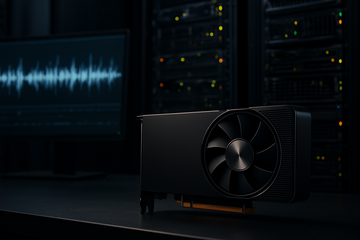
Nvidia's Open Speech Model Transcribes Up to 2,238 Hours of Audio Per GPU-Hour — the New Benchmark Every Paid Speech API Must Clear
On October 28, 2026, NVIDIA released Nemotron 3.5 Transcribe, a roughly30-billion-parameter open-weight speech model that transcribes 40 languages, tags up to eight speakers and translates 31 of them for nothing — and on NVIDIA's own serving numbers it turns one GPU-hour of wall clock into 2,238 hours of finished transcript. That arithmetic is the event: it converts a per-minute API bill into a hardware bill, squeezing the margin out of every hosted speech API while pushing demand back toward the silicon NVIDIA sells. NVIDIA's data-center revenue grew 117% year over year to $89.0 billion in the July quarter, and management told investors open-model adoption is skyrocketing — the speech release is the clearest sign yet that AI's profit pool is migrating down the stack.
What to expect
Evidence-first notes with a visible point of view.
This section collects sharp takes on earnings, shareholder meetings, and market structure. Each new piece should make the thesis, the facts, and the implications obvious within the first few screens.
Expect direct analysis, not generic commentary.
Expect the data to be explicit and the argument to be easy to follow.