Macro & Policy
Rates, inflation and the policy that moves them
Central bank decisions, jobs prints and fiscal policy, read the way a portfolio reads them: what reprices, by how much, and what would change the call.
2026-09-20


Bowman's Stress-Test Finale Resets the Capital Math — Banks Win, Critics Sue
Michelle Bowman's Sept 18 London speech locks in a stress-test rewrite that halves SCB volatility, opens the black box on models and scenarios, and queues up a 4.8% aggregate capital cut for the largest U.S. banks. The reform arrives10 days after a Better Markets lawsuit sought to derail it — and four days before Bank of America's CEO warned Q3 investment-banking fees would fall 10%+. Investors who already priced the June 24 buyback green-light now have to weigh whether the procedural transparency is enough to survive court, or whether the real-economy warning is what matters next.

IMF Tells EU Ministers AI Can Boost Growth — but the Strains Are the Real Story for Duration
At a Sept. 18–19 informal meeting in Dublin, the IMF told EU finance ministers that AI could lift European productivity by ~1% over five years — but warned that the same wave will widen inequality and stress power grids that already consume 3% of EU electricity. With the ECB having just hiked to 2.50% and euro-area HICP at 3.2% in August, the IMF's growth-plus-strain framing tilts the European vs US duration call: AI-exposed euro duration (Bund at 3.52%) is a worse hedge than US duration (UST 10Y at ~5.00%) for the next quarter, but the EU's €600B compute gap and €10B gigafactory plan seed a structural bid for European AI capex names through 2027.

Kashkari's 'too high in all aspects' pulls the dovish floor out of the September dot plot — the hawkish bench now runs five deep
Minneapolis Fed President Neel Kashkari, the FOMC's long-time dove, told Fox News on Sunday that inflation is 'still too high across all sectors,' defending the Fed's September 16 hike to 3.75%–4.00% and reframing the 4.1% median 2026 dot as a ceiling rather than a peak. With Kashkari, Hammack, Logan, Schmid and Cook publicly aligned, the next SEP distribution now needs only four participants to deliver a second 2026 hike — and rate-sensitive equities (REITs, regional banks, small caps) are the first place the dot plot shows up in price.
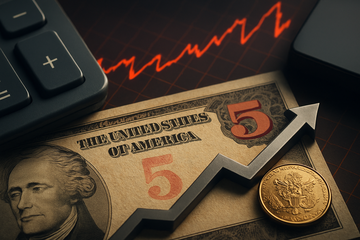
The 10-year just broke 5% while the CBO projects 4.3% — that gap now adds roughly $2 trillion to the US interest bill
The 10-year Treasury yield topped 5% last week for the first time since 2007, running roughly 90 basis points above the Congressional Budget Office's February baseline of 4.3% through 2031. The CRFB calculates that even a 55bp overshoot adds about $2 trillion to federal interest costs over the decade and pushes net interest past defense and Medicare by 2027. Wall Street voices who long waved off deficit risk — Ed Yardeni, ex-CEA chair Jared Bernstein — are publicly flagging the spread, and the Fed under Kevin Warsh just delivered the first rate hike since 2023, leaving JPMorgan Chase and Bank of America with a steeper curve to navigate while D.R. Horton and Lennar absorb a 6.95% 30-year mortgage.

TotalEnergies Enters Venezuela, but the Real Prize Is Washington’s Next Move
The Sept. 19 memorandum between Caracas and TotalEnergies is strategically important even though its commercial terms remain undisclosed. It breaks the assumption that Venezuela’s reopening would be controlled exclusively by U.S. operators, raising competitive pressure on Chevron while leaving the investment case dependent on sanctions permissions, payment rules and contract execution.
2026-09-18

Manufacturing fell 0.3% in August, ending a seven-month streak. The Fed had hiked 25bps into it two days earlier.
The Federal Reserve's September 18 G.17 release showed U.S. manufacturing output down 0.3% in August — the first miss after seven consecutive monthly gains — and the categories that broke weren't AI. Motor vehicles (-1.2%), defense & space equipment (-1.2%), computers (-1.4%), and construction supplies (-0.7%) all fell, while semiconductors held +12.4% year-over-year. The print landed two days after Fed Chair Warsh's FOMC delivered the first rate hike since 2023, lifting the funds rate to 3.75–4.00%. The streak bulls called an AI buildout was actually reshoring, autos, and defense — and three pillars all rolled over in the same month.

Bank of America's $90 Billion Bond Hole Is Now Testing the 'Buy the Dip' Pitch the Bank Is Selling Clients
Bank of America closed Q2 2026 with $85.1 billion in unrealized losses on its bond book, and Barron's estimates that figure has crossed $90 billion in Q3 as the 10-year Treasury yield punched through 5%. Inside BofA, one desk is flagging a disorderly bond move as the market's biggest tail risk while the wealth-management desk tells clients to add on dips — the same call being made by a bank whose $506 billion held-to-maturity portfolio is, on paper, the most underwater in U.S. banking. For investors, the contradiction sets up the cleanest read on rate exposure in years: BofA is the trade.

Manufacturing's Seven-Month Streak Just Snapped — and the AI Buildout Wasn't Big Enough to Hide It
U.S. factory output fell 0.3% in August, ending seven straight monthly gains and missing Reuters-polled expectations of +0.3%, with the Federal Reserve's G.17 release showing the weakness concentrated in motor vehicles, defense and space equipment, business equipment, and construction. The AI-linked information-processing line — up1.2% — only partly offset the broad cyclical roll-over, leaving the print a hard split between AI-supported and traditional manufacturing. With the Fed having just hiked 25bp on Sept. 16 and the dot plot still pointing to another 25bp by year-end, the report forces a reckoning for the goldilocks thesis: investors must now price AI-buildout strength separately from cyclical industrials.
2026-09-17

Amazon's $20 Minimum Just Made 'AI Suppresses Wages' a Margin Story — Not a Macro One
Amazon lifted its U.S. operations floor to $20/hour on Sep 16, 2026 — a $1.5B bet that turns the second-largest U.S. private employer into a wage-setter for retail and last-mile delivery. The raise lands with Costco already at $20 and Walmart stuck in the mid-teens, and it coincides with Amazon's one-millionth warehouse robot and a $220B 2026 capex run. For investors, this is a P&L event first and a labor story second: ~$1.5B of incremental cost, partially offset by automation, passes through the NA segment that just printed $9.1B of operating income on $116B of revenue.
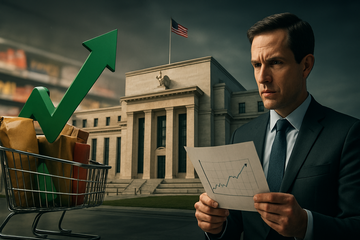
August's Retail Rebound Just Gave Warsh His First Hike — and the Cover for the Next One
Two hours after the Census Bureau reported a 1.2% rebound in August retail sales, Fed Chair Kevin Warsh lifted the funds rate 25bp to 3.75%-4.00% and penciled in more to come. The same print that seemed to disprove the 'consumer is breaking' narrative gave the FOMC cover to act against 3.7% PCE inflation — leaving rate-sensitive retailers squeezed on volume and margin at once.
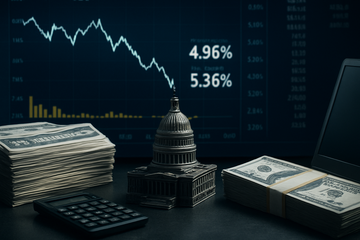
BofA Just Called 5% Treasuries a 'Generational Entry.' The Mortgage and AI Capex Markets Have to Backfill Demand for That Call to Work
Bank of America Securities, via Michael Hartnett's Flow Show the week of September 4, 2026, framed long-dated U.S. Treasuries as a \"generational buying opportunity\" because their 10-year rolling return sits at negative 2% — the worst 100-year reading — and cited December 1959 and September 1981 as historical analogs. The call lands while the 10-year yields 4.96%, the 30-year 5.36%, BofA's own September Fund Manager Survey shows a net 48% underweight in bonds (the largest since May 2022), and the Treasury is simultaneously enlarging long-end auctions and ramping buybacks. For the call to work, the rates-equity-mortgage complex has to absorb three structural drags at once: the U.S. Treasury's bigger long-bond calendar from September 9, hyperscalers on pace for roughly $194B of 2026 debt issuance funding AI capex that approaches $800B, and a mortgage market where 30-year fixed rates of 6.79% sit on a spread of just 1.98% above the 10-year.

The World's Top-Performing Sovereign Fund Just Warned of a US Pullback — and It's Sitting on US$31.7B of NVIDIA
The Guardians of New Zealand Superannuation — ranked first by Global SWF over 20 years — delivered a 14.2% return for fiscal 2026, then publicly flagged that US equity returns are 'close to double' their long-run average and are due 'some reversion to the mean.' With NZ$31.7B of US stocks anchored by NVIDIA, Apple, Microsoft, Alphabet and Amazon, the warning hits the heart of the AI mega-cap trade that has carried the S&P 500 to a CAPE above 40 — the second-highest reading in history. The investor question is no longer whether official-sector money is leaning against US tech, but who replaces it on the way down.

The World Bank Just Tripled Its Private-Capital Pull to $112B — and the EM-Debt Tape Still Hasn't Priced It
On September 17, 2026 the World Bank Group reported $112B of private capital mobilized in FY2026 — more than triple the $35B of FY2022 and 62% above the $69B of FY2025 — driven by IFC's new origination-to-distribute factory and a guarantee platform that's now scaling toward $20B a year. With the same institutional buyers rotating out of US munis (where tax-exempt yields just hit ~5.00% and supply is a record $565B) and into EM debt yielding 7.26%, the marginal EM-credit buyer has changed hands — but the spread tape still widened 9 bps in July. The investors already inside the pipeline — BlackRock, Goldman Sachs, Brookfield Asset Management, Allianz, Legal & General — own the upside before the rest of the market catches up.
2026-09-16
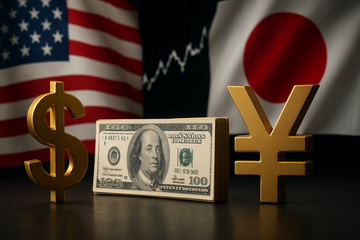
BOJ's 31-Year-High Rate Hike Lands in a US Bond Market Already at 5%—The Cross-Border Math the Carry-Trade Crowds Aren't Pricing
The Bank of Japan lifted its policy rate to a 31-year high of 1.00% on June 16, 2026, and 97% of economists polled by Reuters now expect a follow-up hike to 1.25% on September 18. That is the trigger nobody pricing the USD/JPY carry trade is treating correctly: the move happens into a US 10-year yield that just hit 5.041%—the highest since July 2007—and a Federal Reserve that is about to hike, not cut. Both ends of the rate differential are tightening at once, and a record $2.35 trillion cross-border yen carry position is the fuel line. The trade rewires itself: MUFG, SMFG and Mizuho collect ¥billions per 25 bps while NVIDIA and the AI complex lose the cheapest marginal funding source they have had in years.

Magna International's $42B Revenue Engine Just Got Yanked Between Two Continents
Mark Carney's EU pitch — pitched as 'associate member,' settled as 'unique alliance' — turns Canada's supply chains away from the US at the exact moment 50% Section 338 tariffs hit autos, dairy, and alcohol. The carve-out structure is the story: energy, potash, and critical minerals are excluded from Trump's proclamation, which is precisely what Canada is now selling to Europe. Investors who ignore this miss a multi-year reorientation of North American industrial flows.
2026-09-15

The Iran-Israel halt is back — and chips, oil, and the 4.96% 10-year are all pricing the same fragile peace dividend
President Trump's Sept 12 'Iran war ending very soon' remark and Iran's Sept 14 BRICS restraint declaration have put an Iran-Israel de-escalation back on the tape — and three markets are now fighting over the same peace premium: Brent at $104.61 wants to fade toward $90 if the Strait of Hormuz reopens cleanly, the 10-year Treasury at 4.96% wants to ease off the 5% line if oil follows, and chip stocks like NVIDIA want to rebound on lower discount rates. The trade breaks if the Houthi advance on Yemen's Perim Island — visible Sept 14 — reopens a maritime front that keeps war-risk premium in crude even with Iran-Israel itself quiet.
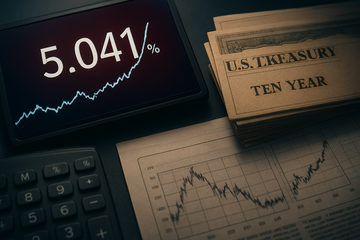
The 10-year just cleared 5% with a hike already priced — the bond market isn't waiting on the Fed to break
On September 15 the 10-year U.S. Treasury hit 5.041% intraday — the first sustained print above 5% since July 2007 — while CME FedWatch simultaneously priced a 92%+ probability of a 25bp Fed hike at the September 15–16 meeting. With the 2s10s spread at 33bp and the 30-year at 5.40%, duration and a re-hawkish Fed are now being priced together for the first time in this cycle, hitting banks, homebuilders, REITs and rate-sensitive utilities while TLT sits near $80.90, down 4.6% YTD.
Warsh's First Hike Is Consensus: The Tail Trades That Mean-Revert Monday
Kevin Warsh's first rate hike, a 25bp lift to 3.75–4.00% on Sept 16, is no longer a tail — CME FedWatch prices it at ~87%, up from 35% before Jackson Hole. The trades that profited from anti-hike positioning — long TLT, long MBB, long GLD, and the steepener that lifted KRE to a 15% YTD — now have to give back the optionality premium. Banks, REITs, and long-duration credit face different math: banks catch a one-quarter NIM tailwind, then a loan-book headwind; REITs absorb the multiple compression; MBS sits at52-week lows with negative convexity.
2026-09-14

2026-09-13

What to expect
Evidence-first notes with a visible point of view.
This section collects sharp takes on earnings, shareholder meetings, and market structure. Each new piece should make the thesis, the facts, and the implications obvious within the first few screens.
Expect direct analysis, not generic commentary.
Expect the data to be explicit and the argument to be easy to follow.