Macro & Policy
Rates, inflation and the policy that moves them
Central bank decisions, jobs prints and fiscal policy, read the way a portfolio reads them: what reprices, by how much, and what would change the call.
2026-10-31

2026-10-30
When Everything De-Risks at Once, the “Safe” Front-End Still Pays: What Oct. 30’s Cross-Asset Tape Signals for Funding Costs
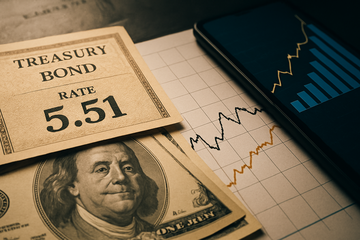
Oct. 30’s cross-asset selloff behaved like collateral de-risking, not sector re-allocation: risky stores of value (bitcoin) fell alongside risk assets, while the front-end remained unusually attractive for cash parked in government-linked instruments. The key investor takeaway is directional—pay attention less to “which sector hit” and more to whether funding costs at the front end stay bid into the next buildout cycle.
The Kiwi Fell 1.7% While Its Own Rates Fell Just 13bp: FX Now Prices Board Credibility, Not Rate Paths
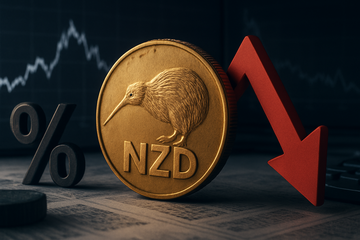
On October 28, 2026 the Reserve Bank of New Zealand held its official cash rate at 2.75% on a 4-3 vote against a market that expected a 25bp hike, and the New Zealand dollar fell as much as 1.7% to $0.5583 while the two-year swap rate fell only about 13bp to 3.98%. That gap is the story: the currency repriced roughly thirteen times harder than the rates it was supposed to track. The same pattern ran through the Bank of Japan's hawkish 8-1 pause, the Federal Reserve's 10-2 hold with two members voting to hike, and the Bank of Canada's fully priced 25bp increase - FX is now paying for whether a committee's path is confirmed, not for the expected rate itself. For US investors that means underwriting USD-funded carry and AI-infrastructure debt on committee dispersion, and it leaves the yen as the only positive-carry funding currency in the majors while its own board tightens.

The 22% Social Security Cut Nobody Prices: $345 Billion a Year With No Buyer, and Who Catches It
The 2026 trustees put a date and a percentage on the trust-fund cliff: the OASI fund empties in the fourth quarter of 2032 and pays 78 cents on the dollar of scheduled benefits, while CBO models a 26% cut by mid-2032. Priced against today's retirees that is roughly $345 billion a year, 1.1% of GDP, and it evaporates — no bondholder, no fund, no offsetting receiver. Households can absorb 0.2% of their financial assets, which is exactly why Washington defers and why the guarantee migrates to private insurers, where retail annuity sales just set a record $464.1 billion. The investable question is therefore not the 2032 date but who is paid to stand behind retirement income in the meantime, with the November 3, 2026 midterms as the first catalyst.
2026-10-29
Lagarde's Exit Puts a 2.50% ECB Against a 155bp French Spread: The Credibility Discount Is a EUR/USD Problem First
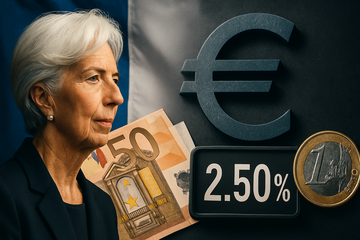
Christine Lagarde told the Governing Council and European Council President António Costa on 29 October 2026 that she will step down on 7 February 2027, nine months early, hours after the ECB held its deposit rate at 2.50% and left a December hike alive. The resignation does not change the December vote, but it removes the authority that made a hawkish path credible, and the market repriced that instantly: the euro fell to 1.113, its weakest since May, while December odds firmed to roughly 88%. The binding constraint is French arithmetic, not French politics: the 10-year OAT broke 5% for the first time since 2002 at 5.089% and the spread over Germany sits at 155bp, so any successor inherits a December hike priced into a sovereign market that cannot easily absorb it. Positioning implication: own the inflation hedge in Shell and TotalEnergies, own the dollar-funding side of the squeeze in JPMorgan, and treat euro-area bank earnings in BNP Paribas and UniCredit as a sovereign-spread trade rather than a rates trade.

Gallup's 29% Engagement Low Is the Demand Signal the December Hike Is Ignoring
Gallup's Q3 2026 survey put US employee engagement at 29%, the lowest reading since 2011 and a two-point drop in a single quarter that equates to roughly 3.2 million workers checking out, while September payrolls came in at 29,000 with two prior months revised down a combined 60,000 and quits sitting at a 1.9% rate. The demand side of that economy is deteriorating quietly while the headline inflation the Federal Reserve is hiking against is being manufactured by gasoline, with headline CPI at 3.7% against 2.6% core and energy up 20.4%. The Committee held at 3.75%-4.00% on Oct 28 with two dissents favoring an immediate hike, and futures still price roughly an 80% chance of a December increase. That pricing assumes the fuel impulse persists and the labor market stays soft without consequences; the read-through is that staffing, recruiting and discretionary apparel names carry the downside, while payroll infrastructure with fee and interest income does not.

AI Bonds Just Hit a Record $419 Billion — and They Are Quietly Setting the Price of 30-Year Capital for Everyone Else
Global investment-grade and junk bond sales hit a record $6.61 trillion through Oct 28, 2026, up 15% from a year earlier, and AI-related US corporate issuance ran $419 billion, up 90% from full-year 2025. The crowding-out is real but it is not where most investors are looking: US investment-grade spreads ended August at 78 basis points, unchanged from the start of the year, because record foreign inflows and annuity demand absorbed the AI paper. What has repriced is duration — 41% of hyperscaler issuance now sits beyond 15 years, and the 30-year Treasury yield has risen about 40 basis points in 2026 to 5.25%. Alphabet can still fund the buildout out of $265.1 billion of cash, Goldman Sachs and JPMorgan get paid on the volume, and the credits squeezed first are the leveraged AI borrowers and the landlords financing the same megawatts.

3.4% GDP, Gasoline Up 34%, Hershey Volume Down 10%: The Consumer Crack Is a Price-Level Problem
The third-quarter advance GDP estimate of 3.4% and September PCE inflation of 3.6% headline and 3.1% core describe an economy whose growth is capital spending, not household consumption: inflation-adjusted consumer spending was unchanged in September and the personal saving rate sits at 3.8%. Hershey's own print showed the same split from the manufacturer's side, with adjusted gross margin up 1,090 basis points on cocoa at $4,317.67 a tonne, organic volume down 10 points, and organic sales guidance cut to about 3% even as earnings guidance rose to $8.58-$8.74 a share. The squeeze is a price-level problem rather than a demand collapse: gasoline is up 34.2% year over year and food away from home 3.5% while food at home runs just 1.8%, so the lowest-income households are cutting small, high-mark-up impulse treats rather than pantry staples, and convenience-store candy sales fell about 5% in September. Own the earnings transfer to branded manufacturers with input leverage, and treat the discounters as the destination of the volume rather than as a consumer-health signal.
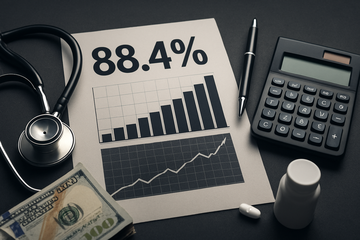
UnitedHealth Group's 88.4% Medical Care Ratio Is Repricing, Not Cost Relief — and It Doesn't Weaken the December Hike Case
UnitedHealth Group reported a third-quarter medical care ratio of 88.4%, 150 basis points better than a year earlier, with operating earnings up 52% to $6.6 billion and full-year adjusted guidance raised to at least $20.50 a share. But $610 million of that improvement came from favorable prior-period reserve development, the chief financial officer says medical costs remain elevated versus historical norms, and the sector did not confirm the trend: Elevance Health improved 70 basis points, Centene was flat at 92.7% and Molina Healthcare deteriorated 30 basis points to 92.9%, with Humana due to report on Nov 6. The Fed prices provider services and net insurance premiums rather than payer margins, so a better medical care ratio mechanically pushes the PCE health insurance index up rather than down — just as the December 8-9 meeting shapes up as a hike.
2026-10-28

25% of Europe's Corporate Debt Refis Within Two Years: The Corporate Layer, Not the Sovereign Curve, Is the Transmission Belt
Goldman Sachs's 23 October note, reported on 28 October, concludes that higher sovereign yields and heavy new issuance are pushing up European corporate borrowing costs — and it is the corporate layer, not the sovereign curve, that now carries Europe's stress. European investment-grade yields have risen about 30 basis points since 1 September to 4.4%, while high-yield costs jumped roughly 90 basis points to 7%, so the weak tail is repricing three to four times faster than the index. Six of Europe's ten weakest borrowers face 2027–2028 maturities with senior debt yielding 20% to 60%, which closes public-market refinancing arithmetically rather than economically. For US investors the transmission runs through a contest for capital, not a default wave: a forecast $420 billion of hyperscaler bond issuance in 2027 competes for the same insurance and pension money European issuers need, which favours arrangers such as Goldman Sachs and JPMorgan Chase while the same arithmetic already runs at CoreWeave.
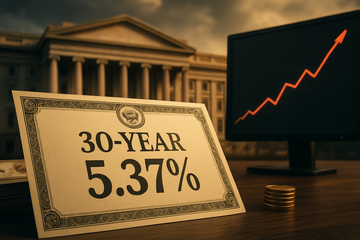
Warsh Cut the Fed's Rate Votes From Eight to Six and Refused to Explain — the 30-Year Bond Added 150 Basis Points for the Silence
Kevin Warsh's Fed held rates at 3.75%–4.00% on October 28 with two dissents for a hike, then announced it will vote on rates seven times in 2027 and six in 2028, will give forward guidance only in a crisis, and will publish no path for investors to lean on. That converts policy from an information service into a market-priced distribution, and it is already showing up in prices: the 30-year Treasury closed at 5.37%, roughly 150 basis points above the policy midpoint, while the December hike is priced near 76% in futures and prediction markets. The money moves to whoever can price or fund the uncertainty — dealers, Treasury buyers and deposit-rich banks — and away from anyone running duration on borrowed money.

Asia Cut $281 Billion of Treasuries Since February — and the Long End Cleared at 5.73% Anyway
The Treasury's own flow data do not show a 60% cut in official buying: in August, official institutions bought $42.9 billion of long-term Treasuries while foreign private investors bought $257.8 billion, the private bid of the year. What shrank was Asia's stock of the paper — Japan, China and South Korea together are down $281 billion since February — and the replacement money is price-elastic and levered rather than official. With a $1.99 trillion deficit, a Fed that hiked to 3.75%-4.00% in September, and a leveraged basis trade roughly $360 billion smaller, the 30-year has to clear at 5.3%-5.7%, and it does. Money funds, stablecoins and the Fed can absorb the bills; they cannot absorb the duration. For investors, that means Circle Internet Group's shrinking reserve book, JPMorgan Chase's wider margin, and a November 4 refunding decision that matters more than any Fed meeting.

Brent Fell on a Deadlocked Knesset: The Oil Premium Is Trading Iran's Diplomacy, Not Coalition Math
Israel's October 27 election produced no clear winner — exit polls put Benjamin Netanyahu's bloc on 52 seats and Gadi Eisenkot's on 49, against the 61 needed to govern — yet Brent settled 1.7% lower at $113.88 the same day while the shekel jumped 1.8% to a five-week high. Crude is trading one channel only: the diplomacy over the Strait of Hormuz, where war-risk insurance and rerouted shipping, not missiles, physically remove barrels, and where4.5 million barrels a day of shut-ins unwind faster than a ceasefire would be signed. The investable consequence is a clean split — upstream producers, tanker owners and refiners are paid per barrel moved, while the war's inflation shows up in the Fed's December hike and in gold's 28% slide from its January record. Positioning for a deadlocked parliament is positioning for volatility; positioning for the oil premium means positioning for logistics that mean-revert.
US Margin-Debt Growth Fell 22 Points in Four Months. The Leverage Migrated to Interactive Brokers, Charles Schwab and Robinhood — Right as the Fed Hiked
CNBC's October 27 read — margin-debt growth decelerating from 53.7% in May to 31.4% in September — looks like deleveraging. It is not: over those same four months US margin debt rose 4.6% to $1.48 trillion, so every point of the \"slowdown\" came from the comparison base, not the balance. The leverage itself migrated: Schwab's, IBKR's and Robinhood's margin books grew 93%, 36% and 59% against 31.4% for the industry, lifting their share of US margin debt from 16.7% to 21.3% and creating roughly 36% of all new margin borrowing. That concentration arrives just as the Fed raised rates on September 16 and decides again on October 28 — and it has already gutted the economics of the business, with Robinhood's margin book up 59% while its net interest revenue fell 9%. Read the deceleration as a composition warning, not a top signal: the marginal levered dollar now sits at online brokerages, in AI hardware, and in foreign hands buying 3x semiconductor funds.
2026-10-27

2026-10-26

37.5% on Covered Brazilian Goods: The Censorship Tariff Lost Its Author in Court, and Lula's Win Doesn't Touch It
Lula's 51.76% runoff win over Flavio Bolsonaro on October 25, 2026 removed the political author of Washington's Brazil penalties, but not the penalties themselves. The 40% duty written around the Bolsonaro-era censorship of US online platforms was already knocked down by the Supreme Court, and what replaced it is a legally durable Section 301 pair: 25% from July 22, 2026 plus a 12.5% forced-labor action from July 24, a 37.5% stack on covered goods. The binding variable for Brazilian assets is now fuel: Atlantic Basin diesel cracks are at records while Petrobras' diesel sells at a near-yearly-record discount to import parity, so the election decides whether that gap is paid by Petrobras's refining margin or by the federal treasury, and a contested handover keeps an institutional risk premium on Brazilian assets until January 1, 2027.

Washington Can't Raise Its Canada Tariff Rate — So It Re-Cut the Product List Eleven Days Before the Midterms
The Oct 23 proclamation stripped 50% duties from Canadian plywood, paper products, machinery, refrigeration equipment and packing crates while adding carpets, valves and waste products, effective Oct 30. That is a schedule rewrite, not a negotiating position, and it reveals how this trade war will now be fought: Section 338 caps the rate at 50%, so the only thing that can move without a signed deal is which product lines sit inside the list. For investors the consequence is precise — trade the list, not the rate, because the companies whose gross margins compressed hardest in Q2 and Q3 2026 are the ones that ship product across the 49th parallel in both directions.

Record Deals, Shrinking Premiums: Ageing Moved Pensions to Insurers — and a 6% Long End Now Sets the Price
UK risk transfer to insurers and reinsurers is forecast at £70bn in 2026, up 15%, and US pension risk transfer assets have reached $339.8bn, up 9% year on year — the ageing liability really is moving onto insurer balance sheets. Yet US premiums fell 26% in the second quarter even as contract counts rose 21%, because with the 20-year gilt near 6.0% and annuity purchase rates at 5.88% to 5.99%, duration is the binding constraint rather than demand. Insurers capture the liabilities and the fee pool, reinsurers capture the capital, and asset managers are left paid on a flat £880bn of hedged liabilities. The unpriced risk is circular: insurers fund 30-year longevity with private credit whose tight yields are what make the buy-in price work.
Nu Holdings Lost $16.4 Billion in One Pre-Market Session — and the Rate Everyone Blamed Is Not the Risk
Luiz Inácio Lula da Silva's 51.8% runoff victory on Oct. 25, 2026 sent Nu Holdings down about 22.5% in pre-market trading on Oct. 26, erasing roughly $16.4 billion of market value and pushing the stock below its pre-first-round level. The sell-off was mostly a repricing of Brazilian sovereign risk — the broad Brazil ETF fell about 19.6% and Brazilian banks 17%-18% — but the transmission into Nu runs through three channels: dollar translation of a real-denominated earnings stream, a credit book whose 90-plus-day delinquency already rose to 6.9% in the second quarter, and a valuation that had priced a fiscal adjustment Brazil has now abandoned. Nu's own second-quarter numbers show the margin was built on credit growth and falling cost of credit, not on rate cuts, so a 13.75% Selic that stays put is not what investors sold.

The Hedge That Pays Is the Pain: $116.72 Oil, a 5% Long End and an FOMC That Can't Hike
Three prices landed inside 72 hours and reset the correlation regime: Brent settled at $116.72 on Friday, the 10-year spent three sessions between 4.96% and 5.13% against a Fed on hold at 3.75%-4.00%, and spot gold broke below $4,000 an ounce on the very session oil hit a six-month high. The classic hedges failed for opposite reasons, because a supply-driven oil shock lifts inflation and the discount rate at the same time. The real transmission runs through funding: Meta posted its first negative free cash flow quarter ($34.91B of capex against $32.79B of operating cash flow) and lifted long-term debt by $25.9B in three months, while roughly a third of hyperscaler capex is now debt-financed. That makes the AI buildout a credit question before it is an equity one, and leaves energy cash flow — Valero at $23.89 of quarterly EPS, INPEX planning on $70 Brent, PetroChina at a record half — as the only place where the shock lands as revenue rather than cost.
What to expect
Evidence-first notes with a visible point of view.
This section collects sharp takes on earnings, shareholder meetings, and market structure. Each new piece should make the thesis, the facts, and the implications obvious within the first few screens.
Expect direct analysis, not generic commentary.
Expect the data to be explicit and the argument to be easy to follow.