Macro & Policy
Rates, inflation and the policy that moves them
Central bank decisions, jobs prints and fiscal policy, read the way a portfolio reads them: what reprices, by how much, and what would change the call.
2026-08-18

Long-end yields at multi-decade highs are now a direct equity valuation test: what to watch when the bond slump spills into earnings
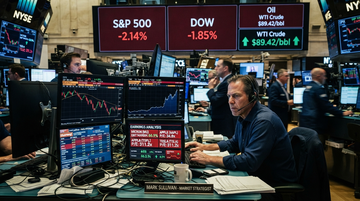
On Aug 18, 2026, global bond prices slid sharply and long-term borrowing costs pushed to multi-decade highs, coinciding with oil strength and pressure on US stock-index futures. The equity transmission is not just “rates up”: higher long yields mechanically compress the value of distant cash flows and immediately tighten the financing and housing channels that can feed into margins and demand over the next few quarters.

Ceasefire expiry flips the “fade” trade: oil lifts back toward $85 as term premium and shipping risk reprice
When the U.S.–Iran ceasefire looked set to expire on Monday, policy language tilted toward coercive pressure and Iran signaled a harder posture—pushing oil and yields higher. The trade implication is not just crude sensitivity: airlines, margin-flex refiners, tanker operators, and long-duration equity exposures can whipsaw as term premium and freight risk re-price before the market regains direction.

Warsh inherits the White House–Fed fight that could reprice the September path—and the long-end term premium
Kevin Warsh’s confirmation and early Fed chair messaging has put Fed independence back at the center of Washington politics. That matters for markets because rising uncertainty about the policy path has already been linked to higher term premia in Fed communications—and political interference is now the missing variable for how September pricing resolves.
2026-08-17

The dollar’s slide is unwinding the hawkish July story—re-rating S&P earnings translation, lifting gold, and de-risking EM
When the ICE U.S. Dollar Index fell on Aug. 17, 2026, traders effectively walked back the odds of near-term Fed tightening. That FX repricing matters beyond price action: it improves multinational earnings translation, changes the opportunity-cost math behind gold, and reopens the path for emerging-market risk appetite.

The US long-end is no longer a “Fed story”: global duration supply is steepening the curve into the next leg higher
The latest term-premium decomposition shows the 10-year risk premium elevated even after expectations of policy settle, consistent with a rising “duration supply” regime. When the Treasury curve keeps steepening, the market implication is that global buyers (and JGB holders) are repricing the US long end as a cross-border portfolio decision—pressuring duration-heavy AI compounders even without a Fed shock.
2026-08-16

German firms are cutting US capex again—tariff whiplash is reversing the “reshoring supercycle” narrative
Fresh Reuters reporting points to a three-year low in German corporate investment into the United States in the first half of 2026, directly tied to policy-driven uncertainty. For US-market investors, the key takeaway is that the reshoring bid is becoming more selective: autos and industrial supply chains can absorb demand shocks, but they struggle to finance new capacity when tariff paths keep moving.

Global rates are the new boss: US duration is losing its policy anchor—and the AI trade just got re-priced
A rising US 10-year is no longer behaving like a clean read-through of the Fed’s next move. Fed research points to a rise in the real risk premium driven by adverse supply-shock and fiscal/debt-sustainability risk, while term-premium concepts explain why the long end can climb even when policy expectations don’t. The practical implication: duration hedges and steepener trades need to price supply and global issuance pressure, and high-multiple AI capex-heavy equities are more rate-sensitive than investors often assume.

The 20-year Treasury auction is the steepening trade’s real stress test—because it prices the duration “bid” before AI capex gets discounted
The next US Treasury 20-year auction (auction date Aug 19, 2026) sits at the weakest point of a steepening narrative: the least-liquid tenor where weak demand shows up fastest via a larger “tail.” If the auction clears with a meaningfully weaker demand signal, long-duration equities and high-quality IG funding used to finance AI buildouts tend to reprice higher on yields—before issuers see the relief.

Native-born unemployment is rising while wages stall: the “America-first” labor contradiction investors still haven’t priced
New labor-market reporting highlights a split outcome: U.S.-born unemployment is moving higher while wage growth is no longer keeping pace with inflation. That mismatch matters for the Fed and for consumer-cyclical earnings because it signals pressure on household labor income without a clean unemployment-relief path.
2026-08-15

Germany’s pension overhaul is a $500B equity flow test—asset managers who win fees decide whether Europe buys Wall Street or stays home
Germany’s new prefunded pension pillar phases in 2% of pay as contributions, reaching about €35B annually by 2031 and allowing materially higher equity exposure. The investment reforms create a structural, multi-year demand shock for managed portfolios and custody/admin infrastructure—so the winner is whoever can package, run, and market the mandates fast enough, not whoever merely owns “the macro story.”

Central banks bought a record 288.9 tonnes in Q2—gold’s August rally is now an official-sector story, not a Fed-timing trade
World Gold Council data shows central banks and other official institutions added a record 288.9 tonnes in Q2 2026 (+62% year over year), alongside a 2026 survey where 45% of reserve managers still plan to add gold over the next 12 months. That shifts the rally’s durability math: the bid is decoupling gold from “Fed-cut hopes fade” narratives, improving the risk/reward for miners and bullion-linked vehicles.

The UK 10-year at ~5% is “breaking” the equity rally’s rates script
On Aug 14, 2026, the UK 10-year gilt yield traded around 5.04% while the US 10-year sat near 4.70% and the S&P 500 closed near 7,786. That Atlantic spread is the market’s way of pricing a UK-duration risk premium without demanding a US-style equity de-rating—yet it raises the odds that hedging flows and bank funding costs re-price first, before equities do.

UMich’s sentiment breaks lower while 1-year inflation expectations jump to 4.3%—the September rate-cut debate just gained a credibility test
The University of Michigan’s August preliminary print showed the Consumer Sentiment Index sliding to 51.0 from 55.2, while 1-year inflation expectations rose to 4.3% from 4.2%. That combination matters because it targets the Fed’s core risk: expectations unanchoring, not just headline CPI prints.
2026-08-14

Flat July PPI + the first 7,800 S&P close reset September: the “hawkish-hold” trade dies, but only because AI/tech keeps leading
July CPI held at a 3.4% pace and July PPI was flat, removing the inflation “re-acceleration” trigger markets had been pricing for September. With the S&P 500 closing above 7,800 for the first time, the market’s disinflation rotation reasserted itself—yet the leadership is still concentrated in AI/semiconductor beta, not cyclicals.

Retail sales just posted their first m/m dip in months—turning “slowing, not breaking” into a live September Fed pricing problem
The U.S. retail sales report for July showed total sales falling 0.6% m/m to $763.6B, shifting the macro debate from “cooling demand” to “possible consumer crack.” With one week separating this print from a -23K July payrolls shock, the burden of proof for September rate cuts moves to whether ex-price, ex-inventory strength can reassert quickly—and which consumer names reprice first.
2026-08-13

July’s deficit widened while tariff receipts went negative—proof that tariffs aren’t financing the tax-cut story
The U.S. Treasury’s July Monthly Treasury Statement shows a $432.3B deficit as outlays rose, while “customs duties” (tariff receipts net of refunds) printed at -$8.5B for the month. With customs duties net receipts turning negative and refunds exceeding collections, the fiscal arithmetic that “tariffs pay for the tax cut” fails—pushing Treasury supply and term-premium pressure into the rate-cut window traders are watching.

July PPI at “flat” forces a rethink: September shifts from a hike call back to a hold-vs-cut trade
U.S. July producer-price inflation came in unchanged month-over-month, with goods falling and services still creeping up. That combination matters because it undercuts the “higher again” rate-hike narrative just as investors price September—making the near-term question less “hike or not” and more “hold, or start cutting if services cool.”

[Kevin Warsh’s Fed unwind] forces markets to buy insurance on uncertainty
Warsh’s push to “go lean” on forward guidance is not just a communication change—it shifts rate-inference risk onto markets. Reuters reporting links that unwind to higher long-end yields, elevated duration sensitivity, and a jump in priced September risk, implying investors are paying an explicit “uncertainty premium” when the Fed stops pre-committing.
2026-08-12

Existing-home sales kept sliding even as small-business optimism hit an 11-month high—why the Fed can’t bridge the housing affordability gap
In the same Reuters morning, U.S. existing-home sales fell again while NFIB small-business sentiment jumped to an 11-month high—widening a “K-shape” between hiring/capex confidence on Main Street and affordability constraints for the average homebuyer. For investors, the immediate playbook shifts away from pure-rate-sensitive home demand and toward mortgage-capex and lending-adjacent winners—especially firms that monetize origination and small-business credit workflows.

IEA’s 4.3M bpd 2026 supply cut flips the oil-market story: less “Hormuz risk” and more “structural oversupply” ahead
The IEA’s August 2026 Oil Market Report projects global oil supply falling by 4.3M bpd in 2026—an explicit forecast shift rather than a timing note—while demand is also revised softer. The implication is that even with renewed Iran-to-Mediterranean flow optionality and OPEC+ adding back supply, the market can still drift toward weaker pricing because the supply/demand balance moves faster than risk-premium assumptions.
What to expect
Evidence-first notes with a visible point of view.
This section collects sharp takes on earnings, shareholder meetings, and market structure. Each new piece should make the thesis, the facts, and the implications obvious within the first few screens.
Expect direct analysis, not generic commentary.
Expect the data to be explicit and the argument to be easy to follow.