Policy & Trade
Tariffs, export controls, and who absorbs them
Rulings, sanctions and trade negotiations traced to the companies that pay for them — margin by margin, route by route.
2026-10-05

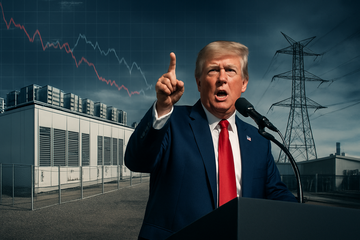
Trump's 'Lower-Taxes-for-Yes-Towns' Data Center Threat Has No New Statute — But EO 14318 and the OBBBA Already Gave Him the Real Levers
President Trump's weekend push to brand data-center-friendly towns as winners and holdouts as 'backwards and poor' is a continuation of an eight-month messaging campaign, not new federal policy — but two statutes already on the books (EO 14318's permitting fast-track and the One Big Beautiful Bill Act's rural opportunity zone expansion) make the threat operationally real. With $725B in hyperscaler 2026 capex now colliding with 399 local moratoriums and $130B of projects already halted in Q1 2026, federal pressure on reluctant municipalities shifts the bottleneck from local politics to federal coordination, with direct read-throughs to colocation REITs Equinix and Digital Realty, hyperscalers like Microsoft, power generators Constellation Energy and Vistra, and infrastructure supplier Vertiv.
Trump's 'Super Intelligence Force' Gives Federal AI Vendors a Phrase for Contracts — Not a New Procurement Map
President Trump's October 4 launch of a Jay Clayton-led Super Intelligence Force gives Palantir, Oracle, and Nvidia a single federal term — 'SI' — they can stamp on existing contracts and task orders, but it does not authorize new budget, new solicitations, or new vendors. The procurement map underneath is the same $90.7B Department of Defense pipeline (98.9% of all 2026 federal AI contract value), the same May 1 Classified Networks AI agreements covering eight vendors, and the same Oracle-led Stargate buildout that already triggered a force-majeure notice in late September. For investors, the takeaway is that the charter resolves regulatory-uncertainty risk for incumbents while leaving the actual spending flows intact — and at Palantir's 144x trailing EV/Sales, that resolution is largely priced in.
2026-10-04

Alibaba Just Sold $10.2B in One Night. The Bill Is Coming for the Rest of Hong Kong's AI Trade.
Hong Kong issuers raised a record $47.5B in Q3 2026 — nearly two-thirds of it from AI-linked deals led by Alibaba's HK$80B placement, Z.AI's $9.6B year and Zhongji Innolight's $6.8B IPO. The marginal buyer has shifted decisively to sovereign wealth and mainland Stock Connect money; Wall Street banks were largely absent from the marquee deals. The spillover into ADR-listed Chinese tech is real but selective — and an 80% aftermarket break rate argues that the easy money has already been made.
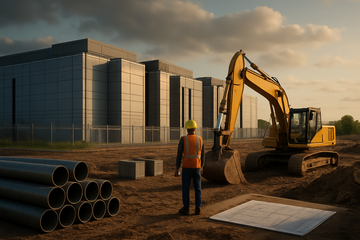
Amazon Drops Data-Center NDAs — Every Permit Just Became a Repricing Event
On October 2, 2026, Amazon ended its use of nondisclosure agreements with local governments on data-center projects — the first hyperscaler to publicly concede that concealment is no longer a viable siting strategy. The concession arrives as community opposition has stalled an estimated $170 billion of US data-center projects across 44 states, and the House Judiciary Committee has opened an investigation into the practice. For the data-center supply chain — utilities, REITs, power-equipment makers, and builders — every project now has to be priced with transparency as the baseline, tilting the siting map away from moratorium-heavy states and toward community-engaged ones. Microsoft, Alphabet, and Meta face the same repricing math; the question is whether they follow Amazon or fight the Raskin probe.

Credo's 8% rally on a 29K-payroll miss is the AI capex trade's loudest 'no-landing' vote
On Friday, Credo Technology jumped 8.1% intraday after the September BLS print missed by ~60K jobs and pushed the implied probability of another Fed hike in October down 43.7 points. The market is voting that AI infrastructure has decoupled from the labor cycle: hyperscaler capex is structural, not cyclical, and a stalled macro will pull forward rate cuts rather than derail spending. We unpack the mechanism, Credo's specific leverage, and what the read-through means for Nvidia, Broadcom, Marvell and the hyperscalers underwriting the buildout.

The 130-Basis-Point Gap: El-Erian's 'Important Reminder' and the Long End That's Already Stopped Listening
Mohamed El-Erian's Saturday warning that the Fed can't fix the fiscal-and-affordability crisis alone landed as the 10-year hit 5.28% and the 30-year 5.61% — leaving a roughly 130-basis-point spread over the new 3.75%-4.00% funds rate that's only widened since Chair Kevin Warsh's hawkish September debut. This is not a rate-path call; it is a credibility test. The bond market is pricing something the central bank cannot reach, banks and asset managers ride the curve higher, and bond-proxy sectors and rate-sensitive real economy pay the bill.

Goldman's 2026 Survey Just Killed the 'Affluent Resilience' Trade
Goldman Sachs' 2026 Retirement Survey shows consumer cash-flow tightness is U-shaped: 42% of sub-$100K earners and 36% of $300K+ earners live paycheck-to-paycheck, against only 23% in the $100K–$300K sweet spot. The high-income consumer is now structurally stretched, which turns the premium-discretionary thesis into a top-line risk and pushes investable exposure toward credit facilitators and accessible-luxury rather than $5K-handbag crests.

Operation Unified Resolve Puts $1.5B of Border-Tech Spending on a Cartel Firefight — And Markets Are Still Pricing the Wall, Not the Software
The Pentagon's October 2, 2026 'Operation Unified Resolve' into the Rio Grande Valley is the trigger that converts a quiet, year-long troop buildout into an investable event: a cartel firefight on the river, a high-energy laser already knocking down cartel drones, and ~10,000 US troops on the line now overlap with $1.5B of DHS counter-UAS work, $363M of Anduril sentry towers, $370M of Elbit border surveillance, and a stalled USMCA review that has the peso sliding7.3% in a month. The winners are not the wall-builders — they are the sensor, helicopter, and rail-logistics names that touch every mile of the corridor.

The 100% Pharma Tariff Has a Back Door — 26 Companies Already Walked Through
Bayer's Oct. 2 announcement of a $2.2B Ohio plant was the loudest response to Trump's April 2026 patented-drug tariff — but the quieter story is the 26-company Most-Favored-Nation bloc covering 89% of the branded market, which has suspended the duty through January 2029. The wall is real for everyone else, and the second-order winners are the Indian and Chinese API producers, the Big 3 U.S. distributors, and the PBMs sitting between manufacturers and patients.
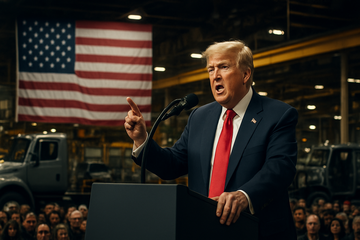
Build Here or Pay 300%: Trump's 18-Month Ultimatum Tests Korea's $350B Pledge
At an Oct. 3 rally in Vandalia, Ohio, Donald Trump escalated industrial policy from Section 301 rate hikes to a build-or-leave demand: roughly 18 months to break ground on a US plant, or face tariffs of 150–300%. With Korea's $350B commitment already on the books and Honda's $2.5B Ohio hybrid plant plus Bayer AG's $2.2B New Albany announcement two days earlier, the bar is set — and the asymmetry between insiders and holdouts is now the trade.
2026-10-03

California's Robo-Boss Ban Just Made AI-HR Compliance a P&L Line for Workday, ADP, and HireVue
Newsom signed SB 947 on Sept. 30 — the first U.S. law forcing employers to put a human in the loop on any AI-driven firing or discipline decision. For Workday, sitting in the crosshairs of Mobley v. Workday and chasing ~$600M in AI ARR, the law turns 'AI automates your workforce' into 'AI advises a human who signs.' That compression of the AI pricing premium — plus vicarious liability already pinned on AI vendors — is the read-through missing from coverage that treats this as just another privacy bill.
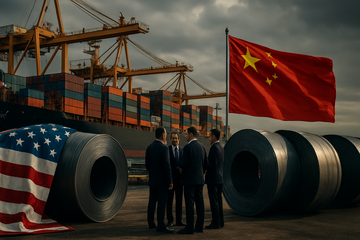
The 'Handful' of G20 Holdouts That Just Vetoed America's Industrial-Capacity Frame — and Why China's Deflation Exports Are Still Outrunning Tariffs
On Oct. 2, 2026, a 'handful' of G20 trade ministers refused to back the US push to label Chinese overcapacity a coordinated crisis, leaving Washington's tariff-led playbook without the diplomatic allies it needs to work. Apollo's 'China Shock 2.0' thesis — August Chinese exports at $401B and a $119B surplus — now has quiet diplomatic air cover, meaning the deflation wave hits US steel, autos, and solar for longer than the tariff math assumes. Investors should treat the G20 veto as a structural moat for BYD and CATL and an extended headwind for Nucor, Tesla, Cleveland-Cliffs, Ford and the tariff-protected steel trio.

The 100M-Barrel G7 Diesel Dump Ends the Refiner Trade — and Trump Pulled the Trigger
G7 leaders agreed Friday to release 100 million barrels of crude and diesel over four months — frontloading the diesel component inside 20 days — after Washington threatened a US diesel export ban. The headline number is modest (~830K bpd), but the signal is what kills 2026's best equity trade: US pure-play refiners are up 80–140% YTD on diesel cracks above $100/bbl, and the same government that let those cracks blow out just coordinated the supply that closes them. Refining margins set to compress from triple-digit records to historical norms of $30–40/bbl. The US Strategic Petroleum Reserve, meanwhile, sits at a 44-year low — meaning this is a one-shot policy tool that cannot be repeated.
The 'Peak Fear' Trade Is Loaded Against Itself: Vol-Control at the 98th Percentile, the 10-Year at a 24-Year High
CNBC's lead headline asks whether the panic is over. The positioning data says the opposite: vol-control funds sit at a 98th-percentile equity allocation since 2010, the 10-year yield has just hit 5.28% — a 24-year high — and the ACM term premium has re-priced above 1% even as the S&P 500 closed at 7,666 and the VIX reads just 16. The asymmetry now runs roughly 4-to-1 against equity bulls: even a mild volatility pick-up would force more than $100B of systematic selling, while upside vol-control buying is capped near $25B. This is not a market past peak fear. It is a market at peak consensus.

Nike Crosses From Cost Cuts to Labor Cuts — The Tariff-Refund Turnaround Is Over
On October 1, Nike unveiled the four-year 'Pace' restructuring — a $2.5B cost program that will trigger another round of corporate headcount cuts starting in 2027 — and reported Q1 FY2027 revenue of $11.21B (down 4% reported, 5% currency-neutral), with full-year adjusted EPS guidance of $1.15-$1.35 sitting more than $0.30 below consensus. Greater China revenue fell 26% currency-neutral as Nike exits its 'Win Now' margin story and re-platforms to three geographies plus a Bengaluru campus, a sequence that, by management's own admission, requires restructuring charges and labor to offset demand erosion. The stock fell to a 13-year low of ~$33.80 — down roughly 80% from its 2021 peak — pricing in the collapse, with read-throughs already visible at Vietnam/Taiwan footwear suppliers and across the discount-tier sportswear complex.

$90 Hits Only Half of Medicare: Why the Slush Fund, Not the Trust Fund, Is the Real Story
President Trump's one-time $90 rebate to roughly 20.8 million Original Medicare Part B enrollees — paid from a dormant $2 billion Medicare Improvement Fund on Oct. 8 — is a $1.87 billion cash transfer, not the recurring $22 billion shock the early headlines implied. By excluding Medicare Advantage members, dual-eligibles, and IRMAA payers, the carve-out sharpens the competitive pressure on UnitedHealth Group, Humana, and CVS Health heading into the annual enrollment period, while signaling a precedent for tapping never-used mandatory accounts that matters more than the check itself.
$350B Korea Deal Splinters: Trump's $8.4B Alaska Oil-Recovery Claim Is Now the Loudest Number Nobody at the Table Has Confirmed
On Oct 2, 2026, Trump tacked an $8.4 billion Alaska enhanced-oil-recovery project onto the US-Korea trade framework via Truth Social — three days after a $54 billion Alaska LNG headline that Seoul also publicly disowned. Korea's industry ministry says both numbers 'go far beyond what was agreed' in the Nov 13, 2025 joint fact sheet, leaving investors to separate the confirmed $350B backbone (nuclear, Texas power, shipbuilding, Boeing) from the aspirational add-ons that the Alaska LNG economics can't yet underwrite.
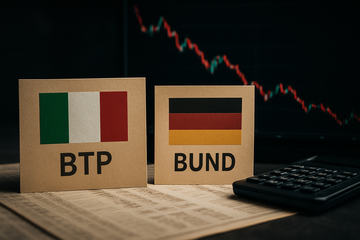
UBS just turned bearish on Italian BTPs vs Bunds — and the trade sits next to its 8,100 S&P call without contradicting it
On Oct 2, 2026, UBS's head of European rates strategy opened a fresh short in 10-year Italian government bonds against 10-year German Bunds, betting the BTP-Bund spread — already at ~127 bps — keeps widening as the global bond rout migrates from France to Italy. The same house still carries an 8,100 year-end target on the S&P 500 and a $3 billion buyback of its own stock. The two views are consistent: UBS expects long yields to stay higher, equity earnings to absorb the rate drag, and European sovereign dispersion to do the painful work instead.
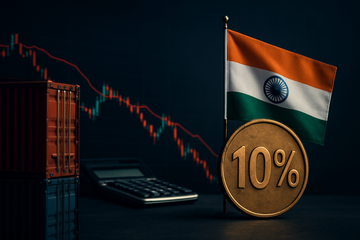
Greer Says India Deal 'Not Imminent' — But an Oct. 18 Tariff Trigger Is Now in Play
USTR Greer's 'not imminent' walk-back after the Modi-Trump call leaves Indian-exposed stocks stuck between a stalled deal and a fresh statutory trigger — the Sanctioning Russia and Iran Act, signed Sept. 18, gives the President until mid-October to impose up to 100% tariffs on India. Pharma stays largely protected by Section 232 generic exemptions and a Sept. 28 specialty-drug waiver, but the February framework that cut duties to 18% lost its legal footing when the Supreme Court struck down IEEPA the same month. For Infosys, Wipro, Dr. Reddy's and the IT majors still priced for a deal, the right read is the stalemate — not the framework.
2026-10-02

What to expect
Evidence-first notes with a visible point of view.
This section collects sharp takes on earnings, shareholder meetings, and market structure. Each new piece should make the thesis, the facts, and the implications obvious within the first few screens.
Expect direct analysis, not generic commentary.
Expect the data to be explicit and the argument to be easy to follow.