Policy & Trade
Tariffs, export controls, and who absorbs them
Rulings, sanctions and trade negotiations traced to the companies that pay for them — margin by margin, route by route.
2026-11-01


FHFA Cut Its Own Watchdog by 80% — and the Capital Rules That Price Mortgage Credit Still Have No Date
The FHFA's own inspector general says, in a report covered by Reuters on Oct 30, 2026, that the agency refused to provide records during at least three congressionally mandated oversight reviews, calling the obstruction \"unprecedented\"; FHFA says it completed 56 document requests and held 16 hour-long meetings, and disputes the findings. The regulator that sets GSE capital floors, approves their counterparties and administers Ginnie Mae has had roughly 80% of its watchdog staff cut, and by its own account can no longer develop the evidence needed to prosecute multifamily fraud. That matters because the rule that actually prices mortgage credit has no date: the Mar 19, 2026 capital proposals closed comments on Jun 18, 2026 with no implementation timeline, while FHFA's own 2025 Report to Congress says both Enterprises fail the minimums it set. The trade is in the fee pools an unsupervised regulator re-prices — private mortgage insurance such as MGIC Investment and NMI Holdings, nonbank origination franchises, and the score toll — not in the mortgage rate, and PulteGroup sits on both sides of the table because its founder runs FHFA.

Ford's 200-Plus 3D Printers Buy Lead Time, Not Steel Savings: Why $1,270-a-Ton Coil Is the Wrong Trade
Additive manufacturing has quietly become a Detroit operating variable: Ford runs more than 200 machines with 3D labs headed to more than 23 plants, and Rivian has spent over $5 million on hardware that pays for itself inside a year. The arithmetic underneath is a fixed-cost and lead-time story, not a bill-of-materials one — at Rivian, an implied $5 million-plus annual benefit equals roughly $73 a vehicle against an automotive gross loss of $80 million on 19,248 Q3 deliveries, about $4,157 a car. Steel at $1,270 a short ton, up from $1,255 two weeks earlier, makes stamping economics worse and steel lead times longer, which raises the value of printed jigs and fixtures; it does not make printed vehicle parts cheaper, and it does not repair an OEM's margin. So the exposure worth owning sits one link up the chain — Stratasys at the printer and powder toll booth, Nucor in the material cycle — while per-vehicle cost improvement at the assembly plant stays unproven.
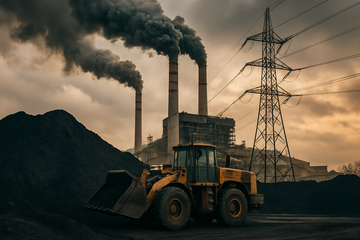
India's Coal Burn Is Back at a Three-Year High — and Almost None of It Is Imported Coal
India's coal-fired generation rose 13.3% year on year in September 2026 and the power deficit hit 560 million kWh, the largest since August 2023, yet the coal was domestic: the government is cutting power-sector thermal coal imports by at least 15 Mt this year while national output heads for a record 1,095 Mt. That matters for the sovereign-compute build-out, because the 26.3 GW of data-centre load India has projected for 2031-32 will be served by coal plants running on three days of fuel and by gas at a tripled $33/MMBtu benchmark, not by clean firm power. The money sits in power equipment, turbines, cooling and compute — not in the seaborne coal trade the headlines imply.

Korea's $115 Billion October Was Already Contracted: The AI Selloff Is Pricing Funding, Customs Is Pricing Shipments
Korea's October trade data, published Sunday, showed exports up 93.7% to $115.28 billion with semiconductor exports up 259.4% to $56.44 billion — half of everything the country ships — and a $42.50 billion surplus, two days after the AI cash-burn selloff took the Nasdaq down 2.86% and SK hynix down 7.1%. The two facts are compatible: the selloff repriced the financing of AI capital spending, while customs data records money already spent on memory that has already shipped. Most of the export growth was price rather than volume, so the honest signal is the level — $115 billion a month, $930 billion in ten months — not the growth rate. And the demand behind it is largely pre-sold and pre-funded: more than 50% of SK hynix's 2027–28 capacity is already under long-term agreement, and Micron holds $32 billion of customer cash deposits. The real risk is not a demand collapse but concentration: semiconductors are now half of Korean exports, and the buyers are funding themselves with debt.

Meta's Humanoid Runs on a Chinese Bill of Materials — and the US Robot Firewall Only Reaches the Robot
Meta built a working humanoid with Shanghai-based Fourier Intelligence in roughly three months, Reuters reported on Oct 31, 2026, three months after Washington barred foreign-produced humanoids from new US market access — but the FCC's rule is written on place of production, so it covers the finished robot and leaves the Chinese joints inside it untouched. The practical result is a demand shift, not a decoupling: Chinese reducer and actuator makers keep shipping into US assembly lines, Chinese finished-robot brands lose the US channel, and the margin gap shows up in the numbers, from Leaderdrive's roughly 22% net margin to Harmonic Drive Systems' 4.3% operating margin. The investable conclusion is upstream: own the joints and the compute, not the robot.

Iran Cleared the Cargo, Then Hit the Ship: Hormuz's Premium Has Moved From Barrels to Permission
On October 30, 2026 the LNG carrier Al Mayeda — owned by Qatar Gas Transport Company, flagged in the Marshall Islands, loaded with Qatari gas for Pakistan — was cleared by Iran to enter the Strait of Hormuz and struck by unidentified objects hours later. The episode exposes a feature of the blockade that crude traders have priced and molecule traders have not: Tehran's clearance is permission, not protection, so a second layer of risk now sits on the cargo itself. That layer prices at the origin rather than in the freight, with Asian spot LNG at $30.50/MMBtu against record-low Atlantic LNG carrier rates. The trade is origin arbitrage, and it pays Cheniere and Venture Global rather than the tanker owners.

Bessent Blesses the Hike While Treasury Buys Back the Long End: The Curve, Not the Rate, Is the Trade
Treasury Secretary Scott Bessent's Oct. 28 comment that further Fed hikes would be \"not necessarily\" a policy mistake, followed by St. Louis Fed President Alberto Musalem's Oct. 30 call for additional firming \"and soon,\" puts the executive branch behind a December rate increase. The real change is not the 25 basis points but the division of labor it creates: the Fed raises the front end to defend 2% inflation while Treasury, running a $1.99 trillion deficit with more than $1 trillion of interest outlays, buys back 10- to 30-year paper to cap the long end. That pairing steepens the curve on purpose — lifting bank net interest income while raising the discount rate and the coupon on an AI buildout being financed with $300 billion to $570 billion of new debt.

A $10 Billion Libel Case Just Died With Prejudice. Publishers' Live Risk Now Runs Through the FCC, Not the Courtroom
A federal judge in Miami dismissed President Trump's $10 billion defamation suit against The Wall Street Journal, News Corp and Rupert Murdoch with prejudice on Oct. 31, 2026, holding the president had not proved actual malice, so the case cannot be refiled. The damages channel is closed; the administrative one is wide open — the FCC has pulled eight Disney-owned ABC stations into early licence renewals with no published timetable, and its ownership approvals now carry explicit editorial-independence conditions after it blessed state-linked foreign owners of the merged Paramount Skydance–Warner Bros. Discovery. Meanwhile the money is moving the other way: broadcast owners are absorbing a record $5.6 billion of political inventory money while the demand-side software layer that used to carry those budgets has lost roughly two thirds of its enterprise value on flat earnings. For media investors, the variable that matters into 2027 is no longer whether a publisher can win a libel fight, but whether a regulator grants the licence, the merger and the advertising dollars.
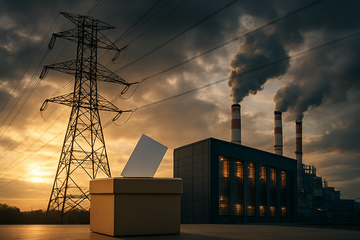
The Ballot Won't Cancel the Build — It Will Decide Who Pays: Georgia Power's $16.3 Billion Test Case Before Nov. 3
Utilities are no longer asking regulators for permission to build for AI; after Nov. 3 they will be asking voters. The cost of that shift is not slower construction but a political cap on who pays for it: 25 states now have an approved large-load tariff, and Virginia's commission just cut Dominion Energy's residential transmission charge by two-thirds by assigning the cost to the data centers that caused it. The result is a barbell — utilities holding binding, collateralized data-center contracts grow rate base without a rate fight, utilities without that book absorb the heat, and the equipment layer, led by GE Vernova at a 116 GW gas-turbine backlog, is insulated from the vote entirely.

Veralto's Water Quarter Priced AI's Second Constraint — and the Trade Is Permitting, Not Scarcity
Veralto has published the sharpest listed-company evidence yet that the AI buildout's second constraint is being paid for. In the quarter ended Oct. 2, 2026, Water Quality core sales rose 6.4% with double-digit growth in water treatment solutions, North America grew 8.8%, and data center sales doubled off a small base — while China and Latin America contracted. That split is the argument: the company is growing where new permits force operators to monitor, treat and report water, and shrinking where water is scarce but nobody has to prove it. The order book is real — Xylem logged data center orders up more than 200% — yet data centers are on track to be just 2% of Xylem's revenue and an undisclosed sliver at Veralto, so this is an option on permitting rules, best expressed through recurring industrial water revenue rather than municipal metering or data center capex.
2026-10-31

Big Tech's Buyback Floor Vanished — and the AI Trade Became a Funding Trade
The five largest U.S. AI spenders returned 9.3% of operating cash flow to shareholders in the first nine months of 2026 — the smallest share in at least 15 years, against 27.4% a year earlier — and the group is now a net seller of its own stock. Buybacks collapsed 83% to $13.6 billion while capital spending roughly doubled to $556.9 billion, flipping combined free cash flow to a $14 billion deficit. The money did not disappear; it moved into data centers and onto the bond ledger, where Microsoft priced its first U.S. investment-grade issue since 2017 on October 29 with share repurchases listed among the intended uses. The consequence for investors is that AI exposure now prices off funding cost rather than end demand, which is why October's drawdowns arrived without a broad guidance cut.

China's Record 22% Auto Collapse Is a Subsidy-Formula Failure — and 8.2 Million Exports Now Set the Floor Under US Prices
China's passenger-vehicle market is on course for its worst year ever: the China Passenger Car Association now forecasts 18.5 million units in 2026, down 22%, below even the 19.29 million trough of 2020. The cause is policy arithmetic — the 2026 trade-in subsidy pays a percentage of the car's price under an unchanged cap, so the buyer of a RMB 70,000 car collects RMB 8,400 where the old fixed rule paid RMB 20,000, and new-energy purchase-tax relief was halved on January 1 after pulling 2025 demand forward. Capacity with no home is going overseas, with 8.21 million vehicles shipped in nine months, up 65.8%, which flattens prices in third markets and queues Chinese plants in Mexico and Canada. BYD and Geely Automobile are converting that into record export earnings, while SAIC Motor, General Motors, Ford and Tesla carry the cost of the adjustment.

A 10% Credit Card Cap Cuts About a Third of $146B in Issuer Card Revenue — and It Lands in 2028, Not 2027
Credit card rates have become the rare affordability issue both parties can name, and the 10% cap bill in Congress would remove 55 cents of every dollar of interest earned on a card book priced at 22.36% — on our arithmetic roughly $48 billion a year, about a third of the $146 billion major issuers collect from cards. The damage is asymmetric in time: the price reset only lands as balances reprice, so November is a political-premium event while the earnings hit is a 2028–2029 event. It lands hardest on Synchrony Financial and Bread Financial, whose entire earnings base is a spread on card balances, and barely touches JPMorgan Chase, where half of revenue comes from non-interest sources. With prediction markets pricing a 2026 cap at roughly 4%, the setup is relative rather than directional: underweight the single-sector card lenders into the vote, own the scale shelters, and wait for the repricing wave rather than the campaign.

China's Carriers Barely Feel the FCC's Numbering Cut — $16 Billion of US Fraud Losses Sit on the Other Side of It
On November 19 the FCC votes on an order that can deny US telephone numbers to Chinese state carriers without ever naming them: one new certification asks whether an applicant has ever had its Section 214 authority denied or revoked on national-security grounds, and China Mobile, China Telecom and China Unicom have all been through that door. The direct earnings cost is trivial — the three carriers generated RMB 1.97tn of FY2025 revenue and their combined disclosed international revenue is about 2.5% of that — but the line being capped is the fastest-growing one they have: international revenue rose 28.5% at China Mobile and 14.1% at China Telecom in 2025. Meanwhile Americans reported roughly $16bn of fraud losses to the Federal Trade Commission in 2025, and the cheapest input into a US scam campaign is a phone number nobody can trace.
Four Labs Just Made Publisher Consent a Single Bit — and Left the Price to Someone Else
On October 30, 2026, OpenAI, Anthropic, Alphabet and Microsoft each said they will honor one robots.txt policy token — __usage_ai-training — drafted as an individual IETF Internet-Draft by Anthropic's Kevin Kelley. The bit replaces years of per-crawler rule-writing with one machine-readable switch, and it hands the enforcement point to the network edge, where AI training already accounts for 52% of crawler requests and where Cloudflare can bill for every fetch. But the draft has no fee mechanism and lets private agreements override the file, so the token prices nothing: what it does is make the right to withhold training credible across four buyers at once, which lifts the floor under publisher licensing fees and leaves collection to the networks. The investable read is a chain repricing — content owners gain a credible veto, the edge gains the toll booth, and publishers who rely on litigation lose the leverage standardization is quietly replacing.
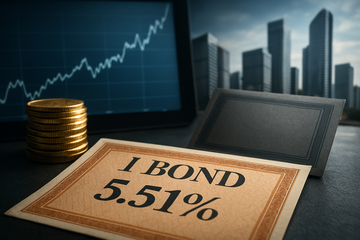
I-Bonds at 5.51% Just Raised the Household's Risk-Free Bar — and the AI Buildout Answered With $228 Billion of Bonds
Treasury's Oct. 30, 2026 announcement set the Series I composite rate at 5.51% for purchases from Nov. 1, 2026 through Apr. 30, 2027 — a 1.40% rate locked in real terms for two decades plus a CPI adjustment, with no mark-to-market and no state or local tax on the interest. That guarantee now sits above the trailing cash yield of most of the AI capital-spending chain: Microsoft, Alphabet, Amazon and Meta Platforms turned $615 billion of trailing capex into $61 billion of trailing free cash flow. The buildout did not slow; it changed sponsors, with Alphabet, Amazon, Meta Platforms and Oracle issuing more than $228 billion of bonds through Oct. 13 — so the marginal risk in the AI trade now sits in credit priced off a 4.98% risk-free rate, not in household equity demand.

New York Halved Its Budget Gap on Wall Street Money — and Its Tax Base Is Now Levered to the AI Trade
New York's Division of the Budget used a record Wall Street year to project roughly $9 billion of surplus for the fiscal year ending March 2027 and cut the state's three-year General Fund gap from $31.7 billion to $17.6 billion. The receipts behind that swing are concentrated: the securities industry generated an estimated $26.3 billion of New York State tax in State Fiscal Year 2025-26, 20.8% of all state tax collections and 88.3% of it personal income tax funded by bonuses and realized gains. That makes the state's balance sheet a derivative of the same equity cycle that pays Wall Street, and the New York City Comptroller's own scenarios show the downside arriving as a $3.4 billion city revenue hit in a single year. Read the update as a cyclical windfall being banked, not a structural fix: the gap re-widens to $8.9 billion by fiscal 2030, and the listed exposure runs from Goldman Sachs and Morgan Stanley through the volume tolls at Intercontinental Exchange and Nasdaq to M&T Bank and SL Green Realty.

A $2.1 Billion Patriot Sale Buys a Place in Line, Not Missiles — Lockheed Martin Controls the Queue
The State Department approved 500 Patriot PAC-3 MSE interceptors for Ukraine on Oct. 30, 2026 at an estimated $2.1 billion, but published no delivery schedule, and two people briefed on the decision said the rounds are not expected until the early 2030s. Money is not the binding constraint; the sole final-assembly line in Camden, Arkansas is, where Lockheed Martin is scaling output from about 600 to 2,000 interceptors a year by the end of 2030 against a European backlog above 4,300 rounds. Ukraine's order is worth 3.6% of the $58.62 billion multiyear award and buys roughly three months of the target rate, so the real trade is who owns the queue position and who converts it into margin: a flat 14.0% Missiles and Fire Control margin for the prime,190 basis points of expansion at RTX, and volume without a fixed price for upstream suppliers Boeing and L3Harris.
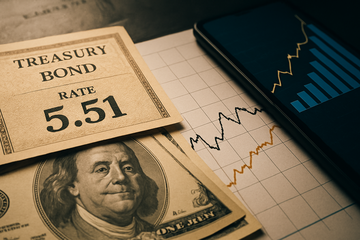
The 5.51% I-Bond Beats the 4.94% 10-Year — and Vanishes in Real Terms
Treasury's Oct. 30 reset hands savers a 5.51% inflation-linked, tax-deferred yield while the 10-year note yields 4.94%, and the headline inversion dissolves once you convert to real terms: the bond's guaranteed 1.40% fixed rate sits 152 basis points below the 2.92% real yield the market demands on 10-year TIPS. What actually survives is the tax treatment — roughly 45 basis points at a 22% federal bracket, closer to 70 for a top-bracket saver in a state that taxes interest — plus a new anchor for deposit pricing. This is not a repricing of federal funding: savings bonds are 0.5% of debt held by the public and each saver can buy only $10,000 a year. The investable consequence is which balance sheets absorb the squeeze: deposit-funded lenders and money-fund sponsors on one side, core-deposit banks and inflation-protected fund vehicles on the other.

Uber Bought a Tokenized Money Fund on Thursday and Sold It on Sunday: Tokenization's Distribution Channel Is a Treasury Desk, Not a Consumer App
On October 30, 2026, Uber completed a corporate treasury pilot in which it funded a Franklin Templeton tokenized money market fund with HSBC tokenized deposits, executed on Tradeweb and settled delivery-versus-payment on the Canton Network by Fireblocks — buying on a Thursday and redeeming on a Sunday for roughly 1.5 extra days of yield. No consumer product was announced and no rider or driver was involved, so the distribution channel on display is the corporate treasurer, and the economics accrue to the fund manager, the venue and the deposit issuer rather than to any app. The arithmetic says why the pilot matters for reasons other than yield: at full deployment the weekend prize is about $43 million a year, roughly 0.45% of Uber's trailing net income. The investable read-through is that tokenized cash is a wholesale distribution business, and the take-rate risk sits in tokenized equities, where the SEC handed trading platforms a five-year exemption on September 17, 2026.
What to expect
Evidence-first notes with a visible point of view.
This section collects sharp takes on earnings, shareholder meetings, and market structure. Each new piece should make the thesis, the facts, and the implications obvious within the first few screens.
Expect direct analysis, not generic commentary.
Expect the data to be explicit and the argument to be easy to follow.