Semiconductors
Chips, from the fab floor to the income statement
Foundry capacity, HBM supply, packaging bottlenecks and export rules — traced through to the companies whose quarters they decide.
2026-10-30

2026-10-29
Intel's 17% After-Hours Drop Is a Memory-Cost Story: Half of Revenue Sits in the Segment the AI Build Is Shrinking
Intel beat its Q3 2026 numbers and then guided Q4 revenue to $15.0–16.0 billion, 9% below the $17.1 billion consensus, sending the stock down as much as 17% in extended trading. The guide-down is a client-PC story, not a foundry story: DRAM costs surged fivefold year on year in the second quarter, global PC shipments fell 22.4% in the September quarter, and HP had to lift Personal Systems pricing 40.8% to hold revenue while units fell 15.8% — Intel's own client segment survived only by repricing into a collapsing market. The profit pool from the AI build has moved upstream: Micron printed an 86.7% gross margin and SK hynix an 80% operating margin, while Intel carries roughly the same market value to trailing revenue as Micron on a 0.1% trailing operating margin against 74.6%. With management now saying the PC slowdown runs at least through the first half of 2027, the trade is long the memory makers and short on the idea that a foundry narrative can outrun a shrinking client base.
Memory Split in Two: SK hynix's 80% Margin Is an HBM Mix Story, Samsung's Record Profit Is a Volume Story
SK hynix beat the sell-side on Q3 2026 operating profit and rallied 11%, while Samsung printed a larger record profit, missed the higher consensus bar and slid — same shortage, same AI budget, different mix. SK hynix converts a quarter of the DRAM market into half of all HBM, has already locked more than half of 2027-28 capacity under long-term agreements with 14 customers, and is entering2027 with HBM4 pricing fixed; Samsung sells more bits at commodity DRAM prices that are decelerating (contract prices up 10-15% quarter on quarter in 4Q26 against roughly 60% in 2Q26) and is still negotiating its 2027 HBM4 book. The consequence for investors is that memory is no longer one trade: with memory rising from 47% to 68% of cloud capex in 2027, the premium is collected by HBM-weighted suppliers and the HBM4 equipment chain, while server and PC buyers absorb the bill.
Nvidia's Open Speech Model Transcribes Up to 2,238 Hours of Audio Per GPU-Hour — the New Benchmark Every Paid Speech API Must Clear
On October 28, 2026, NVIDIA released Nemotron 3.5 Transcribe, a roughly30-billion-parameter open-weight speech model that transcribes 40 languages, tags up to eight speakers and translates 31 of them for nothing — and on NVIDIA's own serving numbers it turns one GPU-hour of wall clock into 2,238 hours of finished transcript. That arithmetic is the event: it converts a per-minute API bill into a hardware bill, squeezing the margin out of every hosted speech API while pushing demand back toward the silicon NVIDIA sells. NVIDIA's data-center revenue grew 117% year over year to $89.0 billion in the July quarter, and management told investors open-model adoption is skyrocketing — the speech release is the clearest sign yet that AI's profit pool is migrating down the stack.
2026-10-28
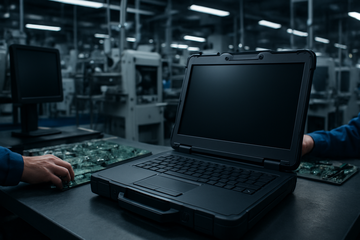
BlueChip's 20% Premium Is a Certification Fee, Not a Markup — and the 8-to-16-Month Audit Trail Is the Real Product
Anduril and Qualcomm unveiled BlueChip on October 27, 2026: a rugged laptop designed and assembled in the US, with circuit board assembly at Anduril's Arsenal-1 plant in Ohio and a Snapdragon X chip built at TSMC's Arizona fabs. It is a prototype — orders open in 2027, pricing is undisclosed, and at any plausible first-year volume the revenue rounds to a fraction of one percent of Qualcomm's. The investable content is the procurement regime the product is built for: the Pentagon's proposed PCB rule turns supply-chain provenance into a certification requirement with an 8-to-16-month lead time, and the FY2026 NDAA puts a January 1, 2030 deadline on adversary-sourced computer displays and optical glass. Provenance, not performance, becomes the moat — and the money sits with the tier-one suppliers who can already hold the certificate, not with the private brand that announced it.
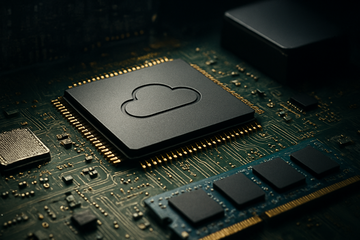
Google Cloud Turned Into a Chip Channel: 20% Margins on Its Own Silicon, 80% at the Memory Suppliers
Alphabet has turned Google Cloud from a place that rents its own silicon into a channel that sells it, with Oracle set to become the first hyperscaler outside Alphabet to offer TPUs from 2027. The economics invert: analysts put operating margin on TPU sales near 20% against a 35.5% segment margin, and Alphabet's own Q2 2026 filing says Cloud product revenue now comes primarily from the sale of TPU systems. The margin is not destroyed — it migrates to the design layer (Broadcom at 69% gross margin, NVIDIA at 75%) and to memory, where SK hynix just printed an 80% operating margin, and it is increasingly paid for by other people's balance sheets, from Broadcom's $63 billion financing vehicle to Alphabet's $811 billion of purchase commitments. The question that matters is no longer who builds the best accelerator, but who ends up holding the asset.

Apple and Nvidia Now Produce 65% of the Magnificent Seven's Free Cash Flow — and That Is Why the Group Stopped Trading as One
Correlation inside the Magnificent Seven has fallen to a decade low, and the usual explanation — that the group is splitting into AI funders and AI monetizers — misses what the filings show. The line deciding 2026 performance is whether a company can fund its AI buildout from its own cash flow: Apple and Nvidia, at roughly 2% of revenue in capital spending, produced $264 billion of trailing free cash flow, nearly double the $137 billion generated by Microsoft, Alphabet, Amazon and Meta combined after $526 billion of capex. That balance-sheet split, not a business-model split, is what broke the group's covariance — and it changes how index concentration and passive-flow risk should be underwritten.

SK hynix Turned Record Profits Into a $25.6B Payday — and the Same Shares Cost 44% More in New York Than in Seoul
Third-quarter operating profit of KRW 83.3 trillion at an 80% margin let SK hynix declare KRW 34 trillion — about $25.6 billion — of dividends and buybacks in a single board meeting, inside a roughly KRW 100 trillion FY2026 return target that is funded by cash generation rather than borrowing. The tension sits in the venue: ten ADRs equal one Seoul share, and at the Oct 27 Nasdaq close the American line priced the identical equity about 44% above the Oct 28 Seoul close, because Korean rules cap new ADR creation at roughly 2.5% of the share register and block the arbitrage that would close it. For investors the question is no longer whether AI memory converts into cash but which line they pay that cash in — and whether a 44% scarcity premium survives a payout cycle.
2026-10-27
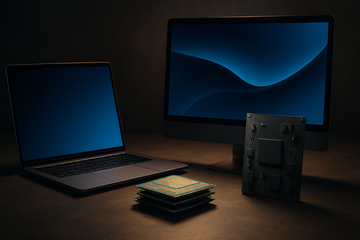
Apple just locked in a pricing test: the M6 MacBook Pro starts at $1,999 with 16GB unified memory as Apple warns DRAM/NAND shortages will pressure costs
Apple’s M6 MacBook Pro refresh and the new M6 iMac put faster “on-device AI” performance front and center, but the real squeeze sits in the bill of materials: 16GB unified memory is now the entry point and can scale to 32GB at a $1,999 starting price. In parallel, Apple’s latest Form 10-Q flags “supply constraints and increasing costs” for components including DRAM and NAND—making this cycle less about benchmarks and more about how much memory cost Apple can pass through without demand breaking.
Nvidia Just Funded Software That Uses Fewer GPUs. India's 45,000-GPU Pool Ran at ~2% Utilization — Which Makes It a Demand Play, Not a Hedge
Nvidia's participation in Simplismart's $14 million Series B — the Bengaluru startup whose software runs AI models on fewer GPUs — is roughly 0.02% of one quarter of Nvidia's data center revenue, so it cannot hedge anything on its own. What it reveals is that inference efficiency has become a layer worth funding, and that Nvidia's own Dynamo 1.0 already claims up to 7x better inference performance on Blackwell silicon. Meanwhile India's subsidised compute pool counted more than 45,000 GPUs by June 2026 but drew down only 9.32 million GPU-hours by August — roughly 2% to 11% of theoretical capacity — so the binding constraint on AI compute has shifted from silicon to software. The consequence for investors is one unpriced variable: GPU units needed per unit of end demand.
2026-10-26
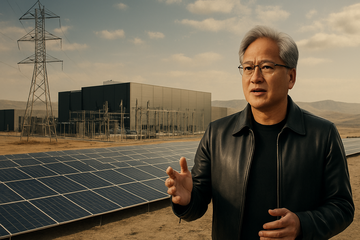
Huang's Kazakhstan Trip Priced AI in Watts, Not Chips: At 2.5 Cents per kWh, the Bottleneck Moves to the Grid
On October 23, 2026 Jensen Huang made his first visit to Kazakhstan, and the announcements that mattered were about electricity and export licenses rather than chip orders: 300 megawatts already allocated at Data Center Valley in Ekibastuz, a proposed long-term tariff of about 2.5 US cents per kilowatt-hour for data-centre investors, and a US export license for 45,000 Grace Blackwell GPUs to Firebird. Read together, they reframe the AI trade — the scarce input is not demand but an energized, permitted megawatt, and NVIDIA's own filing shows the squeeze arriving as purchase obligations and inventory provisions. The metals leg is thinner than the headlines imply: S&P Global Market Intelligence has data-centre copper demand rising only from 1.1 million tonnes in 2025 to 2.5 million tonnes by 2040, with fibre substitution removing another 4-5 tonnes per megawatt. The tradeable exposure therefore sits in grid and power equipment (Vertiv, Q2 2026 sales up 24%), fuel and firm power (Cameco at US$67.79 per pound realized uranium), and the vendors of both (NVIDIA, $89.0 billion of data-centre revenue in Q2 FY2027).

Intel's $3.5 Billion Pentagon Anchor Became 433 Million Shares — and Still Zero Named Production Orders
The Pentagon's headline chip award for Intel never contained a wafer order. What the Defense Department actually awarded on Sept. 16, 2024 was up to $3.0 billion in CHIPS Act funding for a trusted-manufacturing program, and $3.17 billion of that money was converted into 433.3 million Intel shares at $20.47 when Washington took a 9.9% stake in August 2025. When the RAMP-C prototyping program closed on July 28, 2026, Intel named no customer, product or wafer volume. Federal support for the foundry has arrived as prototypes and equity instead of orders, while Intel Foundry grew revenue 31% to $5.77 billion in Q2 2026 while losing $2.09 billion at the operating line — which makes the Oct. 29, 2026 results the first real test of whether external 18A volume is ever disclosed.
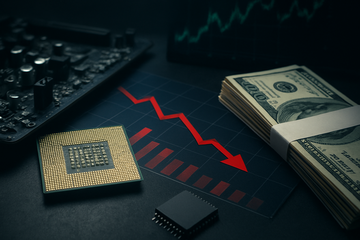
Morgan Stanley mapped a 15% chip drawdown — from inside the bank that helps finance the buyers
On Oct. 26, 2026, Morgan Stanley chief U.S. equity strategist Mike Wilson told clients that semiconductor shares may not find support until 15% below current levels — published on a session when chip ETFs rose nearly 3% and Nvidia added 2.5%. The tension is structural: the same house is a committed funder in the record $60 billion Broadcom–Anthropic chip-financing package, and Nvidia's own Aug. 10 release now markets compute as "an investable asset," so chip equities set the price of the collateral that supports a wave of AI debt Morgan Stanley itself forecasts near $570 billion in 2026. Wilson's framework is therefore a credit input, not a chart level, and both halves of the call — a 15% chip drawdown and a continuing AI-debt boom — can be true at the same time.
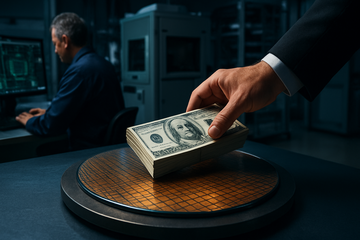
NVIDIA's $1.1 Billion Test Prepayment Puts the AI Buildout on Its Suppliers' Balance Sheets
NVIDIA has stopped letting its back-end vendors finance the AI buildout themselves. On October 21, 2026 it prepaid $1.1 billion to King Yuan Electronics to reserve U.S. chip-test capacity, alongside a multibillion-dollar advance to IBIDEN, a $1.3 billion agreement with Amkor Technology and co-investment with Samsung Electro-Mechanics — all six of its capacity partners are now building with customer money. The structure matters more than the size: NVIDIA's supply and capacity commitments jumped from $119 billion to $279 billion in a single quarter while its own capital spending stayed at 2.4% of revenue, so the fixed assets — and the free cash flow — have migrated onto vendor balance sheets that now spend 25% to 74% of sales on capacity. The durable profit is moving with the owners of scarce capacity: Amkor Technology with $3 billion of NVIDIA agreements, ASE Technology Holding whose packaging unit is scaling optical engines 15x, and upstream at Advantest and Teradyne, whose tool revenue is growing faster than the chips they test.
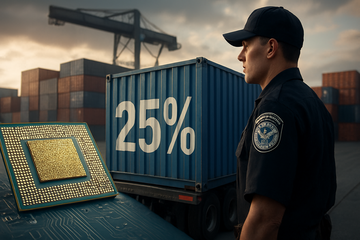
The Semiconductor Tariff Starts at Customs, but Its Real Cost Lands Further Down the Stack
A 25% Section 232 duty begins applying to a narrow set of semiconductor imports on October 26, 2026. The immediate exposure is concentrated in imported chips and chip-containing products, but the larger investment question is bargaining power: foundries and memory suppliers can often pass through the charge, while accelerator designers and hyperscalers face a higher bill of materials before customers see a price increase.
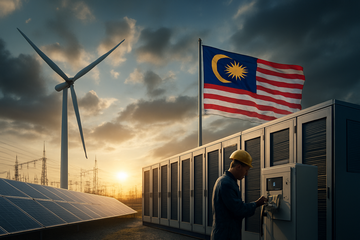
SoftBank's $50 Billion Malaysia Bet Lands on Turbines and Bonding Tools First — and It Bypasses the Credit Stress Now Choking US AI Capex
Malaysia's prime minister said on October 24, 2026 that SoftBank Group will put $50 billion into Malaysian AI, new technology and data centres — a number SoftBank Group has not confirmed in its own disclosures, and the only signed Malaysian document is an October 8 framework agreement with Grab and state oil-and-gas company PETROS that carries no megawatts and no schedule. Sized against the US cycle it is small: J.P. Morgan puts 2026 hyperscaler capex at $697 billion, and Goldman Sachs estimates roughly a third of AI capex is now debt-financed with new-issue concessions on large hyperscaler deals widening to about 20 basis points from 2-3. Malaysia's wave is funded by sovereign and strategic capital rather than that credit market, so it extends the equipment cycle rather than cannibalizing it. And because Malaysia's binding constraints are 9 GW of missing gas-fired capacity by 2032 plus export permits for advanced AI chips, the money lands first on power and cooling gear and on advanced packaging, not on accelerators.
Tower Semiconductor Jumped 9.9% on a Deal Signed Two Weeks Ago — and Still Trades 42% Below Its High
Tower Semiconductor rose 9.9% on October 26 with no new company disclosure, as the market re-marked a capacity contract signed on October 13 in which Semtech reserved dedicated silicon germanium capacity across Tower's American, Israeli and Japanese fabs for 800G, 1.6T and 3.2T AI links. The deeper story is that Tower has already sold 2027: $1.3 billion of contracted silicon photonics revenue and $290 million of customer prepayments, which is how a 200mm specialty foundry funds a 300mm photonics build-out. The tension is that the same shares trade at 72 times trailing earnings while trailing free cash flow depends on those prepayments, and management's 2028 model needs gross margin at 45% on 85% utilisation. Investors should treat the November 2 third-quarter report, not the October 26 pop, as the checkpoint that matters.
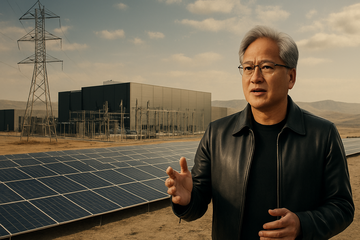
The $450M Pentagon Tungsten Bet Solves the Wrong Problem: China's 85% Refining Grip Still Prices the Metal Inside AI Memory
Washington's $450 million commitment to The Elmet Group buys conversion capacity and a Defense stockpile option — not ore. The United States has not mined tungsten commercially since 2015, China controls roughly 85% of global APT refining capacity, and the first new North American APT plant is dated to restart in the second half of 2028. Meanwhile the metal has already been paid out to the miners: Almonty Industries swung to C$17.6 million of adjusted EBITDA in a quarter while Elmet's margin gain came from holding inventory rather than owning supply. For AI hardware the binding constraint is not price but qualification — standing up an alternative WF6 supplier takes 18 to 24 months — so the chokepoint to watch is a Chinese refinery, not a plant in Maine.
2026-10-25
A Third of the S&P 500's Profit Growth Is a Memory Price Cycle — and Half of It Is Still an Estimate
The Wall Street Journal put a number on AI concentration on Oct. 24: Nvidia and Micron alone account for 34% of projected S&P 500 third-quarter profit growth, and about ten companies account for roughly two-thirds of it. That is an earnings-flow fact, not a market-cap one — blended index earnings growth is 29.5%, and it falls to roughly 20% without those two names, because Micron supplied 5.79 points of the market's 30.7% growth rate on a DRAM price move while its gross margin reached 86.8%. At a forward 12-month P/E of 18.7 against a 5.00% 10-year Treasury, the index is paid roughly 35 basis points for equity risk and can only earn that if memory pricing holds. The catch: Micron has reported, Nvidia has not — its quarter closed on Oct. 25 and results land Nov. 17 — so about half of that concentrated third is still an analyst estimate.
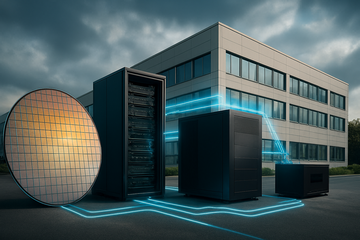
Cadence Turned EDA Into Infrastructure in Munich — and Europe's Sovereign AI Spending Now Flows to NVIDIA, Vertiv and HPE
On Oct. 21, 2026, Cadence and NVIDIA put chip-design software, an AI supercomputer and a data-center digital twin inside a sovereign data center in Munich, available to European customers the same day. The launch carries no disclosed revenue, but the mechanism matters: to keep design data inside EU jurisdiction, an EDA vendor must now operate data centers and rent accelerators, which turns the design layer into a standing buyer of NVIDIA silicon, HPE systems and Vertiv power and cooling — spending backed by policy budgets rather than corporate IT. The uncomfortable part: the sovereign stack runs American tools on American silicon, Europe's publicly funded alternative (the Chips Act-backed EU Chips Design Platform) is being built in parallel, and the same export-control reflex that moved Cadence's China revenue by $124 million in a single quarter is still loaded.
What to expect
Evidence-first notes with a visible point of view.
This section collects sharp takes on earnings, shareholder meetings, and market structure. Each new piece should make the thesis, the facts, and the implications obvious within the first few screens.
Expect direct analysis, not generic commentary.
Expect the data to be explicit and the argument to be easy to follow.