Energy
Crude, refining and the price at the pump
Supply, inventories, crack spreads and OPEC decisions, followed down to the producers, refiners and buyers who book the difference.
2026-10-30

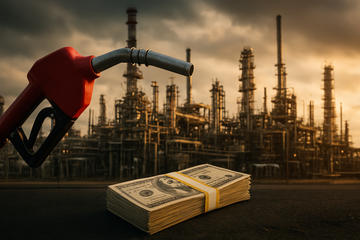
ExxonMobil's Q3 War Premium Is a Refining Story — and That Makes the Buyback a Ballot Issue
ExxonMobil releases third-quarter results before the open on October 30, and its own October 16 filing already shows where the war premium went: $4.5 billion of refining-margin uplift against a $1.3 billion upstream hit from higher crude prices. That mix matters politically, because the profit pool filling up is the one that sets the price at the pump, while the cash funding the buyback is running at 124% of trailing free cash flow. Democrats' Big Oil Windfall Profits Tax Act now names stock repurchases, so ExxonMobil's capital-return pace has become an election-month risk factor rather than a valuation lever.
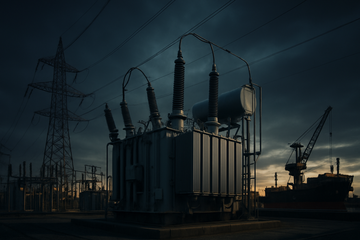
Dnipro Went Dark on October 30. Ukraine's Grid Rebuild Is Being Bought in China, Not Europe
Russian strikes on October 30, 2026 cut power to more than 350,000 consumers in Dnipro and stopped the city's metro, and the deeper cause is a repair bottleneck that turns every destroyed substation into procurement. Ukraine's own customs data shows where that money lands: $1.14 billion of transformers, inductors and reactors imported in the first nine months of 2026, up 47.3% year on year, with 87.8% of the value coming from China while Europe's factories stay booked out for years. GE Vernova exited the third quarter with a $42.2 billion Electrification backlog, up 60% year on year, and is committing $6.0 billion through 2028 to add capacity, so the war's cash flow reaches Western and Korean primes through European and NATO grid-hardening budgets rather than Ukrainian tenders. The binding constraint on the $91 billion energy-sector rebuild is financing and factory allocation, not demand: a €922 million EU package and a €90 million EBRD substation loan against a World Bank estimate of nearly $91 billion.
2026-10-29
Disruptive's $10 Billion Blind Pool Just Became the Largest Bidder in the AI Power Bottleneck — and the Same Assets Trade at Half the Price in Public Markets
A Dallas firm that has never raised a traditional fund closed a $10 billion blind pool on Oct. 27, planning up to $1 billion checks into roughly ten late-stage AI, infrastructure and defense companies. The structural change is not the size but the concentration: one manager writing ten-plus mega-checks behaves like an infrastructure owner, buying the same scarce power, grid and industrial capacity that public companies from GE Vernova to Hyosung Heavy Industries are now selling at record backlogs. The contradiction investors must price is that the private marks on this cohort have fallen while the public marks on the same bottleneck assets have not — Groq's valuation dropped to $3.5 billion in a round Disruptive itself led, roughly a year after the $6.9 billion mark. Meanwhile GE Vernova's gas-turbine backlog and slot reservations reached 122 GW and Vertiv grew organic orders more than 100%. The bulk-buying shift puts private capital directly into the physical assets that public markets are repricing, and makes the public supply chain the cleaner way to own the thesis.
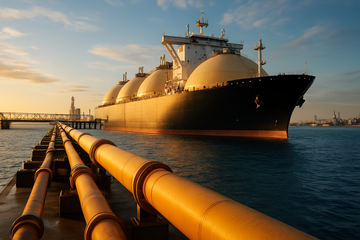
Qatar Just Became a Buyer of American Gas: 4 Million Tonnes Contracted Through 2054, and a $25/MMBtu Spread the Oil Trade Never Saw
QatarEnergy, the world's largest LNG producer, is now buying the molecules it used to sell: 33 US spot cargoes worth about $1 billion so far, a 4 mtpa free-on-board contract with Cheniere Energy running through 2054, and at least 3 mtpa in advanced talks with Venture Global. The hedge works because American molecules never transit the Strait of Hormuz, and it costs more than $20 a MMBtu because the same gas sells into Asia at $32.36 while Cheniere realized $7.07 on its legacy long-term volumes in 2025. Brent at $113.88 captures the oil side of the chokepoint; the equity consequences sit in US liquefaction fees, contracted 2030s volumes and freight tonne-miles, which is where the premium actually changes hands.

Shell's $10.8 Billion Quarter Came From a $42 Crack Spread, Not From the Wellhead
Shell's third-quarter 2026 adjusted earnings of $10.81 billion were a refining result wearing an oil major's clothes: Chemicals and Products earned $3.86 billion against Upstream's $3.19 billion, nine-month output fell 17% year on year, and Shell's own trading books were flat to lower. The engine was a war-inflated crack spread — Shell's indicative refining margin hit a record $42 a barrel against $24 in the second quarter — and Shell is now distributing that premium as though it were a run rate, with a $5.0 billion buyback and about $2.2 billion of dividends returning roughly two-thirds of quarterly earnings. The mechanism matters for the read-through: the same disruption that created the margin destroyed Shell's own Qatari molecules, so investors buying the distribution are buying a geopolitical premium that both the payer and the recipient can lose.
2026-10-28
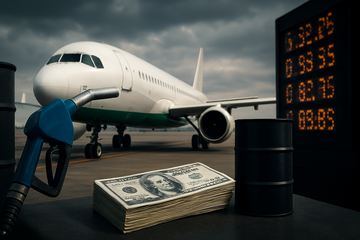
Frontier's 71% Airfare Jump Is the CPI Signal the Fed's Gauge Is Built to Miss — and 2027 Hedge Expiry Makes It Bigger
Frontier Group Holdings reported a 71% jump in average airfare for the third quarter on Oct. 28, and the market read it as pricing power. It was not: jet fuel and the disappearance of the ultra-low-cost price check did the repricing, and the fuel bill grew faster than the ticket. The shock is now visibly in consumer prices — airline fares are up 22.4% year over year in the September CPI — yet the arithmetic of the index makes it nearly invisible to the gauge the Federal Reserve actually reads. Meanwhile Valero Energy earned $39.24 a barrel of refining margin while American Airlines Group guided to a full-year adjusted loss of $1.00 to $1.60 a share, which is exactly where the money went and why 2027 matters more than the fourth quarter.
Brent Fell on a Deadlocked Knesset: The Oil Premium Is Trading Iran's Diplomacy, Not Coalition Math
Israel's October 27 election produced no clear winner — exit polls put Benjamin Netanyahu's bloc on 52 seats and Gadi Eisenkot's on 49, against the 61 needed to govern — yet Brent settled 1.7% lower at $113.88 the same day while the shekel jumped 1.8% to a five-week high. Crude is trading one channel only: the diplomacy over the Strait of Hormuz, where war-risk insurance and rerouted shipping, not missiles, physically remove barrels, and where4.5 million barrels a day of shut-ins unwind faster than a ceasefire would be signed. The investable consequence is a clean split — upstream producers, tanker owners and refiners are paid per barrel moved, while the war's inflation shows up in the Fed's December hike and in gold's 28% slide from its January record. Positioning for a deadlocked parliament is positioning for volatility; positioning for the oil premium means positioning for logistics that mean-revert.
2026-10-26

Record Diesel Is Now a Delivery Fee: The Crack Spread Reaches the Front Door Before the Fed's December Hike
Diesel at $6.276 a gallon in the week ending Oct. 19, 2026 — a quarter of a dollar below the record set the week ending Sept. 21 — is being priced into holiday delivery fees, not just into pump prices: FedEx, UPS and Amazon Shipping all switched on holiday surcharges between Oct. 25 and Oct. 26, on top of fuel charges that reset weekly against the national diesel average. The engine is a refining constraint, not an oil price. The diesel crack spread has held above $100 a barrel since Sept. 1 for the first time in 2026 and stood at $113.24 on Oct. 20, while September producer prices showed gasoline up 20.3% in a month and final demand up 6.3% from a year earlier. That print is why the Fed raised rates on Sept. 16 to 3.75%-4.00% and why every economist polled expects another quarter-point on Dec. 9. The money has one destination: refiners booked $8.8 billion of refining operating income in a single quarter at a $39.24-a-barrel margin, while carriers, truckers and retailers carry the rest of the crack on their price tags.

EQT Pays $16.97 a Molecule for Range, Against Its Own $16.94 — So the AI Power Prize Is the Contract, Not the Rock
EQT agreed to buy Range Resources in an all-stock deal worth $12.83 billion on Oct 26, 2026, creating a company with more than 9 Bcfe/d of production and over $50 billion of enterprise value. Measured by enterprise value per Mcfe of annual production, EQT is paying $16.97 for Range's molecules against its own $16.94, so the molecules change hands at par and the real prize is the contracting machine that can sell them to AI data centers. The evidence says the AI power boom is a volume story, not a price story: the EIA's October forecast has Henry Hub falling 9% to $3.16 per MMBtu in 2027 even as consumption and LNG exports rise. Range shareholders banked most of the announced premium on day one while EQT shareholders paid 1.8%.
The Navy Just Added $2.41B for Its Reactor “Test-to-Fleet” Pipeline—And AI Cant Buy In
A $2.409B Navy modification sent to Fluor Marine Propulsion expands the Naval Nuclear Laboratory’s naval-reactor work—training and readiness for the submarine and carrier fleet, not data centers. That split matters for investors: the next wave of nuclear demand driven by AI power looks fundamentally non-fungible with the margin structure and contracting leverage of naval propulsion.
2026-10-25

Brent at $116.72, WTI at $103.27: The War Premium Is a Paper Premium, and the $13.45 Gap Names Who Pays
Brent's six-month closing high on Oct. 23 came with WTI at $103.27 and a $13.45 gap that stayed remarkably intact even as both benchmarks rallied about 9% in twelve days. The barrels never stopped moving: Hormuz transits ran near 13.1 million barrels a day in late September, and roughly 40% of the region's crude now bypasses the Strait entirely, so the premium is charged in freight, war-risk insurance and deferred futures rather than in missing molecules. The gap is the bill for moving a barrel, and it is paid by whoever needs one delivered to a specific refinery on a specific date, with Asian and European importers first in line, while tanker owners, seaborne US producers and midstream operators collect it. That also re-cuts the December Fed hike: US inflation is running on product cracks, and the futures curve prices the $116.72 front month down to $87.28 by December 2027.
Bloom Energy grew revenue 138% and its stock fell 11%. The fuel cell bottleneck is cash, not orders
Rystad Energy, reported Oct 23, 2026, expects data-center fuel cell spending to reach about $30 billion by 2030 from roughly $2.8 billion in 2025, with a visible order book near 9 GW. Bloom Energy is the one vendor turning that demand into hardware — third-quarter 2026 revenue of $1,235.8 million, up 138.1%, at a 33.8% gross margin — but its own Form 10-Q shows why the stock dropped 11.24% the next day: operating cash flow of negative $27.1 million, contract assets up $617.5 million, and roughly69% of revenue in two customers. Speed-to-power is a real moat, but the fuel cell build is a working-capital machine, and margin only appears for the vendor that can manufacture at scale.
Venture Global's $17.2 Billion Bet Is a Slot Option: Only 8 of 15 Turbines Are Reserved
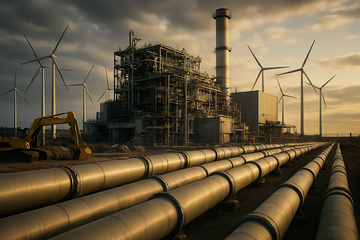
Venture Global's October 9 power and grid frame agreements with GE Vernova and Baker Hughes cover up to 16 gas-fired power islands and an aggregate ~$17.2 billion of equipment, but only eight of the fifteen remaining islands sit under a definitive manufacturing reservation. The economics are not a gas story: at 720 MW a block, the islands could burn up to 1.9 Bcf/d, which turns a fee-based, gas-price-neutral LNG exporter into the operator of a gas-cost-exposed merchant power book where one dollar per MMBtu of Henry Hub moves roughly $424 million of annual EBITDA. For investors this is a slot option — cheap to hold, expensive to exercise — and the test is whether data center customers sign power contracts before the mid-December 2026 grid reservation deadline.
2026-10-24

Two-Thirds of a $389M Federal Chip Award Went to Fusion: Commonwealth Fusion's $85M Buys Electronics, Not Equity
On October 22, 2026 the Commerce Department signed letters of intent worth up to $389 million with four companies, and $260 million of it — two-thirds — went to the two private fusion developers. Commonwealth Fusion Systems's $85 million is not a venture round: it funds radio-frequency heating semiconductors, high-voltage power electronics, advanced packaging and radiation-hardened controllers, because power systems and power components are now the most-cited bottleneck in fusion at 48% of fusion companies, ahead of heat management at 44% and vacuum hardware at 32%. The listed exposure is the supplier of record, not the fusion story: Fujikura has booked the largest superconducting-tape order in history, GlobalFoundries hosts Helion's semiconductor program at its Burlington fab, and the same high-voltage device class is being funded on both sides of the fusion and AI-power markets. At $260 million against $681 million of projected 2026 fusion supply-chain spending, fusion remains a small buyer of chips: this is a qualification and design-in story, not a revenue story.

Alimentation Couche-Tard Is Buying 2.76 Billion Gallons Below Its Own IPO Mark, Days Before the Pump Price Becomes a Ballot Issue
Alimentation Couche-Tard has offered $7.5 billion to $8 billion for Cumberland Farms, the convenience-store group formerly known as EG Group — 11% to 17% below the roughly $9 billion valuation the owners were carrying into a Nasdaq listing they have since postponed. What matters is not the $8 billion but what sits underneath it: West Texas Intermediate at $103.44 and the national pump price at $4.2957 a gallon have turned the price at the pump into an election variable days before the November 3 midterms, while the target's own gallon count has fallen for three straight years. At roughly 19 times FY2025 adjusted EBITDA once $5.79 billion of target debt is added, the bid is a leveraged bet that the political fix arrives through new refining capacity rather than through a lower pump price.
2026-10-23

Airlines Absorbed $6.1 Billion of Extra Fuel in One Quarter: The Elasticity Test Says Cost Shock, Not Demand Shock
US carriers took roughly $6.1 billion of additional fuel expense in the third quarter of 2026 and pushed most of it into fares — airline fares rose 22.4% year over year in September and Southwest Airlines's average fare jumped 26.9% to $231.69 — yet United Airlines recovered only 72% of its $1.8 billion fuel increase and three of the four big carriers cut guidance. The mechanism matters more than the headline: airlines hedge crude rather than jet fuel, so the record $57-a-barrel crack spread passed straight through to fuel bills and was collected by refiners, where Valero Energy earned a $39.24-a-barrel refining margin and a record $6.8 billion quarter. Because capacity was rationed rather than demand destroyed — load factors moved half a point — this is still a cost shock, but the balance sheets that can carry it are unevenly distributed, and the same fuel spike is moving freight off trucks onto rails.
The Dirty Secret of Vietnam's Coal Boom: 25-Year Fuel Contracts Written Against a Narrowing Tariff Moat
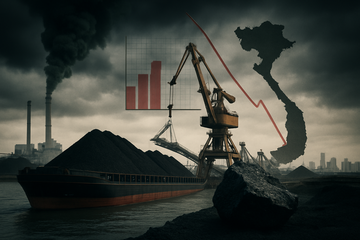
Vietnam is importing 17-19 million tonnes of coal in 2026 and has begun locking fuel supply to state-owned plants through 2047, because coal now supplies 54.5% of its electricity and gas, hydro and the grid cannot close the gap on the same timetable. The hidden fault line is price elasticity: the same Iran-driven spike that made coal strategically necessary pushed Newcastle to $150 a tonne, and Vietnam's seaborne buying shrinks as prices rise. The listed consequences are narrow — Mitsubishi Corp and Doosan Enerbility bank contracted fuel and EPC revenue, Core Natural Resources is converting the demand into profit while Peabody Energy ships its first cargo from a cost curve it cannot yet cover, and the relocation premium behind the load is deflating, which is the bullish case for Jasan Holding.
2026-10-22

2026-10-21

A rare airline quarter where revenue surged and the stock still lost money: Alaska Air Group shows fuel math—not demand—decided the GAAP bridge
In Alaska Air Group’s Q3, revenue rose 14% on only a 2.4% capacity build, yet GAAP still landed on a $147M net loss. The key investor takeaway is that management’s Q4 fuel guidance implies a larger loss risk even as unit economics improved—while Hawaiʻi demand softness was explicitly called out as an operational drag.
One-Third of the Heating-Oil Reserve Is on Loan: Refiners Now Own the $106 Distillate Crack, and December's Hike Is Priced In
On October 21, 2026, the Department of Energy offered to loan up to 315,000 barrels out of the Northeast Home Heating Oil Reserve — roughly two hours of national distillate demand, and 45% of the three storage sites it is actually tapping. Washington is running out of levers because every remaining one holds crude, and crude does not become diesel without a refinery, so a $106-a-barrel distillate crack now decides who gets paid. The refiners own that margin and are already converting it into $10.9 billion of trailing buybacks, while downstream names such as Delta Air Lines pay the same spread twice, once at the pump and once in a failed hedge. The crack is what makes December's 25-basis-point hike the market's base case; the loan is Washington admitting it cannot do anything about the number in the meantime.
What to expect
Evidence-first notes with a visible point of view.
This section collects sharp takes on earnings, shareholder meetings, and market structure. Each new piece should make the thesis, the facts, and the implications obvious within the first few screens.
Expect direct analysis, not generic commentary.
Expect the data to be explicit and the argument to be easy to follow.