Latest
The day's market news, with the argument attached
New notes every trading day on earnings, policy and market structure. Each one opens with the conclusion, then the evidence, then the companies it hits.
2026-08-08


Peloton’s First Annual Profit Proves the Cost Story Works—but the Subscriber Story Still Breaks the Multiple
Peloton’s FY2026 marked the first full-year positive GAAP net income, but the company guided to another year of shrinking revenue and continued subscriber declines. The market reaction is effectively re-rating Peloton from a turnaround narrative to a structural decline, where cost cuts can delay losses but can’t replace subscriber-base erosion.
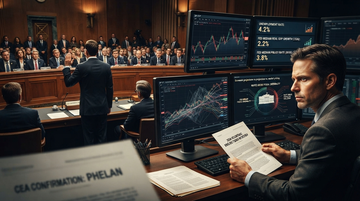
CEA’s Phelan Confirmation Matters More Than Fed Dots: It Rewrites the White House 2026 Growth Math for Fiscal Credibility
The Senate’s confirmation of [Christopher Phelan] hinges on the White House getting to control the macro “story” markets price—especially around 2026. But in this research pass, the only load-bearing, verifiable macro inputs we can anchor are (1) the June 2026 FOMC growth path and (2) contemporaneous BLS labor conditions; the specific post-confirmation White House 2026 GDP forecast numbers were not disclosed in accessible primary sources.

Rippling turns enterprise AI ROI into an auditable cost center, not a productivity vibe
Rippling says it burned “millions” on AI tokens in a few months, then built an internal employee-ROI tracker—now launched as AI Spend Console—to connect token spend to measurable outcomes. The move reframes AI from a blanket capability upgrade into a controllable spend-and-output system, forcing HR/payroll and adjacent enterprise software vendors to prove AI value in employee hours, not marketing.

SEC’s pardon-linked dismissal turns a once-binary insider tail risk into a discretionary policy lever—biotech executives should price the upside differently
When an insider-trading defendant receives a presidential pardon, the SEC can choose to drop the civil case rather than litigate the merits. That “pardon-as-procedural-shield” enforcement discretion is likely to lower expected legal tail-risk for politically connected healthcare and biotech executives—while keeping M&A and trial-disclosure conduct in focus, because the operational information advantage still drives market outcomes.

The CLARITY Act slip turns 2026 crypto market-structure into a 2027 expectation problem
The Senate will not vote on the Digital Asset Market Clarity Act in August, pushing a key SEC/CFTC jurisdiction fight into mid-September instead. For public crypto market-structure intermediaries, that procedural delay matters less because “Congress is slow” and more because it extends uncertainty that directly prices order-flow, stablecoin rails, and token-issuer IPO/launch timing toward 2027.

The “AI Capex Reality Check”: a $400M bet on a stealth chip-fab startup after a $16B unwind is a signal about who funds the 2027–2030 buildout
A post-bailout $400M commitment by Leopold Aschenbrenner’s Situational Awareness into Source Foundry implies that even after a leverage-driven AI-equity unwind, the fund still believes the frontier-AI capex cycle will require new manufacturing capability—especially in tools and process. Public-market drawdowns may have repriced the equity trade, but the chip-supply-chain cash allocation appears to be moving toward the “picks-and-shovels” of scaling production rather than competing on model IP.

Switch’s confidential IPO filing puts “independent data center” pricing to the test—while Westinghouse’s filing shows the window is still open
Switch’s confidential U.S. IPO process signals that late-stage private capital is willing to underwrite public-market multiples again for scaled data-center operators. The investment question is whether the market is already pricing that transition—or whether an “IPO trust premium” still exists for operators that can monetize power-constrained AI capacity fast enough.

Trump’s “cancel offshore wind and pay” policy turns developers’ sunk costs into a utility balance-sheet problem—$4B becomes a 2027 grid reprice trigger
The Trump administration’s offshore-wind buyouts have reached nearly $4B in taxpayer-backed settlements to cancel leases and projects, shifting risk from developers to whoever ultimately must fund the replacement generation build. For investors, the signal isn’t just lower clean power supply—it’s a new cancellation-with-compensation mechanism that can re-rate regulated utilities’ capital plans starting in 2027.

DFC’s $3B minerals bet turns “China decoupling” into a processing-margin race—and the winners are the firms that can monetize working capital first
The U.S. Development Finance Corporation (DFC) has outlined a $3B set of domestic critical-minerals deployments, including a prominently cited $58M-financed component, aimed at strengthening defense-adjacent supply chains. For investors, the key shift is not “more mining,” but which listed processors can pull forward separation/refining timelines—because DFC-style financing changes capex sequencing and who captures the processing margin.

Soft Payrolls Don’t Cut the Swap Convexity Bet—Record Eris SOFR Volume Says “Higher for Longer” Got Re-Anchored
After July jobs disappointed, US Treasuries backed up—but swap futures positioning shows institutions didn’t buy the “dovish reset.” Instead, record Eris SOFR swap-futures trading implies dealers and leveraged accounts are paying (and hedging) a higher-for-longer convexity risk premium that can keep rates “sticky” even as Fed-cut odds rise.

USPS’s $2.5B quarterly loss is a parcel-economics stress test—and UPS/FedEx should expect margin squeeze from slower price/volume alignment
USPS reported a GAAP net loss of $2.5B in its latest reported quarter while operating revenue rose and operating expenses also rose. The mix matters: USPS grew “Shipping and Packages” revenue even as Shipping and Packages volume fell 3.4%, a pattern that points to persistent cost/volume friction—exactly the same variable pricing-power strategies depend on for UPS and FedEx.

Delaware’s Verisk ruling makes activist breakups harder: specific performance beats “we’ll just walk away” in the $2.35B AccuLynx case
A Delaware Chancery judge ordered Verisk Analytics to try to complete its $2.35B cash acquisition of AccuLynx, rejecting Verisk’s attempt to treat the deal as terminated. The ruling matters to investors because it reinforces a template: when a board’s contract choice is enforced, activists must clear a much higher legal bar—often not just “wins on votes,” but “losses on specific performance.”

Volkswagen’s US-built pickup play is a direct tariff-resistant hit at Ford’s truck profit engine
Volkswagen is moving a US-built pickup to the “end of the decade” timeframe as part of a broader US strategy overhaul under new leadership. The move matters to investors because it targets the same US profitability gravity well—Ford’s truck-and-commercial “Ford Pro”—where Ford posted $6.8B of EBIT on $66.3B of revenue in 2025 (10.3% margin), and it forces a rethink of EV-vs-ICE mix inside VW’s Chattanooga footprint.

WBD’s streaming engine didn’t stall—its 10% jump forces the Paramount deal to be judged on growth, not fear
Warner Bros. Discovery’s latest print shows streaming revenue rising 10% year over year as the Paramount combination faces antitrust and court friction. That single datapoint changes the merger debate from “optionality in delay” to “value creation while the clock is running,” and it tightens the antitrust math around likely post-close competitive effects in streaming.

Judge Halts DoD’s WuXi “Chinese Military Company” Label—But BIOSECURE’s Clock Can Re-Start Differently
A U.S. judge preliminarily enjoined the Pentagon from enforcing its June 2026 Section 1260H “Chinese military company” designation for WuXi AppTec, blocking the immediate BIOSECURE reactivation path tied to that label. For investors, the key question is not whether the BIOSECURE restriction exists, but how CROs and US biotechs must re-route procurement after the compliance trigger is legally paused.
2026-08-07

AIG’s underwriting surge is real—cat losses fell and prior-year development swung, so the “pricing power” answer depends on how much of the beat was accident-year vs. reserve mechanics
AIG’s first-quarter 2026 earnings jump was driven by a sharp reduction in catastrophe-related charges and favorable prior-year loss reserve development—not just by accident-year underwriting. SEC disclosures show favorable prior-year development in the same period, reinforcing that the beat has a reserve-development component. For investors, the key question is whether AIG can sustain favorable development while catastrophe costs normalize—because that’s what determines whether the US P&C cycle sees durable pricing power.

American International Group's underwriting “beat” is mostly lower catastrophe losses and reserve, not broad pricing power
In American International Group’s latest disclosed underwriting results, the General Insurance combined ratio improved to 90.1 vs 91.8, with the underwriting income increase tied to $258m lower catastrophe losses and $183m higher favorable prior-year development. The implication for investors isn’t “pricing is the only story”—it’s that the cycle is still dominated by loss-cost variability, catastrophe timing, and reserve/reinsurance mechanics.

Alibaba’s “pay-for-heavy-users” open-weight twist turns Qwen into a monetization moat—weeks after the open-weights cost wave started
Reuters reports Alibaba plans to charge “big users” for its next open-weight model (Qwen3.8-Max), with timing aimed for next week and revenue-sharing for commercial “sale-as-a-service” deployments. The immediate investor signal: if open-weight can be turned into a paid tail without killing developer adoption, it pressures US hyperscalers’ inference-at-low-margin playbooks that currently benefit from free distribution.

Advanced Micro Devices' first “one-model-to-silicon” buy re-ranks the inference chip war
By acquiring Taalas, Advanced Micro Devices is buying an inference architecture where the model is hardwired into custom silicon, not just accelerated at runtime. That shifts the hyperscaler vendor map toward “model-specific throughput” players, while pressuring GPU-style margins to defend against a new cost-performance axis.

Anthropic’s 85% fewer biology fallbacks reframes biosecurity as a measurable, cost-to-serve moat
Anthropic says its Aug 7, 2026 update cut biology-related “fallbacks” by about 85% in testing by tightening the boundary of its biology safeguards (constitutional classifier tuning). If regulated labs buy based on operational friction—not just policy—this kind of measurable false-positive reduction can lower reroute-and-retry costs while improving throughput into life-science workflows.
What to expect
Evidence-first notes with a visible point of view.
This section collects sharp takes on earnings, shareholder meetings, and market structure. Each new piece should make the thesis, the facts, and the implications obvious within the first few screens.
Expect direct analysis, not generic commentary.
Expect the data to be explicit and the argument to be easy to follow.