Latest
The day's market news, with the argument attached
New notes every trading day on earnings, policy and market structure. Each one opens with the conclusion, then the evidence, then the companies it hits.
2026-09-07

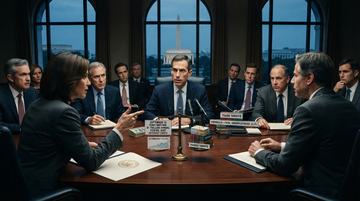
162K Jobs and a Trade Ultimatum: The September Fed Meeting Is Now a $1 Trillion Debt Showdown
The August payrolls surprise pushed Fed pricing toward a September hike at the same moment President Trump demanded cuts and floated halting trade with deficit countries. With $1 trillion in annual federal interest costs, the September 16 FOMC meeting is no longer a monetary-policy decision — it is a test of whether the central bank can remain independent of a White House treating interest rates as debt-service management.
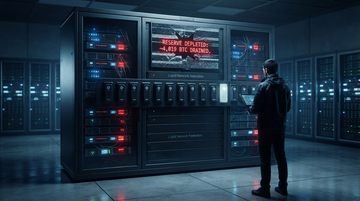
Bitcoin's Sidechain Just Lost 95% of Its Backing — What Liquid's $320M Consensus Bug Means for Crypto Rails
A software flaw in Blockstream's open-source Elements code let an attacker mint roughly 4,000 L-BTC that did not exist, then redeem them for real bitcoin from Liquid Network's 11-of-15 federation wallet on Sept. 6, 2026. The drain wiped out ~95% of L-BTC's reserve backing in a single transaction — every functionary's keys and HSMs worked exactly as designed, which is the unsettling part. The cleanest line of sight for public investors runs through Coincheck Group, whose parent operates a Liquid federation member, and through the BTC-heavy balance sheets of Strategy and the listed miners, where even a sub-1% Bitcoin move now matters because L-BTC's mechanical peg no longer exists.
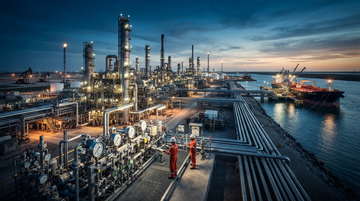
OPEC's October Hold Looks Like Discipline. It's the 2027 Quota War — and Refiners Just Won Q4
OPEC+'s September 6 decision to keep October output unchanged was framed as a supply pause, but it actually signals the start of the 2027 quota fight that will redraw every member's production baseline around audited maximum sustainable capacity. With US diesel cracks at a record $102/bbl, distillate inventories at the lowest August level since 1951, and 5 mbpd of global refinery throughput still offline from the Iran war, refiners and US shale are the cleanest beneficiaries — and any service company whose order book still depends on OPEC+ volume growth is now structurally exposed.
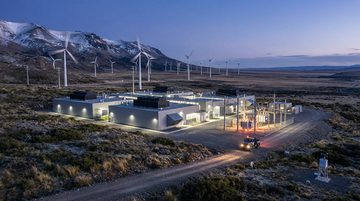
Why Patagonia’s Cold + Wind Can Break the Next AI Data-Center Siting Trade-Off—and Who Benefits
A Sept. 7 Reuters report says hyperscalers are probing Argentina’s Patagonia for mega data centers, attracted by wind-powered power economics and a cold climate that can lower cooling costs. The market signal isn’t just “cheaper kWh”—it’s that AI siting economics may shift toward places with both dispatchable-like renewable pricing dynamics and long runway for grid and generation buildout, reshaping who wins interconnect, power contracts, and capacity. Public investors should watch the listed power and data-center-adjacent names most exposed to these contract and buildout cycles.

Private Credit Marks Fell $2.3 Billion in H1—Software Is Where the Losses Are Concentrating
U.S. business-development-company portfolios were worth $92.88 billion at June 30, 2026, versus $95.19 billion at reported cost, a wider gap than at year-end. The immediate problem is not a system-wide default wave but a valuation and liquidity feedback loop: software borrowers are weakening, while investors in Blackstone Private Credit Fund are requesting redemptions faster than the fund can honor them.

Singapore VLSFO up 76% while Brent lags: the bunker-fuel squeeze hiding inside the Iran war
Marine fuel oil is rising faster than crude because Gulf and US refiners — Marathon Petroleum, Valero, Phillips 66 — are rerouting crude into diesel and jet fuel where margins more than doubled. Singapore VLSFO has climbed 76% since the Iran war began versus 40% for Brent, and Energy Aspects projects a 218,000 bpd Q3 fuel-oil deficit. Tanker operators Frontline, DHT Holdings and International Seaways are printing record VLCC earnings, but the cost lands on container carriers already absorbing €340 million per day in extra bunker fuel. The market is still trading the crude headline; the squeeze is in the residual barrel that powers the fleet.
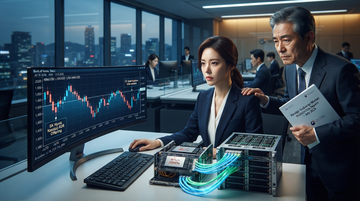
The Reported $20B SK Hynix FX Trade Turns AI Memory Into Korea’s Won Shock Absorber
Reuters reported that South Korea’s foreign-exchange authorities bought about $20 billion of dollars sold by SK Hynix after its July Nasdaq offering, while official government disclosures confirm that the ADR inflow helped move the won from the 1,550 range toward the upper 1,400s. The important distinction is that the public record supports a state absorption trade, not a confirmed legal order forcing repatriation. AI-memory profits made the flow large enough to matter for currency policy, but the intervention also makes SK Hynix’s dollar-conversion choices more policy-sensitive.
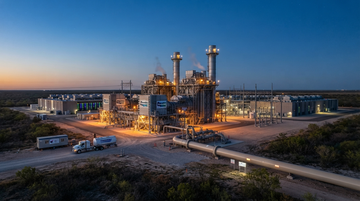
Korea's $22.3B Encinal Gas Plant: The $350B Trade Deal's First Anchor — And Why It Doesn't Power SK Hynix's Fab
South Korea and the U.S. have agreed on a $22.3 billion, 6.3 GW combined-cycle gas plant in Encinal, Texas as the first concrete deployment under their $350 billion Strategic Trade and Investment Deal — though Seoul's Industry Ministry called the headline inaccurate. The plant is sized to feed Texas AI data centers, not SK Hynix's separate Indiana HBM fab, and sits inside a $100B LNG offtake that routes Korean capital toward Cheniere Energy and Energy Transfer while opening a U.S. EPC pipeline for Doosan Enerbility. Cash commitment, gas-turbine orders, and Korean-tied LNG volumes are the three numbers investors should track first.
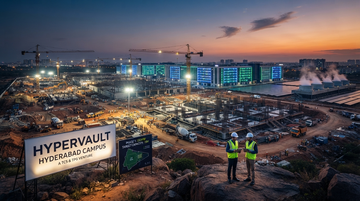
Tata Consultancy Services plants a 1GW hyperscale flag in Hyderabad—forcing a power-and-capex price fight across India’s AI data-center buildout
Tata Consultancy Services’s HyperVault is committing up to ₹70,000 crore (about $7.41B) for a purpose-built up to 1GW AI data-center campus in Hyderabad, backed by TPG—an inflection for India’s hyperscale build map. The move matters less for near-term IT services revenue and more for who controls “AI availability” in India: power, cooling, and capacity scheduling—where NVIDIA NVDA racks and Vertiv VRT infrastructure pricing flow downstream to hyperscale and colocation competitors.

Tesla self-certified the Cybercab into AQ26002 — Zoox already wrote the playbook Tesla didn't use
On Sept. 3, 2026, Tesla launched the Cybercab in Austin and told NHTSA the no-controls robotaxi was compliant with every applicable FMVSS. NHTSA opened Audit Query AQ26002 the same day, probing the exact legal shortcut Tesla used to sidestep the 2,500-vehicle annual cap. Five weeks earlier, Amazon-owned Zoox got the first NHTSA Part 555 commercial exemption for a purpose-built robotaxi, with eight FMVSS exemptions covering exactly the controls Cybercab lacks. Every Cybercab on the road now carries a regulatory tail risk that Samsung Electronics, Samsung Electro-Mechanics, LG Innotek and TSMC are pricing into their 2027 Cybercab volume — and Tesla's bet that self-certification would scale faster than a petition now determines how many Cybercabs NHTSA ever lets hit the road.
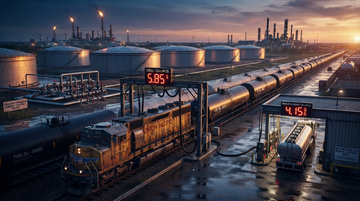
Trump's 'Biggest Oil Deal' Promised Lower Gas Prices—Three Weeks In, Diesel Just Hit $5.85 a Gallon
The White House's Sept. 2 Venezuela deal hands a Pentagon-linked entity 100-year rights over 17 fields containing 65 billion barrels of reserves, with Chevron pledging another $7 billion to double output. Three weeks later, diesel hit a record $5.85 a gallon and gasoline sits at $4.15—not because of the deal, but because the Iran war and a six-week Strait of Hormuz blockade have ripped 10 million barrels a day out of the global market. The deal is a long-dated infrastructure play, not a near-term price fix: Marathon Petroleum, Valero and Phillips 66 are pocketing historic crack spreads while American Airlines and United Airlines absorb roughly $6 billion each in extra fuel costs.
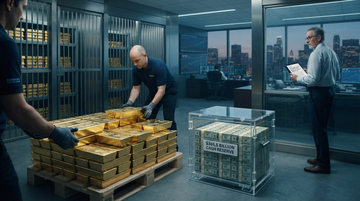
The Ultra-Rich Are Sitting on $365B in Cash and Lifting Gold to 3%—A Tactic, Not a Panic
Goldman Sachs' October 2025 high-net-worth survey shows the cohort still parks ~20% of net worth in cash, UBS family offices now plan a 3% gold allocation (up from 2%), and Berkshire Hathaway holds $365.5B in liquid assets. The rotation is the smartest, slowest money in the market quietly de-risking while AI-capex-driven indices keep climbing—evidence of a topping process, not a crash catalyst. Goldman Sachs, UBS, and the gold miners sit at the center of where that capital lands.
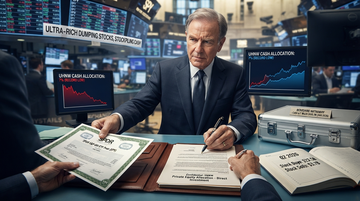
The 'ultra-rich are dumping stocks' headline is wrong — the data shows a K-shaped split, with the $20M+ crowd at record-low cash and record-high private equity
TIGER 21 UHNW cash holdings just fell to 7% — the lowest since the survey began in 2007 — while private equity allocations hit a record 34%. The widely circulated claim that the wealthy are stockpiling cash at record levels conflates the $1M+ HNW tier (where Goldman Sachs surveys show 20% in cash) with the $20M+ UHNW cohort (where actual cash is at a record low and PE is at a record high). Professional managers are simultaneously at their second-lowest cash level since 1998 and most overweight equities since 2021, leaving the real signal buried: $102 trillion of US household wealth is splitting, with the middle moving to cash and the top moving to private markets.
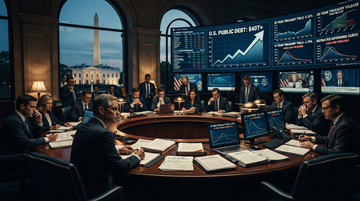
The Bond Market Just Became the Fiscal Disciplinarian — Why 'All-Hands-on-Deck' Is the Treasury's New Baseline
With U.S. debt crossing $40 trillion, the average interest rate on that debt more than doubling since 2021, and Treasury Secretary Bessent doubling long-end buybacks to defend the curve, the bond market is now enforcing fiscal restraint Congress will not. The trajectory — not the next auction — is the story, and it leaves mortgage REITs, long-duration fund managers, and rate-sensitive bank books bearing the bulk of the cost.
2026-09-06

Workers Are Funding Their Own AI Retraining — Three Rails Are Catching the Dollar Corporate L&D Won't Spend
Workers self-funded roughly $1.5B of AI skills via Coursera and Udemy in 2025 while 56% of employees got no training from their employer, per ManpowerGroup's January 2026 Global Talent Barometer. JPMorgan has cut 30–40% of headcount in some teams and is running ~1,000 AI use cases inside a $19.8B technology budget, while Cognizant reports 7.1% adjusted operating income per associate from AI-assisted coding — proof that corporate L&D dollars are being redirected from training to severance and compute. Three rails are absorbing the worker-paid reskilling dollar: the new for-profit megamerger (Coursera+Udemy), hyperscaler free tiers (Alphabet, Microsoft, Amazon, IBM), and public-sector workforce boards now backed by California's free AI micro-credential pilot and H.R. 7576's proposed 30% tax credit.
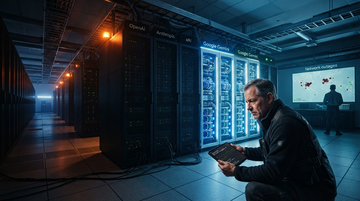
When ChatGPT, Claude, and Grok All Went Dark for 93 Minutes, the Single-Cloud AI Thesis Broke
On September 3, 2026, three of the four frontier AI providers — OpenAI, Anthropic, and xAI — suffered overlapping downtime for 93 minutes. Google Gemini stayed up. The episode didn't expose a shared external failure: each provider cited a different internal cause. What it exposed is that \"cloud AI\" is now a single-point-of-failure problem at the inference layer, and that resilience has become a buying criterion — which is why Alphabet's vertical stack and Oracle's OCI (+93% YoY) are suddenly more relevant than another Azure region.

Apple's 9-9 launch is the first test of Ternus's hardware playbook — and Morgan Stanley is pricing in a $14B foldable payoff
When Apple unveils the iPhone 18 Pro and its first foldable on September 9, it will mark new CEO John Ternus's debut on the world's biggest consumer-tech stage. Morgan Stanley's Erik Woodring calls it Apple's most consequential iPhone launch since the iPhone X, putting ~$14B of December-quarter revenue on the line for the foldable alone, plus a $200+ like-for-like price hike across the Pro lineup. The thesis hinges on Ternus's hardware credibility restoring pricing power just as NAND and DRAM costs are biting — a bet whose payoff flows directly into the supply chain from TSMC to Foxconn.
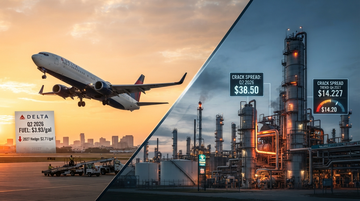
Bessent's $40 oil call breaks the airline–refiner trade in two
Treasury Secretary Scott Bessent's Friday projection of $40–$50 crude once the Iran war ends turns the post-Iran trade into a mirror image: airlines that bled through a $4/gal fuel quarter get a 2027 margin tailwind, while refiners like Marathon Petroleum, Valero Energy and Phillips 66 — whose Q2 2026 refining margins doubled — face the unwind of the record crack spread that drove their 80%+ year-to-date run.
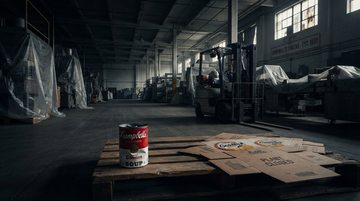
Campbell's 36% Dividend Cut Is the Second Packaged-Food Reset in Two Months — Three More Names Look Exposed
Campbell's joined Conagra on September 3 as the second major packaged-food company to reset its dividend in seven weeks, pairing a 36% payout cut with a 13% salaried layoff and two snack-plant closures on the same day FY27 guidance pointed to another 17–24% drop in adjusted EPS. The reset is no longer a single-name stress test — it is an industry-wide compression of branded volumes against record-high private-label share, and J.M. Smucker, Hormel and General Mills each carry a piece of the same exposure, with Kraft Heinz the only major still declaring victory.
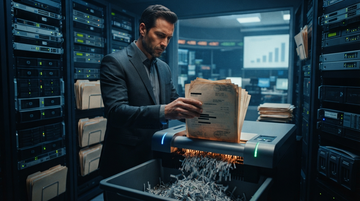
Fidelity's $5,000-per-customer cap is mostly illusion — $3.75M for 373,000 stolen images, settled the same month Reg S-P went live
A federal judge approved Fidelity Investments' $2.5 million class-action settlement on July 9, 2026 — on top of a $1.25 million Massachusetts Securities Division consent order — to resolve an August 2024 breach that exposed roughly 77,000 customer records (and the routing numbers of an additional 86,000 joint holders). The $5,000 per-claimant headline understates how little the cash pool actually buys: at full draw, the fund could fully compensate only 500 of the 163,000 eligible accounts, leaving roughly $100 pro rata for everyone else. The real cost landed in the Massachusetts docket: 23.7 million API calls, ~373,000 unique document images accessed, and an independent cybersecurity consultant with five years of record retention. For investors in custody and record-keeping peers — Charles Schwab, Bank of New York Mellon, State Street, LPL Financial — the settlement closes two weeks after the SEC's amended Regulation S-P small-firm compliance deadline, the rule designed precisely for breaches like this one.
What to expect
Evidence-first notes with a visible point of view.
This section collects sharp takes on earnings, shareholder meetings, and market structure. Each new piece should make the thesis, the facts, and the implications obvious within the first few screens.
Expect direct analysis, not generic commentary.
Expect the data to be explicit and the argument to be easy to follow.