Consumer
What households are actually spending on
Traffic, pricing power, trade-down and inventory across retailers, restaurants and brands — who is holding margin, and who is buying volume.
2026-10-01

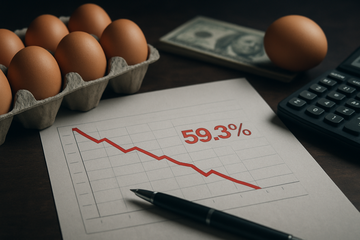
[Cal-Maine Foods]'s Conventional Eggs Lost $71M in One Quarter — the Food-CPI Tailwind Just Started
Cal-Maine Foods's Q1 FY27 print is the receipt for the egg cycle's flip: conventional shell egg prices fell 59.3% YoY, the segment booked a $71M operating loss, and the company posted its first net loss in over a year. Wholesale eggs have collapsed to $0.39/dozen nationally, the BLS egg index swung from a top food-CPI contributor in 2025 to a deflationary force in 2026, and feed costs are still up 4.3% — meaning downstream food makers (Conagra Brands, Kraft Heinz, General Mills, Campbell's) now have a meaningful egg-input tailwind. Specialty eggs and prepared foods, which climbed to 54% of Cal-Maine's mix, are the company's structural hedge against the conventional cycle.
McCormick Beats on EPS, but the Stock Is at a 52-Week Low — Mexico Is Doing the Lifting
McCormick printed +17.4% reported revenue and a $0.7B-1c adjusted EPS beat on Oct 1, 2026, then watched shares drop 2.6% intraday to ~$46 — within dollars of a 52-week low set against the August Fed hawkish pivot. The 15.5-point gap between +17.4% reported and +1.9% organic is the McCormick de Mexico consolidation doing23 points of the 24.9% Consumer-segment growth; underneath, Consumer volume is down 1%. McCormick's pricing power held — gross margin expanded 190 bps — but the rest of branded food is confessing trade-down: Campbell's cut its dividend 36% on -8% sales, Hershey saw 10 points of volume loss, General Mills cut FY26 sales 5%. The bear case isn't that McCormick is failing; it's that the stock has compressed to 12.4x EV/EBITDA on a multiple that doesn't match a +1.9% organic grower in a sector the Fed just made more expensive to own.
2026-09-30

Ternus's First Cuts: How Apple Is Using Layoffs to Refuse the Memory-Cost Tariff
[Apple]'s new CEO [John Ternus] has made his first major cost move — engineering-program-manager layoffs inside hardware engineering — choosing labor cuts over the blanket price hikes [Amazon] deployed and the spec-trimming pivot [HP] chose. The trigger is a memory shock with no near-term relief: DRAM contract prices up roughly 90% quarter-on-quarter in Q1 2026, NAND up 70% in Q2, and 12GB LPDDR5X going from about $25 to $70 per unit. With [Apple]'s product gross margin already at 40.1% and Q4 FY26 guided to 46.5% (ex-tariff), the layoff plan is the surgical alternative to passing the full bill to consumers. The memory suppliers — [Samsung], [SK Hynix], and [Micron] — are the structural winners; for [Xiaomi], the question is whether Chinese share gains outrun the same cost squeeze.
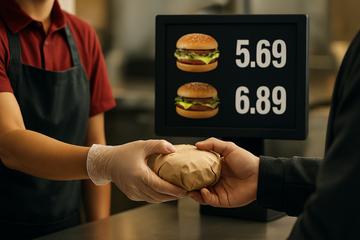
McDonald's algorithm priced a Big Mac 21% higher two miles away — now it's racing the FTC's August rule
A Sept. 29 Reuters probe shows McDonald's using an AI 'willingness-to-pay' engine across all 14,000 U.S. stores, with the same Big Mac ringing up $5.69 in one Fresno company-run restaurant and $6.89 at another two miles away. The deployment arrives as McDonald's shares have lost ~31% from their February peak, U.S. traffic has fallen every month since March, and the FTC's Aug. 19 personalized-pricing enforcement policy is sitting in a 30-day comment period that closed days before the story broke. The chain's 95%-franchised economics mean every dollar the algorithm lifts flows partly to Oak Brook as royalty and rent, but also concentrate McDonald's directly in front of regulators, franchisee lawyers, and three state-level pricing bans now on the books.

Meta Says Muse Didn't Read Your Private Messages. The $16.68B Settlement Already Shows Investors How This Math Ends.
On Sep 19, a tech columnist alleged Meta's Muse agent pulled 187,000 lines of Apple Messages off his Mac without permission. Meta disputes the claim. But Meta has already absorbed $2.40 billion of legal charges in Q2 2026 and signaled a roughly $10 billion Q3 charge tied to the $16.68 billion addiction settlement — meaning investors now have a template for how consumer-AI privacy exposure will land on the income statement. With Section 230 unlikely to shield AI agents and mass-arbitration claims potentially reaching into the trillions, the Muse flap is a reserve mark Meta's 10-Q never names.

Meta's Muse Already Lost the App Store to ChatGPT — Now It's Targeting 33 Million Small Businesses
Three weeks after Meta Platforms Muse peaked at No. 2 on the US App Store with 83K downloads and Amazon blocked it from its $68B ad-supported storefront, Meta has launched Muse for Small Business — a workplace version bundled with the new Meta Enterprise Platform and wired into 15 third-party SaaS tools. The pivot repositions Meta against Microsoft Copilot, OpenAI-backed ChatGPT Business, Salesforce Agentforce and Alphabet Gemini in the $777B SMB software market, where Meta Platforms owns a structural advantage: native access to the Facebook and Instagram ad accounts small businesses actually run their marketing on.
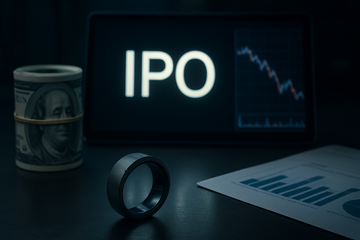
Oura Shelved a 4x-Oversubscribed $2.2B IPO. The 89% Subscription Margin Tells You Why Smart Rings Now Set Their Own Clock
Oura postponed its Nasdaq debut on Sept. 29, 2026 despite being profitable and roughly four times oversubscribed, citing \"uncertainty in the IPO market.\" With Holtec and Bamboo Insurance already shelved, an AI-led risk-off tape pressing the consumer-health window, and the deal's 73% insider secondary structure, the pull exposes a deeper truth: smart-ring subscription economics at 89% gross margin are strong enough that Oura can pick its own listing date. For listed wearables — Garmin, Apple, Peloton, Alphabet and Samsung Electronics — the question is which of them is now on the wrong side of that same subscription math.
Paramount Skydance sells $44.4B of bonds to buy Warner Bros. Discovery — and the equity tells you what the credit market won't
Paramount Skydance launched a $44.4B senior secured note offering on Sept. 28, 2026 to fund its $31-a-share, $110B-EV takeover of Warner Bros. Discovery. The bond market — 109 billion dollars of orders on a 32-billion-dollar investment-grade tranche — said the credit is workable. The stock market, sending PSKY down 3% on launch day to a market cap under $11 billion, said equity holders will eat the leverage. The combined balance sheet will carry roughly $80 billion of debt against a pro forma EBITDA base that S&P Global Ratings puts at a 7.6x leverage ratio through 2027. The strategic logic: a 175-million-subscriber Paramount+–HBO Max stack built to fight Netflix's 325 million subs and YouTube's $11 billion-a-quarter ad machine.
Tesla's Friday Print Tests a Tough YoY Math: Median Consensus 463K Is Already a 7% Drop, and Even the Bull-Case 482K Is Down
Tesla's IR-compiled Q3 2026 delivery consensus, posted Sept 29, sits at a median 463,406 with a 421,758–482,000 range — every estimate is below the Q3 2025 record of 497,099. Combined with operating margin already compressed to 1.4% in Q2 and BYD taking the global BEV crown back in Q2, the print will set the tape not just for Tesla but for Rivian, the GM and Ford EV lines, and the upstream battery names tied to Tesla volume.
2026-09-29

2026-09-28

CarMax's Tuesday Print Tests a Used-Car Floor That Just Tipped Negative for the First Time in 2026
CarMax reports Q2 FY27 on Sep 29 with Manheim wholesale values now down 0.4% year-over-year and Fitch subprime 60+ delinquencies re-accelerating to 6.13% in July from a tax-driven 1H26 average of 5.80%. Three of KMX's margin engines — retail gross profit per unit, wholesale gross profit per unit, and CarMax Auto Finance income — compress at once, making CarMax the cleanest read on whether the lower-credit consumer is starting to crack. The print sets the tone for read-throughs to Ally Financial, Capital One, Carvana, and American Express.
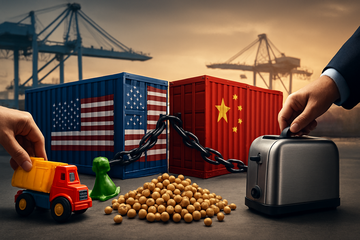
The $60B Trump-Xi tariff cut skips soybeans — but picks 77 tariff lines of toys, toasters, and dollar-store shelves as the real winners
The US-China deal announced Sep 25-28 cuts tariffs on $30B of imports in each direction, but the lists are radically asymmetric: the US released 77 lines concentrated in consumer goods (toys, small appliances, Christmas decorations), while China's 1,619-line schedule covers US farm goods — and excludes the $16B soybean trade. With ~90% of covered products sliding to MFN rates and US toy imports already down 32% since 2024, Chinese exporters (Midea Group, Joyoung) and US importers with deep China sourcing (Five Below, Dollar Tree, Hamilton Beach) collect the biggest windfall, while Hasbro, Mattel, and soybean farmers are the conspicuous losers.

GM Pockets $20.4B From the Final CAFE Rewrite — and Tesla's $2B Credit Pool Quietly Funds It
NHTSA's final fuel-economy rule cuts General Motors' 2031 compliance bill by $20.4 billion and lifts total Detroit savings to $60.6 billion by exempting legacy makers from the EV build-out and emissions gear the 2024 rule would have required. Tesla' regulatory-credit revenue dropped 67% year-over-year to $146 million in Q2 2026, and the rule's new credit-trading curbs shut off the transfer market Detroit was leaning on. The breather lands at GM exactly when its cumulative $10.9 billion of EV-related charges since the second half of 2025 need absorbing.
2026-09-27

Alphabet's Buy Button Just Landed in Flipkart — and India Becomes the Lab Where US AI Agentic Commerce Meets the Festive Cart
Google has started letting Indian shoppers tap a Buy button on Walmart-owned Flipkart listings inside Gemini and AI Mode, the first live test of agentic checkout on UCP outside the U.S. The test is narrow — smartphones, electronics and accessories — but it lands days before Flipkart's October 9 Big Billion Days sale and gives Alphabet a structural head start over Amazon's walled-garden Alexa for Shopping and OpenAI's India ad layer, because checkout, not conversation, is what moves GMV.

Meta Made Smart Glasses the AI Front Door — and Used a Tamagotchi to Do It
At Connect 2026, Meta Platforms launched five glasses SKUs plus a $1,299 VR headset and a 5G \"Muse Charm\" Tamagotchi — pushing smart glasses out of a niche and into the mass-market AI front door at $349–$449. The agent loop now runs through a fingerprint-tapped pendant, not a chat window, putting pressure on Apple's $3,699 Vision Pro and the still-unlaunched OpenAI/Anthropic hardware plays. Reality Labs still bled $4.62B in Q2, but smart-glasses shipments are up 167% YoY and Qualcomm plus EssilorLuxottica own the supply chain underneath.
2026-09-26

Apple's $5.7B Haptic Verdict: Why a ~$10 Vibration Motor Just Became a 4% Drag on Apple's Earnings
A San Diego federal jury ordered Apple to pay Taction Technology $5,721,961,750 on Sept. 25, 2026 — the largest U.S. patent infringement verdict ever — for haptic feedback patents reading on the Taptic Engine that powers every modern iPhone and Apple Watch. The same jury declined to call the infringement willful, removing the treble-damages threat but leaving Apple on the hook for a one-time charge roughly equal to 4.4% of trailing net income. Investors can absorb the cash hit; what they cannot absorb is the precedent that two asserted claims covering \"damped bass-frequency vibrations\" now bind Apple's installed base of more than a billion haptic-equipped devices. Upstream, AAC Technologies and GoerTek sit inside the patent's shadow; downstream, Samsung Electronics — already locked into Immersion's haptic IP since 2013 — just picked up an underpriced competitive moat.
McDonald's 30% Sell-Off Says the Big-Mac Inflation Trade Has Finally Broken — Now QSR Pricing Power Is the Question
McDonald's has shed roughly 30% from its March high — including a ~5% drop on September 23, 2026, when CEO Chris Kempczinski told investors industry traffic will stay flat while inflation keeps accelerating. The $8.5B NEXT plan eases franchisee pressure but concedes that the U.S. consumer no longer accepts price increases without pushback: domestic comps slowed from 2.5% in Q2 2025 to 0.8% in Q2 2026, with guest counts declining. The peer set tells the story — Wendy's traffic collapsed 12.5%, Chipotle comps are positive on real transactions, Yum Brands leans on Taco Bell, Restaurant Brands International is riding Burger King's reset. The trade is no longer about QSR pricing power; it is about who can run a no-traffic-growth operating model.
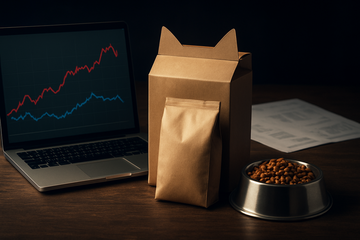
Cat Owners Are Out-Spending the Cycle: How Sep 24's Pet-Retail Print Reshapes the Consumer Trade-Down Map
Chewy and Petco just printed a clean cat-versus-dog split — cat food up double digits, dog food down high single digits at General Mills — while 22% of U.S. pet owners say they're cutting back overall. The thesis is non-obvious: cat discretionary is decoupling from the broader consumer trade-down, and the winners are the cat-skewed e-commerce retailer, the diversified omni-channel operator, and the premium pet-food brands with cat-tilted mix. Over a 1-3 year horizon, that reallocates wallet share away from dog-led staples and toward cat-positioned suppliers and digital retailers.
2026-09-25
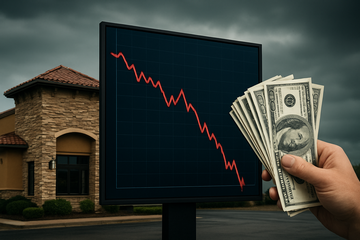
Olive Garden Just Hit the Trade-Down Ceiling — Darden's 1% Comp Is Casual Dining's First Casualty of the Fed's Last Hike
Darden Restaurants printed a razor-thin Q1 FY27 miss on Sept 24 — revenue $3.20B vs $3.21B expected, EPS $2.05 vs $2.06 — but the real story is inside the portfolio: Olive Garden same-restaurant sales fell to 1.0% from4.0% a year earlier, while LongHorn Steakhouse ran 6.8%. Eight days earlier, the Fed hiked to 3.75-4.00% and signaled one more, and on Aug 20 Walmart revealed it's now pulling share gains from households making more than $100,000. The trade-down thesis that fueled casual dining for two years is fragmenting into a barbell — premium steakhouses and dollar-channel grocery — and the middle of the consumer pyramid is suddenly the most dangerous place to be a public restaurant stock.
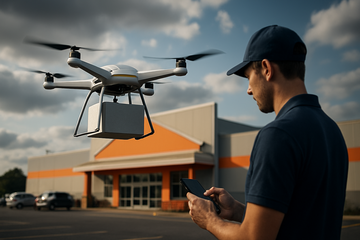
Lowe's Drone Pilot Just Made Wing and DoorDash the Default Last-Mile Stack — and Forced Home Depot to Spend
Lowe's is using Wing drones and the DoorDash app to ship 2.5-lb hardware items to a five-mile Matthews, N.C. radius in as little as 20 minutes — the first credible proof that drone economics work for high-ticket, lower-velocity SKUs, not just sub-2-lb restaurant food. Wing now holds the last-mile infrastructure layer (Walmart + Lowe's + the DoorDash restaurant network), while DoorDash controls orchestration — and simultaneously stood up its own FAA Part 135 carrier, DoorDash Air, to operate alongside the partners it depends on. The repricing is already underway: Home Depot launched nationwide three-hour express delivery five weeks earlier, betting ground couriers can still hold the home-improvement SKU set.
What to expect
Evidence-first notes with a visible point of view.
This section collects sharp takes on earnings, shareholder meetings, and market structure. Each new piece should make the thesis, the facts, and the implications obvious within the first few screens.
Expect direct analysis, not generic commentary.
Expect the data to be explicit and the argument to be easy to follow.