Latest
The day's market news, with the argument attached
New notes every trading day on earnings, policy and market structure. Each one opens with the conclusion, then the evidence, then the companies it hits.
2026-10-27


Treasury Raised Its Long-End Bid to $6 Billion. The 30-Year Still Printed a 19-Year High
On Oct. 26 the Treasury set the preliminary size of its next liquidity-support buyback at up to $6 billion in 20- to 30-year nominal coupons, with the operation running Oct. 27 and settling Oct. 28 — the same afternoon the Fed publishes its decision. The headline size reads like a buyer of last resort; the operating record does not. Through July, Treasury filled 100% of its cap in the long end on offers 11.9 times the maximum, but since Sept. 9 it has taken just 68% of the cap ($4.078 billion of $6 billion on Sept. 24) while the 30-year printed a nineteen-year high of 5.36%. What has genuinely changed sits at the front end, where the official sector funded more than $550 billion of extra bill supply in July and August and left the long end to leveraged, price-sensitive private capital — which is why BlackRock's decomposition finds the 10-year's 110 basis point rise in real rates rather than in the term premium. Nov. 4's refunding, where Citi expects $3 billion of 20-30 year auction sizes to be cut and replaced with bills, is the only lever that changes the arithmetic.

Export Credit Is Just 2% of Aircraft Financing — and Now It Holds the US-EU Trade Truce
USTR Jamieson Greer told the EU on October 26 that Washington's inability to see the terms of the European Investment Bank's €3 billion loan to Airbus threatens the 2021 large civil aircraft truce, moving the aerospace dispute from tariffs to the financing terms of a sovereign loan. The lever came from Boeing, which asked USTR in July for a full accounting of the facility, and the 2021 framework obliges both sides to fund their aircraft champion on market terms through an open and transparent process. Export credit is a tiny share of the money but a concentrated one — 2% of Boeing's first-half 2026 delivery financing, and 23% of the financing behind Boeing's 29 deliveries into Europe and Central Asia — and the 2025 US-EU deal already removed aircraft from the tariff schedule, leaving finance and transparency as Washington's remaining aerospace leverage. The asymmetry is stark: the complainant runs a -5.4% trailing operating margin and $38.7 billion of net debt, while the respondent holds €8.4 billion of net cash and a +8.1% margin, so a broken truce hurts both and hands the next order to whoever finances it best.

Walmart Gave AI Agents a Spending Cap and a Login — Which Makes the Retailer, Not the Model Lab, the Owner of the Transaction
On October 21, 2026, Walmart said third-party AI assistants could shop Walmart and Sam's Club on a customer's behalf inside a customer-set spending limit, with approval required by default and no card data ever handed to the agent. The mechanism is a Model Context Protocol gateway, per-agent profiles, and terms that block non-compliant agents — the point-by-point answer to the three objections Amazon used to shut Meta's Muse out of its own store. The prize is attribution: agent checkouts convert at roughly one-third of click-outs, so the value of agent traffic depends entirely on whoever keeps the receipt and can price the ad against it, which is the retailer. For investors the trade is authorization — networks and checkout layers get paid on every delegated purchase, platforms risk losing the impression, and brands lose the customer relationship they used to own.
2026-10-26

37.5% on Covered Brazilian Goods: The Censorship Tariff Lost Its Author in Court, and Lula's Win Doesn't Touch It
Lula's 51.76% runoff win over Flavio Bolsonaro on October 25, 2026 removed the political author of Washington's Brazil penalties, but not the penalties themselves. The 40% duty written around the Bolsonaro-era censorship of US online platforms was already knocked down by the Supreme Court, and what replaced it is a legally durable Section 301 pair: 25% from July 22, 2026 plus a 12.5% forced-labor action from July 24, a 37.5% stack on covered goods. The binding variable for Brazilian assets is now fuel: Atlantic Basin diesel cracks are at records while Petrobras' diesel sells at a near-yearly-record discount to import parity, so the election decides whether that gap is paid by Petrobras's refining margin or by the federal treasury, and a contested handover keeps an institutional risk premium on Brazilian assets until January 1, 2027.

Washington Can't Raise Its Canada Tariff Rate — So It Re-Cut the Product List Eleven Days Before the Midterms
The Oct 23 proclamation stripped 50% duties from Canadian plywood, paper products, machinery, refrigeration equipment and packing crates while adding carpets, valves and waste products, effective Oct 30. That is a schedule rewrite, not a negotiating position, and it reveals how this trade war will now be fought: Section 338 caps the rate at 50%, so the only thing that can move without a signed deal is which product lines sit inside the list. For investors the consequence is precise — trade the list, not the rate, because the companies whose gross margins compressed hardest in Q2 and Q3 2026 are the ones that ship product across the 49th parallel in both directions.

The NBA's First Prediction-Market Toll Is $100M–$200M a Year — What It Sold Was Permission, and a Channel Into the Rulemaking
The NBA has become the first league to split the US prediction market in two: on October 26, 2026 it signed an integrity memorandum with the CFTC, named Kalshi and Polymarket its preferred prediction market exchanges, and made DraftKings an authorized operator with nationwide promotional rights. The fee is trivial — industry sources put the two exchange deals at $100 million to $200 million a year against an estimated $4 billion of annualized revenue at Kalshi alone — so the real transfer is not cash but control over who may trade the league's games. The agreement gives the league a contractual grip on its partners and a formal channel into the rulemaking that decides which sports contracts the CFTC will permit, which is worth more than the rights fee. Own the data supplier that sits on both sides of the deal, Sportradar; be careful with the operators left outside the perimeter, including Robinhood, Flutter and Caesars.

A $377 Million SPAC at Trust Value: What Corxel's Obesity Listing Says About Pricing a Pre-Revenue Pill
Corxel US and Amanat Acquisition Corp will take a Phase 3-ready oral GLP-1 public through a SPAC at an implied $200 million pre-money, with a $300 million PIPE at $10.00 a share and $75 million of trust money — marking the whole pro forma company at trust value, with no premium for the de-risked asset. The mechanism is a specialist syndicate willing to fund the trial but not to pay up for it, and the benchmark is a market that has already repriced oral GLP-1 assets from scarcity to competition since Novo Nordisk's pill and Eli Lilly's Foundayo arrived. For investors, the read-through is that pre-revenue obesity assets can still be financed quickly and at scale, but only at prices the strategic market has already written down.

Private Defense Tech Is Marked at 24–32x Sales; Its First Public Print Cleared at 4x
Private defense-tech marks — Helsing at $18 billion, Shield AI at $12.7 billion, Anduril at $61 billion — now price contract revenue at roughly 24 to 32 times sales, a multiple no listed defense company commands. The one clean public test of that model, the Lyntris IPO in August 2026, priced below its marketed range at $17.50 and trades at $10.28, roughly four times trailing sales. The primes are not where the risk sits: Lockheed Martin closed the third quarter with $292.0 billion of backlog, Northrop Grumman with $109.6 billion and RTX with $340 billion, and all three trade between 1.9 and 3.0 times sales. The warning points at the private marks, and it reaches listed investors through the drone and space proxies and the propulsion suppliers that sized capacity to private order books, not through prime backlog.

Record Diesel Is Now a Delivery Fee: The Crack Spread Reaches the Front Door Before the Fed's December Hike
Diesel at $6.276 a gallon in the week ending Oct. 19, 2026 — a quarter of a dollar below the record set the week ending Sept. 21 — is being priced into holiday delivery fees, not just into pump prices: FedEx, UPS and Amazon Shipping all switched on holiday surcharges between Oct. 25 and Oct. 26, on top of fuel charges that reset weekly against the national diesel average. The engine is a refining constraint, not an oil price. The diesel crack spread has held above $100 a barrel since Sept. 1 for the first time in 2026 and stood at $113.24 on Oct. 20, while September producer prices showed gasoline up 20.3% in a month and final demand up 6.3% from a year earlier. That print is why the Fed raised rates on Sept. 16 to 3.75%-4.00% and why every economist polled expects another quarter-point on Dec. 9. The money has one destination: refiners booked $8.8 billion of refining operating income in a single quarter at a $39.24-a-barrel margin, while carriers, truckers and retailers carry the rest of the crack on their price tags.

EQT Pays $16.97 a Molecule for Range, Against Its Own $16.94 — So the AI Power Prize Is the Contract, Not the Rock
EQT agreed to buy Range Resources in an all-stock deal worth $12.83 billion on Oct 26, 2026, creating a company with more than 9 Bcfe/d of production and over $50 billion of enterprise value. Measured by enterprise value per Mcfe of annual production, EQT is paying $16.97 for Range's molecules against its own $16.94, so the molecules change hands at par and the real prize is the contracting machine that can sell them to AI data centers. The evidence says the AI power boom is a volume story, not a price story: the EIA's October forecast has Henry Hub falling 9% to $3.16 per MMBtu in 2027 even as consumption and LNG exports rise. Range shareholders banked most of the announced premium on day one while EQT shareholders paid 1.8%.

Record Deals, Shrinking Premiums: Ageing Moved Pensions to Insurers — and a 6% Long End Now Sets the Price
UK risk transfer to insurers and reinsurers is forecast at £70bn in 2026, up 15%, and US pension risk transfer assets have reached $339.8bn, up 9% year on year — the ageing liability really is moving onto insurer balance sheets. Yet US premiums fell 26% in the second quarter even as contract counts rose 21%, because with the 20-year gilt near 6.0% and annuity purchase rates at 5.88% to 5.99%, duration is the binding constraint rather than demand. Insurers capture the liabilities and the fee pool, reinsurers capture the capital, and asset managers are left paid on a flat £880bn of hedged liabilities. The unpriced risk is circular: insurers fund 30-year longevity with private credit whose tight yields are what make the buy-in price work.

Grok Shipped Seven Minutes of AI Video. A Finished Minute Now Costs More Than 175x What It Sells For
xAI's Grok Imagine published Episode 1 of an AI-generated Odyssey series on Oct 23, 2026 — 7 minutes 12 seconds, made with a partner studio and a director, three months after promising a full-length feature. The runtime is the headline; the unit economics are the story. Generating a finished minute costs $13 to $220 at the model layer, while the only AI-native feature sold to consumers prices at $9.99 for 135 minutes, or seven cents a minute, so a finished minute costs at least 175x what it fetches. The margin in this chain is accruing upstream and to rights holders — NVIDIA's data-center revenue reached $89.0 billion last quarter and Micron earned an 86.8% gross margin — while the studio layer is still waiting for a buyer. For investors, generative video is a compute-and-rights trade today, not an entertainment trade.

Huang's Kazakhstan Trip Priced AI in Watts, Not Chips: At 2.5 Cents per kWh, the Bottleneck Moves to the Grid
On October 23, 2026 Jensen Huang made his first visit to Kazakhstan, and the announcements that mattered were about electricity and export licenses rather than chip orders: 300 megawatts already allocated at Data Center Valley in Ekibastuz, a proposed long-term tariff of about 2.5 US cents per kilowatt-hour for data-centre investors, and a US export license for 45,000 Grace Blackwell GPUs to Firebird. Read together, they reframe the AI trade — the scarce input is not demand but an energized, permitted megawatt, and NVIDIA's own filing shows the squeeze arriving as purchase obligations and inventory provisions. The metals leg is thinner than the headlines imply: S&P Global Market Intelligence has data-centre copper demand rising only from 1.1 million tonnes in 2025 to 2.5 million tonnes by 2040, with fibre substitution removing another 4-5 tonnes per megawatt. The tradeable exposure therefore sits in grid and power equipment (Vertiv, Q2 2026 sales up 24%), fuel and firm power (Cameco at US$67.79 per pound realized uranium), and the vendors of both (NVIDIA, $89.0 billion of data-centre revenue in Q2 FY2027).

Intel's $3.5 Billion Pentagon Anchor Became 433 Million Shares — and Still Zero Named Production Orders
The Pentagon's headline chip award for Intel never contained a wafer order. What the Defense Department actually awarded on Sept. 16, 2024 was up to $3.0 billion in CHIPS Act funding for a trusted-manufacturing program, and $3.17 billion of that money was converted into 433.3 million Intel shares at $20.47 when Washington took a 9.9% stake in August 2025. When the RAMP-C prototyping program closed on July 28, 2026, Intel named no customer, product or wafer volume. Federal support for the foundry has arrived as prototypes and equity instead of orders, while Intel Foundry grew revenue 31% to $5.77 billion in Q2 2026 while losing $2.09 billion at the operating line — which makes the Oct. 29, 2026 results the first real test of whether external 18A volume is ever disclosed.

Lycia Therapeutics Raised $317.5 Million Into a December Rate Hike — and Put 28% of It Into a Race It Is Losing
Lycia Therapeutics priced 17.64 million shares at $18.00 on Oct. 22, 2026 — $317.5 million gross, the top of its range, and the only traditional US operating-company IPO of $100 million or more to price that week — then closed at $30.00 on debut, up 66.7%, five days before a Federal Reserve meeting at which all 100 economists surveyed expect a December hike. The print tells you the window for pre-revenue biotech has not shut; it has narrowed, and it now demands one thing: enough capital to reach the next value inflection without returning to the market. What the prospectus quietly concedes is where that capital is mispriced. $90 million of the raise — 28% — funds LCA-0321, a Phase 1 Graves' disease program that Biohaven is already running in Phase 3 and licensed to Ono Pharmaceutical two weeks earlier for $80 million upfront plus roughly 20% royalties. Pharma paid cash and a royalty stream for the later-stage asset; public investors paid cash for the earlier-stage one. That gap is the market's revealed preference, and it says this window is paying for Lycia Therapeutics's IgE food-allergy data, not for its autoimmune program.

Agentic Commerce Will Not Be Settled on Oct. 29 — Mastercard's Growth Mix Will, and the Market Already Paid $93 Billion for It
Mastercard reports third-quarter 2026 results before the open on Thursday, Oct. 29, and the print cannot settle whether agentic commerce adds volume: neither network discloses agent-initiated transaction counts, and Mastercard's own research puts routine agent buying at roughly one in ten shoppers only by 2030. What Oct. 29 can settle is the growth mix — currency-neutral value-added services revenue grew 18% in the June quarter against 8% for the payment network — and the stock has already re-rated from roughly 28 times to roughly 34 times trailing earnings since June 30 even as Brent closed at $116.72 and the 10-year sits near 5% with every economist polled expecting a December hike. Visa prints on Oct. 27 and American Express already said on Oct. 23 that the premium consumer is still spending, so a soft mix on Oct. 29 lands on an expensive stock with no macro excuse left.

Microsoft's 60,000 Buyouts Cover Half the Depreciation Step-Up — and Just 2% of the Capex
Microsoft opened a voluntary exit offer on Oct. 26, 2026 covering about 60,000 of its 223,000 employees, but at the take-up rate the company itself disclosed for its April voluntary retirement program, the real number is roughly 18,000 to 24,000 departures worth about $4 billion a year. That is near 2% of the roughly $175 billion calendar-2026 capital plan, so labor is not funding the datacenters — it is funding their depreciation, covering roughly 40% to 70% of the annual step-up implied by a $175 billion asset base on 15-to-25-year lives. The signal for shareholders is that Microsoft is defending reported operating margin, guided down less than a point for fiscal 2027, by cutting its own cost base in the same breath it extends data-center asset lives — the combination Gartner says breaks down when $3.5 trillion of AI infrastructure faces impairment risk by 2030.
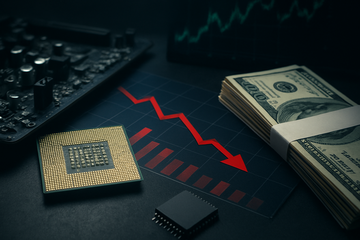
Morgan Stanley mapped a 15% chip drawdown — from inside the bank that helps finance the buyers
On Oct. 26, 2026, Morgan Stanley chief U.S. equity strategist Mike Wilson told clients that semiconductor shares may not find support until 15% below current levels — published on a session when chip ETFs rose nearly 3% and Nvidia added 2.5%. The tension is structural: the same house is a committed funder in the record $60 billion Broadcom–Anthropic chip-financing package, and Nvidia's own Aug. 10 release now markets compute as "an investable asset," so chip equities set the price of the collateral that supports a wave of AI debt Morgan Stanley itself forecasts near $570 billion in 2026. Wilson's framework is therefore a credit input, not a chart level, and both halves of the call — a 15% chip drawdown and a continuing AI-debt boom — can be true at the same time.

The Navy Just Added $2.41B for Its Reactor “Test-to-Fleet” Pipeline—And AI Cant Buy In
A $2.409B Navy modification sent to Fluor Marine Propulsion expands the Naval Nuclear Laboratory’s naval-reactor work—training and readiness for the submarine and carrier fleet, not data centers. That split matters for investors: the next wave of nuclear demand driven by AI power looks fundamentally non-fungible with the margin structure and contracting leverage of naval propulsion.
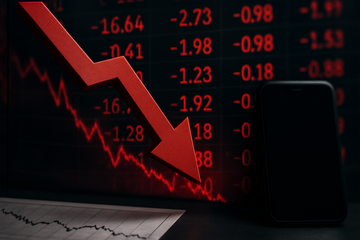
Nu Holdings Lost $16.4 Billion in One Pre-Market Session — and the Rate Everyone Blamed Is Not the Risk
Luiz Inácio Lula da Silva's 51.8% runoff victory on Oct. 25, 2026 sent Nu Holdings down about 22.5% in pre-market trading on Oct. 26, erasing roughly $16.4 billion of market value and pushing the stock below its pre-first-round level. The sell-off was mostly a repricing of Brazilian sovereign risk — the broad Brazil ETF fell about 19.6% and Brazilian banks 17%-18% — but the transmission into Nu runs through three channels: dollar translation of a real-denominated earnings stream, a credit book whose 90-plus-day delinquency already rose to 6.9% in the second quarter, and a valuation that had priced a fiscal adjustment Brazil has now abandoned. Nu's own second-quarter numbers show the margin was built on credit growth and falling cost of credit, not on rate cuts, so a 13.75% Selic that stays put is not what investors sold.
What to expect
Evidence-first notes with a visible point of view.
This section collects sharp takes on earnings, shareholder meetings, and market structure. Each new piece should make the thesis, the facts, and the implications obvious within the first few screens.
Expect direct analysis, not generic commentary.
Expect the data to be explicit and the argument to be easy to follow.