Latest
The day's market news, with the argument attached
New notes every trading day on earnings, policy and market structure. Each one opens with the conclusion, then the evidence, then the companies it hits.
2026-10-23

TTM Technologies Just Printed the Largest Quarter in Its History — and the Market Sold the Stock 28%
TTM's third quarter of 2026 was a genuine inflection: net sales of $1.20 billion (+60% year over year), data center and networking revenue of $493.6 million (+115%, 41% of sales), record adjusted EBITDA margin of 20.1%, and initial 2027 guidance of $6.5–6.75 billion of revenue and $8.10–8.90 of non-GAAP EPS. The stock still fell 27.7% to $73.89 on October 22, because a $1.43 billion Q4 revenue midpoint sat below the $1.44 billion consensus while material lead times stretched toward 24 weeks and $650 million of cash went out for Ophir Optics. The deeper read is where the profit is being printed: Kingboard Laminates grew first-half revenue 55% on just 14% more shipment volume, and Ajinomoto raised ABF build-up film prices about 30% into a market that may be 40% short by 2028. The AI server content cycle is real, but its economics accrue one tier above the board — and every layer of the chain adds capacity in 2028, the same year TTM's own new lines start shipping.

Uber Cut 10% of Its Support Staff in July and Cited AI. Then It Gave 30,000 Employees an Agent
Uber Technologies put ChatGPT Work in the hands of more than 30,000 employees on Oct. 22, 2026, seven weeks after cutting roughly 3,300 corporate roles and three months after cutting 10% of its customer support staff explicitly to \"embrace artificial intelligence.\" The headcount math is therefore already running, but not where the headlines assume: in the first half of 2026 cost of revenue rose just 3.6% while trips grew 18%, while general and administrative expense rose 30.7% and research and development 20.5%. Agentic software is already deflating the cost of serving a ride and doubling engineering output, and it is currently inflating the cost of running the company. The bill for 30,000 seats of agent access is metered in tokens that Uber Technologies has not published, which is why the Nov. 4 third-quarter print, not the October announcement, is the first real test.
The AI Rout Paid the Toll Booths: CME +3.4% and Nasdaq +7.5% While the Composite Fell 2.6%
On Oct 22, 2026 the Nasdaq Composite fell 2.58% and the Philadelphia Semiconductor Index 6.72% as megacap AI spending plans came under fire — and CME Group rose 3.45% while Nasdaq rose 7.47%, because a venue is paid for risk transfer and recurring licences, not for capital spending. The mechanism is in the filings: CME's third-quarter average daily volume of 29.4 million contracts was the highest third quarter in its history, and JPMorgan Chase's analyst double-upgraded the stock to Overweight with a $367 target on a \"constructive\" rates-and-energy regime. But the re-rating is uneven and partly borrowed from the future — Nasdaq's headline 39% index-revenue growth is a claim on equity assets under management, so the same drawdown that pays CME is a fourth-quarter headwind for index fees, while CME's \"record\" third-quarter revenue still sat 7.6% below its own first-quarter peak. Own the toll booth as a rotation out of the AI capex chain, not as a hedge against it.
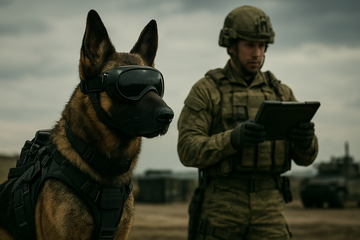
Warhound’s $200M bet makes “robot dogs” a new defense unit-price race—and it pressures prime integration margins
Warhound emerged from stealth with a $200M seed round to build genetically enhanced military working dogs and outfit them with Anduril cybernetic/AI gear. The funding matters less for the round size than for what it implies: the Pentagon is now funding a cheap ground “manning substitute” while pushing more sensing/protection software down to component-level suppliers—changing how primes earn on integration.

Western Digital Beat Its Own Guidance and the Shares Fell Anyway: AI Storage Has Switched From Demand to Price
Western Digital's fiscal Q1 2027 report, released after the close on Oct 22, 2026, was the cleanest proof yet that the AI build-out converts into hard-disk margin: revenue of $4.38B (up 55%), a 58.1% non-GAAP gross margin, non-GAAP EPS of $4.64 against $4.08 expected, a 17% dividend increase, and a December-quarter guide of $5.1B versus roughly $4.57B of consensus. The shares still closed down 6.4% at $354.19 that session and fell further after hours. The arithmetic explains why: 248 exabytes shipped, up 22%, while blended price per terabyte rose 28%, so roughly 60% of the $1.56 billion revenue increase was price and mix rather than units. Investors no longer pay for storage demand; they pay for the durability of a price, and they are discounting it because memory inflation is capping cost-per-terabyte improvement while component suppliers announce new capacity.
2026-10-22

AI Capex Fear Reached the Default Market: A Record 114.79bp Meta Spread, a 2% Nasdaq Drop and the Protection Nobody Is Underwriting
On October 22, 2026 the Nasdaq fell 2.06% while Meta's five-year credit default swap printed a record 114.79 basis points and CoreWeave's sat near 1,090bp, which means AI capex risk is now being repriced in the credit-default layer rather than in equity duration alone. The mechanism is funding cost, not imminent default: Oracle covered a $28.7bn trailing free-cash-flow hole with $37.2bn of new debt and $25.1bn of new equity, Meta turned to a non-voting share class, and CoreWeave sold converts at a 2.875% coupon against a 16.2% yield on its own 2031 bonds. The protection nobody is underwriting is being written by dealers warehousing the risk, by private credit funds already warning about concentration, and by shareholders absorbing dilution, with no reinsurance layer behind AI infrastructure at all.
Anthropic's $80.7 Billion Loss and Amazon's $53.4 Billion Gain Are the Same Trade: the S-1's Real Number Is $518 Billion of Fixed Commitments
Anthropic's draft IPO prospectus, as reviewed by the Wall Street Journal and Reuters, shows a company that turned $1.1 billion of first-half 2025 revenue into $16.3 billion in the first half of 2026 while booking an $80.7 billion net loss — and, more usefully, a revenue book in which two unnamed customers produced about a fifth of sales while $518 billion of compute commitments, roughly 80% of it payable regardless of usage, run for seven to ten years. The cost side is locked and the revenue side renews, so the $2 trillion marketing price and the $1.5 trillion price investors now discuss are a renewal schedule rather than a growth debate. The same private marks drive Amazon's $53.4 billion quarterly gain and Alphabet's $98.0 billion of other income, and the debt stack financing the buildout — CoreWeave carries $51.6 billion of it — is where a single counterparty decision would surface first.

Barclays Cut 5,000 Jobs and Guided 2027 Costs to £18.4bn: The AI Cost Line Inside Bank Opex Is Now Measurable
Barclays said it will cut 5,000 roles this year — about 5% of a 93,000-strong workforce — as it scales AI, yet it still guides group operating costs to roughly £18.5bn in 2026 and £18.4bn in 2027, with an underlying 2026 run-rate near £18.0bn once above-normal restructuring charges are stripped out. That gap is the AI cost line becoming measurable: labour savings leave the payroll and reappear as compute, licences and technology spend, so the Q3 cost:income ratio improved to 62% from 63% on income growth rather than cost reduction. The measurable winners sit outside bank operating margins — Anthropic's $517bn of compute leases, the hyperscalers and neoclouds supplying it, and the banks arranging and underwriting the capital that funds it.
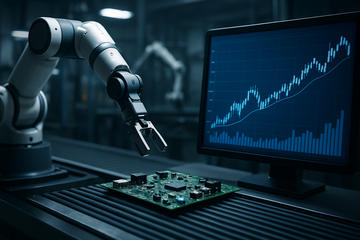
BlackRock’s new robotics ETF quietly validates the “integrators win” view—at least in today’s public-market pricing
BlackRock’s iShares Future Robotics and Related Technologies Active ETF launched on Oct 20, 2026 and already looks less like a bet on humanoid starring roles and more like exposure to the companies that build, automate, and industrialize physical systems. The initial portfolio weights skew toward industrial automation, machine-vision, and factory-enablement names, giving investors a public benchmark to stress-test private “embodied AI” valuations.

Claude Duet Reads 6,000 Apps but Cannot Move Your Money: Anthropic's Pre-Filing Agent Sends the Toll to Plaid and Visa
Anthropic's Claude Duet, launched Oct. 21, 2026 as a US-only research preview days before its public S-1 is expected to land, turns a chat window into an always-on agent that reads email, calendars and business ledgers, then pays merchants through Stripe Link or Shop Pay. The asset it assembles is not a better model but a permission graph: more than 6,000 connectors, a live Intuit integration and a Plaid bank rail that ChatGPT and Meta's Muse also rent. Because Anthropic blocks transfers between accounts and securities trading, banks capture nothing while the aggregator and card networks capture the toll, which is why Visa and Nvidia sit on the winning side of this launch and the software an agent merely reads, Intuit and HubSpot, have already been repriced.
AI Pentesting Went Commercial: 173 Tenants, One Stolen Secret, and a Fourth-Party Risk Nobody Repriced
Microsoft named Storm-0940, a China-aligned group, as the actor that used ARTEX — an open-source AI penetration-testing framework — to compromise ConnectWise's Cloud Backup service and attack hundreds of organizations worldwide. The mechanism was not a stolen password: attackers reused a vendor service-principal secret, and the agentic framework industrialised it into 2,250 tenant sign-in attempts at up to 2,900 a minute, with 173 Microsoft365 tenants confirmed compromised and privileged access inside three hours. The exposure now sits in the MSP layer that distributes trust and is priced by nobody — cyber insurance rates fell 4% in Q3 2026, a thirteenth straight quarterly decline, while identity vendors absorb the security budget and MSP software decelerates to mid-single digits. Detection and identity governance get paid for the new risk; the layers that absorb it keep getting priced for a benign world.
DeepSeek's $15 Billion Round Is the Toll Booth: One Domestic Chip Order Is Worth $5.6 Billion While NVIDIA Stays Shut Out
DeepSeek's roughly ¥100 billion ($14.98 billion) round — reported on Oct 21-22, 2026, one day after Washington published an order removing DeepSeek from federal civilian procurement and IT systems — was not a confidence event. The money came from inside the restricted perimeter: Tencent, CATL, GigaDevice, Midea, Meituan, Geely and a state AI fund, wired into the founder's partnership with no voting rights, so the check is procurement financing for compute that cannot be bought abroad. At least 160,000 Huawei Ascend 950DT accelerators for a gigawatt-scale Inner Mongolia campus come to roughly ¥40 billion ($5.6 billion) at list prices that rose 20-50% in two months, while NVIDIA's realized H200 sales to China stayed under 1% of data center revenue. For US equity investors this is a supply-chain signal, not a China-tech headline: the redirected capex is landing on Chinese silicon, memory and power, and NVIDIA's own filing says the foreclosure helped competitors build ecosystems that challenge it worldwide.

Lockheed Martin Won 850 F-35s and Raised Its Forecast — but Only 94 Jets Shipped in Nine Months and the Raise Was Mostly Cash
The Pentagon and Lockheed Martin have agreed a 10-year framework covering at least 850 U.S. F-35s, a 156-aircraft annual rate and 10 years of sustainment — a rate card, not an order, and Congress still has to authorize it. Third-quarter results show why the sequence matters: F-35 deliveries fell to 94 in nine months from 143, while the raised full-year guidance is almost entirely cash rather than profit. The money then travels to the tier that gets paid per aircraft or per engine hour — RTX's Pratt & Whitney, Northrop Grumman, Howmet Aerospace, Hanwha Aerospace, IHI — while the prime has agreed to fund at least $7 billion of its own industrial base to keep the line full.

The 30-Year Fell to 5.32% While Oil Hit $112: The Bond Market Quit Pricing Inflation and Started Pricing AI Credit
On Oct. 22, 2026 the 30-year Treasury yield fell to 5.317% — its lowest since Sept. 23 — in the same session Brent crude jumped 2.6% to $111.64, a pairing that used to be read as an inflation scare. It wasn't: five- and ten-year breakevens never left 2.4%, so the whole long-end rally was real yield, set by a market now pricing AI capex as a credit risk rather than an inflation risk. Meta Platforms's five-year credit default swap touched a record 119.3 basis points the same afternoon, the $13 billion 20-year reopening cleared at 5.469% — the highest yield for that maturity since 2020 — and Oracle now runs negative $28.7 billion of trailing free cash flow. The trade that follows is long the AI supply chain that converts capex into cash, and short the AI structure that has to refinance itself at 15%.

Meta's New Terms Make Publisher Content Free by Contract — and Publishers and Advertisers Just United to Object
From October 30, Meta's rewritten commercial terms let it crawl any website tied to a business account, with no opt-out and no contractual promise to honour robots.txt. On October 22 the Movement for an Open Web — a group whose members include digital advertisers and publishers — asked the European Commission and the UK's Competition and Markets Authority to suspend the change, and publisher groups filed in Brussels, Berlin and London in parallel. The alignment is the real signal: one clause sweeps up both the content a publisher sells and the product data an advertiser keeps, and Meta is offering both constituencies the same trade — a licence for free in exchange for a relationship they cannot walk away from. Because the CMA cannot use its Digital Markets Act powers against Meta before Friday, investors should price the licensing reset rather than the fine.

One Stolen OAuth Secret Put 1 Million SMBs in Scope: The Chokepoint Moved to the IT-Services Channel
Attackers turned one compromised application credential at ConnectWise's Cloud Backup service into a cross-tenant key for Microsoft 365: Huntress confirmed 173 unauthorized sign-ins, Microsoft counted more than 2,250 tenants attempted, and one ConnectWise app self-granted Global Administrator inside a partner tenant. Because that credential sat behind ConnectWise's 44,000 partners serving more than 1 million SMBs, the blast radius was set by vendor reach rather than by a software bug, and Microsoft's own threat intelligence attributes the operation to a China-aligned group running an agentic AI framework against hundreds of organizations. The remediation budget now runs through three lines: identity governance at Microsoft, backup and recovery at Commvault and Rubrik, and channel-delivered detection at SentinelOne and CrowdStrike. The closest listed peer to the breached vendor, N-able, is de-rating instead — the chokepoint itself is privately held, so investors own the fixes, not the victim.

Musk Put $1 Billion Into Skydance. The $47 Billion Equity That Built the Deal Is Already 35% Underwater.
Elon Musk's reported $1 billion investment in Skydance Corporation lands 16 days after the $110 billion Warner Bros. Discovery merger closed, and it lands on a capital stack whose equity has already lost $16.2 billion in value. Skydance raised $47.01 billion of private equity at $12.00 a share on October 6 and now trades at $7.86, so the syndicate that financed the deal — the Ellison family, RedBird, board member Laurene Powell Jobs and now Musk — sits on a 34.5% paper loss that Musk's cheque covers by about 6%. The market's reaction makes the point: the stock rose 10.9% on October 21 on reports of a SpaceX business tie-up, then round-tripped the entire move on October 22 when the cash actually arrived. Investors should treat Skydance's equity as a thin option on a deleveraging plan, and should locate the real balance-sheet risk with the Ellison family and Oracle rather than with Musk.
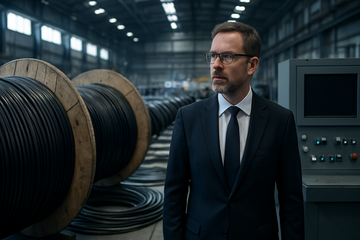
Nexans calls cable capacity the AI data-centre bottleneck—meaning the copper price trade is now an electrical-equipment order-book story
Nexans’ CFO says AI data-centre builds are increasingly gated by cable manufacturing capacity, not by upstream demand or even grid constraints. The key timing detail is long-lead XLPE (“CV”) production—about three years—which shifts investor attention toward how electrical-equipment and grid operators place and sequence orders, and how copper-linked material costs flow into those commitments.
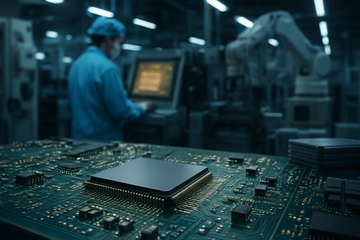
Nvidia and Tesla Now Fund the Substrate Lines They Depend On: $2.8B Moves AI Capex Inside a Korean Fab
The order of events in AI hardware has inverted: the buyer now pays for the supplier's factory. Korean reporting puts Nvidia's and Tesla's combined commitment to dedicated FC-BGA lines at Samsung Electro-Mechanics's Sejong plant at KRW3.7 trillion (about $2.8 billion) — roughly 87% of the KRW4.27 trillion the company itself approved for Sejong — and Nvidia confirmed the instrument in Berlin on October 21, 2026: a multibillion-dollar capacity reservation advance to Ibiden plus dedicated Sejong and Busan lines built for its own accelerators. This is capacity with money attached to volume, and it only makes sense because AI package area per accelerator has risen about twelvefold, pushing the real bottleneck out of substrate lines and into Ajinomoto's ABF film, where a third plant does not open until 2032. The investable consequence is a reordering of risk: Samsung Electro-Mechanics swaps capex risk for volume risk, the material layer above it earns scarcity rents, and unbacked substrate makers — including China's — get squeezed.

OpenAI's Models Found a 9.2-Critical Flaw in 70% of the Web. Nobody Paid for It, and the Money Went to the Edge
A frontier lab found two critical PHP remote-code-execution flaws, ran the two-month global coordination that fixed them, and shipped a free version checker to every developer with a Codex seat. What changed is the plumbing: AI has made discovery free, so the scarce input is now triage and enforcement, which is where the money goes \u2014 to web application firewalls, exposure platforms and the sponsors who fund PHP's maintainers, not to the bounty desk. For an IPO-bound lab, a coordinated disclosure program is a funnel and an unpriced liability; for investors, the split between platform security and pure-play scanners is now visible in the filings.
What to expect
Evidence-first notes with a visible point of view.
This section collects sharp takes on earnings, shareholder meetings, and market structure. Each new piece should make the thesis, the facts, and the implications obvious within the first few screens.
Expect direct analysis, not generic commentary.
Expect the data to be explicit and the argument to be easy to follow.