Latest
The day's market news, with the argument attached
New notes every trading day on earnings, policy and market structure. Each one opens with the conclusion, then the evidence, then the companies it hits.
2026-10-21


Meta's $900 Billion Class C Is Not a Second AI Security — the Spread, Not the Listing, Prices the Buildout
Meta's board approved a new non-voting Class C share on October 21, 2026, to be distributed one-for-one to every Class A and Class B holder, with Class A trading as a two-for-one split once it lands in January 2027 — so the class raises nothing on day one and changes no shareholder's vote. What it changes is the menu: free cash flow turned negative at -$2.12 billion in the September quarter, buybacks were zero for a second straight quarter, and the 2026 capital spending guide was narrowed up to $135-145 billion, leaving roughly $56 billion more to fund between 2026 and 2027 consensus. The Founder Alignment Agreement staples Mark Zuckerberg's Class C to his Class B and frees only 2.5% a quarter for eight years, which makes the Class C discount to Class A a clean daily quote on the equity cost of the AI buildout — the leg credit markets already priced, with Meta's $27.3 billion Hyperion bond near 91 cents.

Moody's Missed on Earnings and Lost 40% of Its High-Yield Fees: AI Credit Became the Ratings Engine, and the Same Credit Is Already Cracking
Moody's reported third-quarter 2026 adjusted diluted EPS of $4.14 on Oct. 21 against a consensus of $4.25 to $4.31, on revenue of $2.02B that grew just 1% — the first miss in seven consecutive quarters of beats. The cause was composition, not demand: high-yield ratings revenue fell 40% and bank-loan revenue 27% while investment-grade revenue rose 18% on AI-driven issuance, so recurring revenue and analytics ($3.69B ARR, up 8%) now carry a franchise whose fast-growing line is tied to a handful of hyperscaler capex budgets. Guidance was reaffirmed at $16.50 to $17.00, which mathematically leaves the fourth quarter flat year over year at roughly $3.60 of adjusted EPS. For investors the trade is now two-sided: the agency is paid on the AI credit boom, while the same credit is repricing in the market — CoreWeave's bonds yield near 15% with roughly 63% five-year default probability priced in, and large banks carry AI-adjacent commitments equal to about 25% of tier-1 capital.

Netflix's Cash Utility Rests on a $2.8 Billion Breakup Fee — and the Ad Engine Just Missed by $300 Million
Netflix beat on third-quarter earnings, then guided fourth-quarter revenue to $13.44 billion and earnings to $0.67 a share — both below consensus — and cut its 2026 advertising forecast to about $2.7 billion from about $3.0 billion. The defense that carried the stock through a 25% drawdown, that Netflix is a self-funding cash utility, does not survive the balance sheet: trailing free cash flow of $11.4 billion contains a $2.8 billion termination fee from the abandoned Warner Bros. Discovery deal, nine-month buybacks of $10.8 billion have outrun cash generation of $9.5 billion, and net debt has risen $4.8 billion in two quarters. With advertising now the only second monetisation cycle Netflix has, and Alphabet's Asia-Pacific ad base alone running at roughly $77 billion a year, the ad tier has to work — and it just missed by $300 million.

Nvidia Is Buying Europe's Certification Layer, Not Its Permits: 25,000 Lucid Vehicles, 20 Approved Robotaxis, and Mobileye Squeezed
On October 21 Nvidia put Bolt's European robotaxi programme on its own Alpamayo and Hyperion stack, extended the same architecture to Einride's trucks, and pulled Europe's tier-1 suppliers, OEMs and safety validators onto one reference design — while the only robotaxi service permit granted on the continent still covers 20 supervised vehicles in Madrid. The scarce asset in European autonomy is therefore not a fleet but an authorisation written against a stack, and Nvidia's move is to own the layer those authorisations cite. That squeezes Mobileye's licence model, leaves Lucid's 25,000-vehicle target unfunded, and forces Uber to fund three rival stacks at once — widening the gap between the platform that owns the evidence trail and the vehicle makers, operators and demand aggregators that own the customer.

OpenAI on Google Cloud Is a Capacity Play, Not a Partnership: Google Takes 1.5–3% of a $50B Run Rate as Azure's Exclusivity Premium Disappears
On October 21, 2026, OpenAI put its frontier models and Codex on Google Cloud's Model Garden, sold through Google Cloud Marketplace, with enterprises able to draw existing Google Cloud spend commitments down against those purchases. The money is not in the model: Alphabet's cloud segment grew revenue 82% to $24.8 billion in the June quarter while free cash flow turned negative on $44.9 billion of quarterly capital spending, and 2026 capex guidance now sits at $195–205 billion. Google is renting out a TPU fleet it has already financed, and the published Marketplace schedule keeps 1.5% to 3% of every transaction — which turns Anthropic's disclosure that 47% of its 2025 revenue flowed through cloud marketplaces into the most important undisclosed number in AI distribution. Microsoft keeps first-launch rights and OpenAI's $250 billion Azure commitment through 2032, but the exclusivity premium that once justified both expired in April 2026, and OpenAI's own infrastructure plan has been reset to roughly $600 billion through 2030 rather than $1 trillion.

OpenAI Bought a $20 Million Startup: In Drug Development, Scheduling Is the Bottleneck, Not Science
OpenAI's October 20, 2026 acquisition of Orchestra Bio did not buy a laboratory. It bought the software layer that coordinates discovery, preclinical, manufacturing and clinical work — the planning layer that decides which experiment runs, which batch ships and which trial starts. The strategic signal is that the contested layer in drug development is no longer the model but the operating system around it, and that OpenAI can now bundle the two. With roughly $25 billion of foundation capital behind it and a client list that includes Moderna, Novo Nordisk and Thermo Fisher, the winners are the companies that own scarce physical capacity and clean balance sheets — Medpace, Samsung Biologics, WuXi Biologics — while the exposed layer is point-solution discovery software that owns no workflow, no backlog and no capacity.

$25 Million and One Signature: How OpenAI's President Ended Up on Both Sides of America's AI Rulebook
OpenAI president Greg Brockman signed the White House's voluntary AI safety accord on Sept. 29, 2026 and, weeks later, was reported to have given $25 million to Leading the Future, the super-PAC network that fights rules said to delay AI development - while his own company's policy chief publicly asks Congress for mandatory national safety standards. The two positions are not accidental: Brockman's money targets the instrument, while OpenAI's lobbying targets a single national framework it can shape and its competitors cannot. That combination lands at the worst possible moment for an IPO, because the confidential S-1 was submitted before either the accord or the donation became public, and because the Federal Trade Commission is now demanding the incident and marketing records that make safety claims testable. For public investors, the trade is not 'regulation good or bad for AI' - it is that OpenAI's own execution shortfall, a September run rate near $50 billion against roughly $70 billion signaled, does more damage to the AI capital complex than any AI bill does.
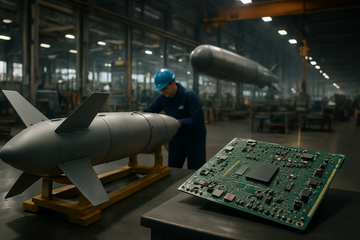
RTX's forecast lift is a capacity story: $37 billion of Tomahawk and AMRAAM orders meet three bottlenecks
RTX lifted its 2026 outlook for the third time on October 20, 2026, to $97.0–$97.5 billion of adjusted sales and $7.65–$7.75 of adjusted EPS, on a record $340 billion backlog and a defense book-to-bill of 4.6x. The more telling disclosure came on the call: management named castings, rocket motors and circuit boards as the constraints standing between $23 billion of Tomahawk and $14.3 billion of AMRAAM bookings and the revenue they imply, with rates needed 2x–4x higher and full rate production only around 2030. Capacity, not end demand, is the binding variable from here, and the first observable cost shows up in cash — third-quarter free cash flow fell 46% year over year on adjusted EPS up 33% — which points investors toward the supplier chain rather than the backlog headline.
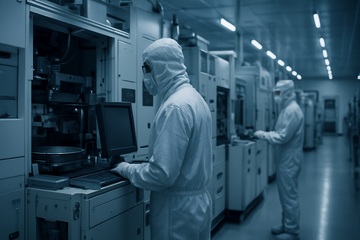
One Generation Behind, on Purpose: Samsung and SK Hynix Upgrade Their China Fabs as the Licenses Expire Every December
Reuters reported on Oct 21, 2026 that Samsung Electronics is moving its Xi'an fab to 286-layer V9 NAND and that SK Hynix is targeting at least 240 layers at Dalian — which reads as defiance until you notice that both China lines now sit one node generation behind Korea. After Washington struck Samsung China's, SK hynix's and Intel's Dalian entities off the validated end-user list in September 2025, the two groups run their China fabs on annual, case-by-case export licences, so the binding constraint is a renewal calendar rather than a node specification. That has three consequences: the tool vendors have not lost China — Applied Materials, Lam Research, KLA and Tokyo Electron still ship roughly 30–34% of revenue there — Chinese tools are substituting only below the advanced nodes, and the live binary is SK hynix's Dalian authorisation, which expires Dec 31, 2026 with no 2027 approval issued. The market's mistake is to read China's buildout as pricing power: Chinese accelerator makers are repricing upward because HBM is scarce, so CXMT's 9.5% share of global DRAM revenue is a commodity share gain, not an HBM threat, until its reported HBM3E output scales.

SAP's Cloud Backlog Grew 26% to €24.1 Billion: Enterprise AI Budgets Are Real, and They Land in Software, Not Labour
SAP's third-quarter statement, published Oct 21, 2026, put current cloud backlog at €24.144 billion, up 26% at constant currencies, and moved full-year cloud revenue guidance to the upper end of the €25.8–26.2 billion range — the first signed order book for enterprise AI spending this cycle. The budget is buying subscriptions, not billable hours: SAP's services revenue fell 3.7% while cloud revenue rose 26%, and IBM published the same split the same day, software up 8% and consulting flat. Against that, the infrastructure pool is compounding far faster — $421 billion of trailing capital spending across Microsoft, Amazon and Alphabet, with Amazon's trailing free cash flow at minus $11.6 billion — so only the smaller of the two AI budgets is matched by contracts. For shareholders the sharpest detail is inside the mix: SAP's core Cloud ERP Suite grew 28% at constant currencies while the Extension Suite, where new AI-priced products would land, grew 8%.

Super Micro's $4 Billion Quarter Was Already Funded — Nov. 3 Audits the Cash, Not the Revenue
On Oct. 20, 2026, Super Micro Computer pre-announced fiscal first-quarter revenue of $18.5–19.5 billion, $4.0 billion above the $14.5–15.5 billion it had guided on Aug. 11, roughly 25% above the $15.23 billion consensus, and disclosed 14 days before the Nov. 3 print — with gross margin guided to 12.0–12.5% against the 17.5% posted in the June quarter. The money behind that revenue was committed months earlier: a June financing raised $4.90 billion of net equity proceeds earmarked for components against roughly $39 billion of orders, inventory reached $12.90 billion at June 30, and fiscal 2026 operating cash flow was minus $6.81 billion. The revision converts a publicly disclosed order book faster than the plan implied; it does not create demand, and at roughly 4.9% sequential incremental gross margin the dollars accrue to memory, GPU and power suppliers rather than to the integrator. Nov. 3 decides who finances the ramp, and it does so against one customer that bought 28.1% of last year's revenue, unremediated material weaknesses, and a live export-control investigation.

One Buyer: $1.5 Billion of a Single Day's $2.2 Billion Went to One AI Chip Company as Fintech's Late-Stage Funding Fell 43%
More than $2.2 billion of startup financing was announced worldwide in the 24 hours to Oct 20, 2026, and roughly two-thirds of it — a single $1.5 billion Series E — went to Tenstorrent, the RISC-V AI chip company. That concentration is the same force that cut global fintech venture funding 21.4% year on year in Q3 2026, with rounds of $100 million or more down 43.3% quarter on quarter and accounting for roughly 93% of the dollar decline. With venture's marginal dollar committed to AI infrastructure, fintech's late-stage money must now come from strategic buyers or the IPO market, which makes self-funding public fintechs the likely consolidators and every private fintech that still needs a $100 million round a candidate for the 2027 IPO queue.

Weatherford's 43% Operating Income Jump Came From Normalization, Not Volume — and a $48 Million Tax Swing Did More for Earnings
Weatherford's third quarter looks like the cleanest proof yet that oilfield-services margins have broken away from volume: revenue rose 3% sequentially to $1,143 million while operating income jumped 43% to $153 million. The filing tells a cooler story. The sequential surge is a rebound off a war-disrupted second quarter, operating margin is still 100 basis points below a year earlier, and a $48 million drop in tax expense — $44 million of it a non-cash deferred credit — did more for the 48% jump in earnings per share than anything the business did. The trade that matters is 2027, when shut-ins should fall from 4.5 million barrels a day to 2.7 million and Brent averages $84, and the shale operators holding that cash have kept their rigs flat.
2026-10-20

Microsoft Calls AI Agents Insider Threats. Four Buckets Now Compete for the New Liability Budget.
On October 19, 2026, Microsoft reclassified enterprise AI agents as insider threats and rolled out Project Perception plus Guardian Agents to police them, reframing agentic AI from a productivity story into an access-control, audit and insurance problem. With88% of enterprises already experimenting with agents and global cyber premiums projected to nearly double by 2030, the dollar flows migrate toward identity platforms, endpoint and network defenders, and specialty insurers writing affirmative AI cover while stripping generative-AI exclusions into base policies. Investors should treat Microsoft's announcement as a marker that determines the shape of the next security-spend cycle — not a productivity feature.

The AI Bust Won't Hit Where Consensus Is Looking — Allianz Isolates the Second-Order Channels Nobody Is Hedging
An Allianz Trade framework, formalized across its September–October 2026 publications, names the spillover routes an AI correction would actually travel — neo-cloud debt, IT distributors, builders, the grid, and household utility bills — and shows why the consensus equity hedge misses them. The IMF's October 2026 Global Financial Stability Report corroborates with a $1.4T circular-financing loop; CoreWeave's 2032 bond yield hit 14.8% on Oct 14, 2026, while CDS widened to ~1,000 bps. The asymmetry is the point: a $5B loss would sink a neocloud, while a $50B loss is absorbed by a hyperscaler.

TorchNeuron Just Made Leaving CUDA a 30-Second Choice — and AWS Has 7 Gigawatts of Demand Behind It
On Oct 20, 2026, Amazon open-sourced TorchNeuron under Apache 2.0 at PyTorch Conference, registering AWS Trainium as a native PyTorch device via the framework's PrivateUse1 backend mechanism — collapsing a CUDA migration that took months into a configuration change. The new backend already powers 89% of the top 100 Hugging Face text-generation architectures on Trainium, versus 46% on the prior Optimum Neuron path. With Anthropic committed to 5 GW and OpenAI to 2 GW of Trainium capacity and Amazon guiding its silicon business to a $20B annual run rate, the wedge into Nvidia's CUDA moat now starts at the developer experience layer — not the silicon.

Bank Stocks’ “Earnings Resilience” Is Breaking on Credit-Loss Pressure—And It’s Showing Up Across the Biggest Names
US bank shares are enduring their longest losing streak since 2008 while earnings still look sturdy at first glance. The tension is that reported results are increasingly dominated by provision and net charge-off dynamics—especially where banks have to build allowances—so the market is repricing “safe” earnings into a credit-cost trajectory.

Blackstone's $10 Billion IntraFi Bid Prices an 80%-Margin Network Below S&P Global's Own Multiple
On Oct 20, 2026, Reuters reported that Blackstone and Warburg Pincus have hired Morgan Stanley and Guggenheim Securities to explore a sale of IntraFi at more than $10 billion. On $630 million of annual EBITDA the print implies about 15.9x enterprise value to EBITDA — under the 16.7x trailing multiple at which S&P Global trades and far below Moody's at 22.4x and MSCI at 23.3x, for an asset with roughly double their EBITDA margin. That is not a revived exit market but the one lane still open: global M&A value fell 41% in the third quarter of 2026 to $993 billion, while $10 billion-plus mega-deals grew 114% year over year to $1.3 trillion in the first half and now supply 42% of all deal value. Read IntraFi as the template for what still clears — scaled, contract-like financial infrastructure bought by a strategic that can refinance 9.67% leveraged paper — not as evidence that private credit can lean on exits.

Beijing Banned Selling Biotech Platforms, Not Licensing Them — and Only 5 of 121 China Deals Were Ownership Transfers
Beijing's October 16 draft catalogue adds five biomedical technologies to China's export-control list, but the prohibition bites only on transfers of intellectual property ownership: licensing, contract research and production services stay outside the regime. The restriction therefore lands on the 5-of-121 ownership-transfer slice of a market that did as much as $110 billion of licensing in the first half of 2026, not on the licensing itself. What reprices is who can own a platform, what Chinese service providers are worth, and how little structural room Western buyers have left in China-linked deals.

$1.45 Billion for a Robot Model With No Revenue — 23 Times Interlink's Entire Market Cap
Eka Robotics closed a $150 million Series A at a $1.45 billion post-money valuation on Oct 20, 2026, and in doing so put a software multiple on a stack where almost nobody earns software margins. NVIDIA's trailing gross margin is 74.7%; Symbotic's, selling fully deployed warehouse automation, is 21.6%; Teradyne's robotics segment lost $2.6 million before tax in Q2 2026 on $99.9 million of revenue. The mechanism is Eka's claim that force, not vision, is the control signal for manipulation — which pushes value toward whoever owns the simulation-to-deployment loop and toward tactile sensing content per robot, even as it deflates the arm. The investable consequence is a split, not a verdict on robotics: force-sensing suppliers and the simulator layer gain pricing power, while deployed-system integrators and vision-centric franchises lose it.
What to expect
Evidence-first notes with a visible point of view.
This section collects sharp takes on earnings, shareholder meetings, and market structure. Each new piece should make the thesis, the facts, and the implications obvious within the first few screens.
Expect direct analysis, not generic commentary.
Expect the data to be explicit and the argument to be easy to follow.