Latest
The day's market news, with the argument attached
New notes every trading day on earnings, policy and market structure. Each one opens with the conclusion, then the evidence, then the companies it hits.
2026-10-22


69% of the Web Runs on One Runtime: PHP2Shell Priced Third-Party Code Concentration
Two critical unauthenticated remote-code-execution flaws in PHP, patched on Oct 21, 2026, pulled banking, airline, rail, tax and government services out of production from Japan to Finland without a single publicly confirmed breach — because for roughly a third of the PHP estate there was no upstream fix to wait for. The cost landed on the wrong balance sheets: perimeter and security vendors captured the emergency budget, while banks, an airline and an insurer paid in outage hours and emergency change windows. For investors, the durable read is that runtime dependency inventory has moved from an IT footnote to a diligence, insurance-pricing and regulatory-reporting line, and the 97% projected US cyber insurance combined ratio means nobody is paid to carry the correlated tail.

Santos just turned LNG into a timing advantage—and oil into a risk: record output in Q3 changes where the margin sits across the LNG value chain
Santos reported record quarterly production of 26.3mmboe in the September quarter (Q3 2026), alongside high LNG run-rate and cargo liftings. The signal investors should care about is not just higher volumes: when gas prices are soft while oil is buoyed by geopolitics, the “in-the-middle” players that earn on logistics, tolling, shipping and regas can capture more value than upstream producers.

SpaceX Grew AI Revenue Ninefold to $7.6 Billion and Spent $19.6 Billion Doing It — the Tesla Merger Committees Are a Financing Decision
SpaceX is now an AI infrastructure company with a launch business attached: Super Intelligence revenue of $7.56 billion in the quarter ended Sept. 30, 2026, up more than ninefold, exceeded what Starlink and space launch produced together, and the company posted its first operating profit as a public company at $2.79 billion. That profit came with $19.59 billion of capital expenditure — 84% of it inside the AI segment — and negative $9.96 billion of free cash flow, with fourth-quarter capital expenditure guided to $35–40 billion. Both boards have formed special committees of independent directors to study a Tesla combination, yet no merger agreement has been filed, the committees have not agreed on terms, and SpaceX's final IPO lock-up tranche expires on Dec. 8, 2026. Read the committees as a financing and governance decision for a GPU build-out that equity markets are unlikely to fund cheaply into that unlock, not as an industrial combination.

Trump's Data Center Power Mandate Has No Legal Teeth — the Money Still Flows to Turbines
President Trump's Oct. 21 directive that new large data centers must make their own electricity and pay host communities a “dividend” arrived with no executive order, no dollar figure and no enforcing agency — and a week earlier FERC had ruled that federal regulators cannot reach retail rate design for large loads. What actually binds is being written in state capitals, where Virginia's commission has already forced Dominion Energy to bill data centers directly for the transmission that serves them. The investable consequence is a capital shift out of utility rate base and into equipment order books such as GE Vernova, whose gas backlog reached 116 GW in the second quarter, while the ratepayer shield compresses returns on the utilities that built for data centers in the first place.
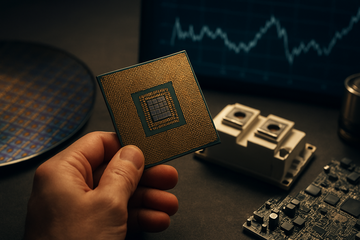
The $389 Million Power-Chip Award Is 77% of Everything Washington Has Actually Spent on Chip R&D
On October 22, 2026, the Commerce Department's CHIPS R&D Office signed four letters of intent worth up to $389 million for power semiconductors and critical materials — the first federal R&D money pointed at the grid-facing end of the AI buildout instead of at accelerators. Against the $506.8 million Commerce had actually spent on the whole advanced-microelectronics R&D program, this single round equals about 77% of delivery to date. Two-thirds of it ($260 million) goes to fusion companies that have nothing to do with data centers, only $73 million targets vertical gallium nitride for a 2.5-megawatt AI rack, and the metal behind that transistor — gallium — is still roughly 99% Chinese. The investable read-through sits with the vendors already selling power into AI racks (onsemi, Vertiv, Eaton), the specialty foundry being paid to build the tooling (GlobalFoundries), and the substrate and materials layer with real pricing power (Coherent, Shin-Etsu Chemical, Sumitomo Metal Mining).
2026-10-21

AEP Raised Guidance Into a 5.42% Long End: The AI Buildout Is a $78 Billion Rate-Base Bet, and the 30-Year Decides Who Pays
AEP raised 2026 operating EPS guidance to $6.25–$6.55 on July 30, 2026 — the clearest print yet tying the data-center buildout to regulated earnings, with 69 GW of contracted load behind a $78 billion capital plan and an ~11% rate-base CAGR through 2030. The catch is the funding stack: $45.5 billion of that plan is debt issued into a 30-year Treasury that closed at 5.42% on Oct. 20, 2026, while AEP's 3.05% dividend yield sits 237 basis points below that same bond. Because regulators, not customers, now decide who pays for the grid, the binding variable is the spread between the ~9.84% returns AEP is authorized to earn and the cost of the money that builds the assets — and the Oct. 28, 2026 call, where a new 2027–2031 capital plan is due, is the first test of it.
FERC Punted, Trump Pressed, Utilities Pushed: The AI Power Bill Now Has a Payer
Within 24 hours on Oct. 20, 2026, the Federal Energy Regulatory Commission said it was drafting rules to widen its authority over AI-driven load, President Trump told data center operators to pay host communities a 'dividend' and to make their own electricity, and the Edison Electric Institute published a study showing electric companies have already won ratepayer protection in more than 20 proceedings across 16 states. The answers differ in form but not direction: the data center pays for its own interconnection. That shifts grid construction off utility rate base and onto private balance sheets, which is why the beneficiaries are the contractors and equipment makers building the grid rather than the utilities whose rate cases have been stalled by the fight. It also means hyperscaler power costs become a company-level margin question instead of a political one.

A rare airline quarter where revenue surged and the stock still lost money: Alaska Air Group shows fuel math—not demand—decided the GAAP bridge
In Alaska Air Group’s Q3, revenue rose 14% on only a 2.4% capacity build, yet GAAP still landed on a $147M net loss. The key investor takeaway is that management’s Q4 fuel guidance implies a larger loss risk even as unit economics improved—while Hawaiʻi demand softness was explicitly called out as an operational drag.

Anthropic's $80.7 Billion First-Half Loss Is Mostly a Mark on Amazon's Own Paper. The $518 Billion It Owes Is the Number That Bites
Anthropic's first-half 2026 net loss of $80.7 billion is roughly 89% a non-cash charge from revaluing the convertible notes that funded its compute buildout, leaving about $8.7 billion of real loss and a $55.7 billion mark-up on Amazon's Anthropic position in a single quarter. The economic story is not the write-down; it is the payment schedule underneath it. The prospectus discloses at least $518 billion of compute obligations over about a decade, roughly 80% of it non-cancelable or payable regardless of usage, against $20.28 billion of cash at the end of 2025. A $2 trillion November listing is therefore less a valuation verdict than the funding mechanism for a fixed schedule, which makes the credit cycle that finances AI capacity, not the model, the thing investors are actually underwriting.

AT&T Bought $23 Billion of Spectrum and Pledged Half Its Fiber to a Pension Fund: The AI Grid's New Financing Template
AT&T closed a $23 billion EchoStar spectrum purchase at the end of July 2026, lifting net debt from $126.4 billion to $149.8 billion in a single quarter and net leverage from 2.68x to 3.13x, and its own answer is to hand half of the fiber engine it just bought to a joint venture with Global Infrastructure Partners and CPP Investments. That is the template for financing the American AI grid: when the ten-year Treasury yields 5.11% and Brent sits near $109 a barrel, a telecom balance sheet cannot own both the spectrum and the fiber, so long-duration pension and infrastructure capital takes the asset while the carrier keeps the customer. For investors, the spread between contracted AI-grid cash flows and the long end — not headline AI capex — is what now sets the price of fiber, of contracted megawatts and of the vendors that build both.

Chubb's Record $7.66 Was Bought, Not Earned — and 1.9% Premium Growth Marks the Top of the US P&C Cycle
Chubb's third-quarter core operating income fell 2.2% to $2.98 billion in dollars; the record $7.66 per share was manufactured by a 3.4% smaller share count and $1.18 billion of repurchases at an average $344.32, or 1.80 times book value. Premiums grew 1.9% to $15.14 billion against 5.1% for the first nine months, and North America commercial premiums fell 2.7% in dollars — the same turn Travelers reported (US commercial renewal rate change of 0.9% versus 4.3%) and the Marsh & McLennan index confirmed (global property rates down 10%, a ninth straight quarterly decline in the composite). For the first time in this cycle, growth is coming from the wrong side of the ledger: overseas, personal lines and reserve releases, funded by buying back stock at cycle-peak prices.

Danaher's 3% Core Print Hid a Mid-Teens Bioprocessing Order Book — and CDMO Capex Is Funding the Tools Cycle
Danaher reported third-quarter core revenue up 3.0% on Oct 21, 2026, but that headline is a respiratory-testing drag rather than a bioprocessing verdict: excluding respiratory, core revenue grew 5.5%, bioprocessing revenue landed at the upper end of mid-single digits, and bioprocessing orders grew mid-teens, led by upstream consumables and resins. The customers funding that order book are mid-wave in their own capacity build — Samsung Biologics ran Plants 1-4 at full utilization, raised KRW 3 trillion (about $2.2 billion) in August and agreed to buy PolyPeptide for CHF 1.46 billion, while WuXi Biologics carried a US$25.1 billion backlog and Bachem is spending CHF 350-400 million in 2026. Tools vendors get paid when CDMOs spend and CDMOs get paid when they run, so the 2027 absorption test lands on the CDMOs' multiples while the tools cycle's cash arrives as 2028-plus greenfield orders convert. The conclusion for investors: read the order book rather than the 3%, and treat the peptide capacity wave as a separate cycle with its own absorption date.

Fireworks AI's $40 Billion Ask Values the Inference Software Layer at 40x Revenue — and NVIDIA, Its Supplier and Shareholder, at 17x
Fireworks AI is in early talks to raise at a $30–40 billion valuation, roughly double the $17.5 billion it marked in July on a run rate it disclosed as more than $1 billion. That puts inference-serving software at 30–40x revenue, against Modal's 15.8x set on October 14, fal.ai's above 18.8x, NVIDIA at 17.3x and CoreWeave at 10.5x enterprise value to sales. The catch is the margin structure: Fireworks' gross margin is estimated near 50%, below CoreWeave's 65.9% and NVIDIA's 75.0%, so the layer winning the software multiple looks more like a hardware reseller. The mechanism matters more than the multiple — private capital raised by the software layer is what funds the GPUs it buys, so every mark raised upstream converts into chip orders downstream, and the balance-sheet cost lands on the neoclouds.

Getty’s Chapter 11 turns the “AI broke the scarcity premium” story into a creditor fight over the image catalog
Getty Images’ prepackaged Chapter 11 restructures control of its rights catalog before any court-versus-contract debate about who can monetize (or withhold) image licensing after AI training. The filing also hardens a key market lesson: when a licensor can’t stay solvent, the value of licensed content becomes less about AI scarcity and more about deal terms, creditor approvals, and post-restructuring ownership.

General Motors's $20 Billion Buyback Is a Credit Decision, Not a Growth One — the Stock Fell 8.6% in Two Days
General Motors beat third-quarter numbers — adjusted diluted EPS of $3.70 against $3.63 expected, revenue of $50.0 billion — then authorized a $20.0 billion multi-year repurchase equal to roughly 31% of its market cap. The stock fell 6.8% on Oct. 20 and another 1.9% on Oct. 21, an 8.6% two-session decline, because the narrowed full-year adjusted EPS range of $12.75–$13.75 landed below consensus while the commodity, logistics and DRAM cost headwind was raised to about $2 billion and 2027 profit was made explicitly conditional on commodity prices moderating. The cash behind the authorization is the cash freed by the EV exit — $7.4 billion of charges, $4.6 billion already paid — plus the $250 million quarterly dividend from a captive finance book carrying $113.0 billion of debt at 5.5% with delinquencies and charge-offs all rising. At a 5.11% long end, shrinking the share count with that earnings mix is a credit decision rather than a growth one: it fixes the denominator and leaves the numerator exposed to a $4.26 gallon and a Nov. 3 election.

Alphabet's London Cloud Outage Was a Generator Failure — and It Landed 99 Days After the UK Called It Critical Infrastructure
Google Cloud lost one London availability zone to a power event on 20 October 2026, and the backup generators failed to engage: mains power came back, yet the outage ran 7 hours 52 minutes, a follow-on incident took another 5 hours 16 minutes, and 38 services were listed as unavailable. Eight banks and fintechs, NHS England, the courts' video platform, Royal Mail, DPD and Rightmove were hit, and 99 days earlier the same provider had been designated a Critical Third Party to UK financial services. The earnings impact is noise — Google Cloud did $24.8bn of revenue in the June quarter — but the failure mode is not: the binding constraint on cloud reliability has moved to electrical redundancy, which redirects spending toward power and cooling vendors and makes single-provider concentration an explicit cost for the banks that were knocked out.

One-Third of the Heating-Oil Reserve Is on Loan: Refiners Now Own the $106 Distillate Crack, and December's Hike Is Priced In
On October 21, 2026, the Department of Energy offered to loan up to 315,000 barrels out of the Northeast Home Heating Oil Reserve — roughly two hours of national distillate demand, and 45% of the three storage sites it is actually tapping. Washington is running out of levers because every remaining one holds crude, and crude does not become diesel without a refinery, so a $106-a-barrel distillate crack now decides who gets paid. The refiners own that margin and are already converting it into $10.9 billion of trailing buybacks, while downstream names such as Delta Air Lines pay the same spread twice, once at the pump and once in a failed hedge. The crack is what makes December's 25-basis-point hike the market's base case; the loan is Washington admitting it cannot do anything about the number in the meantime.
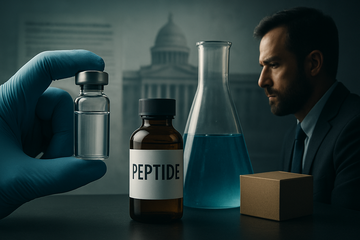
The $2–3B Peptide Marketplace: Washington Is Building the Channel the FDA Is Prosecuting, and Hims & Hers Owns the Toll Booth
HHS and the FDA filed an 'Interim Access Policy for Compounding Using Certain Peptides' with the White House on Oct. 14, 2026, and on Oct. 20 HHS Secretary Robert F. Kennedy Jr. said the administration wants a regulated peptide marketplace with factory inspections — six weeks after the FDA started posting warning letters against the online peptide sellers. The mechanism is enforcement discretion, not approval: no peptide becomes legal, but qualified pharmacies can compound six of them without being targeted, and state boards plus marketplace operators become the de facto regulators. For Hims & Hers, which is already validating peptide APIs in Menlo Park and plans to sell peptides before year-end, that is a distribution channel into an estimated $2–3B market; for Novo Nordisk and Eli Lilly, the immediate threat is nil because compounded GLP-1s stay out of scope — the risk is the template. The first checkpoint is the Nov. 9 Hims & Hers print.

Housing Starts Missed for a Third Straight Month at 1.22 Million — With December's Hike Priced In, Only Spec-Light Builders Keep Their Margin
September housing starts came in at 1,221,000, about 6% below the 1.3 million consensus and a third straight monthly decline, while builder sentiment fell to 29, the lowest since June 2012, and futures kept roughly an 89% probability on a December Fed hike with the 10-year Treasury near 5.08% and the 30-year mortgage at 7.52%. That is a rate-lock regime, not a volume regime: the margin now belongs to the builders with the least finished spec to discount, not the ones with the most land. D.R. Horton closed 23,983 homes with roughly 7,600 finished homes unsold, and Lennar printed a 15.8% home-sale gross margin while spending 12% of sales price on incentives, about $44,600 a home. No cut repairs this, because the binding constraint is the roughly $890-a-month gap between a pre-2022 mortgage and today's rate, and a resale market that has stopped turning over.

Meta's $25 Billion Privacy Verdict Comes In at 40% of Its Own Disclosed Risk — and Puts a $569 Price on Every Deceptive Privacy Claim
A New Mexico judge ordered Meta on Oct 21, 2026 to pay $25 billion after a jury counted 43,899,725 violations of the state's Unfair Practices Act in the Cambridge Analytica case — 44 times the $567 million the same court ordered in August, but only 40% of the $62.85 billion exposure Meta itself disclosed in its last quarterly filing. Judge Francis Mathew priced every counted violation at $569 against a $5,000 statutory ceiling, and that per-user arithmetic, not the headline, is what other state attorneys general can reuse. The cash is absorbable at 1.4% of market value, yet it lands on a balance sheet where free cash flow has just turned negative, and an accrual in Q4 2026 would cost $9.72 a diluted share against $3.83 of third-quarter earnings. The real repricing runs through the data supply chain, where provenance claims now carry penalty risk for data brokers, AI data licensors and independent ad-tech.
What to expect
Evidence-first notes with a visible point of view.
This section collects sharp takes on earnings, shareholder meetings, and market structure. Each new piece should make the thesis, the facts, and the implications obvious within the first few screens.
Expect direct analysis, not generic commentary.
Expect the data to be explicit and the argument to be easy to follow.