Latest
The day's market news, with the argument attached
New notes every trading day on earnings, policy and market structure. Each one opens with the conclusion, then the evidence, then the companies it hits.
2026-10-30


Toyota Just Took the Right-Hand-Drive Robotaxi Supply Chain — and Autonomy Software Is Being Repriced as a Component
On October 30, 2026, Toyota said it will build the 2027 bZ4X at its Takaoka plant and fit Waymo's autonomous-driving hardware to it on the same line, validating a fleet in Japan in 2027 and reaching the United Kingdom in the years after. The move happens because Alphabet's Waymo wants to go from roughly 4,000 vehicles to 20,000 by the end of 2027 on $5 billion of new debt, while the Other Bets segment earned $372 million and lost $2.05 billion in the September quarter alone. Because Japan and the UK require licensed operators and locally homologated cars, the gatekeeper of robotaxi volume is the vehicle supply chain rather than the driving stack, and the profit pool splits three ways: compute and software keep the margin, a roughly $50,000 vehicle sets the cost floor, and everything in between gets squeezed. Read that way, Mobileye and Lucid are on the wrong side of the structure Toyota just signed, Hyundai Motor already holds the scale contract in the United States, and Toyota is buying the right to sell hardware to any operator with a permit.

xAI's 418-Home Buyout Slips Through Treasury's Home-Buyer Ban. The Rental REITs Don't
xAI's Southaven subsidiary is offering to buy up to 418 homes for roughly $75.24 million, conditioned on owners releasing a June 2026 noise class action against the 1.2 gigawatt turbine plant behind Colossus 2. Read against Treasury's proposed ROAD to Housing Act rules, the buyout shows the compute buildout can buy its way out of local risk with property while the January 7, 2027 ban lands on housing REITs instead: a temporary-and-incidental carve-out most likely leaves xAI outside the definition of a large institutional investor, while Invitation Homes' 86,192 homes sit 246 times above the 350-home trigger. The tradable split is upstream, where turbine orders keep coming whoever wins the siting fight, and inside the housing names, where acquisition-led growth and development-led growth no longer deserve the same 13.7x multiple.
2026-10-29

Alphabet's 10% Drop Was a Funding Verdict, Not a Demand Verdict: Cloud Doubled, Cash Flow Went Negative, and 2027 Has No Number
Alphabet reported Q3 2026 on Oct. 28, 2026 with revenue of $127.6 billion, up 25% year over year, and Google Cloud revenue of $30.7 billion, up 103% with segment operating income more than tripling to $11.1 billion. Shares still fell more than 10% in after-hours trading and market capitalization slipped below $4 trillion, because the quarter carried $51.4 billion of capital spending, $9.1 billion of negative free cash flow, and a promise that 2027 spending will increase significantly with no number attached. Holding the unchanged $195-205 billion guide now requires $63.0-73.0 billion in Q4, and the suppliers of servers, memory and power are already being paid while the owners of rented compute are being repriced by a credit market in distress.

Anthropic’s new “smart reports” turn enterprise AI spend into a receipt—and force the vendor to defend the ROI it’s selling
On Oct 28, 2026 Anthropic rolled out Claude Enterprise tools that show admins what teams used Claude for, what it cost at list price, where sessions hit friction, and how much shared budgets ran out. By embedding cost/quality attribution and spending controls inside the model product, Anthropic shifts renewals from “usage volume” to a tighter, vendor-mediated proof of cost-per-outcome—right when enterprises are trying to stop AI budgets from drifting.

Apple ushers in the “touch Mac” era with a new PROLED XDR BOM: OEMs face a panel+hinge cost step-up Apple is willing to pay
Apple confirmed on Oct. 28, 2026 that its new MacBook Pro with PROLED XDR gets integrated touchscreen capability—ending the company’s long-standing “no-touch” stance. The move rebuilds the MacBook Pro bill of materials around a touch-enabled display stack and a redesigned hinge, creating a direct pricing and manufacturing-yield stress test for competing PC OEMs already under pressure from memory storage cost inflation.

Ares Just Declined AI Chip Financing. The Money Still Exists — It Now Costs SOFR+550
On October 29, 2026, Ares Management chief executive Michael Arougheti said his firm would not underwrite financing against AI chips, because it cannot model how fast GPU residual values decay; Ares will concentrate on the roughly $2 trillion of data-center shells and power inside a greater-than-$5 trillion AI capital spending need through 2030. That is an underwriting standard, not a funding shortage: roughly $500 billion of AI-related debt was issued in 2026, the marginal compute-backed loan printed at SOFR+550, and 18 data-center financings now yield double digits. The gap is being filled by bank syndicates arranged by JPMorgan Chase and Mitsubishi UFJ Financial Group, by vendor and borrower balance sheets — including residual-value support of up to 25% from Nvidia, $30.2 billion of funded debt at CoreWeave and $5.1 billion of trailing interest expense at Oracle — and by fee-based platforms from Apollo Global Management, Blackstone, BlackRock, Brookfield Asset Management, Goldman Sachs and KKR, whose $500 billion headline is a mobilization target rather than committed capital. For investors, the shift matters less for who is bullish on AI than for where the residual risk now sits: outside the private-credit funds that built the AI lending playbook, and increasingly back on the vendor's own balance sheet.

26 Biotech IPOs, but the Float Doesn't Arrive Until April 2027
Biotech is the one sector still clearing the shut 2026 IPO window: 26 U.S. debuts, more than double 2025 and the highest count since 2021, yet the 22 offerings priced in the first nine months raised only about $7.5 billion, roughly 5% of what 114 U.S. IPOs raised through mid-October. The wave is genuine funding rather than sellers flipping stock, which is exactly why it cannot pay public shareholders before 2027: in the current queue just 18.8% of shares trade freely at listing and 79.9% become eligible 180 days later. The first live test already reads badly, with Kailera Therapeutics trading 16% below its $16.00 offer after its own mid-October lock-up expiry and a tolerability problem in its lead asset, and the 2020 cohort's base rate is 16% positive with 44% down at least 90%. Own the banks, the originators and the acquirers around the wave, not the listings inside it.

Caterpillar Beat on Earnings, Lost 8%: Why a Record $78 Billion Backlog Stopped Being Enough at a 5.6% Long Bond
Caterpillar's third quarter of 2026 was operationally strong and financially unforgiving: sales and revenues of $20.68 billion rose 17%, adjusted profit per share of $7.20 beat the $7.08 consensus, and the order backlog reached a record $78.1 billion — yet shares fell about 8% because management held full-year sales growth at mid-to-high teens while the market was positioned for roughly 18%. The proximate cause is Caterpillar's own capacity, not demand: one day earlier GE Vernova reported orders up 96% organically and raised guidance, while Caterpillar's turbines and engines cannot be built fast enough to convert its backlog. What changed is the price of long-dated industrial cash flow — with the 30-year Treasury at a 24-year high of 5.61% and the 10-year near 5%, the market now pays for shipped product rather than orders, and Caterpillar's trailing cash yield of about 3% sits below the long bond. The read-through for investors: the earth-capex cycle is not slowing — Deere, Komatsu and United Rentals all raised guidance in the same window — so this is an idiosyncratic, duration-driven unwind rather than the end of the AI build-out.

Cohere's CAD $35.7 Billion Is the Richest Revenue Multiple in AI: 106x Its Own Disclosed Sales, Funded by Governments
Cohere's Oct. 29 initial Series E close values the enterprise-AI lab at CAD $35.7 billion — about US$25.5 billion — which is roughly 60 to 95 times the recurring revenue implied by its own 165% growth rate, and two to four times what Mistral costs per dollar of sales on its own year-end target. The price was not set by model quality but by sovereign capital: Canada's government (up to C$1.6 billion of equity) and Schwarz Group (EUR 500 million) are underwriting a lab that has already contracted US$745.6 million of GPU capacity from listed landlords HIVE Digital and Boost Run. That chain turns a private mark into debt-financed data centers, which is where the credit risk now sits — and it leaves public AI software priced from 11.6x sales at Microsoft to 73.3x at Palantir, with no floor beneath it.

Agave Prices Collapsed, Tequila Prices Collapsed Faster: Cuervo's Sober Quarter Is a Category-Wide Warning Shot
Becle's third quarter of 2026 looked catastrophic - net income down 84.6% to 633 million pesos and net sales down 15.3% - but the headline overstates the damage: last year's quarter carried a 753 million peso one-off gain, and even adjusted for it, EBITDA margin still fell 760 basis points. The mechanism matters more than the number, because with agave trading between 0.8 and 8 pesos a kilogram against a 30-peso peak, cost deflation is being handed straight to the shelf as price cuts, and volume explains less than half the value loss. Diageo (US tequila net sales -21.1% in FY2026), Brown-Forman (-13% organic tequila in Q1 FY2027) and Cuervo are repricing the same premium tier at the same time while the drink budget visibly went to beer and ready-to-drink. Investors should watch the price line rather than the volume line, and the December-to-February prints for confirmation.

Disruptive's $10 Billion Blind Pool Just Became the Largest Bidder in the AI Power Bottleneck — and the Same Assets Trade at Half the Price in Public Markets
A Dallas firm that has never raised a traditional fund closed a $10 billion blind pool on Oct. 27, planning up to $1 billion checks into roughly ten late-stage AI, infrastructure and defense companies. The structural change is not the size but the concentration: one manager writing ten-plus mega-checks behaves like an infrastructure owner, buying the same scarce power, grid and industrial capacity that public companies from GE Vernova to Hyosung Heavy Industries are now selling at record backlogs. The contradiction investors must price is that the private marks on this cohort have fallen while the public marks on the same bottleneck assets have not — Groq's valuation dropped to $3.5 billion in a round Disruptive itself led, roughly a year after the $6.9 billion mark. Meanwhile GE Vernova's gas-turbine backlog and slot reservations reached 122 GW and Vertiv grew organic orders more than 100%. The bulk-buying shift puts private capital directly into the physical assets that public markets are repricing, and makes the public supply chain the cleaner way to own the thesis.

Lagarde's Exit Puts a 2.50% ECB Against a 155bp French Spread: The Credibility Discount Is a EUR/USD Problem First
Christine Lagarde told the Governing Council and European Council President António Costa on 29 October 2026 that she will step down on 7 February 2027, nine months early, hours after the ECB held its deposit rate at 2.50% and left a December hike alive. The resignation does not change the December vote, but it removes the authority that made a hawkish path credible, and the market repriced that instantly: the euro fell to 1.113, its weakest since May, while December odds firmed to roughly 88%. The binding constraint is French arithmetic, not French politics: the 10-year OAT broke 5% for the first time since 2002 at 5.089% and the spread over Germany sits at 155bp, so any successor inherits a December hike priced into a sovereign market that cannot easily absorb it. Positioning implication: own the inflation hedge in Shell and TotalEnergies, own the dollar-funding side of the squeeze in JPMorgan, and treat euro-area bank earnings in BNP Paribas and UniCredit as a sovereign-spread trade rather than a rates trade.

Ford's Flat 2027 Guide Is the Tell: Tariff-Assisted Earnings Just Met a 5% Long-End, and Ford Credit Is Where It Lands
Ford beat on every headline number of the third quarter — $2.66 billion of adjusted EBIT, 49 cents of adjusted EPS, $4.7 billion of adjusted free cash flow — and still guided 2027 to roughly in line with 2026, because commodities, memory and logistics will add about $2 billion of cost next year. The tell is not the plant: Ford Credit supplied 30% of quarterly adjusted EBIT and grew 27% on a favorable derivative mark, even as its US retail loss-to-receivables ratio rose to 0.67% and off-lease auction values fell 3%. With the 10-year Treasury printing 5.13% on October 21 and Ford Credit carrying $139.4 billion of debt at an implied cost of funds of roughly 5%, a flat guide is Ford admitting that tariff-washed pricing power has peaked and the balance sheet is where the shock now lands.

Fortinet's AI-Security Billings Grew 15% — Half Its Own Rate — and the Stock Fell 26%. Palo Alto Networks and CrowdStrike Carry More Risk
Fortinet beat on revenue, raised full-year guidance for the third time in 2026, and still lost about 26% after hours on Oct. 28, closing Oct. 29 down 22.6% at $134.71. The market did not punish AI-security demand: billings rose 29% and AI-infrastructure demand was the strongest driver management could point to. It punished the recurring base — 2026 service revenue guidance was cut while product guidance was raised — and it noticed that Fortinet's own AI-driven security operations billings grew just 15%, less than half the pace of the company. That is the exposure still sitting inside Palo Alto Networks at 28 times trailing sales and CrowdStrike at 49 times, neither of which has been marked down.

Gallup's 29% Engagement Low Is the Demand Signal the December Hike Is Ignoring
Gallup's Q3 2026 survey put US employee engagement at 29%, the lowest reading since 2011 and a two-point drop in a single quarter that equates to roughly 3.2 million workers checking out, while September payrolls came in at 29,000 with two prior months revised down a combined 60,000 and quits sitting at a 1.9% rate. The demand side of that economy is deteriorating quietly while the headline inflation the Federal Reserve is hiking against is being manufactured by gasoline, with headline CPI at 3.7% against 2.6% core and energy up 20.4%. The Committee held at 3.75%-4.00% on Oct 28 with two dissents favoring an immediate hike, and futures still price roughly an 80% chance of a December increase. That pricing assumes the fuel impulse persists and the labor market stays soft without consequences; the read-through is that staffing, recruiting and discretionary apparel names carry the downside, while payroll infrastructure with fee and interest income does not.

GE HealthCare signaled that hospital capex can still fund premium margins in a “5% long end” earnings cycle
On Oct. 28, 2026, GE HealthCare reported 6.2% organic revenue growth in Q3 and adjusted EBIT margin of 16.6%, and it raised full-year guidance. The market’s attention is still split between AI and regulation—but GE HealthCare’s margin math suggests providers are willing to keep investing in imaging and services rather than crowding out the capital line.

AI Bonds Just Hit a Record $419 Billion — and They Are Quietly Setting the Price of 30-Year Capital for Everyone Else
Global investment-grade and junk bond sales hit a record $6.61 trillion through Oct 28, 2026, up 15% from a year earlier, and AI-related US corporate issuance ran $419 billion, up 90% from full-year 2025. The crowding-out is real but it is not where most investors are looking: US investment-grade spreads ended August at 78 basis points, unchanged from the start of the year, because record foreign inflows and annuity demand absorbed the AI paper. What has repriced is duration — 41% of hyperscaler issuance now sits beyond 15 years, and the 30-year Treasury yield has risen about 40 basis points in 2026 to 5.25%. Alphabet can still fund the buildout out of $265.1 billion of cash, Goldman Sachs and JPMorgan get paid on the volume, and the credits squeezed first are the leveraged AI borrowers and the landlords financing the same megawatts.

Continuity Risk Hits the Oil Premium, Not the $741.6B Defense Book at Lockheed Martin, RTX and Northrop Grumman
Defense Secretary Pete Hegseth removed Army Lt. Gen. Brett Sylvia, the Pentagon's top military planner, on Oct. 28-29, 2026, hours after President Trump denied any Iran peace talks were underway and as U.S. forces prepared to move within 96 hours of an order. The firing does not reprice a single award: Lockheed Martin, RTX and Northrop Grumman closed Q3 with $741.6B of combined backlog, all appropriated and contracted, so continuity risk lands on FY2028 program prioritization and on the factory capacity needed to build it. The tradeable expression of the same signal is oil, where Brent settled at $111.64 on Oct. 28 with Hormuz war-risk insurance at 3-10% of hull value and tanker rates at records, and where the futures curve already prices the premium unwinding. Own the funded backlog and the capacity build; the tanker trade needs Iran's 7-Day Plan to fail.
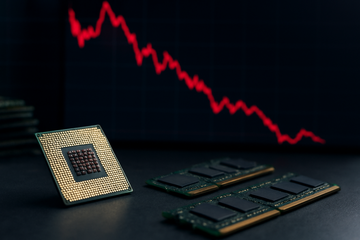
Intel's 17% After-Hours Drop Is a Memory-Cost Story: Half of Revenue Sits in the Segment the AI Build Is Shrinking
Intel beat its Q3 2026 numbers and then guided Q4 revenue to $15.0–16.0 billion, 9% below the $17.1 billion consensus, sending the stock down as much as 17% in extended trading. The guide-down is a client-PC story, not a foundry story: DRAM costs surged fivefold year on year in the second quarter, global PC shipments fell 22.4% in the September quarter, and HP had to lift Personal Systems pricing 40.8% to hold revenue while units fell 15.8% — Intel's own client segment survived only by repricing into a collapsing market. The profit pool from the AI build has moved upstream: Micron printed an 86.7% gross margin and SK hynix an 80% operating margin, while Intel carries roughly the same market value to trailing revenue as Micron on a 0.1% trailing operating margin against 74.6%. With management now saying the PC slowdown runs at least through the first half of 2027, the trade is long the memory makers and short on the idea that a foundry narrative can outrun a shrinking client base.

Eli Lilly's Blowout Comes With a Price Tag: +53% Volume, -15% Price, and a Raise That Locks a Flat Q4
Eli Lilly beat on October 29, 2026 with $24.4 billion of revenue, up 39%, and lifted the midpoint of 2026 revenue guidance $5.5 billion to $91.0–$92.0 billion. But the release shows the beat was manufactured with units: worldwide volume rose 53% while realized prices fell 15%, and outside the US volume rose 76% against a 29% price decline. That reframes the GLP-1 class from a demand contest into a supply-and-price contest, reprices Novo Nordisk's oral-first strategy, and shrinks the economics that reach the distributors and device suppliers in between — and the raise itself buys a flat fourth quarter rather than an accelerating one.
What to expect
Evidence-first notes with a visible point of view.
This section collects sharp takes on earnings, shareholder meetings, and market structure. Each new piece should make the thesis, the facts, and the implications obvious within the first few screens.
Expect direct analysis, not generic commentary.
Expect the data to be explicit and the argument to be easy to follow.