Latest
The day's market news, with the argument attached
New notes every trading day on earnings, policy and market structure. Each one opens with the conclusion, then the evidence, then the companies it hits.
2026-11-06

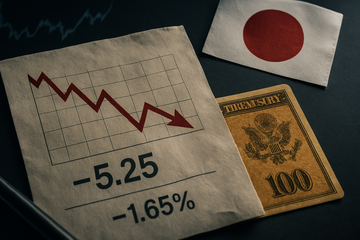
GPIF's First Loss in Six Quarters Was a Rates Shock, Not a Yen Shock — and It Puts a Price on Japan's $232 Billion Treasury Stake
Japan's sovereign savings fund lost ¥5.25 trillion, a −1.65% return, in the July–September 2026 quarter — its first loss in six quarters — and the cause was neither an AI-driven equity unwind nor a weak yen. Global sovereign yields rose across the curve after the Bank of Japan, the Federal Reserve and the ECB all hiked in September, while the yen actually strengthened about 3% on coordinated intervention and erased the translation gain on foreign equities. What matters for US duration is arithmetic: at a 5.29% 10-year Treasury yield and a 1.25% Tokyo policy rate, the yen return on a hedged Treasury is roughly 1.6%, about 140 basis points below the 3.055% yield on a 10-year JGB. That gap makes the world's largest foreign holder of Treasuries a price-sensitive marginal buyer, while the fund's own mandate caps how much it could even sell.
Banks Are All That's Left Standing: Hedge Funds Dumped the Rest After a 19-Month-Worst Day
The Nov 5 crash — the S&P 500's worst day since April 2025 — and Nov 6's Seoul circuit breaker left hedge funds holding one crowded long, financials, and an AI basket with no marginal buyer. Prime-brokerage data show gross equity exposure 7.8% below peak, the largest cut in the series since 2016, five straight October sessions of AI selling that erased every dollar of net buying since early 2025, and funds now underweight the AI trade for the first time since 2023. Banks are where the money went, from Samlyn Capital's restructuring to Citrini's paid-to-wait basket, but the Q3 2026 beat was paid by the crowd now liquidating, with equities revenue up 72% at Goldman Sachs and 41% at Morgan Stanley while JPMorgan and Bank of America missed. The result is a rate-sensitive, increasingly crowded long in the one sector nobody can afford to sell.

Holiday 2026's Squeeze Is a Diesel Bill, Not a Demand Problem: Valero and UPS Collect the Spread
US on-highway diesel hit $6.292 a gallon in the week of Nov 2, 2026 — nearly 2.5 times the year-ago price — and carriers are passing every cent of it through holiday surcharges ($0.75 a residential package at UPS, $0.80 at FedEx) while demand stays flat, with Visa putting inflation-adjusted holiday spending growth at just 1.1%. That makes this a cost-push season: small merchants absorb the whole bill, while the spread lands on refiners, brokers, LTL carriers and the card network. The pass-through math, not the sales number, decides who earns in 2027.
ING Groep's $500 Million Data-Center Loan Auction Shows Who Actually Holds AI Credit Risk
ING Groep put 12 data-center loans worth about $500 million up for bid on Nov. 5, 2026, including the first openly priced slice of Stargate-linked construction debt. The auction is worth less than a tenth of one percent of ING's €903.8 billion loan book, which is exactly why it matters: it puts a market-clearing price on AI construction credit at the moment banks, hedge funds and insurers are all changing hands on the same paper. For Oracle and CoreWeave, which run the same asset class at very different leverage, one winning bid on Nov. 19 sets the cost of capital for both.

IREN Deferred $4 Billion of ARR at Its Customer's Request — and $2.5 Billion of Deferred Revenue Shows the Cash Was Already in the Door
IREN moved its more-than-$4 billion contracted AI cloud ARR target from December 31, 2026 to January 31, 2027 (possibly February 28) after a customer-requested design change and supplier timing, while revenue backlog rose 22% sequentially to $20.3 billion and the program stayed fully contracted and fully funded. Deferred revenue of $2.54 billion and $2.25 billion of net cash show the gap is a commissioning-and-acceptance problem, not a demand or funding problem. The read-through: silicon orders were already placed — Dell Technologies racks and 50,000+ NVIDIA B300s — so NVIDIA and AMD order flow is intact while the neocloud revenue multiple, and the leverage sitting behind CoreWeave and Nebius, is what breaks first.

2027 Tax Brackets: A 17-Point Gap Between AI Pay and AI Sales, and a Permanent $40,800 Cap Nobody Priced
The Nov. 5 release (Rev. Proc. 2026-35) changed no rate and indexed every threshold by roughly 3.2% while September inflation ran 3.7%, so the first fully permanent US rate schedule now indexes below the price level. That fixes the after-tax schedule for the AI complex: 40.8% on equity compensation as it vests, 23.8% federally on a long-term sale, a $51,050 zero-rate window, and a state tax deduction capped near $40,800 and rising 1% a year. The tradeable consequence is not the AI equities — it is that the only new federal money in the 2027 code, the Saver's Match plus higher contribution limits, routes household savings into retirement platforms, recordkeepers, payroll software and tax software.

Korea's Defense Backlog Fell 4.1% in One Quarter — the Market Keeps Paying for a Drone Pivot With One Export Order
Seoul's arms makers have lost roughly two-thirds of their market value from their 2026 peak, and the Nov. 5 selloff after the US midterms was the trigger rather than the cause. The cause sits in the order books: Hanwha Aerospace, Hyundai Rotem and Korea Aerospace Industries together shed ₩3.06 trillion of backlog in Q3 2026, while Hyundai Rotem and Korea Aerospace Industries each won zero new overseas contracts this year. The pivot to drones and counter-drone systems is real in how Seoul buys and empty in what Seoul sells — the country has yet to export a single military drone, and LIG Defense & Aerospace has booked one missile sale to Malaysia. The investable question is not tanks versus drones; it is whether Korean order flow stops shrinking before a won that cut 13.2% against the dollar in ten weeks finishes the damage.

Microsoft's Oracle Wind-Down Puts $1.09 Trillion of 'Contracted' AI Capacity on Trial
On November 6, 2026, Bloomberg reported that Microsoft has stopped renewing an arrangement to rent AI computing capacity from Oracle and has been switching the rented capacity off - the first publicly reported case of a hyperscaler shrinking a third-party AI capacity lease rather than adding one. The reason it matters is not Microsoft's balance sheet but the financing model underneath the buildout: roughly $1.09 trillion of uncommenced data center lease commitments against about $285 billion of lease liabilities that have actually begun. Oracle alone carries $288 billion of leases that have not yet commenced against $43.8 billion on its books, and it has guaranteed up to $3.3 billion of a lessor's borrowing. Landlords are now funding contracted demand with their own balance sheets, and the option value of a tenant that can walk at renewal has never been priced.
Moderna Raised Guidance Into a Fourth Quarter That Implies a 14% to 43% Revenue Drop — and 56% of Its $390M Profit Swing Came From Cutting R&D
Moderna beat and raised on November 6, 2026: third-quarter revenue of $1.31 billion, up 29%, and diluted earnings of $0.38 a share against a consensus loss of $1.25, with full-year revenue growth guidance lifted to 15%–25% from up to 10%. The raise is thinner than the headline suggests, because the $780 million US line was flat against a year earlier, the growth came from overseas COVID-19 volume and shipment timing, and the raised range still implies fourth-quarter revenue of $389–583 million, 14% to 43% below the $678 million booked a year ago. The $390 million swing to operating profit was 56% funded by a 27% cut to research and development, while operating cash flow worsened to negative $1.56 billion, so year-end cash of $8.1–8.3 billion is flat on 2025 only because of a $3.0 billion zero-coupon convertible struck in September. Investors are paying roughly 38 times trailing revenue for a platform whose value rests on the melanoma vaccine Moderna and Merck are taking to regulators, not on this print.

1-for-200, Then 1-for-40: Nasdaq's $1 Bid Rule Is Where the AI Selloff Reaches the Retail Account
Between Oct. 27 and Nov. 5, 2026, six Nasdaq-listed issuers put reverse splits and compliance extensions on the calendar: Solowin Holdings at 1-for-200, Accuray at 1-for-40, Jasper Therapeutics at 1-for-30, Robo.ai at 1-for-25, C3is at 1-for-5 after a 1-for-40 in August, and Intrusion with a second 180-day grace period running to May 3, 2027. None of them sells AI, and that is the point: what they share is a quote that fell below Nasdaq's $1.00 minimum bid and the compliance clock that follows, while the Nov. 5 AI unwind erased roughly $2.5 trillion of index value and repriced AI credit. The splits create no enterprise value, but they are the only mechanism that restores a quotable price without new capital, and they settle in the accounts of retail holders as odd lots and fractional cash, against roughly $315 billion of client margin loans at Robinhood, Charles Schwab and Interactive Brokers.

77% Hike Odds, a 16% Drop in Brent: December's Fed Is an Energy Story, While the Blue Sweep Breaks the AI Capex Chain
October payrolls beat by about 95,000 jobs and pushed market-implied odds of a December rate hike to 77%, but the print only removed the option of pausing — it did not decide the meeting. What decides it is energy: Brent has dropped 16% in a week to $98.55 on hopes that a Democratic Congress ends the Iran war, pulling out the inflation impulse that produced the September hike. The sweep's real damage landed in equities, not bonds: about $2.3 trillion came off the Nasdaq100 on Nov. 5, data-center developers fell 10% to 14%, and the 10-year yield actually fell to about 4.83%. The investable result is a higher-for-longer path that banks and insurers collect on while long-duration AI capex names pay for it.

Oscar Health's Record Quarter Was a 36% Price Hike — and Its Own Guidance Books a Fourth-Quarter Loss
Oscar Health's third quarter looked like a boom: $5.14 billion of revenue, up 72%, a third guidance raise, and a swing to a $0.49 diluted profit. But membership rose only 27% while the price per member rose roughly 36%, inside a marketplace whose enrollment fell from 21.8 million to 19.2 million after enhanced subsidies expired — and a single $250 million risk-adjustment true-up was larger than the quarter's entire $178 million operating profit. Oscar's raised guidance actually implies a fourth-quarter operating loss of roughly $315 million to $415 million, because nine-month operating earnings already exceed the full-year range. For investors the question is not whether a managed-care tailwind exists; it is whether a genuinely cheaper cost structure and a redistributed book survive a 2027 market that KFF expects to shrink again.

Private AI Prints41x–55x Sales, the Public Tape Prints 6x–16x: Anthropic's IPO Is the Arbitrage Test
On Nov. 5, NEPC's Q3 2026 report put AI at 82.7% of US venture deal value — $426.7 billion of a pie that shrank from $253.5 billion in Q1 to $98.4 billion in Q3 — while the same session took5.5% off the Nasdaq Composite and roughly $5 trillion off AI and chip stocks since Oct. 6. The divergence is not a quirk to be arbitraged; it is a funding-arbitrage mechanism, and it has already raised the price of the marginal AI dollar, with AI infrastructure debt trading at 15% to 16% yields. The public tape is repricing Alphabet and Meta for cash burn and depreciation, not the margins of the suppliers who still get paid — which is why Micron sits at roughly 4.9x forward earnings and SK hynix at 4.3x trailing after losing half and58% of their value, respectively. Anthropic's IPO pricing, with a reported range of $1.5 trillion to $2.0 trillion, decides which mark survives.
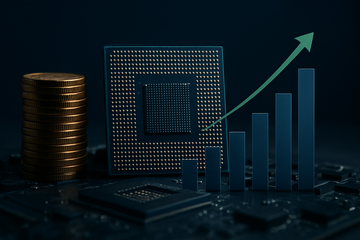
Spend Flatlined, Tokens Surged 37%: Ramp's Card Data Is the Brake the AI Capex Chain Isn't Pricing
Ramp's transaction data shows AI token volume up 37.1% in the week ending October 23, 2026 while token spend rose only 8.9%, because the blended price per million tokens fell 26.8% to $0.56. That is price deflation, not demand collapse — adoption still widened to 55.9% of businesses — but it means the dollars funding GPUs now come from bond issues and equity raises rather than from enterprise token budgets. Alphabet's third-quarter free cash flow was -$9.1B, Amazon's -$34.8B and CoreWeave's trailing twelve months -$13.7B, while the layers paid in cash — Nvidia, Micron and SK hynix — run 75% to 87% gross margins. Model 2027 compute revenue off price per token and depreciation, not off application-layer spend growth.
2026-11-05

Amazon Put Uber Eats Inside Prime. The Unpriced Variable Is the Delivery Subsidy: Amazon's $28.1B Quarter Absorbs It, Uber's $1.06B May Not
On Nov. 5, 2026, Amazon made Uber Eats its official US restaurant-delivery partner for Prime members — $0 delivery fees on orders of $25 or more placed on Amazon.com, with no Uber account required — and let its two-year Grubhub arrangement expire the same day. Neither side disclosed who funds the waived fee, and that silence is the whole trade: Amazon's Q3 2026 operating income of $28.1B at a record 13.9% margin makes a per-order delivery credit immaterial, while Uber's delivery segment operating income of $1.057B and DoorDash's $1.060B of quarterly adjusted EBITDA — just 3.1% of gross order value — leave no room if a platform ends up paying the courier. The result is a funnel transfer that resets DoorDash's US share math without a single new order, and it hands Uber's largest US channel to a rival on the very day its $14.8B Delivery Hero takeover reached its acceptance deadline.

Anthropic Paid a Newswire for the First Time — and Getty Images's Chapter 11 Shows What AI Content Is Worth
Anthropic signed its first paid content license with the Associated Press, putting real-time, AP-attributed election data into Claude during the November 2026 midterms, with the price, the term and the scope all undisclosed, and the news broke days before Anthropic's IPO roadshow. The invoice is trivial beside the $895.4 billion Anthropic has already committed to buy compute and infrastructure, which is the real finding: labs have become paying customers of journalism on terms that leave the price of AI's facts unpriced. For the sellers, the receipts are rounding errors — Alphabet's publisher pilot pays about one-tenth of one percent of ad revenue, and Getty Images signed with OpenAI in June before filing for Chapter 11 in October. Treat AI content as a rounding-error revenue line for publishers and a rounding-error cost line for labs, and reserve judgment on the only number that could change the arithmetic: what training data costs if fair use does not survive.
The 2028 Rate Cycle Is the Trade Nobody Priced: Part D's 50% Premium Shock and a Blue Sweep Pull in Opposite Directions
Two things landed in November 2026 that managed-care investors have not connected: Democrats took both chambers and are promising early-2027 action on Medicaid funding, while the 2027 Part D market repriced the average stand-alone premium for current enrollees from $34 to $51. The Part D shock is arithmetic, not sentiment — the base beneficiary premium is capped at 6% growth while the cost of the basic benefit rose about 25% — and it is already written into contracts, so it flows into the June 2027 bid file. Medicaid is the mirror image: enrollment fell 5.1 million in twelve months, work requirements start January 1, 2027, and CMS is about to remove the uniform-rate-increase tool states used to plug their Medicaid gaps. Both price files lock in mid-2027, before the new Congress acts, and the asymmetry favors the names that win drug volume over the names that win Medicaid enrollment.

Dow +3%, 10-Year Down 7bp, Semis at a 6-Month Low: November 4 Was a Rotation Out of AI, Not a Risk-On Call
November 4, 2026 was three trades stacked on one morning, not a risk-on call. Crude fell about 8% to $88.55 a barrel as the Iran war moved toward diplomacy, the 10-year Treasury yield fell 6.6 basis points to 4.88% even with futures pricing roughly an 83% chance of a December Fed hike, and the equity rally ran through banks and self-funded mega-caps while the Philadelphia Semiconductor Index closed at a six-month low. The mechanism was a repricing of the AI buildout's funding and permitting risk, not of the demand for it: the hyperscalers have committed $510.9 billion of capital expenditure over the trailing four quarters and issued about $221 billion of net debt, so cheaper funding and a new wave of state-level data-centre restrictions hit the same trade from opposite ends. The investable book is a barbell — lenders and cash-generative mega-caps on one side, levered AI builders and peak-cycle memory on the other.
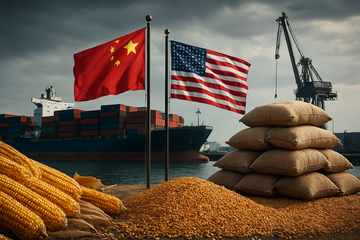
Beijing Made Farm Purchases Conditional — and Corn Basis Cracks First, Not Soybeans
On Nov. 5, 2026 China's commerce ministry said U.S. farm purchases would move only if Washington and Beijing strike a reciprocal tariff-cut deal, turning a $17 billion annual pledge into a condition rather than a contract. The pledge is already running at a seven-year low: $7.2 billion of non-soybean farm goods bought January through September, with soybean buying now steered by state buyers rather than commercial crushers. The first crack is not in soybeans, whose basis sits above its two-year average on a record crush, but in corn, where inland basis hit record lows for the season, and in nitrogen, where China's export quotas took Indian urea tenders from $959 to $352 a ton between April and October. Positioning follows the cash basis and the fertilizer curve, not the bean headline.

Crypto's $300 Million Bought Votes, Not Rules: Inside the Fee Pool That Now Follows Rates, Not Congress
The crypto industry spent more than $300 million across the 2024 and 2026 cycles, won 29 of the 34 races it funded, and still handed both chambers to the party whose committee chairs have said oversight comes first. The CLARITY Act died on a 49–50 Senate vote and expires Jan. 3, 2027, while a Democratic replacement bill moves jurisdiction back toward the SEC and adds ethics provisions aimed at the White House. But the money at stake is not set in Washington: Circle's reserve income fell 8% year over year even as average USDC balances grew 8%, because the reserve return rate dropped 61 basis points to 3.5%, and banks have already issued deposit tokens onto public chains. For Coinbase, Circle and Robinhood, this is now a rate trade with an oversight overlay, and the deposit wall is the competitor that needs no election.
What to expect
Evidence-first notes with a visible point of view.
This section collects sharp takes on earnings, shareholder meetings, and market structure. Each new piece should make the thesis, the facts, and the implications obvious within the first few screens.
Expect direct analysis, not generic commentary.
Expect the data to be explicit and the argument to be easy to follow.