Latest
The day's market news, with the argument attached
New notes every trading day on earnings, policy and market structure. Each one opens with the conclusion, then the evidence, then the companies it hits.
2026-11-07

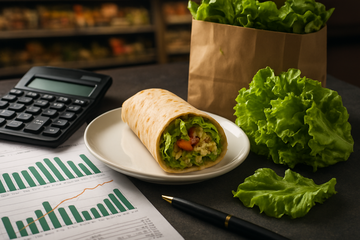
Sweetgreen's Comps Flipped From Mix to Traffic in One Quarter — and 500 Basis Points of That Drop Was a Lettuce Scare
Sweetgreen's fiscal third-quarter 2026 comparable sales of -6.4% were nearly identical in size to June's -6.2%, but built from opposite parts: traffic fell 4.9% while product-mix damage halved to 2.1 points and menu price turned positive at +0.6%. The real trade-down is inside the menu — guests shifting to cheaper wraps — and management is buying traffic back with $11-$13 entry price points, which is why October comps turned +5% with traffic +4%. Underneath the demand noise sits the actual damage: three net new restaurants, nine permanent closures excluded from the comparable base, and restaurant-level margin down 270 basis points to 10.4%, while the only reason trailing net income is positive is a $160.6 million disposal gain. The read-across for fast casual is share shift, not a consumer pullback: Chipotle Mexican Grill and CAVA Group both grew traffic in the same quarter Sweetgreen lost it.
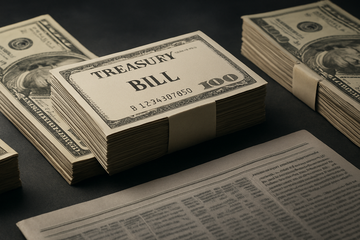
The February Squeeze Lands in Bills: $800 Billion of Borrowing, a $7.4 Trillion Bill Market, and a Fed That Stopped Buying
Wall Street's February call is arithmetic, not alarmism: roughly $754 billion of room under the $41.104 trillion debt cap against the $800 billion of privately-held borrowing Treasury expects between January and March. The first squeeze lands in Treasury bills, because coupon sizes are flat to smaller at the long end, buybacks are running, and the entire January cash rebuild has to be sold as bills into a market whose aggregate supply already reaches $7.4 trillion. The cushion that used to absorb it has thinned: the Fed's reserve-management bill purchases fell from $40 billion a month to $10 billion by mid-2026 and were reported paused in October, leaving dealers, banks and money funds to warehouse the risk. That points investors at JPMorgan Chase's dealer and custody economics and at the fee-waiver arithmetic inside BlackRock and Franklin Resources, not at the 30-year.

Brent Fell 16% on Election Night While Refining Cracks Held $47: The War Premium Now Has a December Clock
The Nov. 6 U.S. strikes on Iran's Qeshm Island were real, and President Trump confirmed them as \"minor strikes\" that disabled an air-defense site \"in about 15 minutes.\" Yet Brent rose only 26 cents to $98.32 on the day, because the market had already repriced the war from a military risk into a legislative one: the barrel's war premium, worth roughly $19 a barrel on the March consensus survey, mostly evaporated in the week after the midterms, while the 3-2-1 refining crack held at $47.84. Democrats now hold 254 called House seats and 54 Senate seats, which moves the binding constraint from the House floor to a Senate that needs 60 votes to end debate, and puts a December continuing resolution and the $1.15 trillion 2027 defense bill on the calendar. The split is clean: Marathon Petroleum at a $45.70-a-barrel refining margin, Frontline on doubled tanker revenue, Cheniere Energy on raised LNG guidance and Marsh & McLennan on war-risk brokerage have converted escalation into cash, while Delta Air Lines at $1.15 of quarterly earnings and Dow Inc on a $897 million trailing loss still carry the bill.

Vistra's $1.14 Billion Quarter Is 37% Paper — and the AI-Power Payday Doesn't Arrive Until 2029
Vistra booked third-quarter GAAP net income of $1,140 million and Ongoing Operations Adjusted EBITDA of $2,378 million, but $559 million of that net income was an unrealized gain on hedges expected to settle in future years — roughly $426 million after tax, or about 37% of the bottom line. The gain exists because the ERCOT forward curve fell, not because AI demand rose, and Vistra has already sold 98% of its 2027 power. So the AI-load option management describes does not land in cash until 2029-2030, the same window in which the hedges behind the mark mature. The investable AI-power trade sits elsewhere: contracted floors at Constellation and Talen, equipment backlog at GE Vernova, Baker Hughes and Doosan Enerbility, and cargoes at Cheniere.

Warren's Banking Gavel Is a Hearing Calendar, Not a Statute Machine: 145 Bank Mergers and a $73.9 Billion Stablecoin Float Now Have an Owner
Democrats took the Senate and the House on Nov. 3, and Elizabeth Warren is widely expected to take the Senate Banking gavel in January. The rulebook she inherits is already written — the March 2026 Basel III endgame reproposal, the FDIC's September 2026 merger-review framework, and the GENIUS Act rules that switch on Jan. 18, 2027 — so the tradable variable is not whether bank capital gets tougher but who signs, who testifies and who waits for confirmation. That points to a slower deregulatory merger pipeline, a frozen crypto market-structure statute, and a private credit transparency agenda that lands on the five banks holding 63% of committed business-development-company loan amounts.

Three Consumer IPOs Priced in 2026 — and Wonder's $9 Billion Confidential Filing Shows Which Consumer Story the Window Still Funds
Wonder Group's confidential Form S-1, submitted on Nov. 5, 2026, registers a food-delivery and kitchen-automation platform — roughly 170 storefronts, projected net revenue just under $2 billion this year and a $618 million adjusted EBITDA loss — not a turnaround retailer, and that distinction decides what the filing is worth as a gauge. The consumer IPO window has narrowed to three consumer discretionary deals priced in all of 2026, split cleanly by cash conversion: Jersey Mike's is down 17.4% from its offer price while Reformation is up 20.3% and Bob's Discount Furniture up 14.2%. Meanwhile the trade-down dollar has shown up in incumbent retailers' comparable sales rather than in new paper, and delivery assets are being cleared by strategic buyers paying a 26% control premium, which sets the private-market reference point Wonder's $9 billion mark depends on more than any IPO window does.
2026-11-06

Akamai's AI Upside Is a Warrant, Not Cash Flow: $5.5B of Capex Lands Before the First Anthropic Dollar
On Nov 5, 2026, Akamai Technologies trimmed 2026 revenue guidance to $4.44–4.465B and said roughly $30M of fourth-quarter revenue would slip into 2027 on supply-chain and third-party data-center delays — the same tape on which Cloudflare grew 39% to $782.5M and lifted its own full-year outlook. The gap is capital intensity, not demand: Akamai spent $605M, or 54% of revenue, on capex in the third quarter and burned $172M of free cash flow, pre-funding a $5.5B build to serve a $11.6B, seven-year Anthropic contract that adds nothing to 2026 guidance and only 25–30% of its 2027 ramp. The equity sweetener — a warrant over 7.7M shares, about 5% of the company, struck at $111.33 — is the cheap part of that deal, and the guidance cut is the tell that the bill for edge AI arrives as debt and depreciation long before it arrives as cash.

The EU Cleared the $25 Billion Axalta Deal With a European Refinish Carve-Out: PPG and Sherwin-Williams Get a Smaller Rival, Not a Bigger One
The European Commission approved Axalta's all-stock merger with AkzoNobel on November 6, 2026, but only on condition that AkzoNobel sells its European vehicle refinish business to a buyer the Commission first approves. That condition shrinks the combined group in the one segment where coatings margins are highest and puts Europe's body shops in the hands of a new single-purpose owner, so the read-through for PPG and Sherwin-Williams is a capped rival rather than a bigger one. For Axalta shareholders it is 45% of a group guided to roughly 7.6 times adjusted EBITDA, against the 10.6 times their own shares trade at.
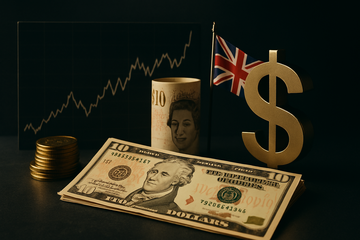
Gilts Now Yield More Than Treasuries at Every Maturity: Britain's First Hike in Three Years Hands the Funding Advantage to the Dollar — and to JPMorgan Chase
The Bank of England's first hike in three years — 25 basis points to 4.00% on November 5, 2026, carried 8–1 — matters less for the move than for what it reveals: the Bank's own projections assume Bank Rate of 4.9% through 2028 while inflation peaks near 5% in mid-2027, so sterling is on course to be the most expensive major funding currency in the world. On November 5, ten-year gilts yielded 5.15% against 4.84% on ten-year Treasuries, and two-year gilts 4.78% against 4.07%, while the Debt Management Office cut long-dated issuance to under 7% of the remit and the Bank unwinds its own gilt holdings to zero by 2034. With the Fed still on ample reserves and Japanese investors back in foreign duration after six weeks of selling, global funding demand converges on the dollar: JPMorgan Chase and BlackRock monetise that, HSBC faces the 2027 UK credit bill, and SK Innovation sits on the oil shock that caused it all.

The Marginal Buyer of Energy Is a Data Center — and Baker Hughes Already Holds $39.4 Billion of Those Orders
At ADIPEC on Nov. 5, 2026, Baker Hughes's Lorenzo Simonelli pitched a \"demand decade\" while bp's Meg O'Neill told CNBC to plan for a lower-price environment. They were describing two different cycles, and only one of them is investable. The volume cycle is real and already contracted: Venture Global has committed up to 11.52 GW of behind-the-meter power with GE Vernova and Baker Hughes, Vistra has contracted 2,609 megawatts of nuclear output to Meta, and Baker Hughes' industrial backlog hit a record $39.4 billion in Q3 2026. That is why the cycle survives the AI capex trims that knocked the power complex 30% to 42% off its 52-week highs — the buyer signs 20-year contracts while the equity market still prices a one-year budget. Trade booked backlog and contracted off-takers, not barrels.

17% Segment Profit Growth on 5% Revenue Growth: Healthcare Profit Has Moved Downstream, and at 18.3x You Already Pay for It
Cardinal Health reported fiscal 2027 first-quarter results on Nov. 5, 2026 that invert the old drug-distribution story: revenue rose 5% to $67.5 billion while pharmaceutical segment profit jumped 17% to $783 million, lifting segment margin to 1.25% from 1.13% and pushing management to raise full-year non-GAAP EPS guidance to $12.80–$13.00 from $12.40–$12.60. The mechanism matters more than the beat — distributors earn a spread on units shipped and services rendered, so the Medicare price reset that takes effect on Jan. 1, 2027 (a 71% cut to Novo Nordisk's GLP-1 list price in Part D) lands on a manufacturer's price line rather than on the distribution fee pool. Capital is following that logic with cheques, not commentary: roughly $20.4 billion of delivery-layer enterprise value since December 2024, including Option Care Health at a $5.8 billion enterprise value and OneOncology at $7.4 billion. The uncomfortable part is price — Cardinal trades at 18.3x trailing EV/EBITDA against Cencora's 11.6x, and the same quarter contained a 28% profit decline in medical distribution.

China's AI-Unwind Safe Harbour Has a State-Sponsored Buyer; India's Refuge Runs on Oil, Not Chips
Goldman Sachs is right that China and India are where money goes as the AI hardware trade unwinds — but the mechanism matters more than the call. China's marginal buyer is no longer a foreign institution: state funds bought an estimated RMB 170 billion of onshore ETFs in October, on top of a stock of Chinese equities Goldman puts at roughly RMB 6 trillion, about 6% of the mainland market's capitalisation. That price-insensitive bid is what lets China internet names such as Tencent trade on 9.7x enterprise value to EBITDA with a beta of 0.73 while NVIDIA trades on 18.8x with a beta of 2.22. India's refuge runs on a different engine — a sliding oil import bill and the largest one-day foreign purchase since February 2021 — and it reverses faster than Beijing's bid does. The catch is that the state buys blue chips, not the AI complex, so Alibaba is still spending RMB 155 billion of capex a year with negative free cash flow, and the same national team sold at least US$123 billion of ETFs in January 2026.

Claude Reads Your Bank Account but Cannot Move Your Money — and Plaid Just Became the Toll Booth for Every AI Lab
Anthropic put Personal Finance into Claude on Nov. 5, 2026: US-only, paid tiers only, read-only, and running on Plaid's rails. Six months after OpenAI opened ChatGPT Finances to every US tier, both labs now buy the same account connectivity from one private aggregator that bills by connected account and by successful API call. The read path is where consumer AI can monetize today; the write path, where interchange lives, still belongs to the card networks building agentic rails. Investors are being asked to price that grid in real time — Anthropic filed its IPO prospectus on Oct. 26, the networks keep compounding services revenue, and the bank-technology vendors are already choosing which lab to build for.

Cloudflare Grew 39% and Fell 280 Basis Points on Gross Margin: the Edge AI Toll Is Real, the Inference Bill Is $461 Million of Commitments
Cloudflare's third quarter was the first print where metered agent traffic showed up as growth while the cost of serving it showed up as margin: revenue rose 39% to $782.5 million and GAAP gross margin fell 280 basis points to 71.2%, with only $4.1 million of the $225.3 million cost of revenue being stock compensation. The $34.1 million GAAP net loss is mostly a stock-compensation and restructuring story — stock compensation rose $64.2 million year over year and restructuring added $11.0 million — so the durable bill is contracted, not incurred: $461.1 million of compute and co-location agreements signed in October 2026 on three-to-ten-year terms, on top of network capital spending at 15% of revenue. The profit split is being settled upstream, where NVIDIA holds a 75.0% gross margin and SK hynix an 80% operating margin, which leaves the edge platform paid in growth and in the right to meter the traffic.
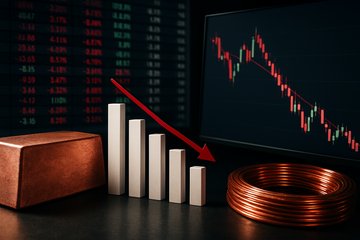
Copper Fell to Its Lowest Since July While Its Physical Market Stayed Tight: The Blue Sweep Broke Both Legs at Once
Copper's record $14,809/t rally rested on two political supports — a US tariff wall that pulled cathode into America and printed a COMEX premium, and an AI buildout both parties wanted. The Nov. 3 midterms took both out in one week: voters approved 40 of 41 data-center restrictions, and copper slid to its lowest since July even as the physical market stayed tight, because the scarcity was itself a tariff artifact. Korea's KOSPI took an 8.6% circuit-breaker halt and China's 10-year bond yield printed a record 1.58% low, so money is leaving a political premium, not a growth cycle. Own the tonnes and the gold hedge, not the copper premium.

Dropbox's $350M Tigris Bid Prices S3 Compatibility at a Commodity Level — While the Drive Makers Keep the Pricing Power
Dropbox agreed on Nov. 3, 2026 to buy S3-compatible object-storage startup Tigris Data for about $350 million in cash — its largest acquisition since 2007 — and wrapped it in DBX Agent Cloud, a storage product sold to developers building AI agents. The read-across is not that storage software is scarce: the S3 API now has at least four credible implementations, and Dropbox paid roughly 11 times everything Tigris has raised and about 61% of the enterprise value of the only listed pure play in the layer, Backblaze. What the price reveals is where the durable margin sits: Seagate and Western Digital grew revenue 61% and 55% year over year at 57%-plus gross margins on AI exabyte demand, while the software toll layers convert that same demand into 53% ARR growth on $6.3 million of trailing capex. For investors the toll is real but the economics accrue upstream to the bytes, while the software layer's pricing power is capped by a $0.015 per gigabyte-month zero-egress card that Cloudflare publishes.
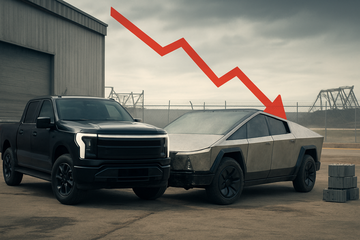
Zero F-150 Lightnings, One Dying Cybertruck: The EV Pickup Collapse Is a Cost Story Before It Is a Demand Story
Ford sold zero F-150 Lightnings in the US in October and Tesla said it will wind down Cybertruck production in Texas around mid-2027 — but the useful read is not that electric pickups failed on appeal. It is that they failed on cost: Model e lost $1.06B on $1.2B of revenue in Q3 2026 while Ford warned of a roughly $2B 2027 headwind from commodities, memory and logistics, with server DRAM contract prices up about 270% cumulatively in 2026. The truck profit pool did not vanish, it migrated to hybrids and combustion — Ram 1500 sales rose 73% in Q3 2026 and Ford's F-Series rose 8.2% in October — which is why the volume damage lands on the lithium and cell supply chain (battery-grade carbonate fell 20.8% in Q3) rather than on the truck franchises. Grid storage is the replacement demand: Tesla started Megafactory Texas, Ford targets 20 GWh of energy capacity, and the truck battery plants now feed the grid. What to watch is Ford's flat 2027 guide, Tesla's Cybercab ramp on freed Texas capacity, and a used-EV correction that has not started yet.

Firefly's $1.3 Billion AST Order Puts an $83 Million Floor Under the Cost of a Launch
AST SpaceMobile is building its own rocket because it cannot get enough rides on other people's rockets, and on Nov. 6, 2026 it bought the engines from Firefly Aerospace instead: 36 engines, a perpetual manufacturing license and three years of engineering support worth more than $1.3 billion. The arithmetic underneath is awkward — $250 million of engine hardware for three vehicles works out to about $83 million per rocket, more than a dedicated Falcon 9 lists for in 2026 — so Blacklift only makes sense at a flight rate that does not exist yet. Only $400 million of the headline is cash at signing, the balance is 10 to 14 million AST Class A shares, and Firefly Aerospace's stock added roughly $947 million of market value in a single session, so the market has already paid for most of this order.

GE Aerospace's Record $12.9 Billion China Expo Haul Is a Services Lock-In, Not an Airframe Bet — and Boeing's 200 Jets Are Still Unconverted
GE Aerospace's Nov. 6 announcement of more than $12.9 billion of Chinese engine and service agreements — 202 LEAP-1A engines for 101 China Eastern A320neo-family jets, 14 spare engines across three CFM engine types, and repair supply deals with MTU Maintenance Zhuhai — is best read as a long-duration services annuity rather than an airframe bet. The reason is installed base: China Eastern already flies 215 LEAP-1A aircraft and more than 380 CFM56-powered jets, so the spares and repair agreements pull the carrier's entire CFM fleet into GE's parts and service network as deliveries run from 2028 to 2032. That annuity prices against real friction: the Section 232 proclamation of July 9, 2026 set no tariffs on aircraft or engines but started a 180-day negotiation clock closing in early January 2027, while Boeing's May 200-jet China accord remains unconverted with the trade truce expiring Nov. 10, 2026. Treat the order as evidence that GE's aftermarket moat in China is widening, but discount the revenue until the equipment-versus-service split and China Eastern's own confirmation are disclosed.

Google's $17 Billion Wyoming Bet: The First Hyperscaler That Pays for Its Own Grid
Google will build its first $17 billion data center in Wyoming and pay for 100% of the power it uses, locking 2.7 GW of contracted resources with Black Hills and a $4 billion, 702 MW fuel-cell plant from AEP — two days after voters rejected 40 of 41 data-center ballot measures across ten states. The mechanism matters more than the megawatt count: a hyperscaler that signs 22-year, cost-bearing power contracts converts a political objection into a financial cost it can absorb. That splits the AI buildout into two tiers and moves value toward utilities holding credit-backed, self-funded load.
What to expect
Evidence-first notes with a visible point of view.
This section collects sharp takes on earnings, shareholder meetings, and market structure. Each new piece should make the thesis, the facts, and the implications obvious within the first few screens.
Expect direct analysis, not generic commentary.
Expect the data to be explicit and the argument to be easy to follow.