Latest
The day's market news, with the argument attached
New notes every trading day on earnings, policy and market structure. Each one opens with the conclusion, then the evidence, then the companies it hits.
2026-10-10

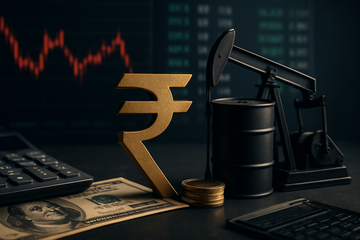
RBI rewrites the rupee rule book: dollar window for state oil firms, derivatives clampdown as $51B defense meets a record-low currency
On October 10, 2026, the Reserve Bank of India opened a direct dollar window for IOC, HPCL and BPCL, banned the rebooking of cancelled rupee derivatives, and cut the exposure cap on uncovered FX bets from ₹100M to ₹5M — the most aggressive rule change since 2013. The trigger is a perfect storm: the rupee at 96.73/USD against its all-time low of 96.96, $51B of forex reserves burnt in four weeks, a $200B net forward short, Brent at $102, India's 10Y at 7.21%, and the first $26.3B monthly EM outflow since June. For HDFC Bank and ICICI Bank, the read-through cuts through net interest margins and the value of the FCNR-B swaps that artificially inflated Q2 loan growth — making the rupee defense the dominant fundamental story of the October2026 earnings cycle.
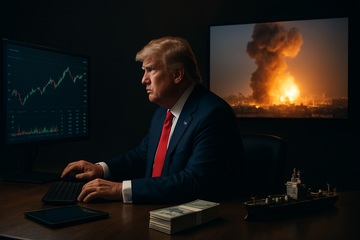
Trump's Third Iran Pause Hands Out the Same Chips-Up, Oil-Down Trade — And the Tape May Be Done Funding It
President Trump on the evening of Oct. 9 ruled out pre-election strikes on Iran, sending Brent back from $108 toward $104 and giving chip stocks their third 'peace dividend' of this cycle — this time with the VIX already under 15 and the SOX down 14% from its June all-time high. The trade has run before in March, June and late July, and each prior pause ended with fighting resumed, which means today's buyer is loaded with the most fragile peace premium of the cycle. The setup rewards sizing chip exposure into upcoming Q3 prints and parking the next-escalation upside in refiners and midstream/tankers, the names that re-rate fastest when Brent re-runs.
The Radiant World Freeze: How Jefferies' $500M Receivables Hit Tests Private Credit's Fraud Defenses
A Jefferies-managed trade-finance fund just secured a worldwide freezing order for up to $499M against Singapore iron-ore trader Radiant World, exposing a ~$870M receivables fraud that stretches across six banks and a major commodity trader. Because Jefferies Financial Group owns only 5.9% of the fund, the direct hit to the parent is small — but the case shows how trade-finance warehouses, private-credit funds, and bank syndicates are silently absorbing the same falsified-invoice template that hit Hin Leong, Tricolor, and First Brands.

The First $7.5B Non-Text Foundation Model Just Repriced Every AI Inference Bet
Three weeks after TypeSafe AI launched Jev — a model that returns typed probabilities instead of language — Andreessen Horowitz led an $870M round at a $7.5B valuation. With 13% of Vercel paid teams onboarded in 24 hours and $100M ARR inside a week, Jev proves most production AI never needed a decoder. That re-rates every stock whose thesis assumes transformer-inference economics — from Cerebras and CoreWeave to NVIDIA's data-center build-out.

JPMorgan's Buy-Side Calls 6.5% IG 'Once-in-a-Generation' While Dimon Still Won't Touch the Long End
Inside JPMorgan Chase & Co., portfolio manager Priya Misra frames 6.5% investment-grade corporate yields — lockable inside a BBB+ portfolio — as the best risk-adjusted entry in decades. CEO Jamie Dimon, speaking in July 2026, still won't buy long-dated Treasuries. The trade between those two views is being intermediated by every major U.S. fixed-income desk, where Q2 2026 revenue ran 6% to 32% higher year over year.
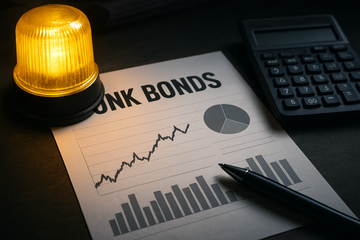
Junk Bonds Are Flashing Yellow — Why the Index Looks Calm but New AI Paper Is Pricing at 9.75%
The US high-yield index spread has widened only 15 basis points on its BB cohort over the past year, and 33 bps on the overall index — yet the 10-year Treasury sits at 5.28%, pushing absolute HY yields to 8.1% and forcing new BB issuers like SoftBank ($11.1B at 9.75%) and CoreWeave ($1.75B at 9.75%) to pay double-digit coupons. With BB bonds now 60% of the index (vs. 38% pre-GFC), AI-related issuance at 24% of new supply (vs. 6% a year ago), and 372 large US bankruptcies in H1 2026 (a 16-year high), the tape is pricing a slow-burn default cycle. Moody's forecasts HY spreads widening to 470 bps over the next year; investors should watch BB composition, hyperscaler CDS, and the 5.3% Treasury level as the triggers that turn yellow to red.
OpenAI's $20B Revenue Gap Just Hit Korea First — Exposing the Foreign-Carry Tail Behind the AI Trade
After OpenAI told investors its annualized revenue was ~$50B (vs the $68B widely reported), the KOSPI closed Oct 8 down 2.62% to 6,625.93 — Samsung Electronics -2.42%, SK Hynix -2.44% — with foreigners dumping 2.44 trillion won in a single session. The Oct 9 Hangul Day holiday freezes the tape until Monday Oct 13, but the mechanism is now visible: two Korean memory names make up ~52% of the index, so any US AI-capex wobble translates one-for-one into KOSPI losses. The numbers behind the names are record-breaking, which is exactly why the re-rating cuts so deep.
Miebach Picks the War: Mastercard's CEO Just Put $290B of Cross-Border Revenue in Play Against the Banks
From a Bloomberg TV appearance on Oct. 9, 2026, Mastercard CEO Michael Miebach named cross-border payments the clearest stablecoin use case. With the $1.8B BVNK acquisition now closed, SoFiUSD live on its rails, and an 8-point gap already between Mastercard's cross-border volume growth and assessment growth, the card networks have the means to capture most of the $290B revenue pool that McKinsey sizes as cross-border payments — leaving correspondent banks defending a market their own rails are about to eat.
SCOTUS Signals the 401(k) Pleading Bar Will Hold — and the $51T Retirement Pool Just Got a New Map
The Supreme Court heard Anderson v. Intel on October 6 with both Democratic and Republican-appointed justices leaning toward keeping the Ninth Circuit's \"meaningful benchmark\" requirement for ERISA underperformance claims. A pro-Intel ruling stacks on top of Executive Order 14330 and the DOL's pending alternatives safe harbor to clear the path for private equity and private credit into target-date funds run by BlackRock, State Street, T. Rowe Price, and the $1.8 trillion Vanguard franchise. The next decision is the single biggest asset-allocation signal for $51.2 trillion of US retirement savings in years.

Lai turns Taiwan into the chip-alloy anchor: why the democracies-unite tape rewrites the bull case for TSMC, ASML and SK Hynix
Sixteen days after the Trump-Xi summit deliberately left chip export controls off the table, President Lai's October 10 National Day address converted Taiwan's 'over 90%' grip on leading-edge wafers into a political ask: coordinate democracies around a non-red semiconductor supply chain. That call lands just as TSMC posts a50% YoY Q3 revenue jump, SK Hynix locks in a $500B-plus HBM4 deal with NVIDIA, and US lawmakers queue MATCH/STRIDE bills to bind Dutch and Japanese partners to Washington's controls. The investable conclusion is asymmetric: equipment chokepoints, allied foundry buildouts, and qualified HBM suppliers re-rate together; the laggards fall behind.

Tesla Drops Its 'Full Self-Driving' Name in Europe — and Hands Regulators the Template They'll Use on the Cybercab
Tesla renamed FSD to \"Tesla Assisted Driving\" on its European websites this week after Germany's transport ministry called the FSD brand \"somewhat misleading.\" The concession bought Berlin's support for the December EU vote but also gives regulators a written template for how to constrain the Tesla Cybercab — and how Mobileye, Mercedes-Benz and Alphabet/Waymo are positioning for a Europe lane Tesla cannot fully defend with its old brand.
Trump's Cook Mortgage-Fraud Committee Sets a Nov. 5 Removal Showdown — And the 7.4% Mortgage Market Has to Price It
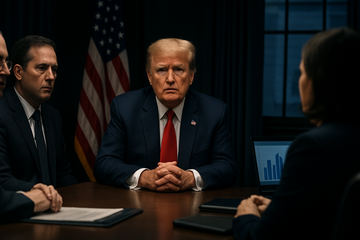
President Trump convened a three-person inquiry committee to examine Federal Reserve Governor Lisa Cook's 2021 mortgage statements, with a closed-door White House hearing set for Nov. 5, 2026 — converting a yearlong legal fight over Fed independence into a procedural countdown that the Freddie Mac PMMS 7.40% mortgage market, large-cap bank stocks, and the 5.24% 10-year Treasury have to price. The mechanism runs through two channels: a higher term premium on Fed-removal risk, and the prospect of a Trump-aligned Federal Reserve majority voting for cuts the Federal Reserve Open Market Committee just rejected 12–0.

Trump's Russian Diesel Deal Collides With the Sanctions Architecture He Just Signed
On October 9, 2026, Trump announced a Trump–Putin deal for 4.8 million tons of Russian diesel (~36 million barrels) to be supplied to the U.S. and global markets, backed by OFAC General License 135 valid through April 7, 2027. The announcement lands three weeks after Trump personally signed the Lindsey O. Graham Sanctioning Russia and Iran Act (H.R. 5334, September 18, 2026), thirteen months after he signed sanctions on Rosneft and Lukoil (October 22, 2025), and against the backdrop of an active Russian diesel export ban extended through October 31. U.S. refiners Valero Energy (VLO), Marathon Petroleum (MPC), and Phillips 66 (PSX) sit at 52-week highs on a combined $12.6 billion Q2 2026 profit and an all-time-high diesel crack spread of $113.48/bbl on September 16 — the very cracks the deal, if it delivers, would compress.

The Visa Data Doesn't Back Vance's Microsoft Story — But It Exposes a Different Problem
On Oct. 8, 2026, Vice President JD Vance accused Microsoft of replacing laid-off American workers with H-1B visa holders and pulled it — alongside Adobe and six Indian IT firms — from the PERM green-card program. The actual USCIS employer data tells a more complicated story: 80% of Microsoft's H-1B filings are status changes for existing workers, Amazon has three times as many approvals and was untouched, and Indian IT firms have been quietly cutting H-1B use for a decade. The real financial damage lands on the green-card pipeline, not new visas — a risk that hits the affected Cognizant, Infosys and Wipro ADRs harder than Microsoft itself.
2026-10-09
AmEx's $350M AML Fine Is Small. The Read-Through to Compliance Opex Isn't.
American Express will pay a $350 million civil penalty — the first large BSA/AML enforcement action against a US card network this cycle — for missing roughly $13 billion in suspicious activity from 2014 to 2025. The fine is just over 3% of its $11.45 billion trailing-twelve-month net income, but the parallel Federal Reserve order against the parent and a mandatory 90-day remediation plan reset compliance spend as a real P&L line item — a frame investors will now apply to every hybrid network-bank, from AmEx to its closest chartered competitors.
Nikkei Just Turned Apple's Memory-Cost Story Into a Demand Story
Apple cut October component orders for the iPhone 18 Pro and iPhone 18 Pro Max by 15-20% after raising prices more than 10% across the lineup to absorb memory costs that surged roughly 400% year over year. The Nikkei scoop reframes Apple's fiscal Q3 iPhone revenue beat of 21.7% as ASP pass-through, not volume strength — and creates a clean winner-loser split: SK Hynix and the broader memory complex are insulated (2027 capacity already sold out to AI customers), while LG Display, assemblers, and the iPhone Pro Max supply chain absorb the cut.
Bessent Recruits Shelton — And the Treasury Now Has the Fed's Most Hawkish Shadow
Treasury Secretary Scott Bessent has hired economist Judy Shelton — the 2020 Fed board nominee who lost a47–50 Senate vote over gold-standard advocacy — as Counselor in the Office of the Secretary, advising on currency policy with a China focus. Combined with Kevin Warsh's September25 bp hike and a December move now near-certain, the move embeds a harder-money voice directly inside Treasury while the10-year still trades near a 24-year high of 5.36% and gold holds above $4,100. Investors should read this as a higher bar for any 2027 cut, a more durable term-premium floor, and a Treasury willing to use radical supply-side tools if the long bond keeps misbehaving.

$8 Trillion in Money Funds Won't Move Until the Fed Cuts. That's the AI-Capex Funding Test.
Bank of America's Michael Hartnett wrote on Oct. 9, 2026 that the cash parked in money-market funds has stopped being a tactical waiting room and become a structural position — one that exits only when the Federal Reserve delivers sustained easing. The bond market has priced the opposite: the 10-year yield sits near a 24-year high of 5.36% and 'short Treasuries' is back as a top crowded trade, with fund managers citing a disorderly rise in yields as their biggest tail risk. That gap is the AI-capex funding test, because hyperscalers have already issued nearly $500 billion of AI-related debt in 2026 while competing with a Treasury that crossed $40 trillion in August.
The $740 Billion Data Center Buildout Is a Completion Trade Now. Boockvar Says One Shock Could End It.
Peter Boockvar used an Oct. 9 CNBC appearance to reframe the AI data-center capex cycle as a clock: it works until it doesn't. With hyperscaler capex approaching ~$720–745 billion in 2026 and already consuming roughly 90% of operating cash flow, the trade is priced for the buildout to complete, not stall. Even a single trigger — a financing pinch, a power-cost spike, or a fresh wave of cancellations on top of the $260 billion already pulled in 2026 — could revalue the supply chain from completion to stall, with Vertiv at 27.8x and Equinix at 52x forward earnings the most exposed.

Eight Down, One Standing: Bittar Quashing Caps a Five-Year Rout for Rate-Rigging Prosecutions
London's Court of Appeal on October 9, 2026 overturned the conviction of Christian Bittar, a former Deutsche Bank star trader who pleaded guilty to rigging Euribor in 2018. With that ruling, eight of nine Serious Fraud Office rate-rigging convictions are gone — and the DOJ's parallel fights in LIBOR and FX have lost at the Second Circuit too. For trading desks, the rout rewrites the cost-of-compliance math: trading surveillance budgets built up to defend against benchmark and front-running cases now face a credibility question.
What to expect
Evidence-first notes with a visible point of view.
This section collects sharp takes on earnings, shareholder meetings, and market structure. Each new piece should make the thesis, the facts, and the implications obvious within the first few screens.
Expect direct analysis, not generic commentary.
Expect the data to be explicit and the argument to be easy to follow.