Latest
The day's market news, with the argument attached
New notes every trading day on earnings, policy and market structure. Each one opens with the conclusion, then the evidence, then the companies it hits.
2026-10-05


Anthropic's $100M Engineer Academy Is a Pre-IPO Moat Disguised as a Training Program
Anthropic committed $100M on Oct. 2 to certify 10,000 Frontier Deployed Engineers by end-2027, drawing cohorts from Accenture, [Deloitte], [McKinsey] and the same Fortune 500 buyers already on its $2.16B cloud-marketplace contracts. With the IPO roadshow launching in mid-October and the prospectus hinging on $190-200B of 2028 revenue, the academy is a structural lock-in on the engineers who decide where the next trillion dollars of enterprise AI spend lands.

Barclays Just Handed Anthropic Its First Universal-Bank Reference — And the $2T IPO Math Just Shifted
On October 1, Barclays widened its Anthropic partnership to run Claude across software engineering, Global Markets email triage, and a colleague knowledge assistant already used by 16,000 staff — the first time a tier-one universal bank has formally anchored Anthropic for core workloads. The deal re-prices Anthropic's pre-IPO channel mix: after Charles Schwab for wealth custody and OpenAI for investment banking with Morgan Stanley, Claude now owns the wholesale bank. For Amazon, Alphabet, Nvidia and Broadcom, every Barclays query is another credit of training-grade and inference-grade compute flowing back to their multi-billion-dollar Anthropic infrastructure bets.

Bessent's Bond-Market Bravado Breaks at 5.31% — Why the Treasury's Failed Test Resets the Cost of Capital
Treasury Secretary Scott Bessent's two-month push to jawbone the long end — capped by the 'I am the house now' remark on September 8 — has collapsed with the 10-year at 5.31–5.34% and the 30-year at 5.68%, both highest since 2002. His walk-back to Axios on October 3, paired with Bill Gross's 'don't own bonds' FT op-ed, marks the moment the bond market stopped testing Treasury credibility and started pricing a permanently higher cost of capital. The fallout flows straight through to rate-sensitive equities — utilities, REITs, homebuilders — while steepening curves hand banks their best net-interest-income setup in years.
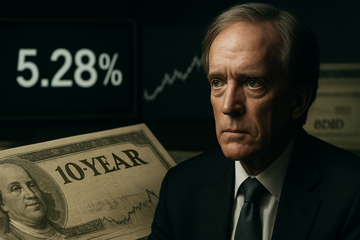
Bill Gross Says Don't Own Them. The 10-Year Is Already at 5.28%, TLT Is Down 7.8%, and the Bond King Has Been Vindicated.
On September 30, 2026, Bill Gross — the co-founder of PIMCO and the figure who turned the bond fund into a $100-trillion asset class — used a Financial Times op-ed to tell investors to avoid bonds outside one-year Treasury bills, which he pegged at 4.55%. The10-year Treasury is already at 5.28%, a 24-year high; the 30-year at 5.61%, the highest since 2007; the iShares 20+ Year Treasury Bond ETF (TLT) is down 7.81% year-to-date despite a 5.54% yield. The structural drivers Gross is calling — a record $40.17T federal debt load, term-premium repricing, and a hedge-fund basis trade unwinding that has drained leveraged duration demand — make this warning stick harder than his earlier calls. The trade Gross is calling wrong is duration: 73 basis points of extra yield for ten extra years of risk, in a $84T credit system where the marginal buyer is leaving, not arriving.

Buffett's 11.2% Lennar Bet Says the Housing Bottom Is Already Behind Us
Berkshire Hathaway has quietly accumulated an ~11.2% stake in Lennar — roughly 26.6 million shares worth about $2.16B at an average near $81 — by buying aggressively through the Sept. 16 delivery-guidance cut and the 30-year mortgage's breakout past 7%. The position sits next to the $8.5B Taylor Morrison acquisition Greg Abel closed in July, turning Berkshire into a top-five U.S. homebuilder at the precise moment peers are pulling guidance. The message: the worst of the rate damage is in the rearview mirror, not the next two quarters.

Federal Lands Just Halted the First AI Data Center on Public Estate — 17,600 More Acres Are in the Permit Queue
On Sept. 1, 2026 the Interior Board of Land Appeals stayed construction of the 167-MW Townsite Data Center near Boulder City, NV — the first AI build ever authorized on U.S. public land — after finding the Bureau of Land Management likely violated NEPA by reusing a 2023 solar review. With at least 12 more data-center or related-infrastructure proposals pending on 17,600 acres across six Western states, the Center for Biological Diversity and Sierra Club have turned the AI capex trade from a state-zoning story into a federal-NEPA fight. Read-through names Oracle, NVIDIA, AMD, Vistra, Constellation Energy, Vertiv and Equinix.

The CPI Just Told You Where Inflation Is Hiding — and the Sector Trade Already Moved
Beneath the headline, the August 2026 CPI shows core rent already rolling over while gasoline drives a 16% energy jump. Leading indicators (Apartment List, Zillow) confirm rent has tipped negative year-over-year for the first time, while Brent at $103 has pushed refining margins to record highs. The market has split accordingly: the Energy Select Sector SPDR ETF is up roughly 44% year-to-date against a 3.8% total return for the Real Estate Select Sector SPDR ETF — a 40-point spread that maps directly onto the new inflation regime. Refiners like Marathon Petroleum, Valero and Phillips 66 carry the highest leverage; apartment landlords Avalonbay, Mid-America Apartments and Camden Property Trust face the opposite.

EliseAI's $4B Round Puts a 20× ARR Multiple on the Line — and Vivmark Residential's 184,000 Units Are Why It Might Hold
EliseAI closed a $350M Series F at $4B on Sept. 29, 2026 — a roughly 1.8× step-up from its $2.2B Series E thirteen months earlier, but a clean ~4× step from its $1B Series D in Aug. 2024. At $200M ARR, the round prices a 20× multiple on a vertical-AI vendor whose single largest demand engine just became the Vivmark Residential merger of AvalonBay Communities and Equity Residential. The investable question is whether the data flywheel compounds in EliseAI's favor — or whether RealPage and the cap-rate math on Zillow's rentals segment leave the multiple stranded.

Iran's Rial Has Become Unspendable — The Sanctions War Just Cut the Wires Between Iran's Oil and Its Money
The rial broke 2.69 million per dollar on Oct. 5 with Iran loading zero crude in September — and Tehran's own president admits the proceeds it does have are locked in China. With Treasury's Oct. 1 designation of the A7 shadow-banking network and Iran's automotive and rail sectors, the bottleneck has migrated from tankers to payment rails. Brent at $101 means war risk is already priced; the trade now is whether Gulf producers and US shale can capture the ~1.4 million bpd Iran used to ship to China on a sustained basis, or whether sanctions evasion re-routes the barrels again.

Morgan Stanley's NVDA Top Pick Meets $947M of Insider Selling: The AI Capex Credibility Test
Morgan Stanley reinstated NVDA as its top semiconductor pick on Oct 2, 2026 with a $300 price target after meetings with Jensen Huang and Colette Kress, sending the stock to a $237.88 intraday record and a $5.7T market cap. Director Mark Stevens had already sold ~$947M of NVDA in the prior two months and Michael Burry's Q3 2025 13F still carries a $186.6M put position — the gap between sell-side endorsement and insider behavior is the live AI capex test. Bulls have Q2 FY27 revenue of $96.22B and hyperscaler capex guided to $720–745B for 2026; bears flag the insider distribution, the 24.9x forward P/E, and the circular financing behind NVDA's biggest customers.

Schneider's $20B PTC Bid Forces a Reckoning for Dassault, Siemens — and Every PLM Holder
Schneider Electric is closing in on a roughly $20 billion all-cash takeover of PTC, the US leader in CAD and product lifecycle software, at a ~28% premium to PTC's last close. The deal would be the largest cross-border acquisition of a US industrial-software asset in years and would instantly re-rate the competitive map against Dassault Systèmes and Siemens, the two incumbents that have dominated PLM since the 2000s. The question for investors is no longer whether Autodesk and Cadence sit on the same M&A runway — it's how the financing math holds up: the bid would push Schneider's pro-forma net leverage from 1.7x to roughly 3.6x EBITDA, a stretch even for a serial acquirer that just spent $3.1B on Cognite.

$333M in Savings, 225,000 Letters: Inside the Capital-Markets Fault Line the SEC's Semiannual Plan Just Opened
Optional Form 10-S would let U.S. issuers replace three quarterly 10-Qs with a single semiannual filing, saving roughly $200,000 per year per company and roughly $333 million industry-wide — but record investor pushback, the SEC's own acknowledgment of information-asymmetry risk, and a CFA Institute survey showing 62% of investors oppose the change point to a structural re-pricing of who gets to see corporate results first. The fight is now the next big capital-markets policy battle, with JPMorgan and the Business Roundtable on one side and roughly 225,000 retail letters, BlackRock, State Street, the SEC's own Investor Advisory Committee, the CFA Institute, and the Council of Institutional Investors on the other.

SpaceX's SI rebrand splits the public space trade — Rocket Lab lags, EchoStar and AST SpaceMobile catch the bid
Musk's October 4 confirmation that SpaceX will rename its AI unit SpaceXSI is more than a label change — it lands inside the same five-day window as Trump's Super Intelligence executive order, the Pentagon's Project Meridian appointment and a new federal Super Intelligence Force, giving SpaceX the only policy-aligned SI brand in the constellation. Morgan Stanley still values SpaceX at $300 against a ~$167 print, leaving roughly 80% upside concentrated in the AI/SI segment the market has yet to credit. The rebrand is doing exactly what the federal SI push was designed to do: pull capital toward SI-aligned suppliers and away from pure-launch names, which is why Rocket Lab is sliding 1.9% today while EchoStar, AST SpaceMobile, Planet Labs and Iridium catch the bid.

Why Nation-State AI Espionage Became Cybersecurity's New Floor — And Three Stocks That Will Never Look Cheap Again
A Sept. 8 CISA/NSA/FBI advisory named six Chinese AI labs in an industrial-scale distillation scheme, and Anthropic's Sept. 10 threat report put a Chinese state actor on 80–90% AI-driven automation. The cyber-vendor trade just shifted from 'incident response' to 'state-actor defense floor.' CrowdStrike, Palo Alto Networks and Okta — all up 12–15% on the Sep. 14 AI safety-warning rally — now carry a structural bid. Pull-through runs to defense primes (Leidos, Palantir, Lockheed Martin), identity governance (SailPoint), and the frontier-AI S-1 channel where Anthropic disclosed 'catastrophic or existential risks.'

Constellation Brands at 9.6x Forward Earnings: A Premium-Beer Litmus Test the Market Already Thinks It's Failing
Constellation Brands reports Q2 fiscal 2027 on Oct. 6 with the cleanest read in U.S. alcohol on whether premium pricing can still beat a documented consumer trade-down. Beer is still 94% of revenue, but Modelo and Corona depletions slipped in Q1 while Pacifico and Victoria absorbed share, and a 25% tariff on Mexican canned beer plus Hispanic-consumer strain keep the cost-and-demand lines moving the wrong way. The stock already trades near a 9.6x forward earnings multiple — recession pricing — so the print has to defend the premium-beer moat or the multiple will keep compressing.

Tesla's 486K Q3 Beat Flipped the EV Growth Story — and the Real Numbers Now Live in the Battery Supply Chain
Tesla delivered 486,532 vehicles in Q3 2026, ~4.9% above the ~463,761-unit consensus and the third-best quarter in company history — but still down 2.1% year-over-year against a record 497,099 a year ago. Reuters framed the print as the moment the car business returned to a 'growth path,' yet energy storage came in 13.8% below consensus at 13.7 GWh and Q3 operating-profit estimates have already been cut 56%, so the durable EV thesis now hinges on what happens in the battery and cell ecosystem: LG Energy Solution's $4.3B Lansing plant is live, BYD outsold Tesla by 56.7% in BEVs, and the Oct 21 earnings call will determine whether this print is a real inflection or a one-quarter inventory draw.

TikTok Just Made Social Commerce the Real Agentic Battleground — and Stripe Won the First Round
On October 5, 2026, TikTok rolled out an AI Shopping Assistant and Buy Direct one-click checkout to US users, partnered with Shopify, Salesforce, Shoplazza, and Stripe — putting the largest social-discovery graph in the world ahead of OpenAI's now-defunct Instant Checkout, Alphabet's Universal Commerce Protocol, and Amazon's Alexa for Shopping in the race to own the agentic commerce entry point. The read-through is decisive: chat-first agentic commerce failed because intent has to exist first; TikTok is the place intent gets made, and the winners are whoever owns that feed, whoever processes that tap, and whoever sits between the two.
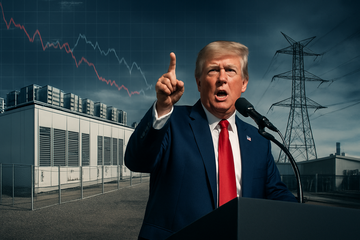
Trump's 'Lower-Taxes-for-Yes-Towns' Data Center Threat Has No New Statute — But EO 14318 and the OBBBA Already Gave Him the Real Levers
President Trump's weekend push to brand data-center-friendly towns as winners and holdouts as 'backwards and poor' is a continuation of an eight-month messaging campaign, not new federal policy — but two statutes already on the books (EO 14318's permitting fast-track and the One Big Beautiful Bill Act's rural opportunity zone expansion) make the threat operationally real. With $725B in hyperscaler 2026 capex now colliding with 399 local moratoriums and $130B of projects already halted in Q1 2026, federal pressure on reluctant municipalities shifts the bottleneck from local politics to federal coordination, with direct read-throughs to colocation REITs Equinix and Digital Realty, hyperscalers like Microsoft, power generators Constellation Energy and Vistra, and infrastructure supplier Vertiv.

Trump's 'Super Intelligence Force' Gives Federal AI Vendors a Phrase for Contracts — Not a New Procurement Map
President Trump's October 4 launch of a Jay Clayton-led Super Intelligence Force gives Palantir, Oracle, and Nvidia a single federal term — 'SI' — they can stamp on existing contracts and task orders, but it does not authorize new budget, new solicitations, or new vendors. The procurement map underneath is the same $90.7B Department of Defense pipeline (98.9% of all 2026 federal AI contract value), the same May 1 Classified Networks AI agreements covering eight vendors, and the same Oracle-led Stargate buildout that already triggered a force-majeure notice in late September. For investors, the takeaway is that the charter resolves regulatory-uncertainty risk for incumbents while leaving the actual spending flows intact — and at Palantir's 144x trailing EV/Sales, that resolution is largely priced in.

TSMC Eyes Musk's Terafab — And Intel's 14A Anchor Just Slipped
Taiwan Semiconductor confirmed it's talking to Elon Musk about operating and owning the $16.8B first-phase Terafab fab — a site Intel had locked in for its 14A node just six months ago. Intel shares fell more than 4% pre-market on Monday, the foundry math just turned against the lone external node win in its $5.8B Foundry segment, and the customer shock now runs downstream into every AI chip buyer eyeing 14A.
What to expect
Evidence-first notes with a visible point of view.
This section collects sharp takes on earnings, shareholder meetings, and market structure. Each new piece should make the thesis, the facts, and the implications obvious within the first few screens.
Expect direct analysis, not generic commentary.
Expect the data to be explicit and the argument to be easy to follow.