Latest
The day's market news, with the argument attached
New notes every trading day on earnings, policy and market structure. Each one opens with the conclusion, then the evidence, then the companies it hits.
2026-10-05


Sub-5% for 18 months and counting: the Warsh Fed just got its 'higher-for-longer' cover back
A 29K payrolls print that should have broken the soft-landing tape didn't. Unemployment held at 4.2%, the longest sub-5% streak since the 1965–1970 record keeps growing, and Chair Kevin Warsh's case for one more hike is back on the table — pushing rate-sensitive REITs, regional banks, and small caps back into a 'higher-for-longer' world.

Warner Bros.'s $437M Box-Office Year Lands Inside Paramount Skydance's $44.4B Bond Deal — The Math the Skydance Pitch Never Modeled
Warner Bros.'s 2026 domestic box office is stuck at $437.7M through Oct. 2 — 5.6% of the U.S. and Canada market — and the Oct. 3 debut of 'Digger' at $8M against a $125–180M budget hands the combined company a $200M+ theatrical loss to absorb in the 48 hours before its Oct. 6 close. With the new Paramount Skydance bonds already trading down ~4 points on day one and the antitrust settlement forcing 30 theatrical releases a year, the deal's underwriting never priced in the slate, the NBA-driven ad-revenue drag, or the cost of buying regulatory clearance.
2026-10-04

AI Agents Are Flooding the SMS Inbox—Meta's Per-Message Billing on WhatsApp AI Reveals the Real Gatekeepers
TechCrunch's October 3 catalog of text-message resident AI agents marks the end of the standalone-app era for consumer AI and the start of an inbox-native distribution war. With Meta now charging $2 per million tokens for WhatsApp Business Agent replies and per-message fees for service messages starting October 1, the new toll booth sits on the message thread, not the app icon—and Apple, Twilio, and the U.S. carriers are about to learn whether they collect, route, or lose the traffic.

Alibaba Just Sold $10.2B in One Night. The Bill Is Coming for the Rest of Hong Kong's AI Trade.
Hong Kong issuers raised a record $47.5B in Q3 2026 — nearly two-thirds of it from AI-linked deals led by Alibaba's HK$80B placement, Z.AI's $9.6B year and Zhongji Innolight's $6.8B IPO. The marginal buyer has shifted decisively to sovereign wealth and mainland Stock Connect money; Wall Street banks were largely absent from the marquee deals. The spillover into ADR-listed Chinese tech is real but selective — and an 80% aftermarket break rate argues that the easy money has already been made.
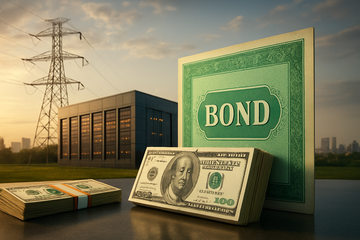
Amazon Just Issued the Industry's First $1B, 5-Year Permit Bond — Hyperscalers Are Now Pricing Community Opposition Like Capital
Amazon paired a $1B+, five-year \"Built Together\" community fund with the end of data-center NDAs on Oct 2, 2026 — fixing $200M a year of community goodwill into the cost of every permit, exactly eight weeks after Meta priced the same instrument. The math behind the structure: AWS carries a $496B backlog against $220B of 2026 capex, so a $1B community line is rounding error. CoreWeave and Nebius cannot write that check, so they will either pay the implied premium on their own build pipeline or be shut out of the next 100+ moratorium fights. Vistra, Constellation Energy, Vertiv, Equinix, Digital Realty and Quanta Services read straight through the deal.
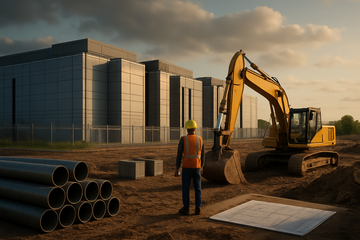
Amazon Drops Data-Center NDAs — Every Permit Just Became a Repricing Event
On October 2, 2026, Amazon ended its use of nondisclosure agreements with local governments on data-center projects — the first hyperscaler to publicly concede that concealment is no longer a viable siting strategy. The concession arrives as community opposition has stalled an estimated $170 billion of US data-center projects across 44 states, and the House Judiciary Committee has opened an investigation into the practice. For the data-center supply chain — utilities, REITs, power-equipment makers, and builders — every project now has to be priced with transparency as the baseline, tilting the siting map away from moratorium-heavy states and toward community-engaged ones. Microsoft, Alphabet, and Meta face the same repricing math; the question is whether they follow Amazon or fight the Raskin probe.

Black unemployment jumped a full point to 7.0% in September — and the entire 0.1-point rise in the headline came from one demographic
September's jobs report looks almost calm on the surface — 4.2% headline unemployment, +29K payrolls — but Black workers' jobless rate spiked from 6.0% to 7.0% in a single month, the fastest one-month jump since the Covid shock. White, Hispanic, and Asian rates were flat or down. With the Fed having just raised rates into a softening labor market and Walmart already disclosing a $7.8B lower-income spending pullback, the racial gap is the real canary — and value retailers, QSR, and subprime credit lenders are the trade.

FAA's Max 10 Reversal Hands Boeing the 2027 Narrowbody Window Back — Airbus's A321neo Lead Narrows
Five days after sending Boeing shares down 6.9% with a Max 10 certification pause, the FAA's Corrective Action Review Board cleared the U14 landing-software glitch as a non-safety issue on Oct. 2, 2026, reopening a path to Max 10 approval within weeks and a 2027 delivery ramp on a roughly 1,500-jet backlog. The reversal pulls the rug back from the late-September thesis that the A321neo would absorb the 2027 narrowbody opportunity; Airbus still holds the deeper order book, but the marginal 2027 single-aisle has tilted back to Boeing — with GE Aerospace, Howmet Aerospace, RTX, the Max-customer airlines, and major lessors all re-rating against a constraint that has just lifted.

Broadcom Just Became Anthropic's $42B Banker — And the Chip Vendor Now Owns the AI Compute Risk
Per Anthropic's October 1 IPO prospectus, Broadcom agreed to lend the AI lab up to $42 billion in convertible notes to lease Broadcom-designed TPUs from Alphabet — taking on four roles (chip supplier, equipment lessor, lender, and likely equity holder) for a single customer that lost $42 billion in 2025 and carries $161 billion in non-cancellable Broadcom-related obligations. The structure reshuffles where AI rack margin accrues: Broadcom now captures chip economics, lease economics, interest spread, and potential equity upside on the very racks it finances, while Anthropic inherits covenant risk on a counterparty that also holds the supply keys.

Credo's 8% rally on a 29K-payroll miss is the AI capex trade's loudest 'no-landing' vote
On Friday, Credo Technology jumped 8.1% intraday after the September BLS print missed by ~60K jobs and pushed the implied probability of another Fed hike in October down 43.7 points. The market is voting that AI infrastructure has decoupled from the labor cycle: hyperscaler capex is structural, not cyclical, and a stalled macro will pull forward rate cuts rather than derail spending. We unpack the mechanism, Credo's specific leverage, and what the read-through means for Nvidia, Broadcom, Marvell and the hyperscalers underwriting the buildout.

The 130-Basis-Point Gap: El-Erian's 'Important Reminder' and the Long End That's Already Stopped Listening
Mohamed El-Erian's Saturday warning that the Fed can't fix the fiscal-and-affordability crisis alone landed as the 10-year hit 5.28% and the 30-year 5.61% — leaving a roughly 130-basis-point spread over the new 3.75%-4.00% funds rate that's only widened since Chair Kevin Warsh's hawkish September debut. This is not a rate-path call; it is a credibility test. The bond market is pricing something the central bank cannot reach, banks and asset managers ride the curve higher, and bond-proxy sectors and rate-sensitive real economy pay the bill.

France's OAT Spread Just Hit 2011 Crisis Levels and the UK's 30-Year Gilt Cracked 6% for the First Time Since 1998 — The Channel Into US Bank Stocks
Societe Generale's worst FICC quarter in years meets BNP Paribas's multi-billion-euro OAT holdings and HSBC's gilt book, while JPMorgan and Bank of America carry European bond inventories across the Atlantic. The October 1–3 stress event — France's OAT-Bund spread at 152 bps (worst since 2011) and the UK 30-year gilt at 6.029% (highest since January 1998) — is the first time in this cycle that two G7 sovereigns have broken crisis-era records simultaneously, and the dealer-bank channel makes the spillover into US financials structural, not headline-level.

Goldman's 2026 Survey Just Killed the 'Affluent Resilience' Trade
Goldman Sachs' 2026 Retirement Survey shows consumer cash-flow tightness is U-shaped: 42% of sub-$100K earners and 36% of $300K+ earners live paycheck-to-paycheck, against only 23% in the $100K–$300K sweet spot. The high-income consumer is now structurally stretched, which turns the premium-discretionary thesis into a top-line risk and pushes investable exposure toward credit facilitators and accessible-luxury rather than $5K-handbag crests.

Google Froze Its OSS Bug Bounty Until 2027 — and the AI-Slop Wave That's Rewriting Who Gets Paid to Find Flaws
On October 1, 2026, Alphabet suspended product-flaw submissions to its Open Source Software Vulnerability Reward Program after a flood of AI-generated reports buried its maintainers — the same pattern that already killed the curl bug bounty, paused HackerOne's Internet Bug Bounty, and forced Node.js to drop its program. The move exposes the structural fragility of volunteer-triage disclosure economics and tilts demand toward enterprise security vendors — Microsoft, Cloudflare, CrowdStrike, Palo Alto Networks — and AI-native scanning startups that can absorb the noise human programs can't. Investors should treat the pause as a leading indicator: when the largest open-source bug bounty in the world can't keep up with AI slop, the money follows platforms, not researchers.

Operation Unified Resolve Puts $1.5B of Border-Tech Spending on a Cartel Firefight — And Markets Are Still Pricing the Wall, Not the Software
The Pentagon's October 2, 2026 'Operation Unified Resolve' into the Rio Grande Valley is the trigger that converts a quiet, year-long troop buildout into an investable event: a cartel firefight on the river, a high-energy laser already knocking down cartel drones, and ~10,000 US troops on the line now overlap with $1.5B of DHS counter-UAS work, $363M of Anduril sentry towers, $370M of Elbit border surveillance, and a stalled USMCA review that has the peso sliding7.3% in a month. The winners are not the wall-builders — they are the sensor, helicopter, and rail-logistics names that touch every mile of the corridor.
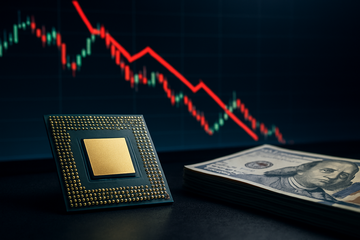
Micron Just Priced AI Memory to 2031—And Burry's $205 'Cycle Peak' Short Is Now Underwater 424%
Micron Technology's fiscal Q4 2026 report didn't just beat the quarter—it stretched contracted AI memory demand into 2031, with 26 strategic customer agreements, $32B in customer cash deposits and a $150B remaining performance obligation anchoring pricing through the second half of the decade. That single duration reset burns Michael Burry's $205.10 short into a 424% underwater loss and leaves the Korean peers, SK Hynix and Samsung Electronics, fighting to keep HBM4 share at exactly the moment the cycle's structural floor is being dug out by NVIDIA's Vera Rubin ramp.

Nvidia Sits on Both Sides of the Compute Deal — and Wall Street Now Wants a Different Multiple for Each Side
Three months after Nvidia unveiled a $500B chip-financing platform with six Wall Street firms, Reuters reports the syndicate is pushing back on a 25% residual-value offer and a 9–10 year chip life that lenders won't underwrite. With up to $125B of potential backstops, $105B in disclosed residual guaranties at SB Energy alone, $99B of equity investments on the Nvidia balance sheet and another $25B committed, the chip-vendor multiple is decoupling from the credit-book exposure — and the trade splits.

The 100% Pharma Tariff Has a Back Door — 26 Companies Already Walked Through
Bayer's Oct. 2 announcement of a $2.2B Ohio plant was the loudest response to Trump's April 2026 patented-drug tariff — but the quieter story is the 26-company Most-Favored-Nation bloc covering 89% of the branded market, which has suspended the duty through January 2029. The wall is real for everyone else, and the second-order winners are the Indian and Chinese API producers, the Big 3 U.S. distributors, and the PBMs sitting between manufacturers and patients.
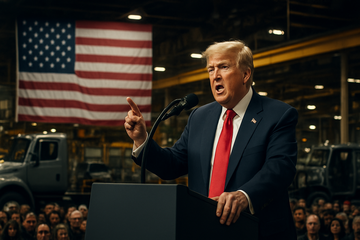
Build Here or Pay 300%: Trump's 18-Month Ultimatum Tests Korea's $350B Pledge
At an Oct. 3 rally in Vandalia, Ohio, Donald Trump escalated industrial policy from Section 301 rate hikes to a build-or-leave demand: roughly 18 months to break ground on a US plant, or face tariffs of 150–300%. With Korea's $350B commitment already on the books and Honda's $2.5B Ohio hybrid plant plus Bayer AG's $2.2B New Albany announcement two days earlier, the bar is set — and the asymmetry between insiders and holdouts is now the trade.

Gas Cars Just Dipped Below 50% Globally — but the US P&L Has Already Moved, and Not From the Milestone
Petrol vehicles fell to 49% of global new-auto sales in H1 2026, the first half on record below 50% and down from 73% in 2021 — a milestone the Iran war oil shock accelerated. The US still runs ~73% ICE, so the second-order P&L impact for US investors is not the headline; it's a supply-shock windfall for Valero and Marathon Petroleum, an insulated aftermarket at Genuine Parts and AutoZone, and an OEM barbell where Ford and GM ICE prints cash while EV drains it. Tesla's US EV-segment share just hit a record-low 50%.
What to expect
Evidence-first notes with a visible point of view.
This section collects sharp takes on earnings, shareholder meetings, and market structure. Each new piece should make the thesis, the facts, and the implications obvious within the first few screens.
Expect direct analysis, not generic commentary.
Expect the data to be explicit and the argument to be easy to follow.